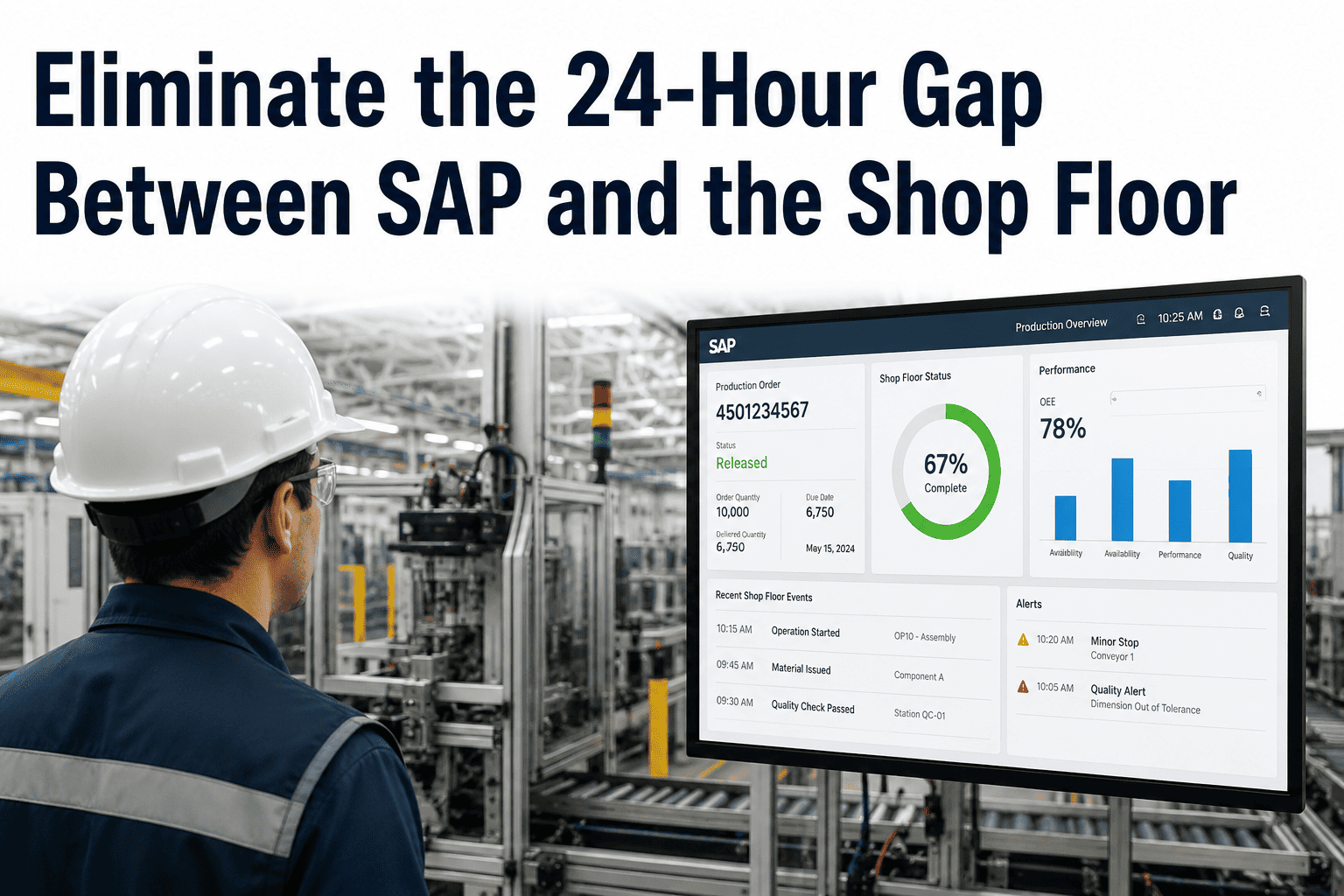
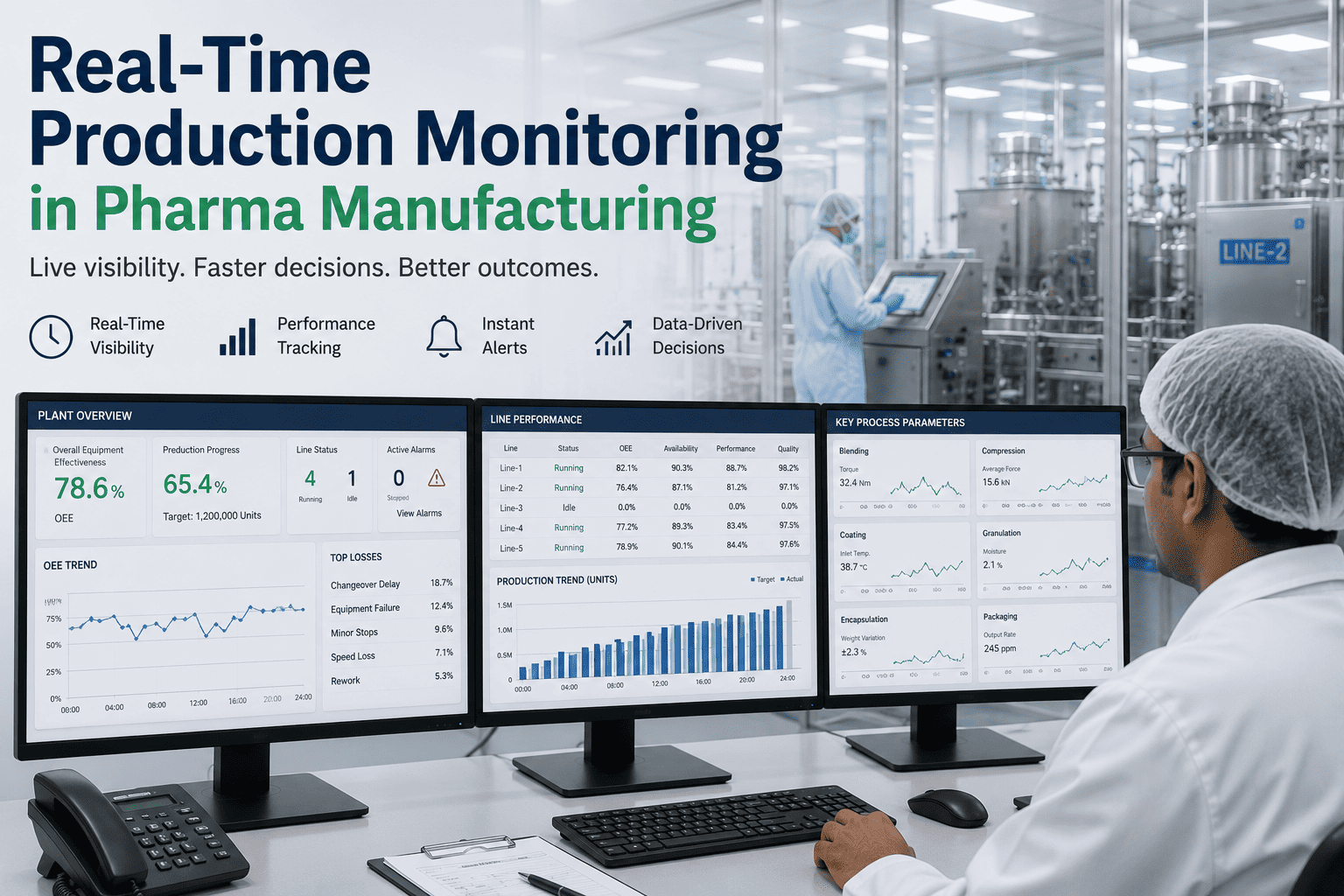
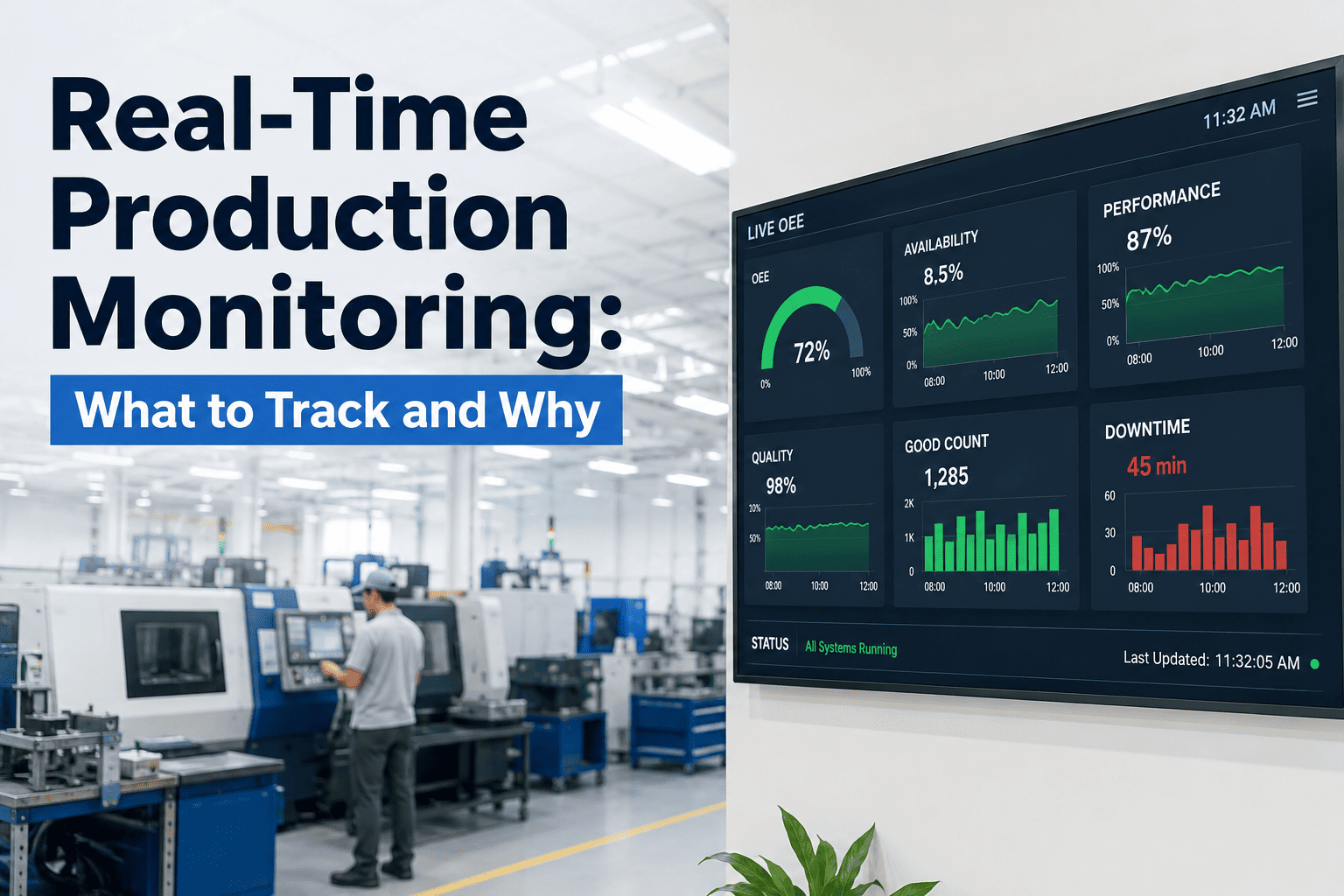
Most manufacturing ERP systems were built to manage purchase orders, inventory counts, and financial ledgers, not the second-by-second reality of a running production line. That gap between what the ERP records and what is actually happening on the shop floor is one of the costliest blind spots in modern manufacturing. Plant managers enter production confirmations hours after a shift ends, yield figures get rounded to convenient numbers, and by the time a scheduling decision is made in SAP or Oracle, the underlying data is already stale. Closing this gap is no longer optional for plants competing on speed and margin. iFactory connects machine-level data directly into your ERP so every order, confirmation, and yield figure reflects what is actually happening on the floor right now, and you can book a demo to see the connection live.
Give Your ERP Eyes on the Shop Floor
Stop reconciling yesterday's numbers. Automated machine data collection feeds real-time production confirmations, scrap tracking, and yield reporting straight into your existing ERP.
Why ERP Systems Go Blind at the Shop Floor Door
ERP platforms are transactional by design. They excel at recording what was planned and what was billed, but they were never architected to ingest a continuous stream of machine states, cycle times, and sensor readings. The result is a structural gap that widens every year as production complexity increases.
Delayed Confirmations
Operators log production counts manually at shift end, often estimating quantities from memory. Orders remain open in the ERP for hours after work is actually complete, throwing off downstream scheduling.
Rounded Yield Numbers
Scrap and rework rates get entered as tidy round figures rather than precise counts, masking quality drift that would otherwise trigger corrective action weeks earlier.
Static Capacity Data
Machine downtime and changeover time rarely make it back into the ERP's capacity planning tables, so scheduling continues to assume equipment availability that no longer exists.
Disconnected Systems
MES, SCADA, and PLC data typically live in separate historians that never talk to the ERP, forcing planners to stitch together spreadsheets before every review meeting.
How iFactory Bridges the Gap
iFactory sits between your machines and your ERP, translating raw shop floor signals into the structured transactions your ERP already understands. No rip-and-replace, no custom middleware project spanning quarters.
Connect Machine Data Sources
Lightweight edge collectors read PLC tags, sensor feeds, and MES events without touching your control logic, capturing cycle counts, states, and quality flags continuously.
Normalize and Validate
Raw signals are cleaned, deduplicated, and matched against active work orders so every reading maps to the correct production run before it ever reaches the ERP.
Post Automated Confirmations
Completed quantities, scrap, and labor time post directly into your ERP's production order transactions the moment they occur, eliminating manual entry lag.
Surface Live Yield Reporting
Yield, OEE, and scrap dashboards refresh continuously, giving planners and quality teams the same real-time picture instead of yesterday's end-of-shift summary.
Where the Data Gap Costs the Most
Not every plant feels the ERP-shop floor gap the same way. The financial impact depends heavily on production mix, changeover frequency, and how tightly your scheduling depends on accurate capacity data. The scenarios below reflect patterns we see repeatedly across manufacturing verticals.
High-Mix Discrete Assembly
Frequent changeovers mean planners reschedule several times a day. When confirmation data lags by hours, the schedule planners are working from is already out of date before the shift ends, causing repeated firefighting and expedited freight to cover missed commitments.
Process Manufacturing with Yield Variability
Batch yields that fluctuate with raw material quality need to be caught within the batch, not discovered at month-end reconciliation. Delayed yield visibility means quality drift compounds across dozens of batches before anyone notices the trend.
Multi-Shift Operations
Handoffs between shifts are where manual data entry breaks down most visibly. Incoming shift leads inherit whatever numbers the outgoing shift had time to log, which is rarely a complete or accurate picture of the previous eight hours.
Contract and Make-to-Order Manufacturers
Customer-facing delivery promises depend on accurate available-to-promise calculations in the ERP. Stale capacity and confirmation data means sales teams quote dates the floor cannot actually hit, damaging customer trust over time.
What Automated Machine Data Collection Actually Captures
Closing the ERP gap is not just about speed, it is about capturing detail that manual entry never could. iFactory's edge collectors pull a much richer data set than any operator could realistically log by hand every hour.
Cycle-Level Timestamps
Every part cycle is timestamped individually rather than estimated in batches, giving true cycle time distributions instead of shift averages that hide outliers and emerging equipment issues.
Micro-Stop Detection
Short stoppages under five minutes rarely get logged manually but often account for the largest share of lost capacity. Automated collection captures every stop, no matter how brief, and rolls it into accurate OEE figures.
Quality Flags at the Source
Vision systems and in-line sensors can tag scrap and rework at the exact station where it occurred, rather than relying on an operator to remember and report it accurately at end of shift.
Setup and Changeover Duration
Actual changeover time, not the standard time in the routing, feeds back into the ERP so future schedules reflect reality instead of an outdated engineering estimate.
Manual Confirmation vs. Real-Time ERP Sync
The table below compares outcomes measured across iFactory deployments at discrete and process manufacturing plants ranging from 80 to 600 employees.
| Metric | Manual Confirmation | iFactory Real-Time Sync |
|---|---|---|
| Data entry lag | 2-8 hours | Under 1 minute |
| Confirmation accuracy | ~82% | >99% |
| Scheduling rerun frequency | Once per shift | Continuous |
| Scrap visibility | End of shift | Real-time |
| Planner hours on data reconciliation | 6-10 hrs/week | Under 1 hr/week |
Your ERP Deserves Real Data
Every scheduling decision is only as good as the data behind it. Give your planners a live feed instead of a lagging estimate.
Signs Your Plant Is Running on Stale ERP Data
Before investing in a fix, it helps to confirm the gap is actually costing you. These are the patterns we hear most often from plant managers and schedulers during discovery calls.
Schedules Change Mid-Shift Constantly
Planners find themselves rebuilding the schedule multiple times a day because the capacity data they started with was already wrong by the time they acted on it.
Month-End Yield Surprises
Quality metrics that look fine week to week suddenly show a concerning trend at month close, because rounded daily entries hid a gradual drift that only becomes visible in aggregate.
Spreadsheets Bridge the ERP and the Floor
Someone on your team maintains a manual spreadsheet that reconciles what the ERP says against what actually happened, updated by hand every day or every shift.
Customer Delivery Dates Slip Without Warning
Sales confirms a ship date based on available-to-promise data that does not reflect real machine availability, and the plant only discovers the conflict days before the order is due.
What Plant Teams Ask Before They Connect
Does this require replacing our current ERP?
No. iFactory is designed to sit alongside SAP, Oracle, Microsoft Dynamics, and most mid-market ERP platforms, pushing transactions through standard APIs or IDocs rather than replacing any existing module. Most plants keep their ERP exactly as configured and simply gain a live data feed into it. Implementation typically focuses on the production confirmation and inventory movement transactions first, then expands. Visit our support page for a list of tested ERP connectors.
How long does a typical connection project take?
A single production line can be connected and validated in two to four weeks, depending on how many machine types and protocols are involved. Multi-line or multi-plant rollouts are phased, with each additional line taking days rather than weeks once the initial integration pattern is proven. We recommend starting with your highest-variance line to demonstrate value quickly. Our team handles the edge configuration so your IT staff is not pulled off other projects.
What happens if a machine or network connection drops?
Edge collectors buffer data locally during any network interruption and replay it in sequence once connectivity restores, so no production events are lost. Every transaction is timestamped at the source, not at the point of ERP posting, which keeps historical reporting accurate even after an outage. Alerts notify your team if a collector goes offline for more than a few minutes so issues get caught early.
Can we control which data actually posts to the ERP?
Yes. You define the mapping rules for which machine events trigger which ERP transactions, and thresholds can be set so only meaningful changes post rather than every micro-fluctuation. This keeps your ERP transaction volume manageable while still capturing the data quality and scheduling teams actually need. Configuration changes do not require vendor involvement once your team is trained.
Is this only useful for large enterprise plants?
Plants with as few as three or four production lines see measurable scheduling and yield reporting improvements, since even a small manual reconciliation burden compounds weekly. The platform scales from a single-line pilot to a multi-site enterprise rollout without a different underlying architecture. Book a demo to see a sizing estimate for your specific plant footprint.
Close the Gap Between Your Floor and Your ERP
Real-time production data is no longer a nice-to-have. See how iFactory connects your machines to your ERP without disrupting either.