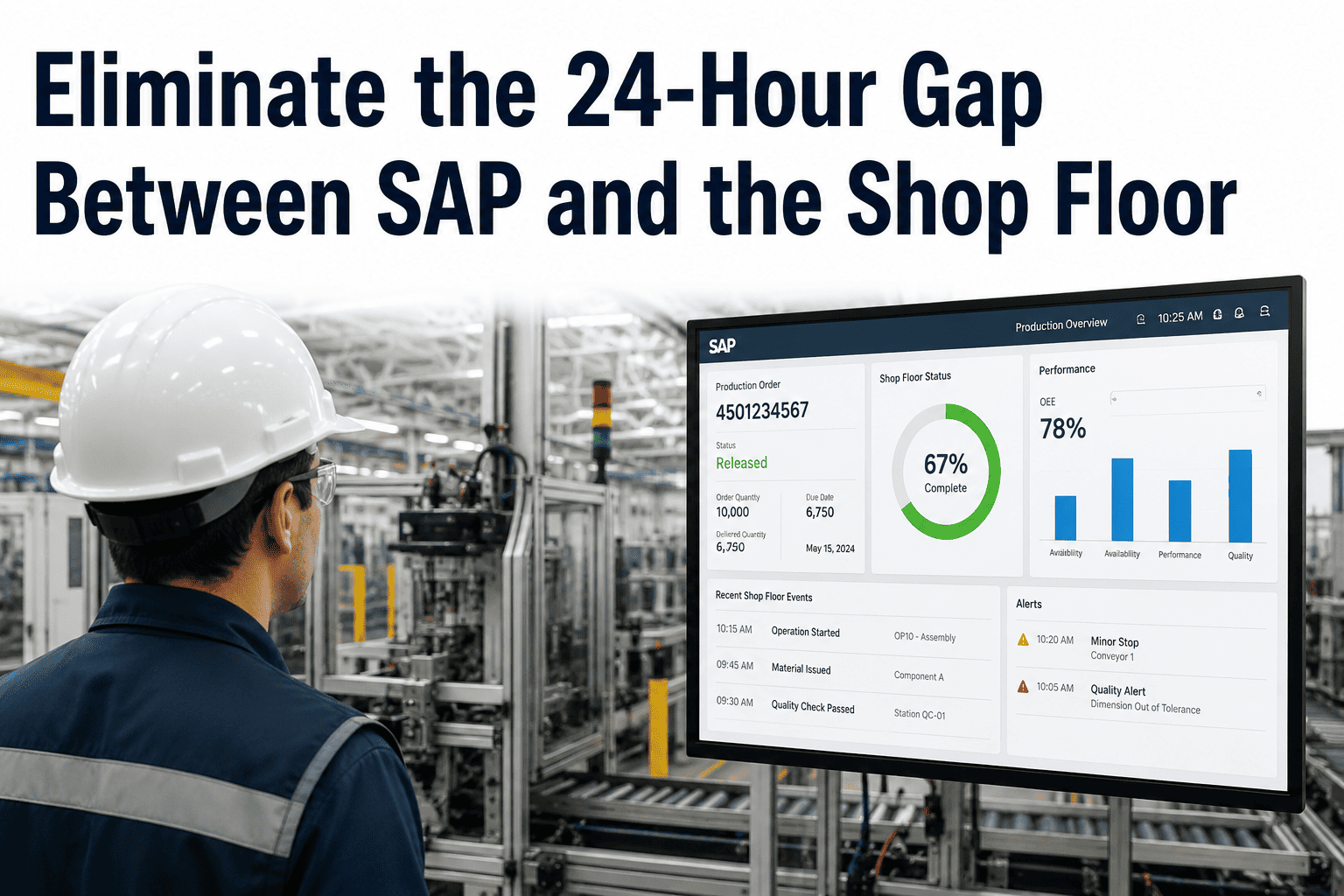
Walk onto most shop floors and pull up the SAP order screen, and you'll see a production order sitting "in process" for a job the line finished three shifts ago. That gap isn't a reporting inconvenience — it's a planning risk, because every downstream decision, from order promising to material staging, is being made against data that's already stale. Here's what it actually takes to close the gap between SAP and the shop floor to under a minute.
Your SAP Order Says "In Process." The Line Finished It Yesterday.
End-of-shift batch uploads are the default in most plants, which means every SAP-driven decision runs on data that's a full shift or more behind reality. A live connector closes that gap to seconds, not hours.
Where the Hours Actually Go
Nobody designs a 24-hour gap on purpose. It accumulates from a series of individually reasonable steps that add up to a day-old picture.
Order Begins on the Line
Production starts against the SAP order, but the order status in SAP itself has not moved yet.
Progress Exists Only on the Floor
Operators, supervisors, and MES all know the real status, but SAP still shows the order as it did at shift start.
The Batch File Gets Queued
Completion data is packaged into an end-of-shift export, waiting for the scheduled batch job to run.
SAP Finally Updates
The batch job posts the update, often hours after the actual work was completed on the floor.
The Gap Closes to Seconds
A live connector posts each completion the moment it happens, so SAP reflects the floor in near real time.
What Sub-Minute Sync Actually Looks Like
These numbers come from a live tick counter running against a production connector, not a lab estimate.
Stop Planning Against a Shift-Old Picture
iFactory's live tick counter, 2-second MSMQ poll, and REST plus webhook bridge keep SAP and the shop floor in sync — verified live, not estimated.
The Same Order, Two Very Different Pictures
The technology difference is a connector. The operational difference is whether every team is planning against reality or against yesterday.
| Capability | End-of-Shift Batch Upload | Live REST + Webhook Bridge |
|---|---|---|
| Update frequency | Once per shift or per day | Every 2 seconds |
| Order status accuracy | Hours to a full day behind | Under a minute behind |
| Material staging decisions | Based on stale consumption data | Based on current consumption |
| Order promising confidence | Padded to cover uncertainty | Based on actual line progress |
| Exception detection | Found the next morning | Flagged as it happens |
Four Decisions That Depend on Fresh Data
These are the moments where operations excellence leads see the batch-upload gap turn into a real cost, not just a reporting annoyance.
Order Promising
Sales commits a delivery date based on where SAP thinks the order actually sits, not where it really is on the line.
Material Staging
Warehouse teams stage the next lot based on a consumption number that hasn't caught up with the current shift.
Exception Escalation
A line stoppage that should trigger an immediate response instead surfaces in a report the next morning.
Financial Close Accuracy
Work-in-process valuation is only as accurate as the last completion event SAP actually received.
The Bridge Behind the Sub-Minute Sync
Closing the gap doesn't mean replacing SAP or the shop floor systems — it means connecting the ones you already have.
Map the Completion Events
Identify every shop floor event that should trigger a SAP update — order start, completion, scrap, and rework.
Stand Up the MSMQ Poll
Configure the message queue to poll shop floor events every two seconds rather than waiting for a scheduled batch window.
Connect REST and Webhook Paths
Bridge events into SAP through REST calls and webhooks so both directions of the connection stay live.
Verify Sync Time in Production
Run the live tick counter against real orders until sub-minute sync is confirmed under actual shift conditions.
SAP-to-Shop-Floor Sync — Questions Answered
What operations excellence leads typically ask before replacing an end-of-shift batch process with a live bridge.
Q: Does closing this gap require replacing our existing SAP setup?
No, the live bridge connects to your existing SAP instance through standard REST and webhook interfaces rather than requiring a new ERP configuration or module. The change is additive: completion events start arriving continuously instead of in a single overnight batch, but the underlying order structure, material master, and production order logic in SAP stay exactly as they are. You can book a demo to see the bridge connected against your specific SAP version.
Q: What happens if the shop floor connection drops mid-shift?
The MSMQ-based polling layer is designed to queue events locally if the connection to SAP is temporarily unavailable, then flush the queue in order once connectivity returns. This means a brief network interruption doesn't result in lost completion data, only a short delay in when it posts. The queue depth and any backlog are visible so a controls or IT team can confirm nothing was dropped.
Q: How is the two-second poll interval verified in production, not just in a lab?
The live tick counter runs continuously against real production orders, timestamping each shop floor event and the moment it appears in SAP, so the sub-minute sync figure is measured rather than assumed. This verification runs during the rollout phase and can continue afterward as an ongoing health check on the connector itself. Our support team can share what that verification looks like for a plant your size.
Q: Will this change how planners and schedulers currently use SAP?
Planners and schedulers keep using the same SAP screens and reports they already know, the only difference is that the data behind those screens now reflects the shop floor within a minute instead of a full shift later. No new training on a separate system is required, since the improvement happens in the data pipeline feeding SAP rather than in a new interface layered on top of it.
Q: Does this also fix work-in-process valuation accuracy?
Yes, because work-in-process valuation in SAP is only as current as the last completion event it has received, closing the sync gap directly improves how accurately WIP reflects the actual state of production at any given moment. This matters most at month-end close, when a full day of unposted completions can materially shift the valuation numbers finance is working from.
Stop Making Decisions on Yesterday's Data
An end-of-shift batch upload was never designed for a plant that needs to react in real time. iFactory's live tick counter, MSMQ poll, and REST plus webhook bridge bring SAP and the shop floor into sync in under a minute.