Bottleneck Detection Using Real-Time Production Data

By James Smith on November 4, 2026

bottleneck-detection-real-time-production-data

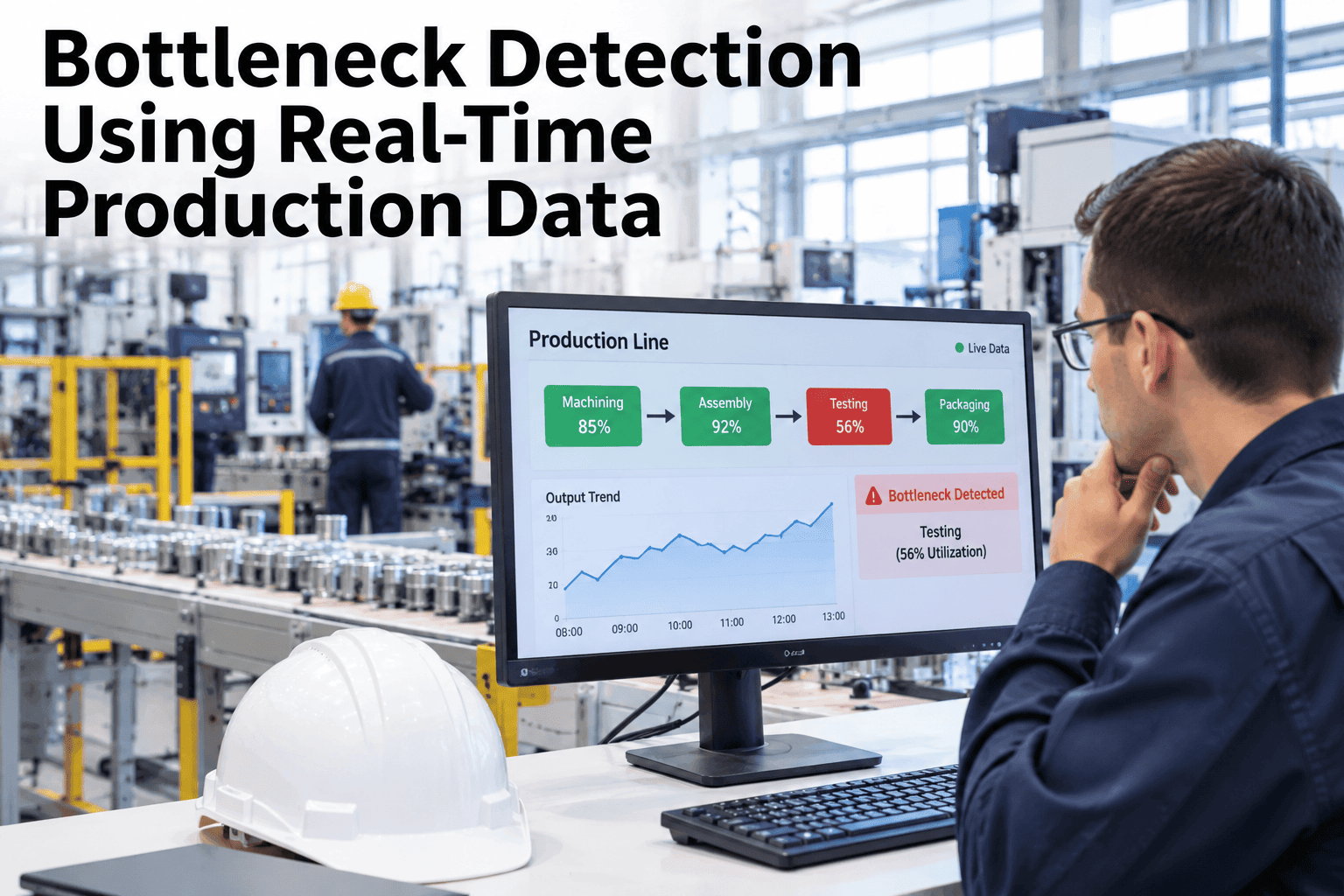
By the time a weekly production report shows a work center running behind, the bottleneck that caused it has usually already moved somewhere else. Real-time bottleneck detection watches machine state, cycle time and queue length continuously, flagging the constraint as it forms rather than after a week of output is already lost. An hour lost at a true bottleneck is an hour lost for the entire plant — there is no making it up downstream — which is exactly why catching it live matters more than catching it in a report. You can see your current bottleneck live on your own line with our team.

Live Production Monitoring, 2026

The Bottleneck Moves. Your Monitoring Should Move With It.

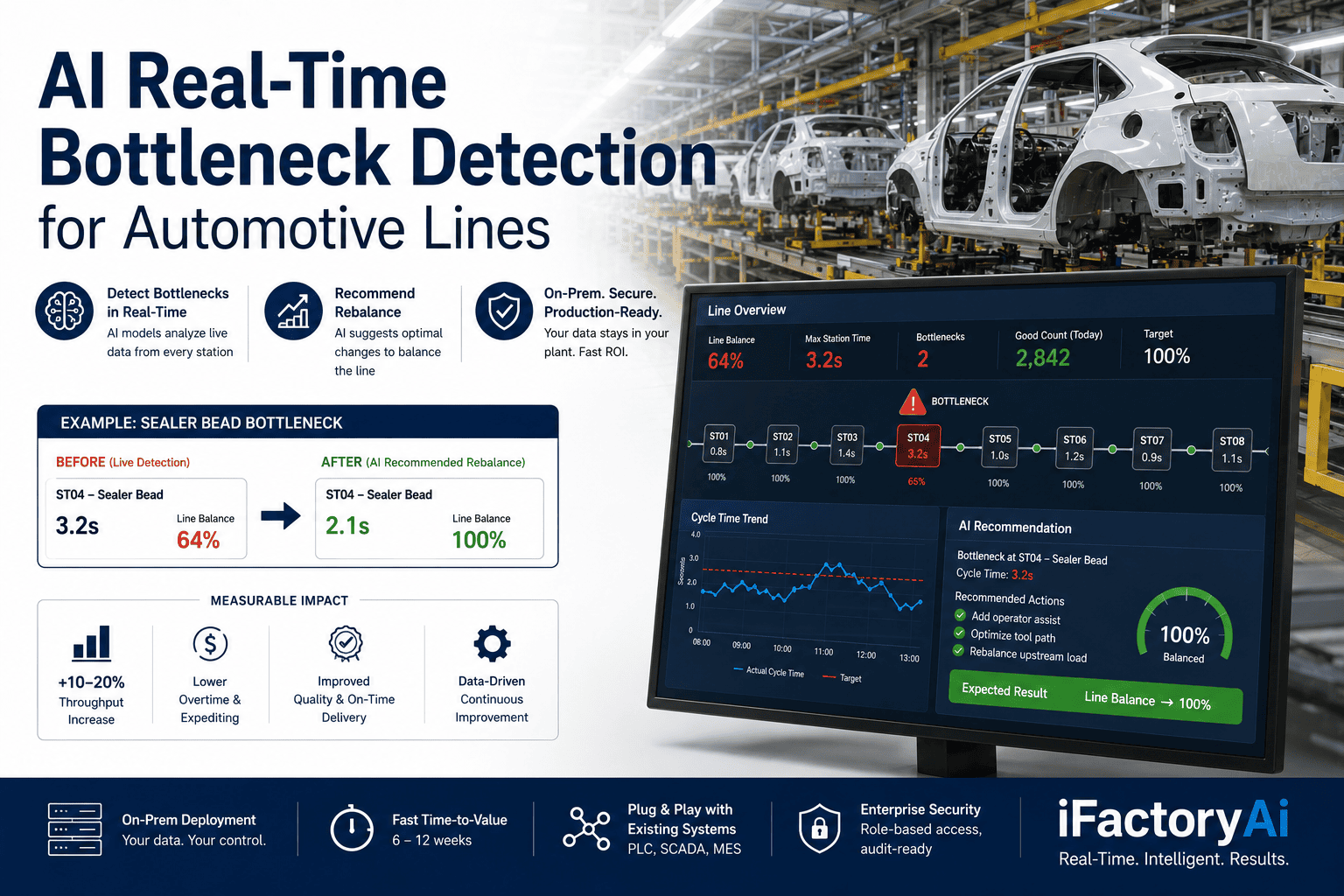
iFactory, an on-premise AI platform for production monitoring, tracks machine state, cycle time and queue depth continuously across every work center, flagging the active constraint the moment it forms.

Station A
Station B — Constraint
Station C
Station D
What it is

What Does Real-Time Bottleneck Detection Actually Measure?

Real-time bottleneck detection identifies which work center is currently limiting total line output by watching live signals — cycle time against standard, queue length building upstream, and whether downstream stations are starved waiting on it — rather than inferring the constraint from a report compiled after the shift ends.

A bottleneck is not always the slowest machine on paper. It is whichever station is actually limiting throughput right now, once blocking and starving between stations are accounted for — and that station can change hour to hour as product mix and stop patterns shift.
The signals

Four Live Signals That Reveal the Active Constraint

Cycle time drift
A station running measurably slower than its standard rate right now.
Upstream queue growth
Work-in-process piling up in front of a station faster than it can process.
Downstream starving
Stations after the constraint sitting idle, waiting for parts that never arrive fast enough.
Alarm frequency
A station triggering stops more often than its historical baseline.
Why it moves

Why the Bottleneck Rarely Stays in One Place

Cause of movementWhat changes
Product mix shiftDifferent SKUs load different stations unevenly
Maintenance eventA fixed station's capacity drops, shifting the limit elsewhere
Staffing changeA station loses an operator and its effective rate falls
Upstream fix appliedSolving yesterday's constraint reveals the next one

Find Out Where Your Bottleneck Is Right Now

Share live or recent machine-state data from one line and see which station is actually limiting output today.

Book a Bottleneck Detection Review Ask About Sensor Requirements
A documented case

What Catching a Bottleneck Live Is Worth

A Swiss precision parts manufacturer facing growing delivery delays found, through a constraint analysis, that a single manual quality inspection station was the actual limit on the whole line — not the modernized machining centers everyone suspected. Once the team protected that station with a buffer and stopped over-optimizing stations around it, production throughput increased 25% within three months (industry case analysis, 2026).

The lesson generalizes: time spent improving a station that is not the current constraint delivers close to zero throughput gain. Real-time detection exists specifically to stop that wasted effort before it starts.
Expert review

What a Production Engineer Would Check First

Holds up
Identifying the dynamic constraint through blocking and starving signals is standard Theory of Constraints practice, with decades of manufacturing application behind it.
Watch for
A dashboard that flags "the slowest station" by rated speed alone — that is not the same as the actual dynamic constraint once buffers and blocking are factored in.
Do next
Start monitoring the line where output has been hardest to explain, since that is usually where the bottleneck has been quietly moving undetected.
FAQ

What Production Teams Ask About Real-Time Bottleneck Detection

How is real-time detection different from a weekly OEE report?
A weekly report shows where output was lost after the fact. Real-time detection flags the active constraint as it forms, so a team can respond mid-shift instead of discovering the problem a week later when it has likely already moved. See the difference on your own line.
What data does bottleneck detection actually need?
At minimum, machine state and cycle time from each station in the line, ideally supplemented with queue or buffer-level data between stations so blocking and starving can be observed directly. Ask what your current sensors already provide.
Can the bottleneck change within a single shift?
Yes — a maintenance event, a staffing change, or a shift in product mix partway through a shift can move the constraint to a different station, which is exactly why static, report-based detection misses it.
Is the slowest machine always the bottleneck?
Not necessarily. A fast machine with frequent stops can limit the line more than a slower machine that runs steadily, which is why real-time detection looks at blocking and starving patterns rather than rated speed alone. Check your own line's pattern with our team.
What should a team do once the live constraint is identified?
Protect it with adequate buffer, subordinate other stations' pace to it rather than running them faster for no benefit, and focus improvement effort there first — improving a non-constraint station rarely moves total output. Discuss next steps once your constraint is found.

Catch the Bottleneck While It's Still Costing You Output

Book a session with iFactory AI to set up real-time bottleneck detection on your line and see the constraint as it forms.

Book a Live Monitoring Session Talk to Our Support Team
Share This Story, Choose Your Platform!