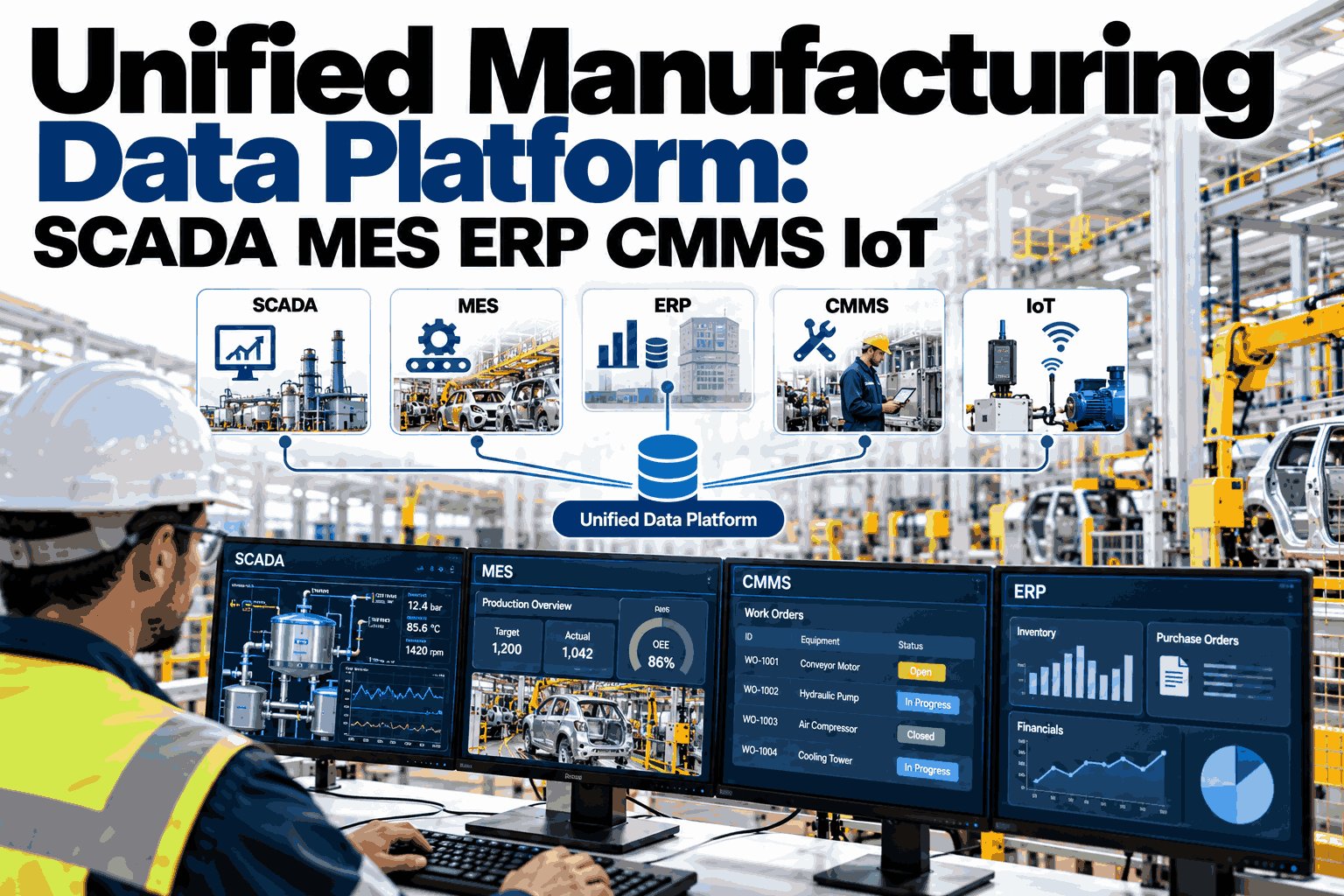
Only 13 percent of manufacturers report having a Unified Namespace in production, even though 48 percent name legacy integration and data silos as their top barrier to AI adoption (industrial IoT integration survey, 2026). iFactory, an on-premise AI platform built around a unified data layer, connects MES, ERP, SCADA, CMMS, and IoT systems while leaving each as the system of record for its own domain. Manufacturing leaders who want to see this architecture applied to their own systems can request a demo with our team.
Unified Manufacturing Data Architecture · 2026
A Unified Namespace Doesn't Replace Your Systems. It Gives Them a Common Language.
iFactory AI aggregates MES, ERP, SCADA, CMMS, and IoT data into a shared layer, so every connected application reads from and writes to the same structured source.
MESERPSCADA
Unified Data Layer
CMMSIoT SensorsQuality/Lab
Why silos persist
Each System Was Built to Be Its Own Source of Truth
MES, ERP, SCADA, and CMMS were each designed to manage their own domain well, not to share data with each other by default. That's by design, not a flaw — the problem isn't any single system, it's the absence of a shared layer above them that lets an AI model, a dashboard, or a new application read consistent data without needing a custom connection to every source individually.
What a unified layer preserves vs changes
Systems of Record Stay. The Access Pattern Changes.
| What stays the same | What changes |
|---|
| MES remains the system of record for production execution | Production data is also published to the unified layer for other systems to consume |
| ERP remains the system of record for financials and orders | Order and inventory data becomes accessible without a direct ERP integration per consumer |
| CMMS remains the system of record for maintenance history | Asset and work order data joins the same shared namespace as production data |
What this enables
Four Capabilities That Need a Unified View
Cross-domain analytics
A model correlating quality outcomes with maintenance history needs both data sets in one place.
New applications without new integrations
A new dashboard or AI tool connects once to the unified layer instead of separately to every source system.
Consistent asset identity
The same asset is referenced by the same ID everywhere, ending the mapping-table problem.
Easier legacy retirement
Replacing an old system later only requires reconnecting it to the unified layer, not to every downstream consumer.
See What a Unified View Would Look Like Across Your Current Systems
Share a list of your current MES, ERP, SCADA, and CMMS systems, and iFactory AI will walk through what a unified data layer would connect for you.
Building it incrementally
You Don't Need to Connect Everything on Day One
A unified data architecture is typically built incrementally, connecting the highest-value systems first — often MES and a key quality or maintenance system — rather than attempting to onboard every data source simultaneously. Each additional connection adds value without requiring the previous ones to be redone.
Common pitfalls
Four Mistakes That Undermine a Unified Architecture
1
Treating it as a replacement project
Trying to retire existing systems instead of connecting them adds unnecessary risk and cost.
2
No agreed data model
Publishing data without a shared naming and structure convention just moves the silo problem into the new layer.
3
Ignoring data ownership
Without clear ownership, nobody is accountable for a source feed going stale or wrong.
4
Boiling the ocean
Attempting to connect every system at once instead of proving value with the highest-impact sources first.
Expert review
What a Manufacturing IT Director Checks First
A unified data architecture earns trust when it demonstrably speeds up the next new application, not just when it looks good on an architecture diagram.
Verdict
Strong when systems of record are preserved and the unified layer is clearly additive, not a parallel source of truth competing with the originals.
Watch for
A data model that's agreed on paper but not actually enforced as new sources get connected.
Do next
Identify the two systems whose combined data would deliver the most immediate analytical value and start there.
Frequently asked questions
What Manufacturers Ask About Unified Data Architecture
Does this replace our MES, ERP, or CMMS?
How common is this kind of architecture today?
Still relatively uncommon — only 13 percent of manufacturers report having a Unified Namespace in production, despite data silos being the most commonly named barrier to AI adoption (industrial IoT integration survey, 2026).
Ask support where your plant currently stands.
Which system should we connect first?
Most plants start with MES, since it sits at the center of production data, paired with whichever secondary system — quality, maintenance, or energy — would unlock the most immediate analytical value.
Discuss a connection sequence for your systems.
Who should own the shared data model once it's built?
How long does a first phase typically take to show value?
Timeline depends on how many systems are connected in the first phase, but most plants aim to show value from an initial two-system connection within a few months rather than waiting for a full architecture to be complete.
Discuss a realistic first-phase timeline.
One shared language, every system keeps its job
Give Every System a Common Layer to Read and Write Through
Book a demo to see how iFactory AI unifies your MES, ERP, SCADA, and CMMS data without replacing any of them.