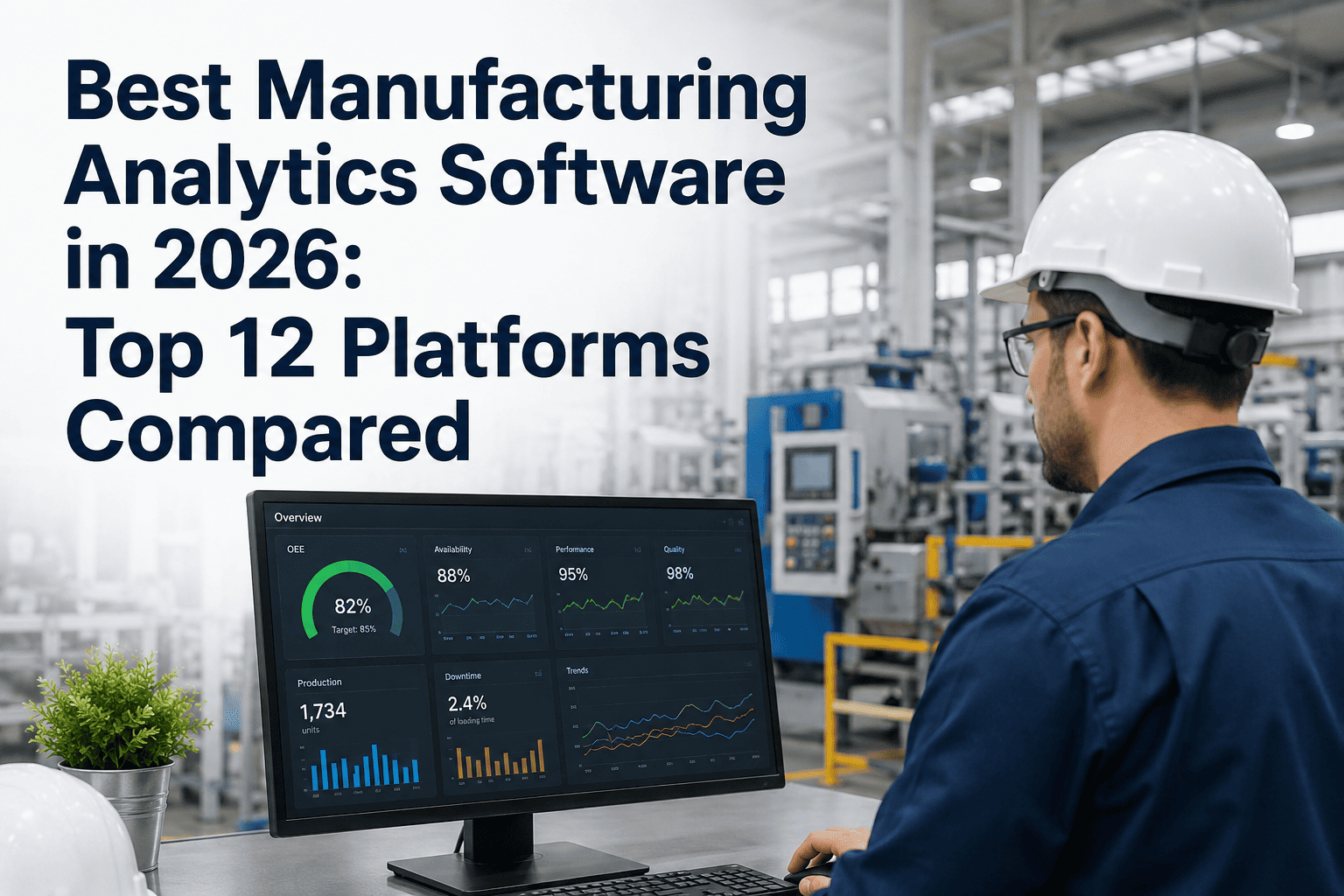
Best Manufacturing Analytics Software in 2026: Top 12 Platforms Compared

By Dave on May 15, 2026

best-manufacturing-analytics-software-2026

Every hour your production floor runs on gut instinct and spreadsheets, a competitor with real-time AI analytics is capturing the margin you're leaving on the table. In 2026, manufacturing intelligence is no longer a luxury — it's the operational baseline separating plants that scale from plants that stall. Choosing the wrong analytics platform costs more than the software: it costs you unplanned downtime, bloated maintenance budgets, and the strategic visibility your leadership team needs to act fast. This guide cuts through the noise — comparing the 12 best manufacturing analytics platforms so you can make a decision that pays back in weeks, not years.

Executive Summary
$2.4M
Average loss from failed analytics deployments that lacked a phased roadmap
48%
CAGR of the digital twin and manufacturing analytics market through 2028
10–30x
ROI range for manufacturers who follow a validated phased deployment model
4–6 wk
Time to first measurable value with the right AI analytics platform
See how iFactory's AI Analytics Platform delivers measurable ROI in weeks — not quarters.
Book a Free Demo

What to Look for in Manufacturing Analytics Software

The best manufacturing analytics platforms share a set of non-negotiable capabilities. Before evaluating any vendor, align your selection criteria to these operational outcomes:

  • Real-time asset monitoring — live dashboards fed by OPC-UA, MQTT, and REST integrations, not batch uploads from yesterday's historian
  • Predictive failure detection — AI models that alert 14–21 days before failure, not just threshold alarms after the damage starts
  • Phased deployment support — vendors who start with 10–20 pilot assets and prove ROI before scaling, not those who insist on boiling the ocean first
  • CMMS and ERP integration — auto-generated work orders that flow into your existing systems without rip-and-replace disruption
  • Financial reporting — savings tracked in dollars, not just data points, so you can justify the investment to the C-suite every month

The 12 Best Manufacturing Analytics Platforms in 2026

02
Sight Machine
Enterprise manufacturing data platform with deep process analytics and OEM integrations
Key Strengths
  • Broad OEM machine connectivity across 300+ equipment types
  • Strong process analytics for continuous manufacturing environments
  • Established enterprise customer base in automotive and CPG
Considerations
  • Longer implementation timelines for mid-market deployments
  • Pricing skews toward large enterprise budgets
  • Predictive maintenance depth varies by use case
03
Tulip
No-code frontline operations platform for discrete manufacturing workflows
Key Strengths
  • Rapid app building for shop-floor digitisation without coding
  • Strong in assembly, quality, and inspection workflows
  • Intuitive operator-facing UI with low training overhead
Considerations
  • Limited native predictive analytics capability
  • Best suited for discrete manufacturing; less fit for process industries
  • Advanced AI features require third-party integrations
04
Tignis
AI-native process optimisation for continuous manufacturing and oil and gas
Key Strengths
  • Purpose-built AI for high-complexity continuous process environments
  • Strong yield and throughput optimisation models
  • Proven in refining, chemicals, and semiconductor manufacturing
Considerations
  • Narrower applicability outside its core process industries
  • Steeper data science requirement for model customisation
  • Less established for discrete or mixed-mode manufacturing
05
Aveva MES
Industrial-grade manufacturing execution system with integrated analytics layer
Key Strengths
  • Deep MES functionality with embedded analytics reporting
  • Strong compliance and traceability for regulated industries
  • Large installed base with decades of OT integration expertise
Considerations
  • Legacy architecture can limit cloud-native deployment speed
  • AI and predictive features less mature than purpose-built platforms
  • High total cost of ownership for smaller manufacturing sites
06
Rockwell Plex
Cloud-native ERP and MES with integrated manufacturing analytics for mid-market
Key Strengths
  • Unified ERP plus MES plus analytics in a single cloud platform
  • Strong fit for automotive and food and beverage sectors
  • Reduces vendor fragmentation for mid-market operations
Considerations
  • Analytics depth below standalone best-of-breed platforms
  • Implementation timelines typical of ERP complexity
  • Less flexible for asset-level predictive maintenance
07
PTC ThingWorx
Industrial IoT platform with analytics, AR integration, and digital thread capabilities
Key Strengths
  • Broad IIoT connectivity with strong device management layer
  • AR-enabled maintenance workflows via Vuforia integration
  • Scalable from single-site pilots to enterprise deployments
Considerations
  • Platform complexity requires significant configuration investment
  • AI analytics layer requires additional modules and cost
  • Best value realised with full PTC product suite
08
GE Vernova APM
Asset performance management with risk-based maintenance and reliability analytics
Key Strengths
  • Deep reliability and RBI frameworks for heavy industry
  • Strong in power generation, utilities, and oil and gas
  • Comprehensive risk scoring and criticality assessment tools
Considerations
  • Implementation complexity suitable for large enterprises only
  • Less competitive outside GE's core heavy-industry verticals
  • Cloud migration from legacy Predix architecture ongoing
09
Seeq
Advanced analytics workbench for process manufacturing data scientists and engineers
Key Strengths
  • Powerful time-series analytics with historian connectivity
  • Collaboration tools for cross-functional engineering teams
  • Rapid investigation of process anomalies and root cause
Considerations
  • Analyst-oriented tool; less suited for frontline operator use
  • Requires process data expertise to extract maximum value
  • Not a full predictive maintenance or asset health solution
10
IBM Maximo Application Suite
Enterprise asset management with AI-powered maintenance and reliability intelligence
Key Strengths
  • Comprehensive CMMS and EAM functionality in a single suite
  • AI anomaly detection via Maximo Monitor module
  • Strong in regulated industries with compliance and audit trails
Considerations
  • Significant implementation cost and configuration time
  • Analytics maturity varies across the suite's modules
  • Best suited for organisations with existing IBM infrastructure
11
Aspentech Mtell
Machine learning-driven predictive maintenance for process and refining environments
Key Strengths
  • Strong ML-based failure prediction for rotating and static equipment
  • Deep domain expertise in refining, petrochemical, and mining
  • Proven in high-consequence, high-complexity asset environments
Considerations
  • Pricing and complexity target large-cap industrial operators
  • Narrower vertical focus limits applicability in discrete manufacturing
  • Full value requires deep Aspen ecosystem integration
12
Microsoft Azure Digital Twins
Cloud infrastructure layer for building custom digital twin solutions on Azure
Key Strengths
  • Highly flexible platform for organisations with internal engineering capacity
  • Native integration with Azure IoT, Synapse, and Power BI
  • Scales to virtually unlimited asset complexity and data volume
Considerations
  • Infrastructure, not a solution — requires significant build investment
  • No out-of-box predictive maintenance or analytics models
  • Internal data science team required to realise manufacturing value
Ready to see the difference?
iFactory deploys on 12 sensors and delivers measurable ROI in 4–6 weeks
Book a Strategy Session

Legacy Friction vs. Optimised Excellence: The Analytics Gap

The decision to delay investment in manufacturing analytics is never neutral. Every week without predictive intelligence is a week of reactive maintenance costs, unplanned downtime, and energy waste that compounds against your bottom line.
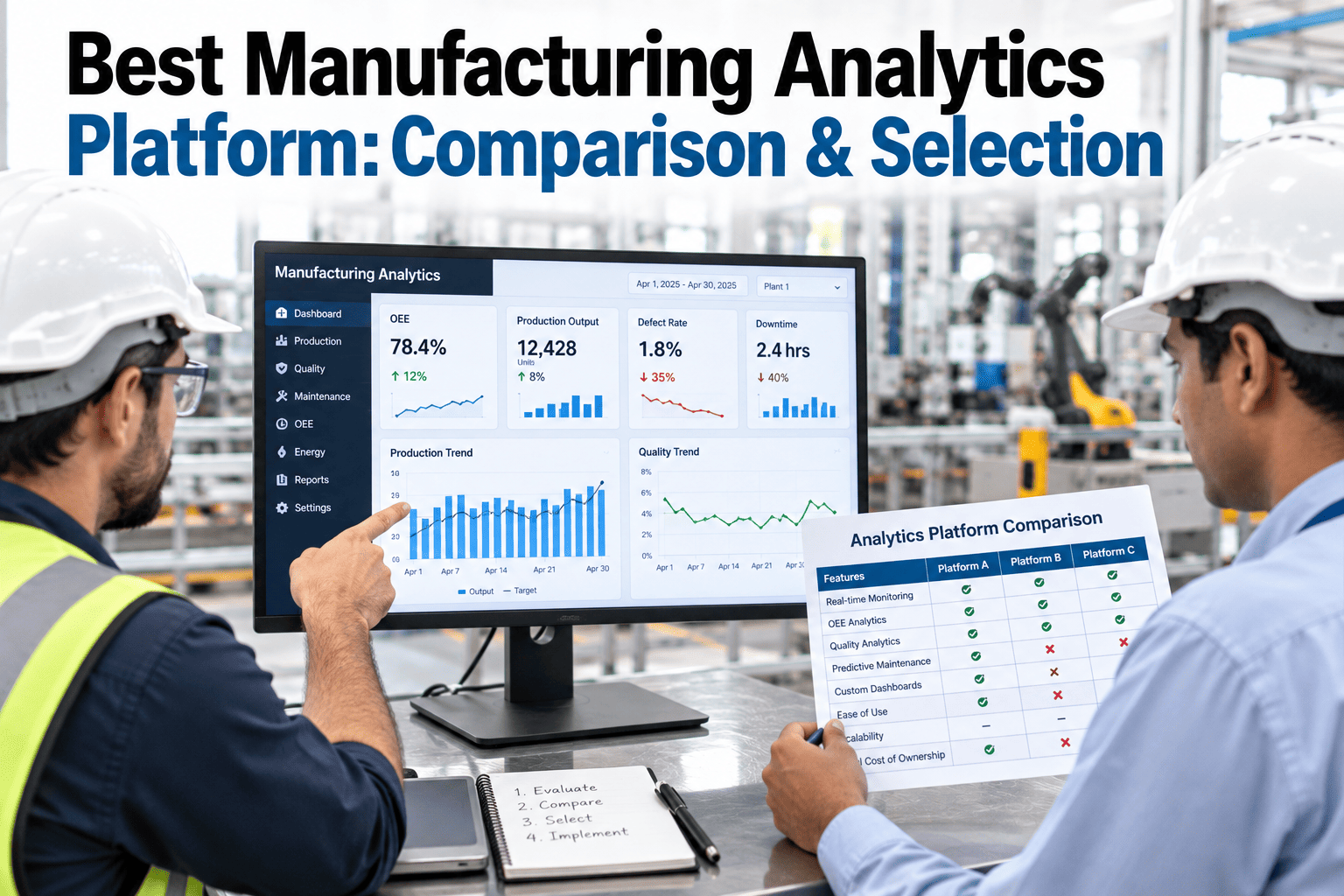
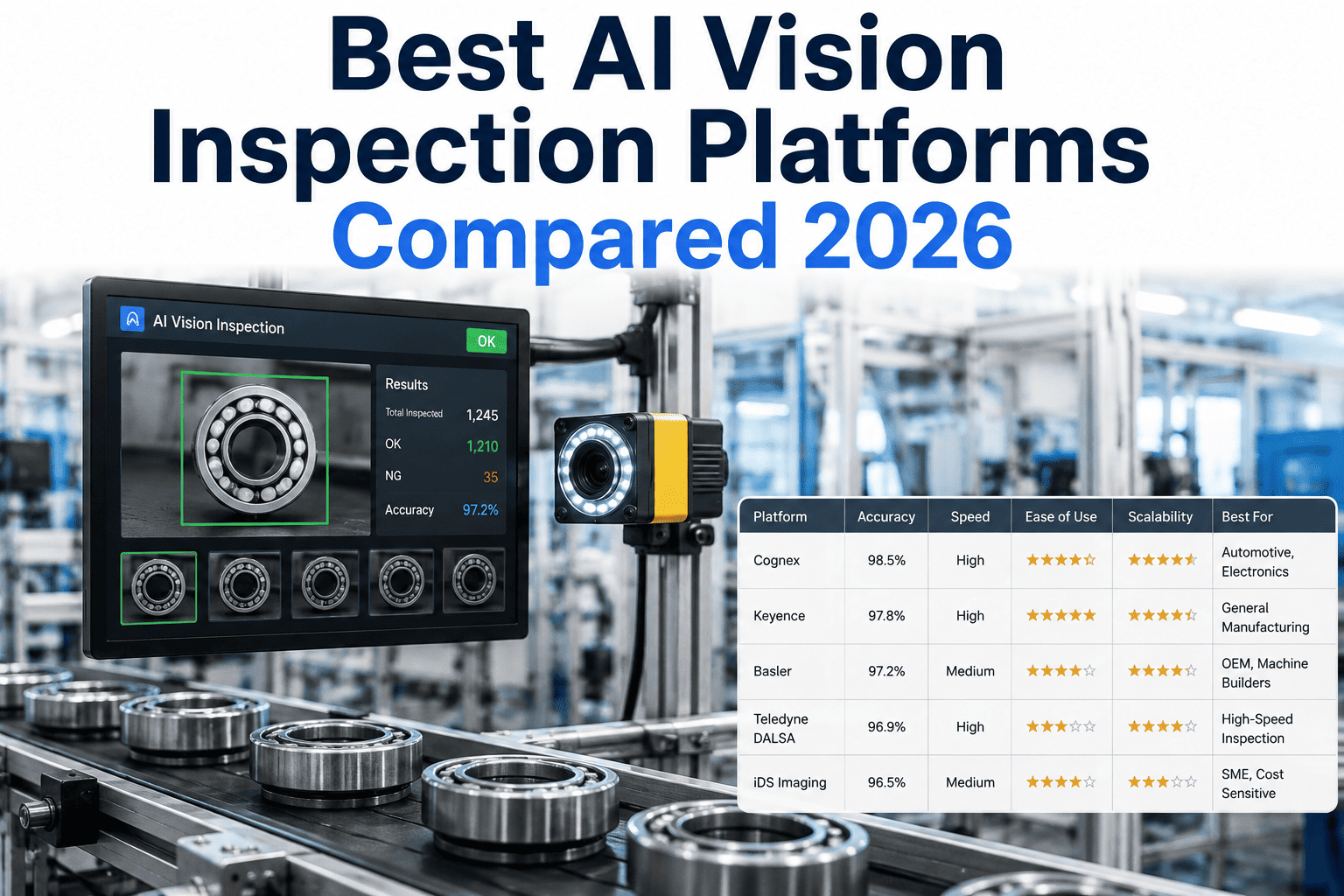
Legacy Friction — The Old Way
Optimised Excellence — With AI Analytics
Maintenance Model
Calendar-based PM schedules regardless of actual asset condition — over-maintaining healthy assets, under-protecting failing ones
Condition-based and predictive maintenance triggered by real AI signals — work orders generated 14–21 days before failure
Failure Detection
Discovered on breakdown — reactive response, emergency parts sourcing, unplanned line stoppage averaging 4–8 hours
Anomaly detected weeks in advance — planned intervention, correct parts pre-staged, zero unplanned downtime
Energy Visibility
Monthly utility bills are the only feedback — no correlation between consumption, asset condition, and production output
Real-time energy monitoring per asset — waste identified automatically, consumption optimised relative to output
Leadership Reporting
40-slide decks assembled manually — stale data, subjective interpretation, and no clear link to financial outcomes
Automated financial KPI reports — savings in dollars, uptime percentages, and ROI metrics delivered monthly
CAPEX Planning
Replacement decisions based on age and anecdote — over-investing in assets with remaining life, under-investing in critical risks
Remaining Useful Life projections for every monitored asset — data-backed CAPEX planning that reduces waste by 20–35%
Deployment Timeline
12–18 month implementations that delay value, exhaust internal champions, and invite budget cancellation
First monitored assets live in 4 weeks — first avoided failure typically within 6–10 weeks of deployment

How the Right Platform Transforms Three Core Operations

Workflow Efficiency
Maintenance planners shift from reactive firefighting to scheduled, AI-driven intervention. Auto-generated work orders arrive with correct parts lists, procedures, and timing — eliminating 60–70% of planning overhead and cutting mean-time-to-repair by an average of 35%.
35% reduction in mean-time-to-repair
Overhead Reduction
Energy monitoring layers identify waste at the asset level — not just on the utility bill. Unnecessary preventive maintenance events are eliminated. Spare parts inventory is right-sized against actual predictive demand rather than worst-case historical buffers, reducing carrying costs by 15–25%.
15–25% reduction in spare parts carrying costs
Output and Growth
Overall Equipment Effectiveness improves as unplanned downtime is eliminated and production schedules become reliable. Cross-facility benchmarking identifies the highest-performing operating parameters — making best practices scalable across every site without waiting for periodic audits.
OEE improvements of 8–18 percentage points

Frequently Asked Questions

How quickly can we get our first manufacturing analytics deployment live?
With a phased deployment approach, critical pilot assets can be monitored within 4 weeks. Industrial vibration sensors now cost $50–100 each, and wireless installation requires no plant shutdown. A 10–20 asset pilot can be fully instrumented and streaming data into the platform within 1–2 weeks, with AI baseline learning and first anomaly alerts following within 4–6 weeks.
What ROI can we realistically expect from manufacturing analytics in year one?
For assets with significant downtime cost — typically $50K–$260K+ per hour — a single avoided unplanned failure can exceed the entire Phase 1 deployment investment. Manufacturers following a validated phased roadmap typically achieve positive ROI by month 3–6, with full-year savings ranging from $400K for smaller pilots to $2.1M+ for full-facility deployments. The 10–30x ROI range reflects documented outcomes across iFactory deployments.
Will manufacturing analytics software disrupt our existing CMMS or ERP systems?
No — the best platforms are explicitly designed for non-disruptive integration. They connect via OPC-UA, MQTT, and REST APIs, running alongside existing systems rather than replacing them. Maintenance teams continue using their current CMMS for work execution while AI adds predictive intelligence on top. Over time, auto-generated work orders feed directly into the CMMS, creating a seamless workflow without rip-and-replace risk.
How do we select the right assets for a pilot deployment?
Prioritise assets where unplanned failure cost is highest, maintenance spend is greatest, or failure frequency is most problematic. Motors, pumps, compressors, and fans are ideal first candidates — well-understood failure modes, readily available monitoring sensors, and high impact if they go down. Avoid starting with your most complex asset; start with the one where a single avoided failure produces the clearest, most defensible ROI number.
Start Small. Prove Fast. Scale Deliberately.
Your First 12 Sensors Are the Highest-ROI Decision You'll Make This Year
iFactory's phased AI analytics platform gets critical assets monitored in weeks, delivers the first avoided failure in months, and compounds ROI every quarter after that. Every phase funds the next through documented savings — no budget risk, no boiling the ocean.
4–6wk
Time to first value
95%
Report positive ROI
$3.5M
Annual savings potential
10–30x
Return on investment

Share This Story, Choose Your Platform!