Every day your legacy PLC runs, you are not just running a machine — you are running a countdown clock. Obsolete controllers with no vendor support, proprietary protocols that block integration, and zero remote visibility are costing manufacturers an average of $260,000 per hour of unplanned downtime. The question is not whether your aging control infrastructure will fail. The question is whether you will modernize on your schedule — or scramble on the machine's schedule.
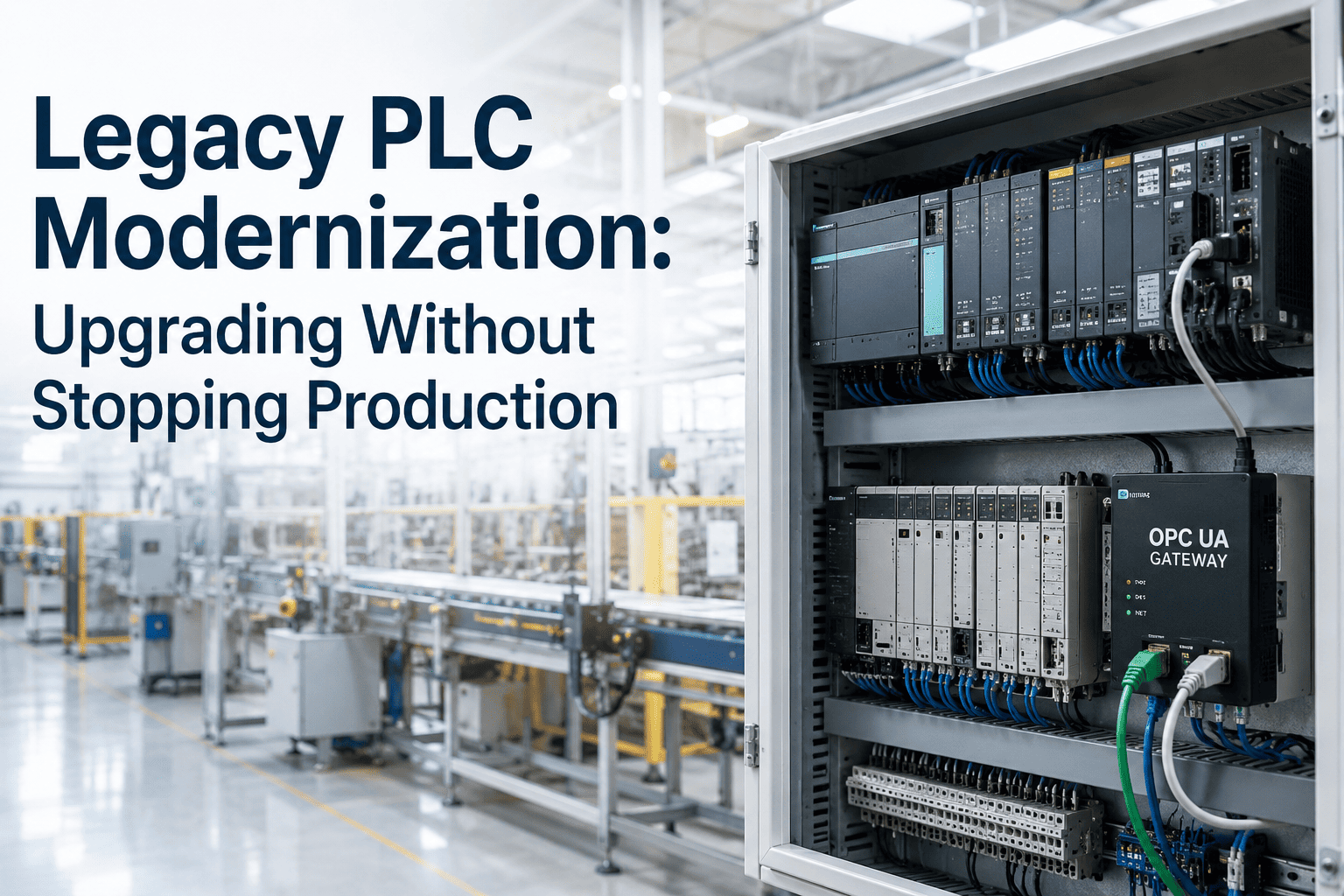
Legacy PLC Modernization: Upgrading Without Stopping Production
The Hidden Cost of Doing Nothing
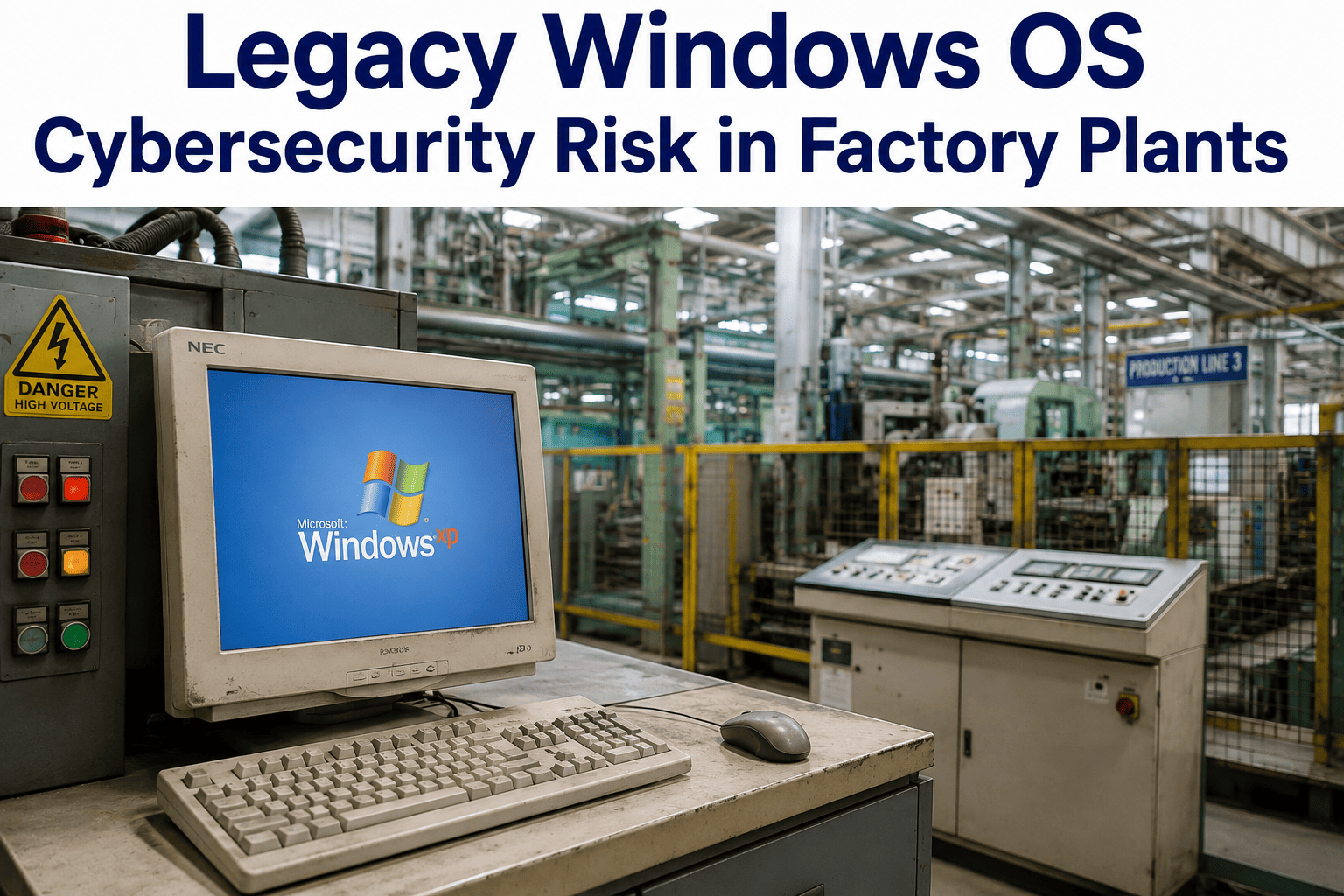
Legacy PLC obsolescence is a silent margin killer. Controllers running on discontinued platforms — Allen-Bradley SLC 500, Siemens S5, Modicon 984 — face parts scarcity, zero security patches, and complete isolation from modern data architectures. When the last technician who knows your legacy ladder logic retires, that institutional knowledge walks out the door permanently. Modern PLC migration is not a capital expenditure. It is risk elimination with a measurable return.
Three Migration Paths — Matched to Your Risk Tolerance
Not every facility has the budget, timeline, or operational flexibility for a rip-and-replace. Successful legacy PLC modernization starts by selecting the right migration strategy for your production environment, maintenance capacity, and digital transformation roadmap.
- Replace one controller at a time during scheduled maintenance windows
- New PLC runs in parallel with legacy system before cutover
- Zero production disruption — validated logic before each switchover
- Budget spread across fiscal periods — no single large capital hit
- Ideal for continuous process environments and lean maintenance teams
- Industrial gateways translate legacy protocols to OPC-UA without PLC replacement
- Legacy Modbus, DH+, and Profibus data flows to modern analytics platforms
- Extends useful life of existing controller hardware 5–10 years
- Lowest upfront cost — minimal engineering intervention required
- Ideal when controllers are stable but data visibility is the primary gap
- Complete controller replacement during scheduled maintenance outage
- Full logic rewrite with modern structured text and function block diagrams
- Cleanest technical outcome — no legacy protocol baggage
- Requires detailed pre-cutover simulation and validation
- Ideal for end-of-life equipment or major line reconfiguration projects
Legacy Friction vs. Optimized Excellence
The operational gap between a legacy-constrained facility and a fully modernized one is not incremental — it is structural. This comparison reflects the actual performance delta reported by manufacturers who completed PLC migration with integrated AI monitoring.
| Capability Area | Legacy Friction (Old Way) | Optimized Excellence (New Way) |
|---|---|---|
| Fault Diagnosis | Manual inspection, ladder logic review, hours to isolate faults | AI-flagged anomalies with root cause analysis in under 60 seconds |
| Remote Access | On-site only — technician dispatch required for every alarm response | Secure remote monitoring and parameter adjustment from any device |
| Data Visibility | Process values trapped in controller — no historian, no analytics | Real-time streaming to digital twin, MES, ERP, and cloud dashboards |
| Maintenance Model | Reactive — fix after failure or rely on fixed-interval schedules | Predictive — AI forecasts failures 14–21 days in advance |
| Cybersecurity | No authentication, no encryption, no patch path | IEC 62443-compliant architecture with role-based access control |
| Integration | Proprietary protocols — islands of automation with no data exchange | OPC-UA, MQTT, REST APIs — native connectivity to any platform |
| Spare Parts Risk | Grey-market sourcing, 4–12 week lead times, 10–20× price premium | Supported hardware with global supply chain and next-day availability |
| Scalability | Fixed I/O counts — expansion requires new hardware and rewiring | Modular architecture scales with production without major rework |
How iFactory Bridges Legacy and Modern — Without a Forklift Upgrade
iFactory's PLC/SCADA integration layer is purpose-built to connect aging control infrastructure to modern AI analytics without requiring immediate hardware replacement. The platform ingests data from legacy protocols — Modbus RTU, DH+, Profibus, DF1 — translating them into a unified OPC-UA data stream that feeds real-time digital twins, condition monitoring dashboards, and predictive maintenance models.
- AI-generated work orders replace manual fault-finding
- Maintenance teams alerted before failures — not after
- Natural language queries on controller health and history
- Auto-generated compliance documentation from live data
- Eliminate 40–60% of reactive maintenance labour costs
- Remove grey-market parts procurement overhead
- Reduce on-site technician dispatches via remote diagnostics
- Cut energy waste with process parameter optimisation
- OEE improvements of 8–15% within the first 6 months
- New asset onboarding accelerated by virtual commissioning
- Digital twin data feeds CAPEX planning with real evidence
- Full ROI typically realised within 12–18 months
The Migration Roadmap: From Legacy Controller to Digital Twin in 4 Steps
A structured migration process eliminates the two failure modes that derail most PLC modernization projects: scope creep and production disruption. Every iFactory deployment follows a gate-driven sequence that validates each step before proceeding.