Selecting the right asset management software is one of the most consequential operational decisions a U.S. manufacturing plant makes — and the wrong choice costs an average of $240K in software, implementation and lost productivity before the system is even fully live. The two systems that dominate this conversation are CMMS (Computerized Maintenance Management System) and EAM (Enterprise Asset Management). They look similar in demos, share overlapping features, and both promise to reduce downtime and extend asset life. But they solve fundamentally different problems at vastly different price points. This guide cuts through the marketing — comparing CMMS vs EAM on scope, cost, ERP integration, deployment time, and ideal use case — so plant managers and operations leaders can choose the system that actually fits their plant.
The Core Difference: Maintenance Focus vs Asset Lifecycle
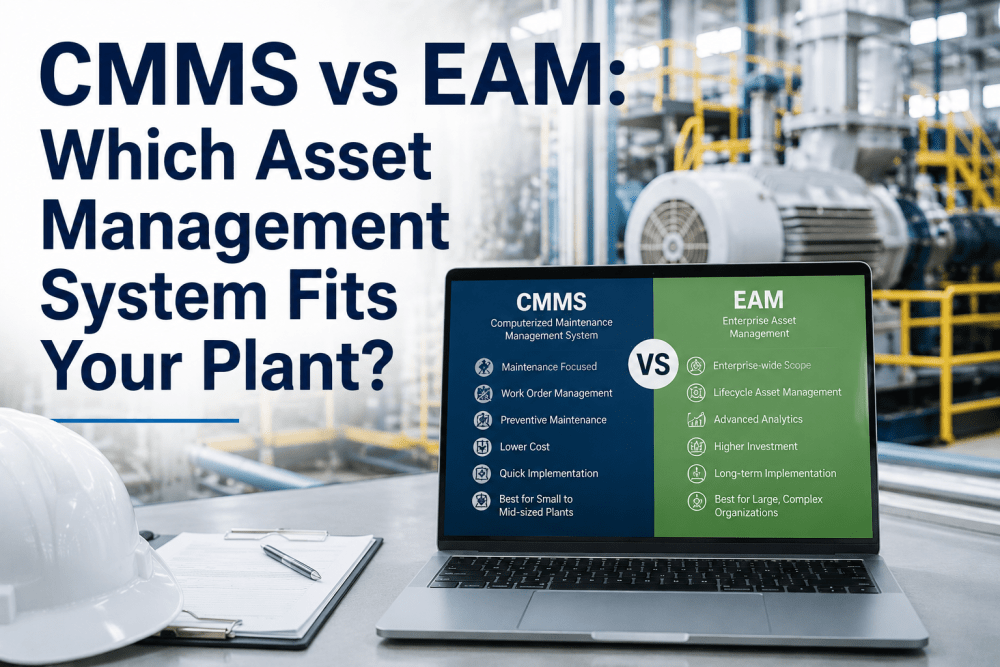
The simplest way to understand CMMS vs EAM is to frame the question each system answers. A CMMS answers: "What maintenance needs to happen, who's doing it, and has it been done?" An EAM answers a broader strategic question: "What do we own, what is it worth, what condition is it in, and when should we replace it?" CMMS is execution-focused — work orders, preventive maintenance schedules, spare parts, technician assignments. EAM extends this into capital procurement, depreciation, multi-site asset accounting, and deep ERP financial integration. Both are valid; only one is right for your plant.
- Primary user: Maintenance team, technicians, planners
- Scope: Work orders, PMs, spare parts, downtime tracking
- Deployment: 4–12 weeks
- Annual cost (20 users): $12K–$40K
- Best for: 1–5 site plants, mid-size manufacturers
- Primary user: Maintenance + finance + procurement + operations
- Scope: Everything in CMMS + CapEx, depreciation, ERP integration
- Deployment: 6–18 months
- Annual cost (20 users): $80K–$150K+
- Best for: Multi-site enterprises, regulated industries
Feature-by-Feature Comparison
The historical gap between CMMS and EAM has narrowed significantly. Modern cloud CMMS platforms — including iFactory — now deliver many capabilities that previously required an enterprise EAM deployment, including predictive maintenance, OEE analytics, multi-site portfolio reporting, and ERP integration. Here is how the two categories compare across the capabilities that matter most to U.S. manufacturing operations.
| Capability | CMMS | EAM | Notes |
|---|---|---|---|
| Work Order Management | Full | Full | Both systems handle the maintenance work order lifecycle |
| Preventive Maintenance Scheduling | Full | Full | Time-based and meter-based scheduling in both |
| Spare Parts & Inventory | Full | Full | EAM extends to procurement workflow integration |
| Predictive Maintenance (IoT) | Modern only | Full | Modern CMMS platforms now match EAM capability |
| Asset Depreciation & Financial Tracking | Limited | Full | EAM strength — capital asset accounting |
| CapEx Planning & Procurement | Basic | Full | EAM provides multi-year capital forecasting |
| ERP Integration (SAP, Oracle) | API-based | Native | EAM offers deeper bidirectional financial sync |
| Multi-Site Portfolio Reporting | Modern only | Full | Cloud-native CMMS now supports multi-site |
| Regulatory Compliance Audit Trails | Standard | Enterprise | EAM stronger for FDA, EPA, OSHA-heavy industries |
| Mobile Technician App | Full | Variable | CMMS typically leads in mobile experience |
| Deployment Speed | 4–12 weeks | 6–18 months | Major CMMS advantage |
Cost & Total Ownership: The Numbers That Matter
Cost is the dimension where CMMS vs EAM diverges most dramatically. A cloud CMMS for a 20-person maintenance team typically costs $12,000 to $40,000 per year all-in. An enterprise EAM deployment for the same team — including licensing, implementation consulting, custom integration, and ongoing support — can cost $80,000 to $150,000 per year, with first-year deployment costs frequently exceeding $250,000. For 78% of mid-size U.S. manufacturing plants, EAM cost is not justified by incremental capability gain over a modern CMMS.
The 5-Question Decision Framework
The CMMS vs EAM choice is not about which system is "better" — both are valid for the right operation. It comes down to honest answers to five questions about scope, scale, and strategic intent. Run through this framework before any vendor demo. Book a demo to walk through the framework with an iFactory specialist applying it to your plant.
Real-World Use Cases: Where Each System Wins
A Tier-2 automotive supplier with 400 assets across one Michigan facility deployed a modern CMMS in 9 weeks. Within 6 months: unplanned downtime reduced 31%, mean time to repair (MTTR) cut by 24%, and PM completion rate moved from 62% to 94%. Total first-year cost: $28K. An EAM evaluation projected $215K first-year cost with 14-month deployment — capability difference was not material.
A regulated pharmaceutical company managing FDA-validated equipment across 8 global plants required SAP-native integration, validated change control, multi-currency CapEx forecasting, and consolidated regulatory audit trails across all sites. EAM was the correct choice — implementation took 16 months at $1.8M, with annual operating cost of $340K, but delivered the enterprise-grade integration their finance and regulatory teams required.
A mid-size U.S. food processor with 2 production lines and refrigeration assets across 2 sites adopted a cloud CMMS with IoT vibration sensors. Result: 38% reduction in unplanned downtime, $310K annual savings on emergency repairs, and full FSMA compliance reporting — all at $34K annual software cost.
A regional U.S. power utility managing thousands of high-value transmission and distribution assets across a multi-state service territory chose EAM. The system handles asset lifecycle, condition-based monitoring, GIS integration, regulatory reporting (NERC, FERC), and capital planning over a 20-year horizon — none of which a CMMS can provide at the required depth.
The Hybrid Reality: How Modern CMMS Closes the EAM Gap
The traditional clean line between CMMS and EAM has blurred significantly. Modern cloud-native CMMS platforms now deliver capabilities that historically defined EAM — predictive maintenance powered by IoT, real-time OEE analytics, multi-site portfolio dashboards, mobile-first technician experiences, and API-based ERP integration. iFactory AI's CMMS platform delivers this hybrid capability stack — combining the deployment speed and cost profile of a CMMS with the analytical depth and integration breadth that previously required an EAM. For the 78% of mid-size U.S. manufacturers who don't need full asset accounting or 18-month implementations, this hybrid model is the right answer.
Expert Review: Insights from U.S. Maintenance Leaders
Across hundreds of U.S. plant deployments, the same patterns emerge from operations leaders evaluating CMMS vs EAM. Three insights consistently surface from maintenance directors, plant managers, and operations VPs who have lived through both selection processes:
The expert consensus: for U.S. manufacturing plants with fewer than 5 sites, asset bases under 5,000 units, and standard regulatory requirements, modern CMMS delivers the operational outcomes that matter — reduced downtime, improved PM compliance, lower MRO inventory — at 10–20% of EAM total cost of ownership. EAM remains the correct choice for enterprise scale, deep financial integration, and heavily regulated multi-site portfolios.
Conclusion: Pick the System That Matches Your Operation
The CMMS vs EAM decision is not about prestige or feature completeness — it's about operational fit. A CMMS that gets deployed in 8 weeks and runs reliably for 10 years delivers exponentially more value than an EAM that drags through an 18-month implementation, exceeds budget by 40%, and underperforms on adoption. For the majority of U.S. manufacturing plants — 1 to 5 sites, mid-size asset bases, standard compliance requirements, finite implementation capacity — a modern cloud CMMS like iFactory AI is the right answer. EAM remains valid only when enterprise scale, deep ERP financial integration, and regulated-industry audit depth justify the cost and complexity. Match the tool to the operation — not the other way around. Book a demo with iFactory to validate the right path for your plant.
FAQ: CMMS vs EAM for Manufacturing Plants
Get the Right Asset Management System for Your Plant — Without the 18-Month Implementation
iFactory AI delivers modern CMMS capability with predictive maintenance, multi-site reporting, and ERP integration — deployed in weeks, not years. Find out which path fits your operation.