
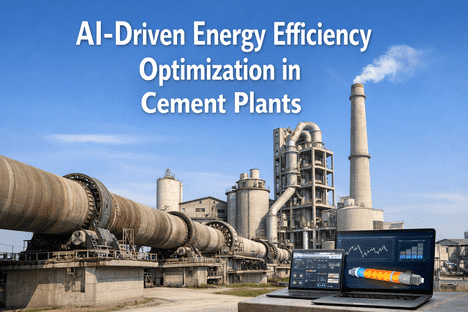
Energy represents 30-40% of cement production costs—₹450-650 per ton. The gap between efficient and inefficient plants is ₹200-250/ton, representing ₹80-100 crores annually for a 4 MTPA facility. This guide explains what drives your energy cost and how to reduce it by 8-15% (₹35-60/ton). Schedule energy assessment.
Understanding the KPI
Why This Matters
30-40% of total vs raw materials (25-30%)
₹400-850/ton range across plants
8-15% improvement achievable
Where Energy Is Consumed
Industry Benchmarks
Top 10% • 720-750 kcal/kg • 45-52 kWh/ton • WHR operational • 15-25% AFR
Middle 50% • 780-820 kcal/kg • 55-65 kWh/ton • Some WHR • 5-12% AFR
Bottom 25% • 850-950 kcal/kg • 70-85 kWh/ton • No WHR • <5% AFR
Want to know where your plant stands? We'll benchmark your energy cost per ton against industry standards and quantify your savings opportunity. Request benchmarking analysis
8 Factors Affecting Energy Cost
Kiln Thermal Efficiency
Impact: ±₹80-120/tonHeat to convert raw meal to clinker. Range: 720-950 kcal/kg. Driven by kiln design, refractory, false air, coating.
Grinding Efficiency
Impact: ±₹40-60/tonPower per ton ground. Range: 32-85 kWh/ton. VRM (32-38) vs old ball mills (70-85). Mill type matters most.
Waste Heat Recovery (WHR)
Impact: ±₹30-50/tonPower from kiln exhaust. Range: 0-22 kWh/ton. Reduces grid power purchases. WHR operational = big savings.
Alternative Fuels (AFR)
Impact: ±₹50-80/tonWaste fuels vs coal. Range: 0-30% TSR. 20-30% AFR usage significantly reduces fuel cost.
Process Variability
Impact: ±₹25-40/tonOperation consistency. High variability = inefficiency. Stable feed rates, temperatures = better energy use.
Equipment Condition
Impact: ±₹30-50/tonAge and maintenance. Worn liners +10-15% power. Degraded refractory +5-8% thermal. Regular maintenance pays.
Production Mix
Impact: ±₹20-35/tonCement type. OPC (95% clinker) = high energy. PPC (65-75%) or PSC (35-45%) = lower energy needs.
Energy Prices
Impact: ±₹60-100/tonCoal (₹3,500-5,500/ton) and power (₹5-8/kWh) prices. External but manageable through sourcing strategy.
How to Reduce Energy Cost
Quick Wins
- Process Stabilization: Reduce variability → 2-3% thermal improvement = ₹6-10/ton
- False Air Elimination: Seal leaks → 15-20 kcal/kg reduction = ₹4-6/ton
- Grinding Aids Optimization: Better chemical dosage → 3-5% power reduction = ₹3-5/ton
- Clinker Factor Reduction: More blending (25% → 32%) = ₹8-12/ton
Medium-Term Projects
- Real-Time Energy Analytics: AI optimization → 5-8% overall reduction = ₹25-40/ton
- VFD on Fans: Variable speed drives → 15-25% fan power cut = ₹4-7/ton
- High-Efficiency Separator: Modern separator → 8-12% mill power cut = ₹8-12/ton
Long-Term Investments
- WHR System: Generate 18-22 kWh/ton from exhaust → offset grid power = ₹90-140/ton
- VRM Conversion: Ball mill → VRM (70 → 35 kWh/ton) → 50% grinding power cut
Not sure which strategies apply to your plant? We'll assess your equipment, technology, and operational maturity to prioritize optimization projects with fastest payback. Get personalized roadmap
Energy Analytics: 5-8% Savings
Real-time analytics deliver 5-8% energy savings by detecting inefficiencies within minutes and enabling immediate corrections.
Track energy/ton hourly. Detect deviations immediately vs 3 days later.
AI identifies unusual patterns—mill power spike, excess O₂, WHR underperforming.
AI suggests: "Reduce kiln speed 3.5 → 3.3 RPM" or "Increase separator speed."
Compare today vs yesterday vs best-ever. Track progress toward targets.
Want to see analytics in action? We can deploy a pilot on one of your kilns to demonstrate real-time tracking with your own data before full deployment. Request pilot demo
Real Results
Shree Cement — Beawar
3.5 MTPA • RajasthanActions: Real-time analytics + AI kiln optimization + VFDs + high-efficiency separator + process stabilization
Dalmia Cement — Ariyalur
2.8 MTPA • Tamil NaduActions: Quick wins focus (false air, stabilization) + grinding aids + AFR increase (5% → 15%) + analytics
Key Takeaways
Energy = 30-40% of Cost: ₹450-650/ton typical. The #1 KPI to optimize for profitability.
₹200-250/ton Gap: Best-in-class vs poor performers. ₹80-100 Cr opportunity for 4 MTPA plant.
60-65% is Kiln Thermal: ₹280-350/ton in coal. Biggest lever for savings (₹80-120/ton potential).
8 Key Factors: Kiln efficiency, grinding, WHR, AFR, variability, equipment, mix, prices.
Three-Tier Optimization: Quick wins (₹21-33/ton), medium-term (₹37-59/ton), long-term (₹125-190/ton).
Analytics = 5-8% Savings: Real-time monitoring + AI = ₹25-40/ton with 6-9 month payback.
Reduce Your Energy Cost per Ton
Get a free energy assessment—we'll benchmark your cost, identify top 5 opportunities, and build a savings roadmap with ROI timelines.


.jpeg)