Foreign object contamination remains one of the most critical food safety risks in modern food manufacturing. Metal fragments, glass, plastic, stones, and packaging debris can trigger costly recalls, regulatory penalties, and lasting consumer trust damage. In 2025, foreign material was the #1 cause of USDA food recalls — responsible for 13 out of 42 total recalls, affecting over 71 million pounds of product. A single recall can cost a global food brand an estimated $10 million in direct expenses, not counting brand damage and lost retail partnerships. For U.S. food processors, the question is no longer whether to invest in foreign object detection — it is which technology or combination of technologies delivers the strongest protection at each critical control point. iFactory AI Vision Camera platform is built to work alongside metal detectors and X-ray systems, adding a real-time intelligence layer that improves contamination detection, traceability and HACCP compliance. Book a demo to see how it integrates with your existing line.
Why Foreign Object Detection Demands a Strategic Technology Choice
No single detection technology catches every contaminant in every product type. Metal detectors, X-ray inspection systems, and AI vision cameras each operate on fundamentally different physics — and each has specific strengths and blind spots. Choosing the right technology is a HACCP hazard analysis decision, not a purchasing decision. Your contamination risk profile, product characteristics, packaging type, line speed, and regulatory obligations all shape the correct answer for your facility. The sections below break down each technology honestly, compare them head-to-head, and show where iFactory’s AI Vision platform extends detection capability beyond what traditional hardware alone can achieve.
Metal Detectors: The CCP Workhorse
Metal detectors are the most widely deployed foreign object detection technology in U.S. food manufacturing. They operate by generating an electromagnetic field that is disrupted when a conductive metal object passes through the aperture. This disruption triggers a reject signal, removing the contaminated product from the line. Metal detectors detect ferrous, non-ferrous, and stainless-steel contaminants — the three categories most commonly introduced through processing equipment failure. They are fast, relatively affordable at $15,000–$45,000 for a typical installation, and straightforward to integrate at multiple CCP positions. However, performance is limited by product effect: wet, salty, or high-moisture products generate their own electromagnetic signal that can mask small metal fragments or cause false rejects. Metal detectors also cannot reliably detect glass, bone, stone, or dense plastics — and they are incompatible with metalized film packaging due to signal interference.
X-Ray Inspection Systems: Broader Coverage, Higher Investment
X-ray inspection works on density differences rather than conductivity. When product passes through the X-ray beam, denser objects attenuate the beam more strongly and appear as dark anomalies in the image. This principle allows X-ray systems to detect a far wider range of contaminants than metal detectors — including glass fragments, bone, stone, dense rubber, hard plastic, and calcified tissue in meat products. X-ray systems can also perform secondary functions such as fill-level checks, packaging verification, weight estimation, and product completeness inspection, delivering value beyond contamination control. Detection sensitivity can reach 0.8mm for metal and 2.0mm for glass in most food matrices with advanced side-beam configurations. Capital costs are significantly higher at $80,000–$250,000, and installation requires radiation shielding and regulatory registration. Performance is affected by product density and thickness — thicker products require higher X-ray energy, which reduces contrast sensitivity. Metalized packaging also reduces X-ray penetration and requires alternative inspection configurations. X-ray systems support compliance with GFSI-recognized schemes including BRC Global Standard and SQF 2000 Code, and align with EU Regulation 2017/625 requirements for documented foreign object control with traceability.
- Metal, glass, stone, bone
- Dense plastics and rubber
- Calcified tissue in meat
- Product defects & fill level
- Soft materials (wood, foam)
- Low-density plastics
- Surface-only visual defects
- Higher capital & shielding cost
- Density/thickness affects sensitivity
- Metalized packaging challenges
AI Vision Inspection: Surface Intelligence and Adaptive Detection
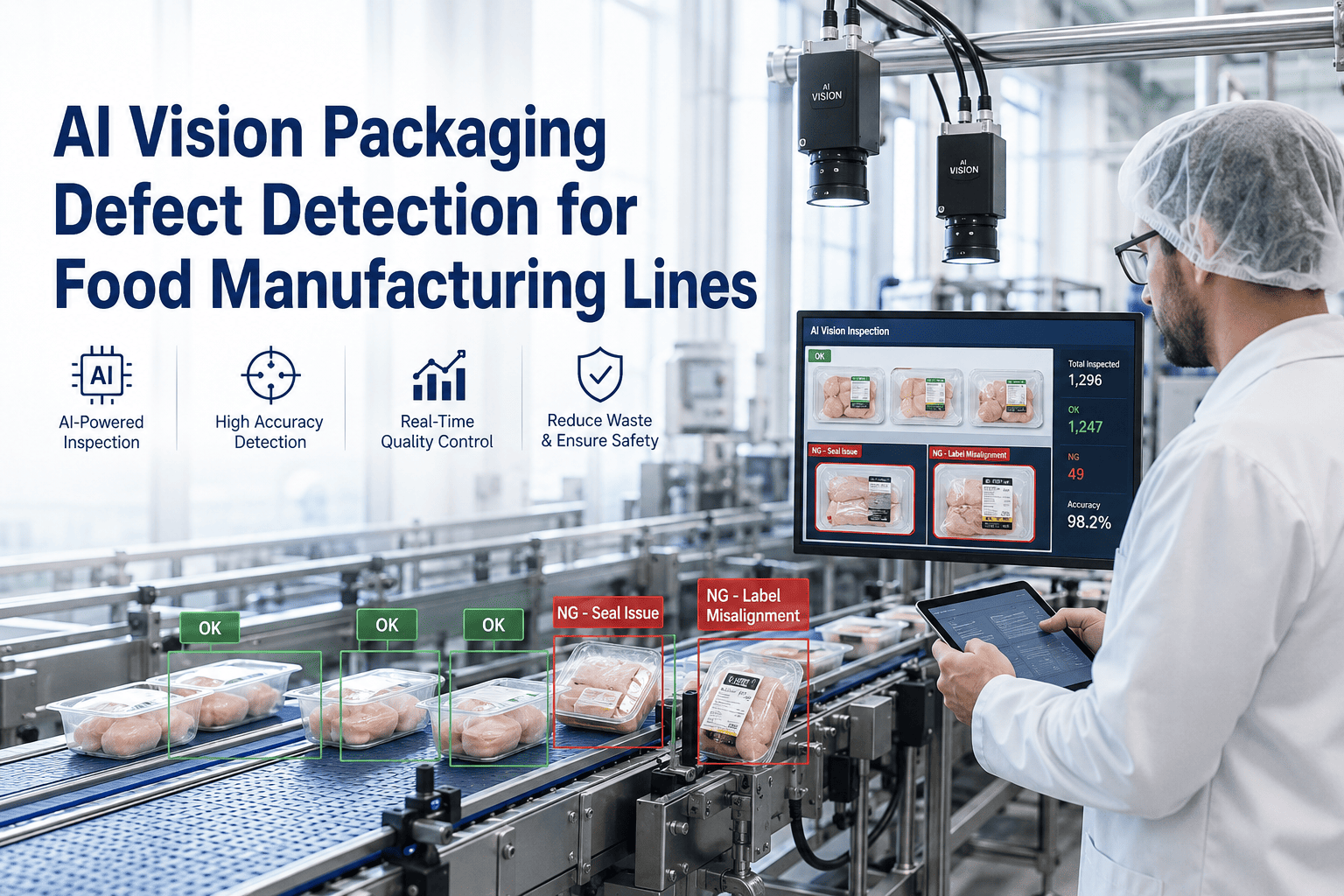
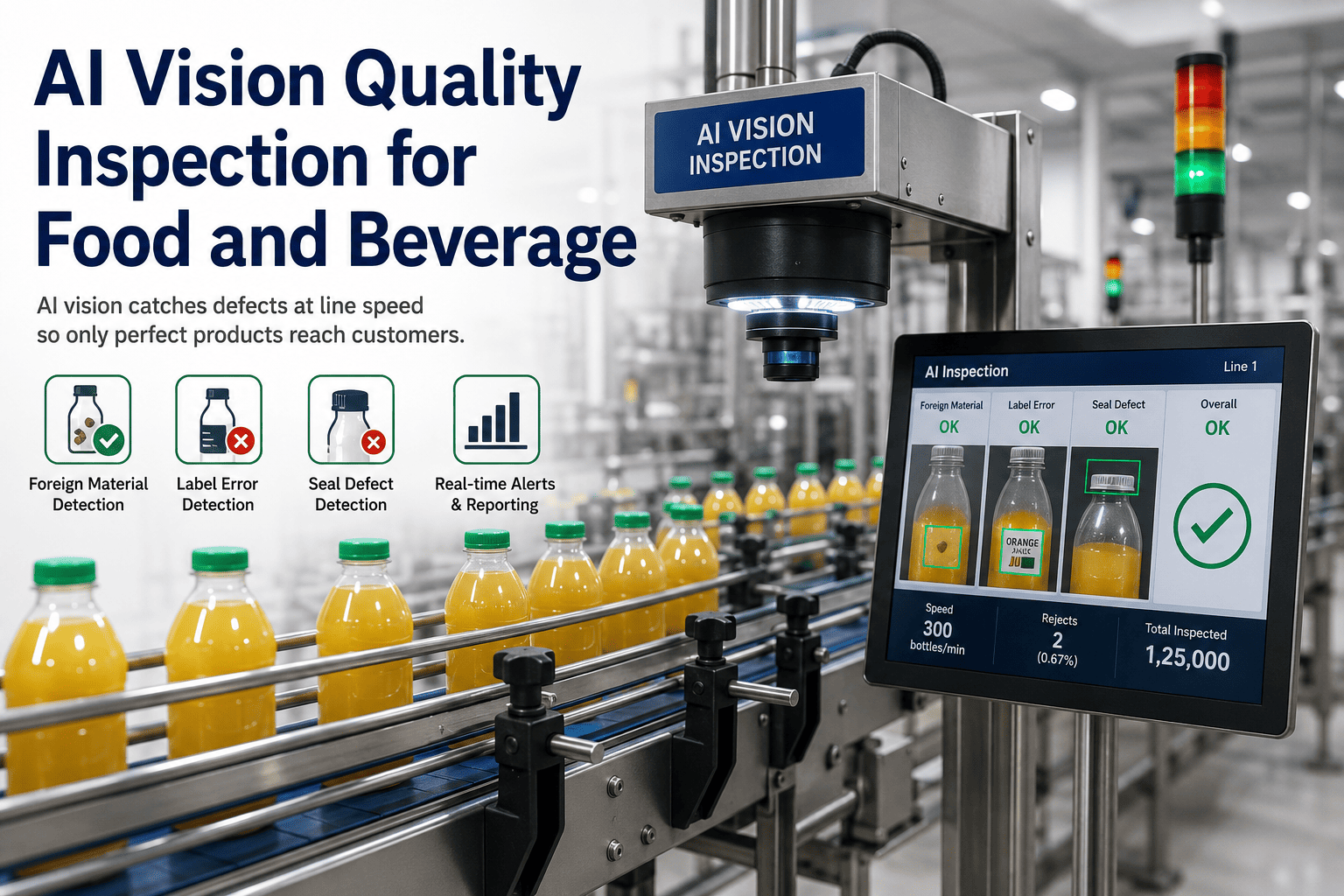
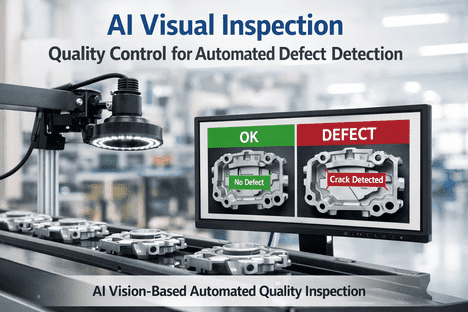
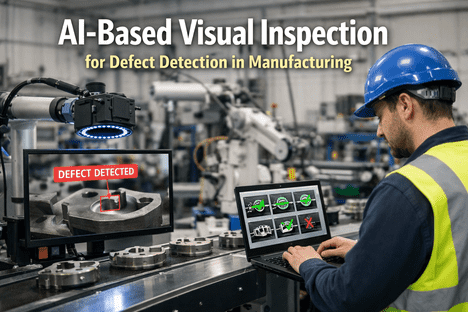
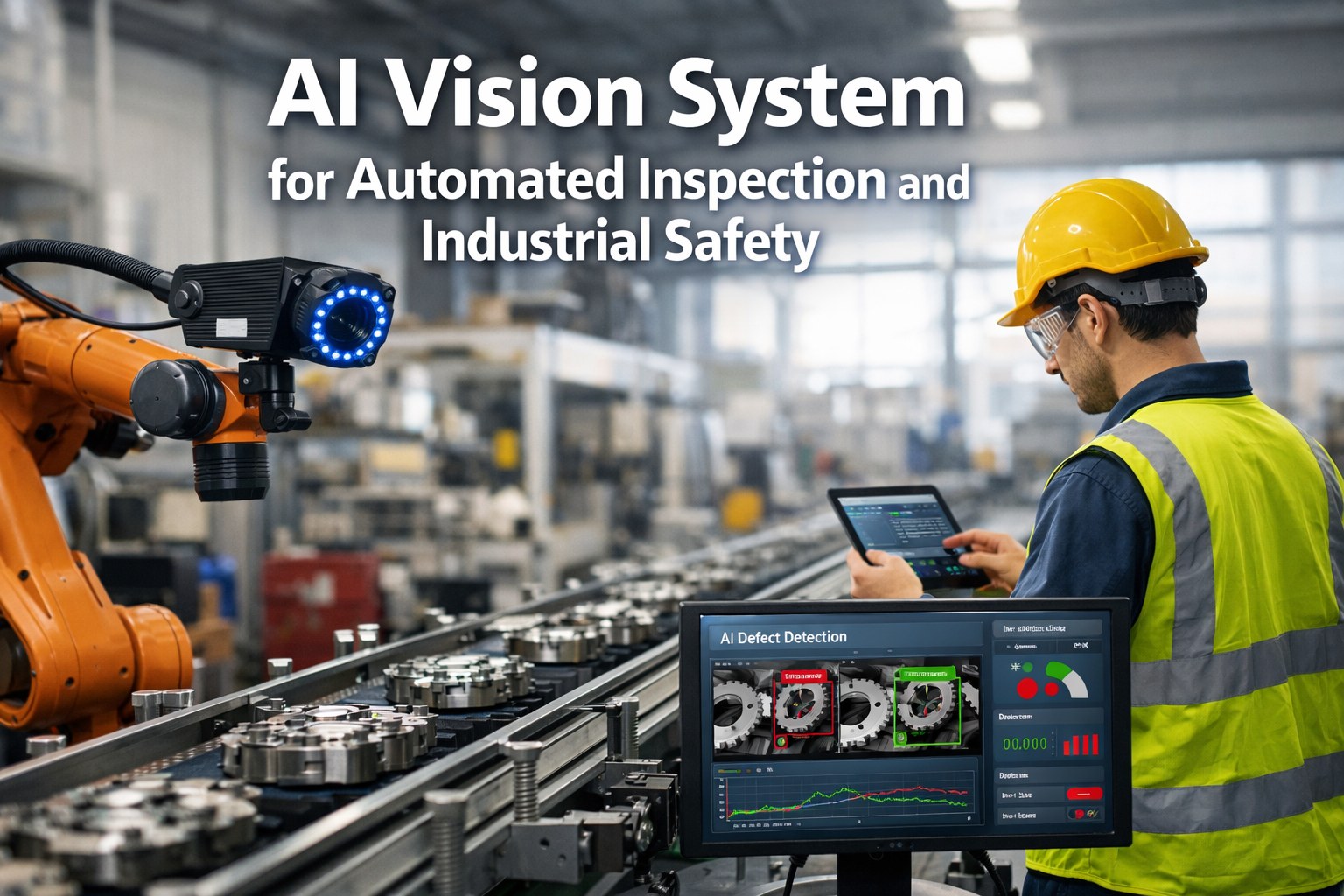
AI vision systems use high-resolution cameras combined with machine learning models trained on thousands of product images to identify visual defects, surface contamination, packaging anomalies, and foreign objects visible on the product or line surface. Unlike metal detectors that rely on fixed conductivity thresholds or X-ray systems constrained by density physics, AI vision learns the specific appearance of your product and flags deviations that no pre-programmed rule could anticipate. The detection system improves over time, adapts to product variants, and identifies contamination categories that did not exist when legacy inspection equipment was installed. AI vision also detects soft foreign materials — wood, paper, foam, rubber, and clear plastic fragments — that X-ray systems routinely miss. iFactory’s AI Vision Camera platform is designed specifically for industrial food lines, integrating with your existing CCP framework and delivering real-time rejection events, batch-level traceability, and audit-ready logs linked directly to your HACCP records. Book a demo to see detection accuracy on your product type.
- Wood, foam, rubber, paper
- Clear & low-density plastics
- Surface visual defects
- Packaging anomalies & label errors
- Embedded internal contaminants
- Objects inside opaque packaging
- Density-based defects (fill level)
- Learns & improves over time
- No product effect sensitivity
- Real-time traceability logs
- Adapts to new product variants
Head-to-Head Comparison: Metal Detector vs X-Ray vs AI Vision
The table below summarizes the practical differences across the three core detection technologies for U.S. food processing operations. Use it as a starting framework for your HACCP hazard analysis — then validate against your specific product, packaging, and contamination risk profile.
| Criteria | Metal Detector | X-Ray System | AI Vision (iFactory) |
|---|---|---|---|
| Ferrous & non-ferrous metal | Excellent | Excellent | Surface only |
| Glass & ceramic | Not detected | Good (≥2.0mm) | Surface only |
| Bone & stone | Not detected | Good | Surface only |
| Wood, foam, rubber (soft) | Not detected | Typically missed | Excellent |
| Dense & hard plastic | Not detected | Partial | Good (surface) |
| Clear & low-density plastic | Not detected | Not detected | Excellent |
| Packaging verification | No | Partial | Full |
| Fill level & product defect | No | Yes | Yes (visual) |
| Wet / salty product effect | High impact | Low impact | Not affected |
| Metalized packaging | Incompatible | Reduced sensitivity | Not affected |
| Typical capital cost | $15K–$45K | $80K–$250K | Scalable |
| HACCP CCP documentation | Standard | Standard + GFSI | Real-time audit log |
| Improves over time | No | No | Yes — ML retraining |
HACCP Alignment and Regulatory Compliance
For U.S. food manufacturers, foreign object detection programs must satisfy HACCP hazard analysis requirements, FDA/USDA physical contamination control expectations, and increasingly stringent retailer codes from programs like Walmart, Kroger, and Costco. On the regulatory front, industry best practice targets sensitivity of 1.5–2.5mm for metal detection and 3.0–4.0mm for glass detection at CCPs. BRCGS and SQF auditors expect documented sensitivity test records, calibration verification at each shift, rejection event logs, and evidence that reject mechanisms have been tested and are functioning. The EU Regulation 2017/625 requires documented foreign object control with traceability for any products entering European markets. Below is the standard HACCP integration workflow that iFactory supports across all three detection layers.
Building a Layered Detection Strategy: How iFactory AI Vision Extends Your Existing Program
The most robust food safety programs combine multiple detection technologies — no single system can catch every possible contaminant across every product type. The practical recommendation for U.S. food processors is to start with a HACCP-driven hazard analysis, identify the contaminant categories your current hardware cannot detect, and fill those gaps with AI vision at the right CCP positions. iFactory’s AI Vision Camera platform is designed as an additive layer above existing metal detector and X-ray installations. It does not replace your certified inspection hardware — it extends coverage to the surface contamination categories and soft material classes that density-based and conductivity-based systems miss. Every detection event is logged automatically in iFactory’s manufacturing platform, linked to the batch record, calibration history, and operator response — creating the audit trail that BRCGS, SQF, and retailer food safety auditors demand.
Conclusion: Match Detection Technology to Your Contamination Risk Profile
Foreign object contamination is not a single-variable problem, and no single detection technology is a complete solution. Metal detectors deliver cost-effective, high-speed metal contamination control and belong at every facility handling raw materials or unpackaged product. X-ray systems extend coverage to glass, bone, stone, and dense plastics, and are essential for any operation targeting BRC, SQF, or retail compliance at final product CCPs. AI vision closes the gaps both leave open — detecting soft materials, surface contamination, and packaging anomalies that density-based and conductivity-based systems fundamentally cannot see, while improving detection accuracy over time through machine learning. The most effective food safety programs layer all three technologies based on a rigorous HACCP hazard analysis, backed by unified documentation, calibration management, and audit-ready traceability. iFactory’s AI Vision Camera platform and manufacturing intelligence suite are built to be that unifying layer — integrating above your existing inspection hardware to deliver the complete, documented contamination control program that modern food safety standards demand.