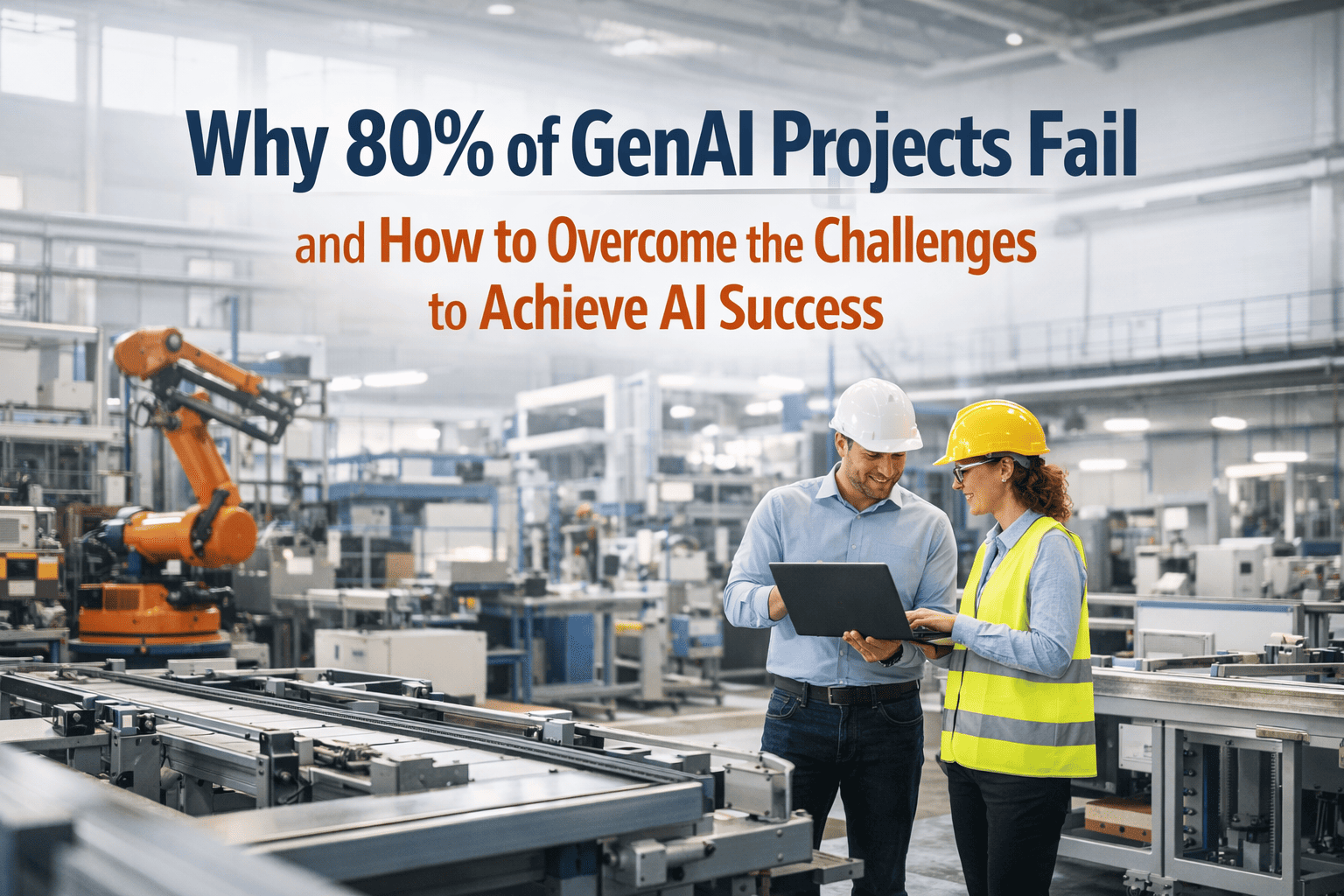
The numbers are brutal: 80% of AI projects fail to deliver business value. RAND Corporation, MIT, Gartner — they all confirm it. Of the $684 billion invested in AI initiatives globally in 2025, over $547 billion delivered zero meaningful return. In manufacturing specifically, the failure rate sits at 76.4%. But here's what nobody talks about: the failures are predictable — and the fixes are known. The 5% who succeed share consistent patterns that any plant manager or CTO can replicate. This guide breaks down exactly why GenAI projects die after proof-of-concept, the 3-phase roadmap that takes you from pilot to production, and how iFactory's AI-native platform is engineered to avoid every single failure mode. Book a free consultation to map this to your plant.
AI-Native Digital Transformation for Smart Manufacturing
Join iFactory's expert-led session covering edge AI deployment, UNS architecture, sovereign data strategy, and the 90-day pilot methodology — with live architecture review and open Q&A for your specific plant challenges.
Register Now — Free Session →The Anatomy of GenAI Failure: 5 Reasons Projects Die After POC
Gartner analyzed hundreds of GenAI implementations and identified the exact failure modes. These aren't random — they're systemic, and they compound on each other. Here's why your GenAI pilot worked in the demo room but collapsed in production.
No Clear Business Value Defined
Organizations chase flashy demos instead of measurable outcomes. Without pre-defined success metrics, projects can't justify continued investment. 73% of failed projects lacked clear metrics from the start.
Poor Data Quality & No AI-Ready Foundation
GenAI is only as good as the data it's trained on. 43% of organizations cite data quality as the top obstacle. Messy, siloed, ungoverned data produces unreliable outputs and broken RAG implementations.
Escalating Costs Without Visibility
That negligible per-token cost becomes a budget nightmare at scale. Projects viable in POC become budget black holes in production. Organizations lack visibility into how costs scale across thousands of users.
No Governance or Risk Controls
Only 21% of organizations deploying AI agents have mature governance models. GenAI introduces new risks — hallucinations, bias, regulatory violations — that weren't present in traditional automation.
Change Management Treated as Afterthought
Even technically excellent tools see minimal adoption without change management. Usage drops, employees feel threatened, and the organization captures a fraction of potential value. Workforce readiness is the #1 barrier.
The Success Pattern: What the 5% Do Differently
The organizations that succeed don't spend less — they spend smarter. Research shows 47% of their budget goes to foundations (data, governance, change management) versus just 18% in failed projects.
iFactory's 3-Phase Roadmap: Pilot to Production
The critical distinction in 2026: design your pilot as a production rehearsal, not a proof of concept. iFactory's 3-phase roadmap ensures every step builds toward production-scale deployment — no pilot purgatory.
Foundation & ROI Mapping
Define success before building anything. iFactory maps your highest-ROI use cases, audits data readiness, and designs the Unified Namespace architecture — so the pilot is already a production rehearsal.
Controlled Deployment & Validation
Deploy on 5-10 critical machines with production-grade infrastructure — not demo-grade. iFactory instruments everything from Day 1: usage, savings, error rates, and business impact.
Scale to Production & Enterprise ROI
Expand across production lines with proven ROI. Connect MES/ERP to the UNS, deploy additional AI agents, and deliver the board-ready business case with documented financial impact.
Expert Perspective: The Industry Verdict
The organizations stuck in pilot purgatory designed experiments. The organizations in production designed deployments.
Agentic AI adoption in manufacturing will more than double — from 6% to 24% — as manufacturers move from pilots to production.
Don't pave the cow path. Take advantage of this AI evolution to reimagine how agents can best collaborate and optimize operations.
The 80% failure rate isn't a technology problem — it's an architecture and approach problem. iFactory is built to solve exactly this: production-grade AI infrastructure from Day 1, AI-ready data foundation via Unified Namespace, embedded governance, and a 90-day path from pilot to measurable ROI. The 5% who succeed aren't luckier. They're better architected.
Join the 5% Who Succeed
iFactory takes you from GenAI pilot to production-scale deployment in 90 days — with proven ROI at every phase. No pilot purgatory. No wasted millions.
Frequently Asked Questions
The Cost of Doing Nothing Is $547 Billion in Wasted Investment
That's the global total. Your share of wasted AI spending is whatever you've invested without production-grade architecture. Let iFactory change that math.




.jpeg)
