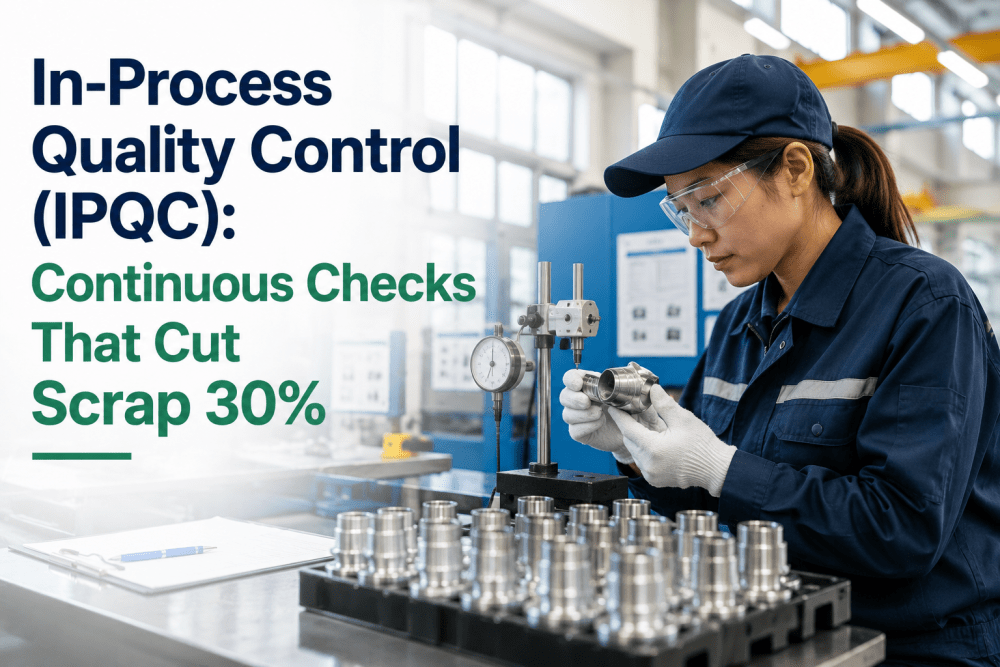
End-of-line inspection finds problems too late. By the time a defect is caught at final QC, the part has already absorbed labor, energy, materials, and machine time—and if that defect propagated upstream, an entire batch may need rework or scrap. In-Process Quality Control (IPQC) flips that economics by inspecting while production runs, catching deviations at the point of creation rather than at the loading dock. U.S. manufacturers adopting real-time IPQC with AI-driven monitoring routinely report scrap reductions of 25–40%, first-pass yield gains and dramatically faster batch release cycles. This article breaks down how IPQC works, where it pays off, and how to deploy it without slowing your line.
Cut Scrap by 30%.
Catch Defects at the Source.
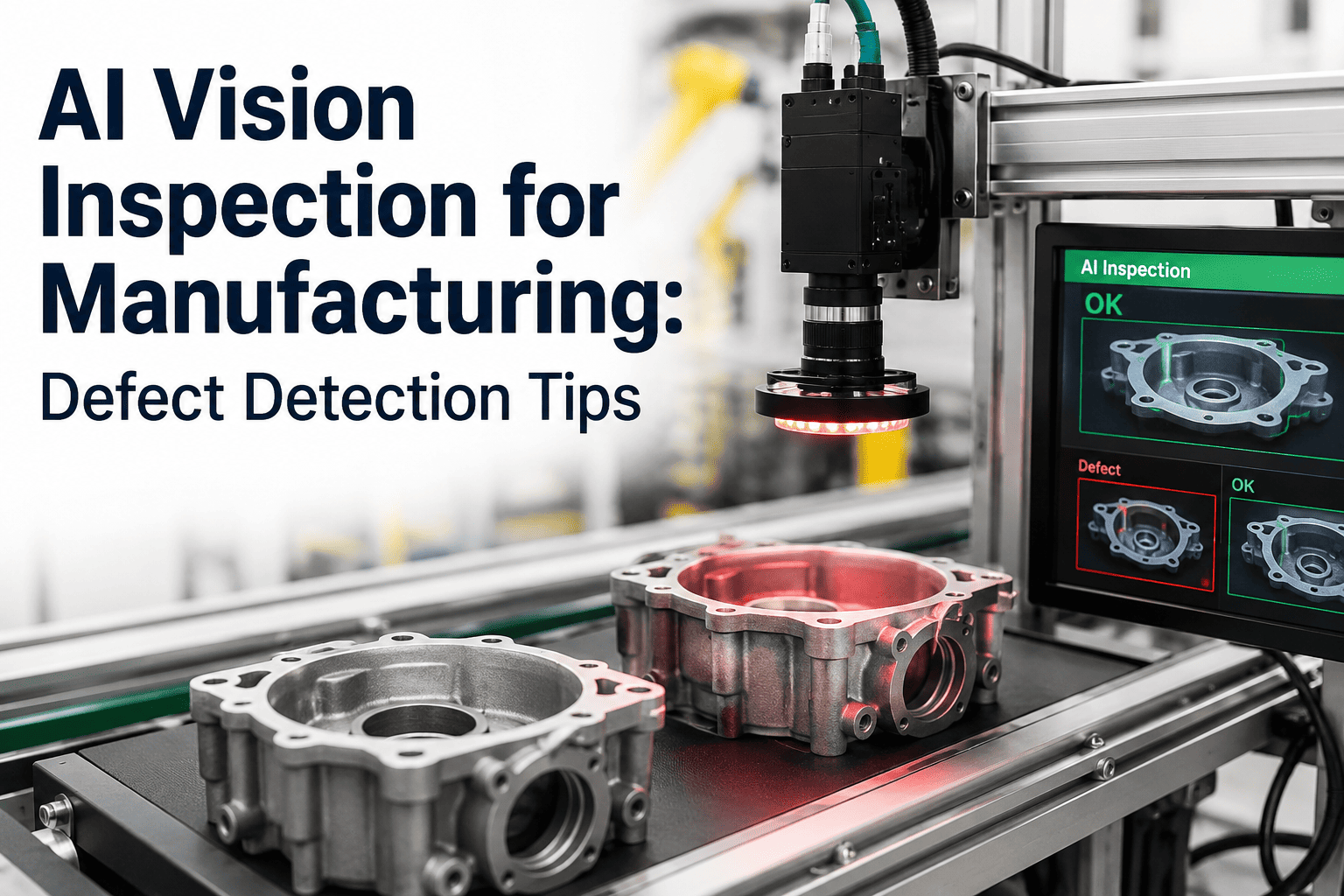
In-Process Quality Control combines real-time sampling, statistical process control, and AI vision inspection to stop defects before they multiply downstream.
What Is In-Process Quality Control (IPQC)?
In-Process Quality Control is the practice of monitoring product quality at multiple checkpoints during production rather than relying solely on incoming or final inspection. Instead of asking "is this finished part acceptable?", IPQC asks "is this process still in control?"—and corrects drift before it produces defective output. It sits between Incoming Quality Control (IQC) and Outgoing Quality Control (OQC), and it's where the highest leverage for reducing the cost of poor quality (COPQ) lives.
A mature IPQC system rests on three pillars: control point identification (using PFMEA to find the stages where quality attributes are most likely to deviate), real-time measurement (sensors, vision systems, gauges, and operator checks), and statistical decision logic (SPC charts that separate normal variation from out-of-control signals).
Control Point Identification
Map every production stage. Use PFMEA to pinpoint Critical Control Points (CCPs) where defects originate most often.
Real-Time Measurement
Connect sensors, vision cameras, torque tools, and gauges to capture dimensional, visual, and process data continuously.
Statistical Decision Logic
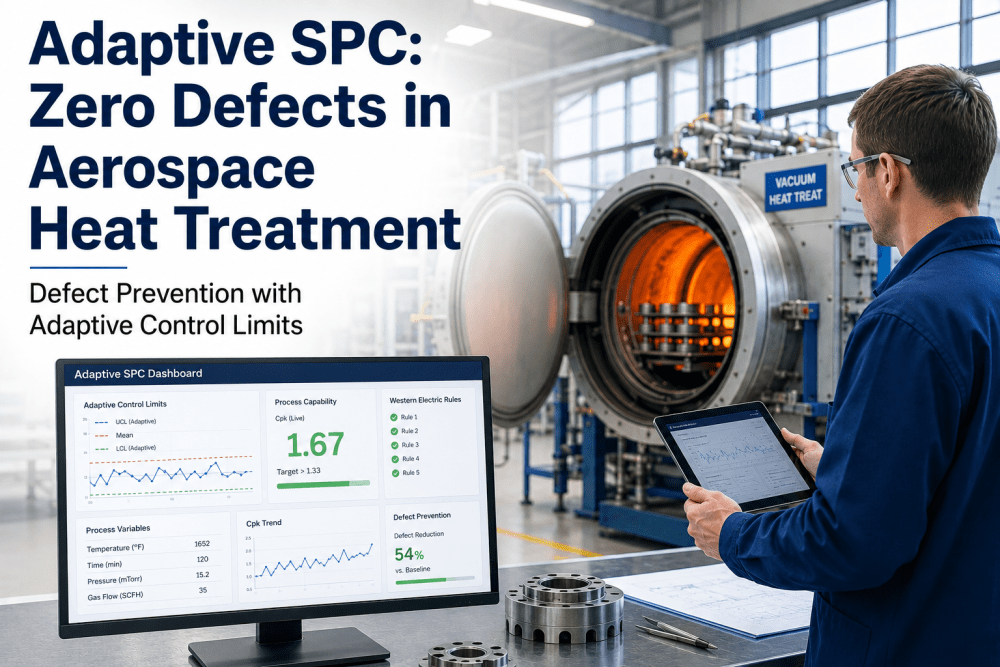
SPC charts, Cpk tracking, and Western Electric rules distinguish noise from real drift—and trigger action only when needed.
The Five Inspection Types Inside IPQC
IPQC isn't one inspection—it's a layered set of checks, each catching a different category of defect. Most U.S. plants combine four or five of the following:
| Inspection Type | When It Runs | What It Catches |
|---|---|---|
| First Article Inspection | Start of run / changeover | Setup errors, wrong tooling, programming mistakes |
| Patrol Inspection | At fixed intervals (e.g., every 30 min) | Process drift, tool wear, operator deviation |
| Self-Inspection | Continuous, by operator | Obvious visual or dimensional defects |
| AQL Sampling | Per batch or shift | Statistical out-of-spec lots |
| Last Article Inspection | End of run | Late-shift drift, end-of-run quality decay |
The trap with traditional AQL alone: a batch with a 2% defect rate will pass a 10-sample inspection about 82% of the time. That's why modern IPQC pairs sampling with continuous AI vision or SPC—so escaped defects become the exception, not the rule.
The IPQC Workflow: From Signal to Corrective Action
A working IPQC loop has to close fast. The longer a deviation runs uncorrected, the more scrap accumulates. Here's the closed-loop flow that modern plants run:
Measure
Sensors, vision systems, and operator checks capture quality data in real time. Each measurement is tagged to machine, operator, part, and timestamp.
Detect
SPC rules and AI models compare measurements to control limits. Western Electric rules flag drift before specs are violated.
Alert
Out-of-control signals route instantly to the operator, supervisor, and quality engineer via mobile or HMI—no waiting for shift reports.
Contain
Suspect material is automatically quarantined. The line either auto-stops or continues under tightened sampling until the root cause is found.
Correct
Operator adjusts the process; in advanced setups, closed-loop machine control auto-corrects feeds, speeds, or temperatures.
Verify & Learn
Re-sample confirms the fix. NCR/CAPA workflow feeds learnings back into the control plan to prevent recurrence.
What IPQC Actually Saves: The Numbers
The ROI of IPQC comes from three compounding effects—less scrap, less rework, and less downstream cost of escape. Manufacturers running mature IPQC programs report measurable gains across all three:
See what continuous IPQC could save on your top three defect codes. Book a Demo with an iFactory AI quality engineer for a walkthrough on your line data.
Manual IPQC vs. Digital, AI-Driven IPQC
Paper checklists and clipboard rounds are still common, but they suffer from three fatal flaws: data latency, inspector variability, and zero traceability under audit. Here's how the two approaches compare side-by-side:
- Paper checklists, manual log entries
- Sampling-only (5–15% of output)
- Defect discovered hours later at end-of-line
- 70–85% human visual detection accuracy
- Inter-inspector variability and standard drift
- Audit prep takes days to compile records
- Real-time data from PLCs, sensors, and vision cameras
- 100% inspection at full line speed
- Out-of-control alert fires in seconds
- 99.5%+ AI vision detection accuracy
- Immutable criteria—no inspector drift
- Any compliance report on demand in seconds
How iFactory AI Powers Continuous IPQC
iFactory AI's Quality Management Solution brings the full IPQC stack into one platform—built for U.S. manufacturers running discrete, process, or hybrid production. It connects to PLCs, gauges, and vision cameras out of the box and turns raw signal into actionable quality intelligence.
AI Vision Inspection
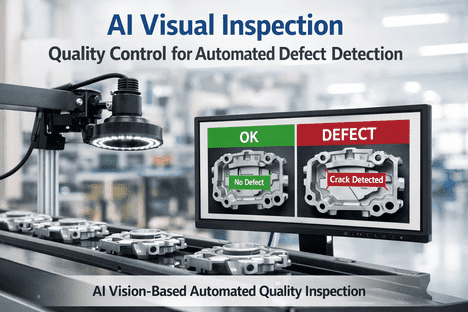
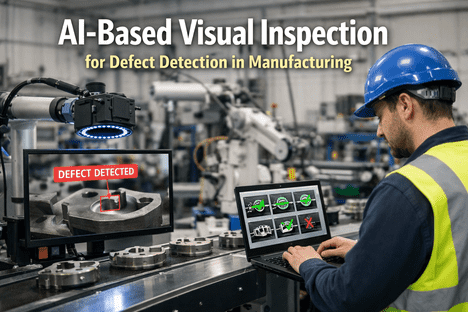
100% inspection at line speed with 99.5%+ accuracy. Catches surface defects, missing components, and dimensional drift that human inspectors miss.
Statistical Process Control
Live SPC charts (X-bar R, p-chart, c-chart) with Western Electric rule detection. Cpk and Ppk tracked per characteristic per line.
Digital First-Article & Patrol
Operators run inspections from tablets. Photos, measurements, and sign-offs are timestamped, traceable, and audit-ready.
Real-Time Alerts
Out-of-spec triggers push to mobile, HMI, and Andon boards. Escalation paths configurable by characteristic severity.
NCR / CAPA Workflow
Non-conformance reports auto-create from failed checks. CAPA tasks routed, tracked, and verified—closing the quality loop.
Full Traceability
Every inspection event linked to lot, machine, operator, raw material, and shift. Genealogy reports ready for FDA, IATF 16949, AS9100, or ISO 9001 audits.
Industries Where IPQC Pays Back Fastest
IPQC delivers value anywhere defects are expensive to find late—but a few sectors see ROI in months, not years:
Automotive
Torque verification, weld quality, paint defects, and dimensional checks on safety-critical components. IATF 16949 documentation built in.
Electronics & PCB
Solder joint inspection, component placement, and BGA verification—where a missed defect costs 10–50× more after PCB assembly.
Pharmaceuticals
Tablet weight, hardness, and friability under GMP. Real-time data supports CPV and right-first-time release per ICH Q9/Q10.
Food & Beverage
HACCP critical control point monitoring—temperature, pH, fill weight, allergen changeover verification.
Medical Devices
FDA 21 CFR Part 820 compliance, complete DHR traceability, and statistical evidence for design controls.
Metals & Machining
Tool wear detection, dimensional drift, and surface finish—where automated process control can cut scrap by 95%.
An IPQC Deployment Roadmap That Actually Works
Most failed IPQC rollouts share the same root cause: trying to instrument everything at once. The plants that hit 30% scrap reduction in year one follow a disciplined, phased rollout:
Pareto Your Defects
Pull 6–12 months of scrap and NCR data. The top three defect codes usually account for 60–80% of cost. That's where IPQC goes first.
Run PFMEA on Hot Lines
For each top defect, identify the upstream process step where it originates. That's your Critical Control Point.
Define the Control Plan
Document characteristic, spec, measurement method, frequency, reaction plan, and responsible role. Load it into the digital QMS.
Pilot on One Line
Deploy sensors, vision, or digital patrol on one line. Train operators. Validate alerts. Measure baseline vs. post-deployment scrap.
Scale and Tighten
Roll out to adjacent lines. Use accumulated IPQC data to tighten control limits, optimize sampling frequencies, and feed CAPA.
Common IPQC Mistakes (and How to Avoid Them)
Six recurring pitfalls show up in nearly every IPQC audit. None are technology problems—they're program-design problems.
Inspecting everything, prioritizing nothing
Use Pareto and PFMEA to focus on the few CCPs that matter. Inspection without prioritization just adds cost.
Tight specs, loose control limits
Control limits should be calculated from process data, not copied from drawing tolerances. Otherwise SPC fires false alarms or misses real drift.
No reaction plan
An out-of-control signal with no defined response is just noise. Every check needs a documented "if this, then do this."
Data stuck in clipboards
Paper records can't trend, can't trigger CAPA, and can't survive audit. Digitize at the point of measurement.
Treating sampling as sufficient
AQL alone leaves a statistical gap. Pair sampling with continuous sensor or vision data on the highest-risk characteristics.
Quality owns IPQC alone
If operators don't understand and own the control plan, IPQC becomes paperwork. Train, empower, and make data visible at the line.
Expert Review
"The single biggest unlock in any IPQC program isn't more inspection—it's tighter feedback loops. When a process drifts and the operator finds out four hours later from a scrap report, you've already lost. When the SPC chart on their HMI lights up at the second out-of-control point and tells them which adjustment to make, scrap drops 30% almost automatically. The technology has been here for years. What changed in 2026 is that AI vision and SPC are now affordable for mid-sized plants, not just Tier 1 automotive. There's no excuse to still be running paper IPQC."
Conclusion
In-Process Quality Control is no longer a "nice to have" for U.S. manufacturers competing on cost, compliance, and on-time delivery. Customers expect zero-defect deliveries, regulators expect documented evidence on demand, and margins won't tolerate the rework that traditional sampling-only QC produces. The shift from end-of-line inspection to continuous, AI-augmented IPQC is the single most impactful quality investment most plants can make this year.
The hard part isn't the technology—it's the discipline: Pareto your defects, run PFMEA, define real control plans, digitize the measurements, and empower operators with live data. Plants that do this consistently cut scrap by 25–40%, accelerate batch release, and pass audits without scrambling. iFactory AI provides the full digital stack to make that transformation a quarterly project, not a multi-year overhaul.
Frequently Asked Questions
What is the difference between IPQC, IQC, and OQC?
How much scrap reduction can IPQC realistically deliver?
Do I need to replace my existing equipment to deploy IPQC?
How does IPQC support regulatory audits (FDA, IATF, AS9100, ISO 9001)?
How long does it take to deploy IPQC with iFactory AI?
Ready to Stop Defects Before They Multiply?
iFactory AI brings AI vision, SPC, digital control plans, and audit-ready traceability into one platform—built for U.S. manufacturers serious about cutting scrap and accelerating quality decisions.