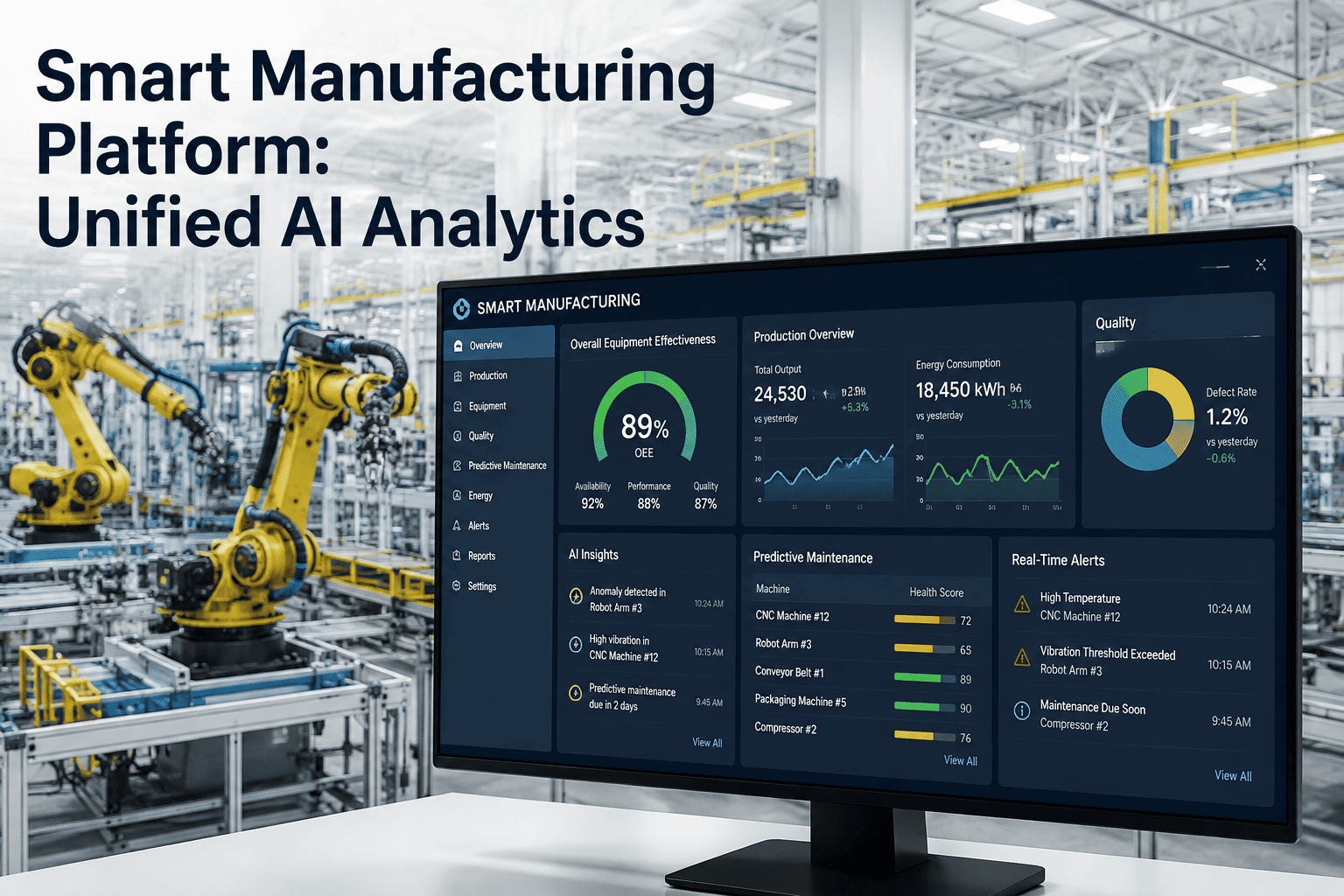
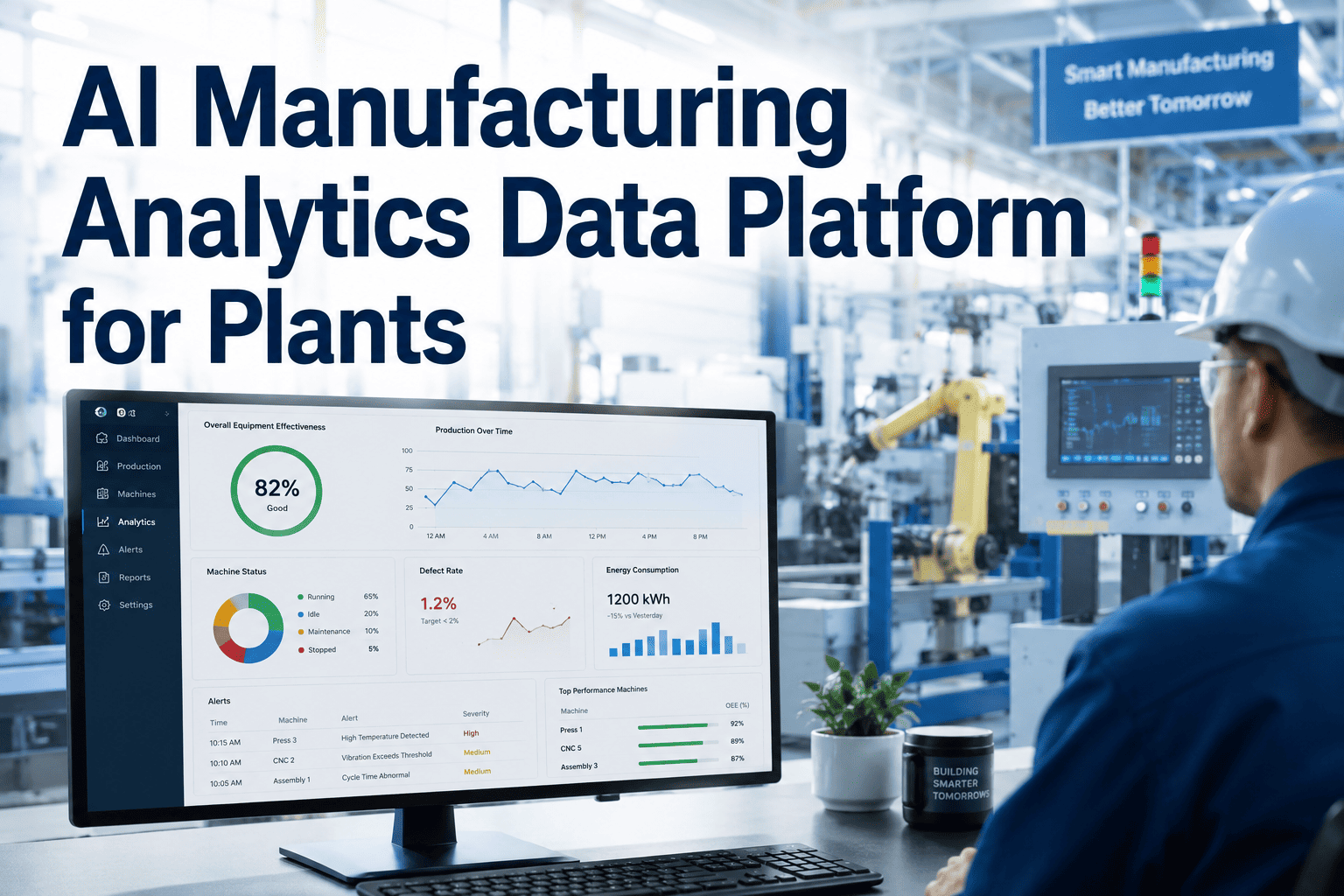
Every Monday morning, a plant manager opens a spreadsheet. Last week's production numbers. Last week's downtime. Last week's scrap rate. The data is accurate, well-formatted, and completely useless—because whatever went wrong already happened, and the line has already moved on. This is traditional reporting: a rearview mirror bolted to a factory that needs a windshield. Meanwhile, 63% of manufacturers now use analytics tools that show what's happening right nowpredict what's about to happen next, and recommend what to do about it. The manufacturing analytics market hit $13.6 billion in 2025 and is racing toward $78 billion by 2035 at 19% CAGR—because the factories that see problems in real time fix them. The ones that read about problems next Monday don't.
$13.6B
Analytics Market 2025
63%
Manufacturers Using Analytics
16-28%
Throughput Improvement
The Head-to-Head Comparison
Traditional reporting and modern analytics aren't just different tools—they represent fundamentally different approaches to running a factory. Here's how they stack up across every dimension that matters:
Days or weeks after events
Real-time, as events happen
Manual — operators type into spreadsheets
Automatic — sensors and systems feed data directly
"What happened" (descriptive only)
"What's happening + what's coming" (predictive)
After damage is done — reactive
Before failure occurs — proactive
Managers reviewing weekly PDFs
Everyone — operator to executive, role-based
More lines = more spreadsheets = more hours
Scales automatically across lines & plants
Error-prone — transcription, copy-paste, formula breaks
Machine-accurate — direct from source systems
Still running on spreadsheets and weekly reports? Book a free analytics assessment and see what real-time visibility looks like for your plant. Or sign up for iFactory to start today.
The 4 Levels of Manufacturing Intelligence
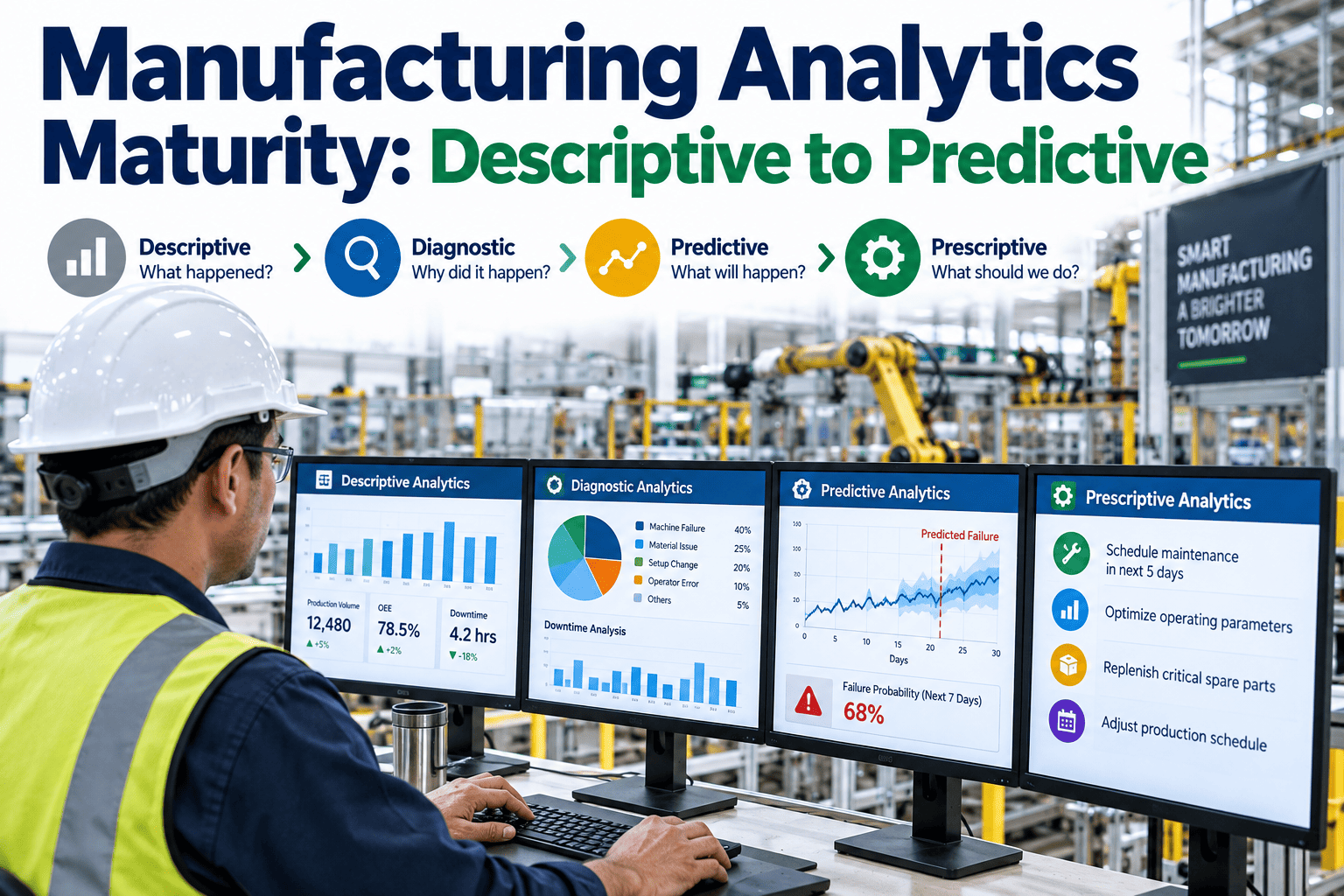
Most factories are stuck at Level 1. The ones pulling ahead are operating at Levels 3 and 4. Here's the progression from data-blind to data-driven:
Level 1
Descriptive
"What happened?"
Weekly/monthly reports, static charts, historical summaries. Most manufacturers live here—reviewing data long after events occurred.
Spreadsheets
PDF reports
Whiteboards
Level 2
Diagnostic
"Why did it happen?"
Interactive dashboards, drill-down analysis, Pareto charts. Managers can investigate root causes—but still after the fact.
BI dashboards
Data historians
SPC tools
Level 3
Predictive
"What will happen?"
Machine learning models predict failures, quality drift, and demand changes 4-8 weeks before they occur. This is where ROI accelerates.
ML models
Predictive maintenance
Anomaly detection
Level 4
Prescriptive
"What should we do?"
AI recommends specific actions: adjust parameters, reschedule maintenance, reroute production. The system doesn't just alert—it advises.
AI optimization
Auto-scheduling
Digital twins
Move From "What Happened" to "What To Do"
iFactory takes your factory from reactive spreadsheets to real-time analytics—with dashboards, predictive alerts, and AI-powered recommendations that operators and managers actually use.
What Analytics Actually Delivers: The Numbers
Real-time manufacturing analytics isn't just "better reporting." It fundamentally changes what's possible on the factory floor.
16-28%
Throughput Improvement
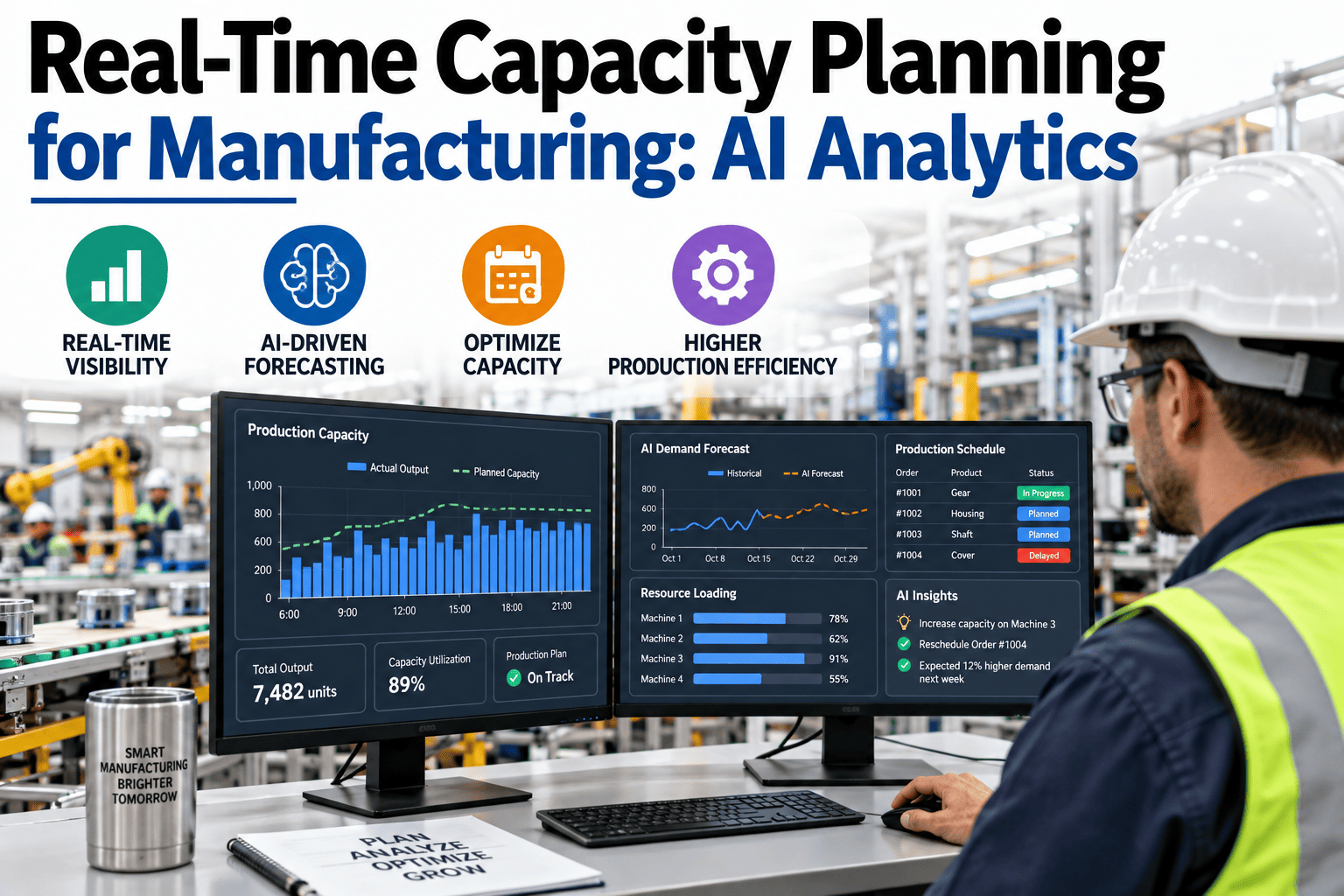
Digitally advanced plants using real-time production analytics see throughput gains of 16-28% compared to plants relying on traditional reporting.
19%
Fewer Equipment Failures
Predictive maintenance analytics reduces annual equipment failures by 19% by detecting problems weeks before they cause unplanned downtime.
14%
Defect Rate Reduction
Real-time quality analytics reduces defect rates by 14% through continuous SPC monitoring, automated alerts, and process correlation.
25-40%
Maintenance Cost Savings
Shifting from scheduled maintenance to condition-based strategies powered by analytics cuts maintenance spending by 25-40%.
5 Signs You've Outgrown Traditional Reporting
1
Your "real-time" data is actually 8+ hours old
If the freshest data anyone sees is from last shift or yesterday's end-of-day report, you're making today's decisions with yesterday's information. Real-time means seconds, not shifts.
2
You spend more time building reports than acting on them
If your team spends 4+ hours weekly compiling spreadsheets, formatting charts, and emailing PDFs, that's engineering time burned on data janitor work instead of process improvement.
3
Different departments report different numbers for the same metric
When production, quality, and maintenance each calculate OEE differently because they're pulling from separate spreadsheets, nobody trusts the data. A single source of truth eliminates these conflicts.
4
You find out about problems after customers do
If quality escapes reach customers before your reporting catches the trend, your detection lag is measured in weeks. Analytics catches drift in minutes.
5
You can't answer "why" without a 2-day investigation
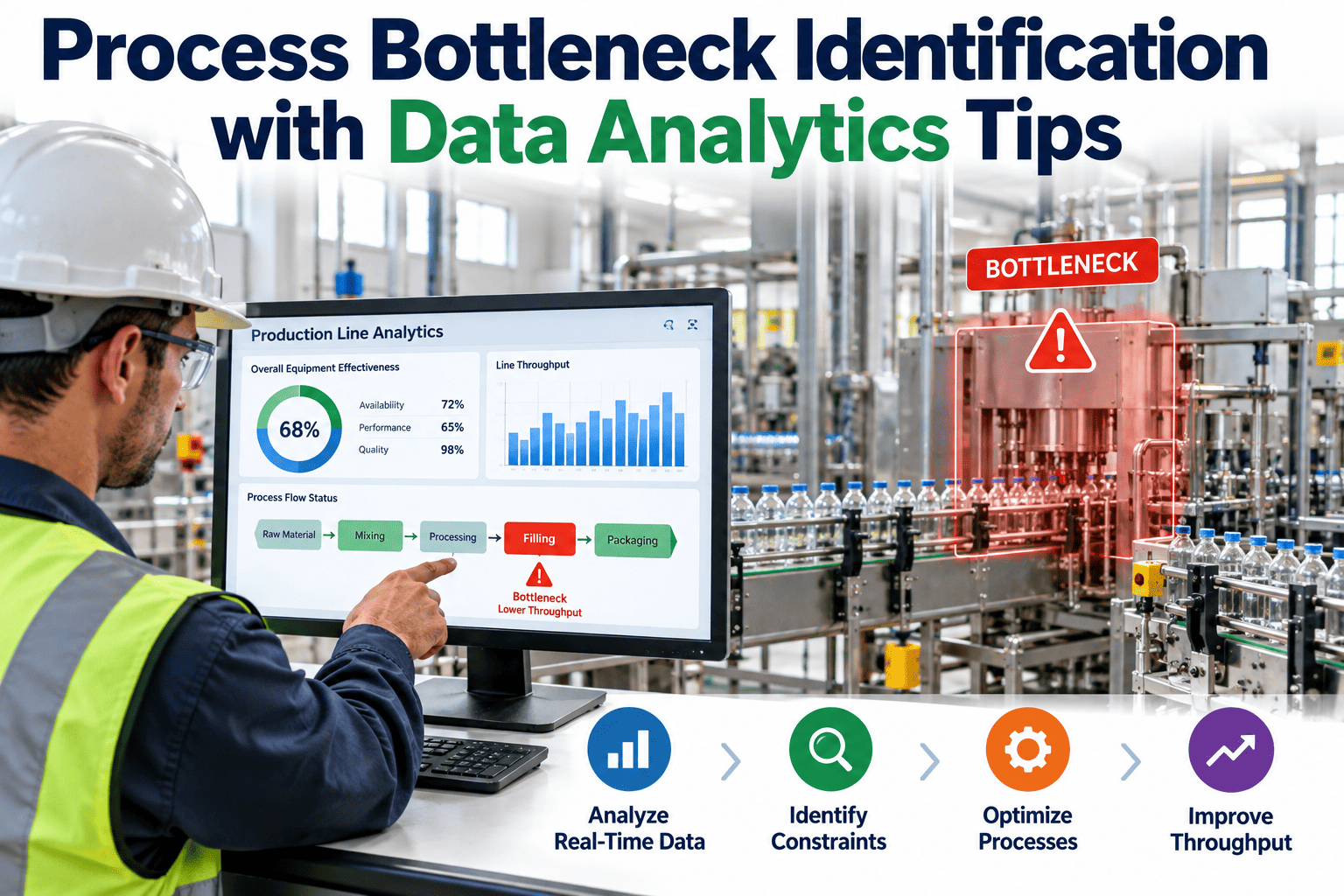
When a downtime event or quality spike requires pulling data from 3 systems, cross-referencing logs, and interviewing operators—analytics replaces that with one click and instant correlation.
See yourself in these patterns? Schedule a demo to see how iFactory replaces spreadsheet chaos with real-time clarity. Ready to switch now? Sign up here.
Expert Analysis
The manufacturing analytics market was valued at $13.6 billion in 2025 and is projected to reach $78 billion by 2035. Real-time production analytics improved throughput by 16-28% in digitally advanced plants, while predictive maintenance reduced annual equipment failures by 19%. Over 62% of manufacturing firms now utilize analytics to streamline operations, with cloud-based deployments growing 39% year-over-year as manufacturers shift from on-premise historians to scalable, multi-site analytics platforms.
Stop Reporting on the Past. Start Shaping the Future.
iFactory delivers manufacturing analytics that operators use and managers trust—real-time OEE, predictive quality, automated alerts, and AI-driven insights that turn data into action.
Frequently Asked Questions
What is the difference between manufacturing analytics and traditional reporting?
Traditional reporting is backward-looking: it compiles historical data into spreadsheets or PDFs that managers review days or weeks after events. Manufacturing analytics is forward-looking: it ingests real-time data from sensors, PLCs, and production systems to show what's happening now, predict what's coming next, and recommend actions. The difference is timing and agency. Reports tell you what broke. Analytics tells you what's about to break—and what to do about it. Plants using real-time analytics see 16-28% throughput improvements compared to those relying on traditional reports.
What ROI can manufacturing analytics deliver?
The manufacturing analytics market hit $13.6 billion in 2025, growing at 19% annually—because the returns are proven. Specific outcomes include: 16-28% throughput improvement in digitally advanced plants, 19% fewer annual equipment failures through predictive maintenance, 14% defect rate reduction through real-time SPC, and 25-40% maintenance cost savings by shifting from scheduled to condition-based strategies. Cloud-based analytics deployments grew 39% year-over-year as manufacturers realized the value of scalable, multi-site visibility.
How do I transition from spreadsheets to real-time analytics?
Start with one high-value metric—OEE is ideal because it combines availability, performance, and quality into a single KPI. Connect sensor data from your most critical line to a cloud-based analytics platform. Once operators see their real-time OEE dashboard and how it correlates with specific events, adoption follows naturally. From there, layer on predictive maintenance alerts, quality SPC charts, and automated downtime tracking. Most manufacturers can go from spreadsheets to live dashboards on a pilot line within 4-6 weeks.
Do I need to replace my existing systems to use manufacturing analytics?
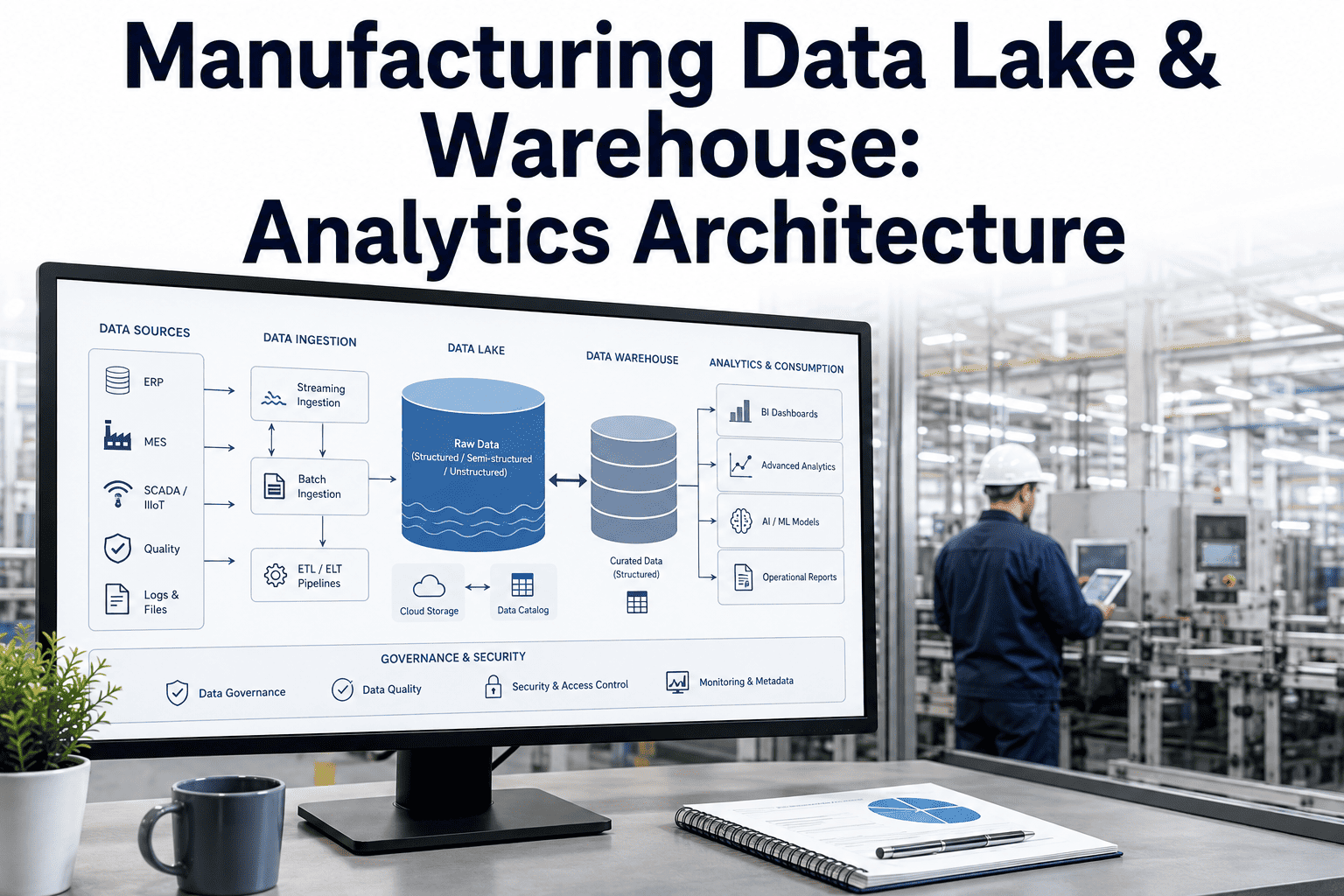
No. Modern analytics platforms like iFactory are designed to integrate with your existing infrastructure—PLCs, SCADA, historians, ERP, and CMMS. They sit on top of your current systems, ingesting data through standard protocols (OPC-UA, MQTT, REST APIs) without requiring you to rip and replace. This means you can start generating value from analytics while preserving your existing technology investments. The key is choosing a platform that connects to what you already have rather than demanding a full infrastructure overhaul.
What's the difference between descriptive, predictive, and prescriptive analytics?
These represent increasing levels of manufacturing intelligence. Descriptive analytics answers "what happened" through historical reports and dashboards—this is where most manufacturers are today. Predictive analytics answers "what will happen" using machine learning to forecast failures, quality drift, and demand 4-8 weeks ahead. Prescriptive analytics answers "what should we do" by recommending specific actions—adjust parameters, reschedule maintenance, reroute production. Each level builds on the one before, and the ROI accelerates as you move from descriptive to prescriptive. iFactory supports all four levels, letting you start where you are and grow.