A factory with robots isn't a smart factory. A factory with sensors isn't either. What makes a factory truly "smart" is the invisible layer—the real-time data flow connecting every machine, every process, and every decision into a single intelligent system. With the smart factory market projected to reach $314 billion by 2032 at a 9.1% CAGR, understanding what separates a connected factory from an automated one has never been more critical. Book a free consultation to explore what a smart factory looks like for your operation.
What Makes a Factory Truly Smart? Technologies, Data, and Intelligence Explained
Beyond robots and sensors—how connectivity, intelligence, and integrated systems define the next generation of manufacturing.
What Is a Smart Factory?
A smart factory is a manufacturing facility where physical production processes and operations are combined with digital technology, intelligent computing, and big data to create a more connected, optimized system.
Unlike traditional factories that use isolated automation, a smart factory creates a cyber-physical ecosystem where machines talk to each other, data flows in real time, and decisions are driven by intelligence—not just instinct. It's not about replacing humans with robots. It's about giving humans and machines the information they need, exactly when they need it.
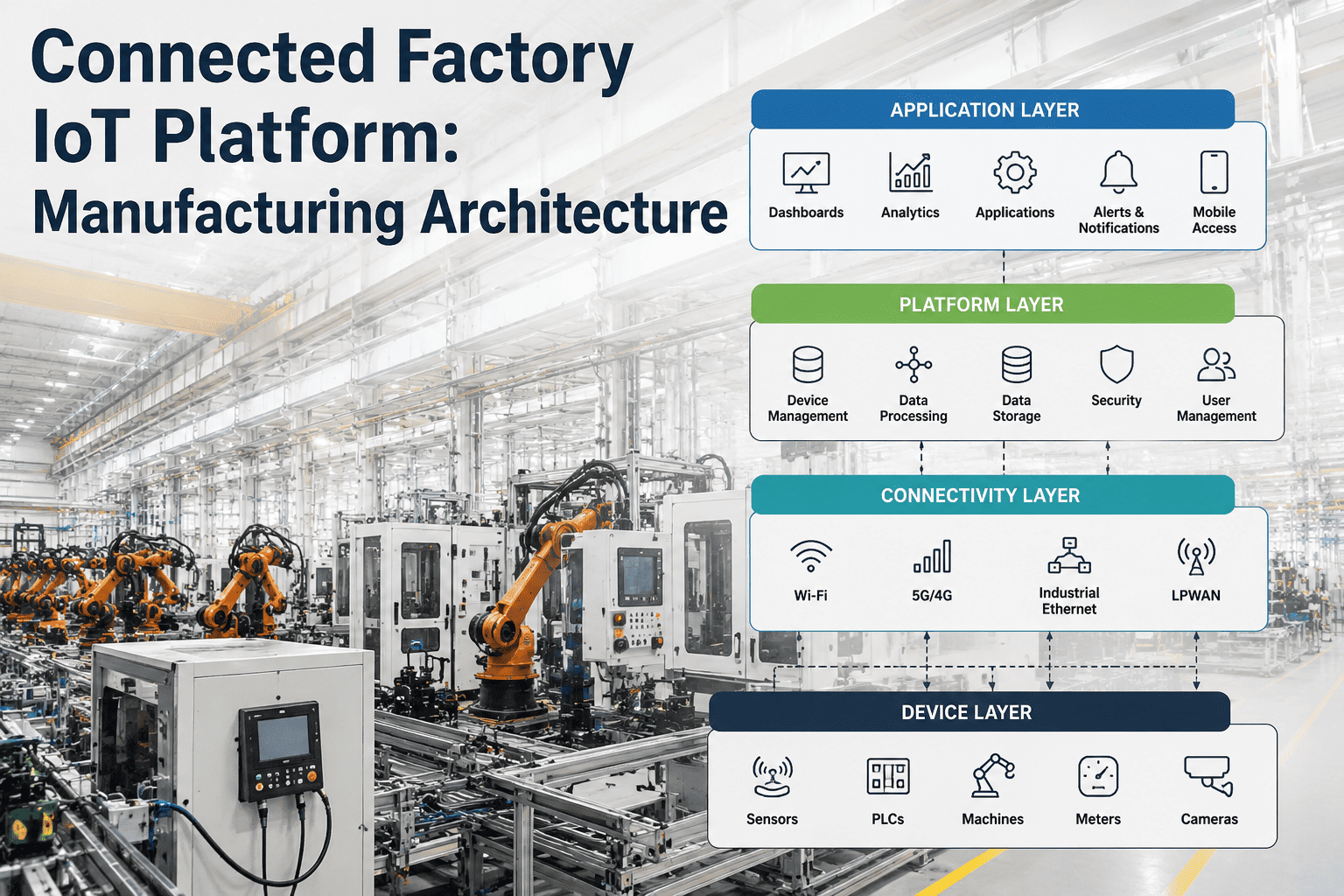
Every machine, sensor, and system is networked into a unified data ecosystem.
Real-time information flows from shop floor to top floor without manual intervention.
AI and analytics turn raw data into predictions, recommendations, and actions.
Systems self-optimize, self-correct, and trigger actions without waiting for human input.
How Smart Factories Differ from Traditional Automated Plants
Automation alone doesn't make a factory smart. Here's the fundamental shift.
Core Technologies Behind a Smart Factory
Six foundational technologies that power every smart factory—from the sensor to the boardroom.
Industrial IoT (IIoT)
Connected sensors on machines, tools, and environments that collect real-time data—temperature, vibration, pressure, speed—and stream it to centralized platforms. IIoT is the nervous system of a smart factory.
46% of manufacturers now use IIoT solutionsArtificial Intelligence and Machine Learning
AI analyzes the massive data streams from IIoT to detect patterns, predict failures, optimize schedules, and make autonomous decisions. ML models improve continuously as they process more production data.
42% of factories leverage AI-driven analyticsCloud and Edge Computing
Cloud platforms aggregate and store factory data for enterprise-wide analysis. Edge computing processes time-sensitive data locally—at the machine—for millisecond response times that cloud latency can't deliver.
57% of manufacturers use cloud computingDigital Twins
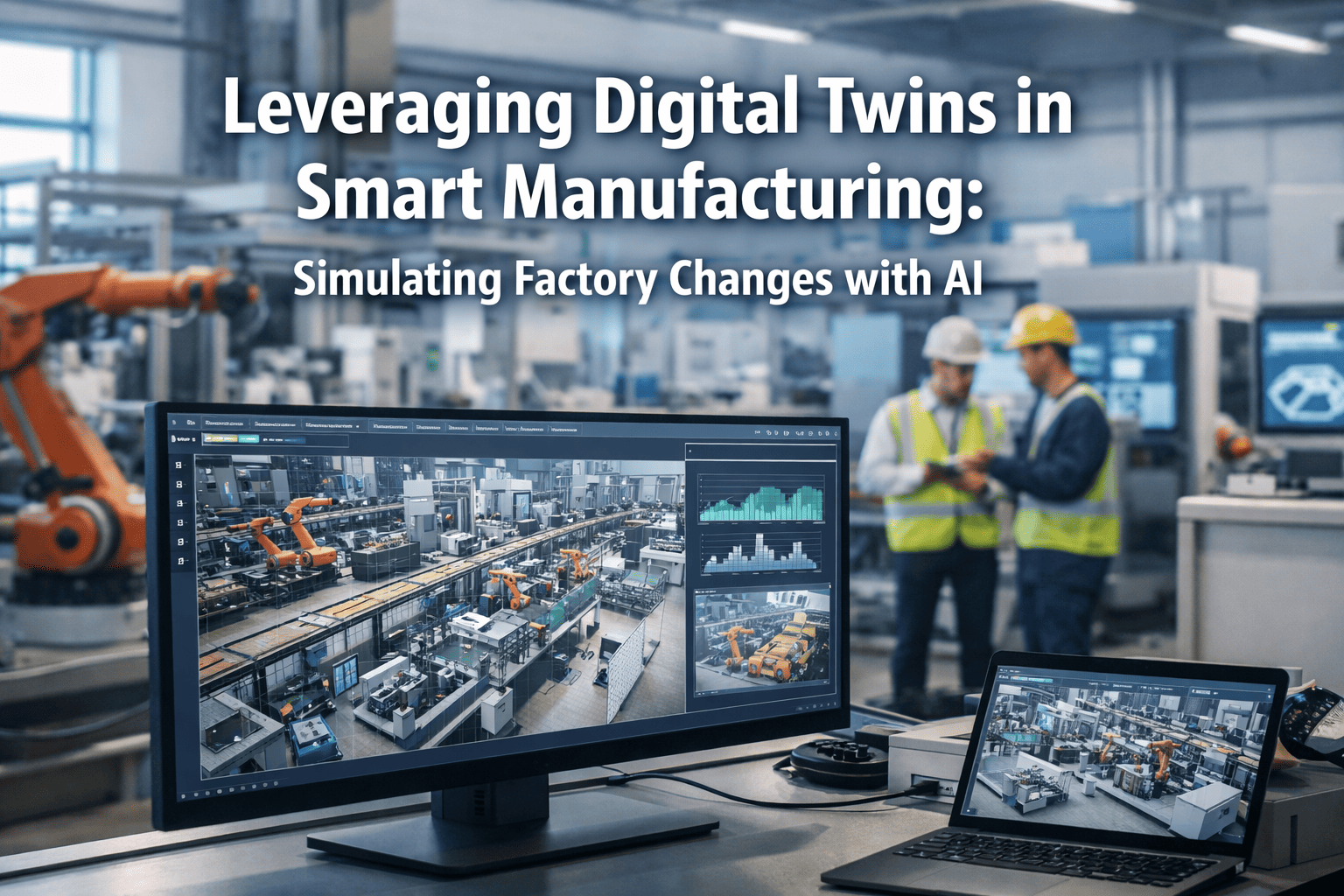
Virtual replicas of physical assets, production lines, or entire factories. Digital twins simulate changes before implementation, test scenarios risk-free, and provide predictive insights into how systems behave under different conditions.
Used by leading OEMs like Siemens, BMW, BoeingAdvanced Robotics and Cobots
Autonomous robots handle repetitive, dangerous, or precision tasks. Collaborative robots (cobots) work alongside humans, adapting to human movement and augmenting—not replacing—skilled operators.
30–50% productivity gains from smart automation5G and Industrial Connectivity
High-speed, low-latency wireless networks enable real-time communication between thousands of connected devices on the factory floor—critical for autonomous guided vehicles, real-time video analytics, and remote operations.
42% of manufacturers adopting 5G connectivityThe Role of IoT, AI, and Real-Time Data in Smart Manufacturing
Data is the lifeblood of a smart factory. Here's how it flows from sensor to action.
Layer 1: Sense
IoT sensors on every critical asset capture vibration, temperature, speed, energy consumption, and environmental conditions—thousands of data points per second, flowing continuously.
Layer 2: Connect
Edge gateways and industrial networks aggregate sensor data and stream it to cloud platforms. 5G and industrial ethernet ensure low-latency delivery for time-critical processes.
Layer 3: Analyze
AI and ML models process incoming data against historical baselines. They detect anomalies, predict failures 48–72 hours in advance, and identify optimization opportunities invisible to human observation.
Layer 4: Act
Insights trigger automated responses—maintenance work orders, quality holds, schedule adjustments, inventory reorders—or surface as real-time alerts on dashboards for human decision-making.
MES, ERP, CMMS, and IoT Platforms: The Software Backbone
MES
Production execution, scheduling, quality, OEE tracking—the real-time pulse of what's being made, right now.
ERP
Business-level planning—finance, procurement, supply chain. Sends production orders, receives actuals from the floor.
CMMS
Maintenance management—work orders, preventive schedules, spare parts. Keeps machines running when production needs them.
IoT Platform
Device management, data ingestion, edge analytics. The connectivity layer that feeds every other system with real-time sensor data.
In a truly smart factory, these aren't separate silos—they share a common data layer. When MES detects a quality drift, CMMS auto-triggers maintenance. When ERP changes a production order, MES adjusts scheduling instantly. The integration is what creates intelligence. Learn more about MES vs CMMS vs EAM
Not Sure Where to Start Your Smart Factory Journey?
Our experts will assess your current setup and identify the highest-ROI starting point—whether that's maintenance visibility, production monitoring, or full system integration.
Benefits of Becoming a Smart Factory
Measurable outcomes reported by manufacturers who have made the transition.
Efficiency and Productivity
Smart factories report 12% average gains in manufacturing output, factory utilization, and labor productivity. AI-driven scheduling and automated material flow eliminate bottlenecks that manual planning misses. Deloitte projects smart factories will surpass traditional facilities with 30% higher net labor productivity by 2030.
Predictive Maintenance
Real-time sensor data combined with ML models predicts equipment failures 48–72 hours before they happen. This shifts maintenance from costly reactive repairs to planned interventions—reducing unplanned downtime by up to 44%.
Quality and Traceability
In-line quality monitoring catches defects at the source, not at the end of the production line. Complete digital traceability links every product back to its raw materials, process parameters, and operator actions—critical for regulated industries.
Operational Agility
Software-defined production lines adapt to new products or changing demand without weeks of retooling. Smart factories respond to supply chain disruptions in hours, not weeks—a capability that became essential during recent global disruptions.
Energy and Sustainability
AI-optimized energy management reduces consumption and waste. Real-time monitoring of resource usage supports sustainability reporting and regulatory compliance. Smart factories enable the transition to circular manufacturing models.
Common Myths About Smart Manufacturing
Misconceptions that keep plants from starting their transformation.
"Smart factories are only for billion-dollar companies."
Cloud-based platforms have slashed entry costs. SMEs are the fastest-growing segment of CMMS adoption at 20.8% CAGR. You don't need a mega-budget—you need a clear starting point.
"We need to replace all our equipment first."
Retrofit sensors and edge gateways connect legacy equipment to modern platforms without replacing a single machine. Smart factory transformation layers on top of existing infrastructure.
"Smart factories eliminate jobs."
Smart factories shift roles from manual data collection to data-driven decision making. The biggest challenge reported by 600 executives in Deloitte's 2025 survey? Finding enough skilled talent—not reducing headcount.
"You need to do everything at once."
The most successful smart factory initiatives start with one pain point—a single line, a specific quality issue, or maintenance visibility. Quick wins build momentum and fund the next phase.
Steps to Start Your Smart Factory Transformation
A practical, phased approach that builds momentum without overwhelming your team.
Assess and Prioritize
Map your current technology landscape. Identify the biggest operational pain points—downtime, quality escapes, visibility gaps. Pick one high-impact, contained area to start. Conduct a maturity assessment to understand where you stand today.
Connect and Collect
Deploy IoT sensors on your critical assets. Implement a cloud-based platform for data collection—CMMS for maintenance, or MES for production monitoring. Establish your data foundation. Understand OEE benchmarks to set meaningful targets.
Analyze and Optimize
Activate analytics and AI capabilities on your collected data. Implement predictive maintenance on your most critical equipment. Connect production and maintenance systems so they share data. Measure results against your baseline.
Scale and Integrate
Expand to additional lines, sites, and systems. Integrate MES, CMMS, EAM, and ERP into a unified data layer. Implement digital twins for simulation and continuous improvement. Your factory is now smart—and getting smarter every day.
The Smart Factory Opportunity in Numbers
Frequently Asked Questions About Smart Factories
Clear answers to the most common questions from manufacturing leaders exploring smart factory transformation.
What exactly is a smart factory?
A smart factory is a manufacturing facility that uses interconnected technologies—IoT sensors, AI, cloud computing, and integrated software systems like MES, CMMS, and ERP—to collect, share, and act on real-time data across the entire operation. Unlike traditional factories where machines and systems operate in isolation, a smart factory creates a unified digital ecosystem where production, maintenance, quality, and business systems communicate continuously. This connectivity enables predictive decision-making, automated responses to anomalies, and continuous self-optimization—turning raw data into operational intelligence.
How is a smart factory different from a factory that already uses automation?
Automation handles repetitive tasks—a robotic arm welding, a conveyor sorting parts, a PLC controlling a sequence. But these systems typically operate independently with no data sharing between them. A smart factory connects all automated and manual systems into a single data layer. The key difference is intelligence and adaptability: automated factories follow fixed rules, while smart factories learn from data, predict issues, and adjust processes dynamically. For example, an automated factory runs a maintenance schedule every 500 hours regardless. A smart factory monitors actual vibration, temperature, and performance data to trigger maintenance only when the machine actually needs it—saving cost and preventing unnecessary downtime.
What technologies are essential for building a smart factory?
The foundational technologies include: Industrial IoT (IIoT) sensors for real-time data collection from machines and environments; Cloud or edge computing for processing and storing that data; AI and machine learning for pattern recognition, anomaly detection, and predictive analytics; Integrated software platforms (MES for production, CMMS for maintenance, ERP for business planning) that share a common data layer; and industrial networking (5G, industrial Ethernet, or Wi-Fi 6) for reliable connectivity. You don't need all of these on day one—most successful transformations start with IoT sensors and a cloud-based CMMS or MES, then expand. Compare MES, CMMS, and EAM systems here
Do we need to replace our existing machines and equipment?
No. This is one of the most common misconceptions about smart factory transformation. Modern IoT sensors and edge gateways are designed to retrofit onto existing equipment—regardless of age or manufacturer. Vibration sensors, temperature probes, current monitors, and optical sensors can be installed on legacy machines without modifying the equipment itself. These sensors feed data into cloud platforms that provide the same real-time visibility you'd get from brand-new smart equipment. Even a 15–20 year old CNC machine, press brake, or compressor can become part of your connected factory within days of sensor installation.
How much does it cost to become a smart factory?
The cost varies significantly based on scope and approach. A focused pilot—IoT sensors on one production line with cloud-based monitoring—can start in the $15K–$75K range. A plant-wide deployment with MES, CMMS, and AI analytics typically ranges from $200K–$1M+ depending on plant size and complexity. Full enterprise transformation across multiple sites with digital twins and advanced AI can exceed $2M. The critical insight: over 90% of manufacturers in Deloitte's 2025 survey plan to maintain or increase their smart factory investment because the ROI—through reduced downtime, improved OEE, and lower maintenance costs—typically materializes within 6–12 months of the initial deployment.
Which industries benefit most from smart factories?
Automotive leads adoption (25% of sites transforming), followed by electronics and semiconductors, pharmaceuticals, food and beverage, and aerospace and defense. However, any manufacturer with capital-intensive equipment, quality compliance requirements, or high-cost downtime stands to benefit significantly. Process industries (chemicals, cement, steel) gain from predictive maintenance and energy optimization. Discrete manufacturers (machinery, fabrication) benefit from production scheduling and quality traceability. The Asia-Pacific region leads global adoption at 35%+ market share, while North America and Europe are investing heavily in modernizing existing facilities.
Will a smart factory replace our workforce?
No—smart factories change roles, not headcount. The shift moves workers from manual data collection and reactive troubleshooting to data-driven decision-making and proactive optimization. In Deloitte's survey of 600 manufacturing executives, the #1 challenge wasn't workforce reduction—it was finding enough skilled talent to operate and manage smart factory systems. Smart factories create demand for roles in data analysis, automation programming, system integration, and digital maintenance management. Companies that invest in upskilling existing workers report higher retention, better job satisfaction, and faster digital maturity.
Where should we start our smart factory transformation?
Start with your biggest operational pain point—not the most impressive technology. If unplanned downtime is your top cost driver, begin with IoT-connected predictive maintenance (CMMS + vibration/temperature sensors). If production visibility is the gap, start with real-time OEE monitoring. If quality escapes are the problem, implement in-line sensor-based inspection. The most successful transformations follow a crawl-walk-run approach: pilot on one line, prove ROI within 3–6 months, then scale across the plant. See OEE benchmarks to set your targets
One Platform. Production + Maintenance + Assets. Fully Connected.
iFactory replaces fragmented tools with a single intelligent platform that connects your shop floor to your top floor—giving you real-time visibility, predictive maintenance, and production intelligence from day one.