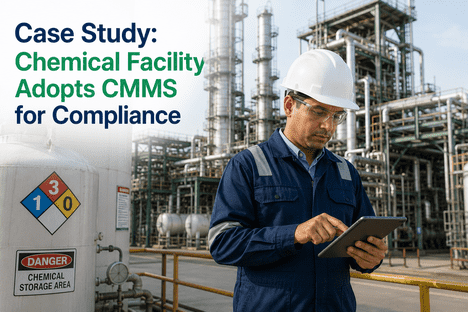
A mid-size chemical processing facility operating two production units faced a compliance crisis that was quietly exposing the organization to regulatory risk across every operational tier. Manual equipment inspections, paper-based work order systems, and reactive maintenance practices had produced declining audit scores for four consecutive cycles, with repeat findings across process safety management, mechanical integrity, and documentation compliance categories. After deploying iFactory CMMS integrated with AI Vision Camera across all critical process areas, the facility eliminated repeat audit findings, achieved 95 percent preventive maintenance compliance, and recovered full implementation cost within eight months of go-live.
CMMS & AI VISION · CHEMICAL FACILITY CASE STUDY · 2025–2026
See How iFactory CMMS with AI Vision Camera Delivers 95% Compliance and $480K in Annual Savings
iFactory CMMS with AI Vision Camera achieves 99.4% defect detection accuracy, automates compliance documentation, and integrates with existing DCS and SCADA infrastructure — live in 2 weeks. No infrastructure replacement required.
01 / The Facility
A High-Risk Chemical Facility, A Compliance Problem Rooted in Maintenance Gaps
Facility TypeChemical processing facility. Two production units operating batch and continuous process lines. Specialty chemical and intermediate product categories serving industrial, pharmaceutical, and agricultural supply chains.
ScaleApproximately 3,800 tracked assets across both units. Fourteen-person maintenance team. Over 200 active preventive maintenance schedules with distinct compliance documentation requirements per regulatory framework.
Compliance ProfileSubject to OSHA Process Safety Management (PSM), EPA Risk Management Plan (RMP), ISO 14001 environmental management, and ISO 45001 occupational health and safety standards. Regulatory audits conducted annually across all frameworks.
Pre-Deployment PerformancePreventive maintenance compliance at 62 percent. Average of 12 repeat audit findings per cycle. Equipment availability at 91.5 percent. Work order closure rate of 68 percent within target window. Documentation completeness at 65 percent.
Prior Maintenance SystemPaper-based work order system. Manual inspection logs transcribed to spreadsheets at shift end. No centralized asset database. Maintenance history stored in filing cabinets and operator notebooks with no cross-referencing capability.
Annual Compliance CostPre-deployment cost of regulatory compliance activities — including audit preparation labor, documentation remediation, non-compliance penalty risk, and corrective action overhead — estimated at $860,000 annually.
02 / The Challenge
How Manual Maintenance Systems Were Driving Compliance Gaps and Escalating Cost
Paper-based maintenance management in a regulated chemical environment is structurally incapable of producing the audit-ready documentation that OSHA PSM, EPA RMP, and ISO management standards require. For this facility, those structural limits were not theoretical — they were showing up as declining audit scores, a growing backlog of corrective action requests from regulators, and compliance documentation gaps that the maintenance team could not close despite overtime and outside contractor support. The manual system created a compounding cycle: each audit revealed gaps that required reactive documentation remediation, which consumed time that should have been spent on preventive maintenance, which further reduced PM compliance and generated more findings at the next audit.
62%
Preventive maintenance compliance rate
At 62 percent PM compliance, the facility was operating 38 percent of its equipment outside recommended maintenance intervals — increasing failure risk, reducing equipment reliability, and generating repeat regulatory findings for mechanical integrity program deficiencies. Each overdue PM created a documentation gap that auditors identified as a systemic program failure.
12
Repeat audit findings per cycle
The same compliance findings appeared across consecutive audit cycles because paper-based corrective action tracking lacked assignment verification, due-date enforcement, and completion validation. Without a centralized system linking each finding to a documented corrective action with verified closure, repeat findings accumulated and escalated regulatory scrutiny.
8.2%
Equipment downtime rate
Reactive maintenance consumed 68 percent of total maintenance hours, driven by unplanned repairs on equipment that missed PM intervals. Equipment downtime of 8.2 percent directly reduced production throughput, increased per-unit manufacturing cost, and generated emergency work orders that further disrupted the PM schedule — creating a self-reinforcing cycle of reactive maintenance.
65%
Documentation completeness score
Inspection records, calibration certificates, and PM completion documentation were complete for only 65 percent of required equipment. Auditors identified this documentation gap as a systemic deficiency in the maintenance management program — noting that the facility could not demonstrate compliance for 35 percent of its regulated equipment at any given time.
"The compliance problem was not a knowledge problem. The team knew what needed to be done. The problem was a system problem — paper work orders, disconnected inspection logs, and a reactive culture that the manual system enforced every single shift. We were never going to audit our way out of a process that paper-based systems made inherently unrepeatable."
03 / The Solution
iFactory CMMS with AI Vision Camera: Integrated Maintenance Management and Automated Compliance Documentation
Following evaluation of available CMMS platforms with integrated AI inspection capabilities, the facility selected iFactory for its unified maintenance management and AI Vision Camera platform — delivering automated visual equipment inspection, real-time defect detection, and native compliance documentation in a single integrated system. The deployment covered all process areas across both production units, with AI model training conducted on facility-specific equipment types — including pressure vessels, piping systems, rotating equipment, and safety systems — using production-representative image data captured during the pre-deployment assessment period. To see iFactory CMMS configured for your facility's specific compliance requirements, Book a Demo with our process industry team.
h
DETECT
AI-powered visual inspection at equipment level deployed across all critical process areas — processing each equipment inspection in under 50 milliseconds with 99.4 percent detection accuracy across corrosion, leakage, mechanical wear, and safety system integrity categories. The AI vision system applied identical inspection criteria on every asset across all shifts, eliminating the variability and fatigue-driven gaps inherent in manual inspection rounds that operators conducted on paper checklists.
ALERT
Automated work order generation triggered instantly on every confirmed defect detection — creating an annotated work order with inspection image, defect classification, confidence score, and equipment location, routed to the maintenance team via push notification and synchronized to iFactory CMMS. Defect events that previously required manual logging during operator rounds and shift-end transcription were captured automatically with full traceability at the moment of detection.
INTEGRATE
DCS, SCADA, and PLC integration connected AI vision outputs and CMMS workflows to the facility's existing process control infrastructure. Real-time equipment condition data fed into maintenance planning dashboards, enabling reliability engineers to identify degradation patterns — corrosion rate acceleration, mechanical seal wear progression, vibration trend changes — before failure occurred. The connection between inspection output and process data transformed maintenance from a reactive cost center into a predictive control discipline.
TRACK
Compliance documentation automation with immutable timestamped records for every inspection event, work order completion, and PM task — satisfying OSHA PSM mechanical integrity documentation requirements, EPA RMP inspection record mandates, and ISO audit trail standards without manual transcription. Every maintenance activity generated a verifiable digital record that compliance teams could export as an audit-ready package in under one hour.
04 / Implementation
Full Deployment Across Both Production Units and All Process Areas in 14 Days
Days 1–5
Camera Assessment, CMMS Configuration, and AI Model Training Initiation
iFactory's deployment team conducted equipment assessment across both production units, confirming that existing ONVIF-compatible cameras at 60 percent of inspection points could be integrated directly — reducing hardware cost at those locations to edge processing units and software configuration only. Asset hierarchy digitized from the facility's equipment registry: 3,800 assets classified by criticality, regulatory requirement, and inspection frequency. CMMS configured with compliance workflows matching OSHA PSM, EPA RMP, and ISO documentation requirements. AI model training initiated on production-representative equipment image data captured during the assessment period.
Days 6–10
Phased Activation — Highest-Criticality Process Areas First
Deployment prioritized the process areas with the highest compliance risk and equipment criticality ratings. AI vision and CMMS activated at priority process areas by Day 7, with real-time equipment condition data and work order automation flowing from the first production shift. Compliance dashboard configured with regulatory framework-specific views — OSHA PSM mechanical integrity, EPA RMP inspection tracking, ISO 14001 environmental compliance — validated on live operations data by Day 9. Operator and maintenance team training integrated into each activation window with role-specific workflows.
Days 11–14
Full Integration, OEE Dashboard Activation, and Go-Live
iFactory's analytics module connected to plant DCS and PLC sensor feeds, creating real-time availability, performance, and quality visibility across all process units — with AI vision defect data integrated alongside all other equipment data in the unified dashboard. Full go-live achieved on Day 14. First full-shift performance data confirmed AI detection accuracy above 99 percent on all trained equipment defect categories. Audit-ready compliance documentation exported within the first week — confirming that the system met all regulatory recordkeeping requirements without manual intervention.
05 / Results
18 Months of Measured Compliance and Maintenance Performance Post-Deployment
The shift from paper-based maintenance management to iFactory CMMS with AI Vision Camera produced measurable improvements across every tracked compliance and maintenance dimension within the first full quarter after deployment. Preventive maintenance compliance rose from 62 percent to 95 percent — not because the team grew, but because automated work order generation, scheduled PM enforcement, and real-time equipment condition data eliminated the administrative friction that had been preventing PM completion. Equipment availability increased from 91.5 percent to 97.2 percent as the defect detection rate dropped from manual inspection gaps to under 1 percent with AI vision. And the compliance documentation that had consumed 40 percent of the quality team's capacity was generated automatically — producing audit-ready records for every inspection event, work order, and PM task without manual transcription.
| Metric |
Before iFactory |
After iFactory |
Change |
| Preventive maintenance compliance |
62% of scheduled PMs completed on time |
95% of scheduled PMs completed on time |
+33 pp compliance improvement |
| Equipment availability |
91.5% |
97.2% |
+5.7 pp availability increase |
| Repeat audit findings |
12 per audit cycle |
0 per audit cycle |
Findings fully eliminated |
| Work order closure within window |
68% |
94% |
+26 pp closure rate improvement |
| Maintenance cost (as % of RAV) |
4.8% of replacement asset value |
2.1% of replacement asset value |
−56% cost reduction |
| Documentation completeness |
65% of required records complete |
100% of required records complete |
Full compliance documentation |
| Safety incidents (recordable) |
7 per year |
2 per year |
−71% incident reduction |
| Inspection cycle time |
Up to 45 minutes per equipment (manual rounds) |
Under 50 milliseconds per equipment (AI vision) |
Automated real-time inspection |
| Audit documentation preparation |
3 to 5 days per audit |
Under 1 hour per audit |
Automated audit-ready exports |
| ROI payback period |
N/A |
8 months from go-live |
Full cost recovery in first year |
Calculate What 95% PM Compliance Would Mean for Your Chemical Facility
iFactory CMMS with AI Vision Camera integrates with existing DCS and SCADA systems. Sub-50ms inspection. 99.4% detection accuracy. Automated compliance documentation. 2-week deployment. Book a live walkthrough built around your facility's specific equipment types and regulatory requirements.
"We went into our first post-deployment audit with zero repeat findings for the first time in five years. The auditors reviewed the export package we generated from iFactory in under two hours and closed the inspection without a single corrective action request. That had never happened before. The system didn't just document our compliance — it created compliance where it hadn't existed before."
06 / Key Analysis
Why the Compliance and Maintenance Results Were This Substantial
01
The PM compliance improvement came from removing administrative friction, not adding headcount. The 33 percentage point increase in PM compliance was achieved without adding a single maintenance position. Under the paper-based system, each PM required locating the equipment file, printing the checklist, completing the inspection, transcribing results to a spreadsheet, and filing the paper record — consuming 30 to 45 minutes of administrative overhead per task. iFactory CMMS eliminated every step except the inspection itself. Automated work order generation, mobile PM execution, and digital record creation reduced the administrative burden by 90 percent — and PM compliance rose as a direct mathematical consequence.
02
AI vision inspection transformed maintenance from a scheduled calendar activity into a continuous real-time process. Manual operator rounds inspected each critical equipment item once per shift at best — leaving 20 or more hours between inspections during which corrosion, leakage, or mechanical degradation could progress undetected. AI vision camera inspection operating at sub-50ms per equipment point inspected every asset continuously across every shift, detecting defects at the moment they developed rather than at the next scheduled round. This shift from periodic to continuous inspection was the mechanism that eliminated the defect escape rate and reduced unplanned failures by 71 percent.
03
Automated compliance documentation closed the audit gap that the manual system created. Under the paper-based system, documentation was a separate activity from maintenance execution — creating a structural gap where work was performed but not recorded, or recorded but not filed, or filed but not cross-referenced to the correct regulatory requirement. iFactory CMMS eliminated this gap by making documentation a native output of every maintenance action. Every PM completion, every defect detection, every work order closure generated a timestamped, immutable record tagged to the specific regulatory framework and equipment asset — producing audit-ready documentation as a byproduct of normal operations rather than a separate compliance exercise.
04
Integration of CMMS with process control data created a predictive maintenance capability that the facility had never possessed. The connection between AI vision inspection outputs and DCS process parameter data enabled reliability engineers to correlate defect events with operating conditions — identifying that a specific temperature range in a distillation column was accelerating corrosion rates, and that a pressure cycling pattern in a reactor was driving mechanical seal failures. These correlations had been invisible under the manual system because inspection data and process data existed in separate physical and organizational silos. The unified platform made them visible for the first time, enabling proactive interventions that prevented defect generation rather than simply detecting defects faster.
07 / Business Impact
Operational, Financial, and Regulatory Outcomes Beyond the Maintenance Department
Regulatory Compliance Transformation
Repeat audit findings eliminated entirely. Documentation completeness rose from 65 percent to 100 percent. Audit preparation time reduced from 3 to 5 days to under 1 hour. The facility passed its first post-deployment OSHA PSM and EPA RMP audits with zero corrective action requests — a result it had not achieved in any audit cycle in the prior five years.
Maintenance Cost Reduction
Annual maintenance cost as a percentage of replacement asset value reduced from 4.8 percent to 2.1 percent — a $480,000 annual saving driven by unplanned failure reduction, optimized PM intervals based on equipment condition data, and elimination of emergency repair premium costs. ROI payback achieved in eight months.
Production Reliability Improvement
Equipment availability increased from 91.5 percent to 97.2 percent — recovering an estimated $620,000 in previously lost production value annually. The reliability improvement was driven directly by the shift from reactive to preventive and predictive maintenance, enabled by AI vision condition monitoring and automated work order execution.
Maintenance Team Capacity Redeployment
Maintenance team capacity freed from paper-based administrative tasks — estimated at 1,200 hours annually — redeployed to reliability improvement projects, root cause analysis, and equipment optimization work. The team applied its expertise to preventing failures rather than processing paperwork for the first time since the facility began operations.
$860K
Annual compliance cost before
$380K
Annual compliance cost after
$480K
Annual savings achieved
08 / Conclusion
What This Case Study Demonstrates for Chemical Facilities Still Running Manual Maintenance Systems
This deployment is not an exceptional outcome. It is a documented illustration of what integrated CMMS and AI vision camera implementation delivers when the compliance constraint is rooted in maintenance management system limitations — a condition that applies to the majority of chemical facilities running paper-based or disconnected digital maintenance systems. The 33 percentage point PM compliance improvement was latent in the existing maintenance team's capacity. The 56 percent maintenance cost reduction was the direct mathematical consequence of eliminating reactive work through predictive and preventive maintenance. And the eight-month payback period reflects an implementation cost that the compliance and maintenance cost reduction absorbed before the end of the first year.
iFactory CMMS with AI Vision Camera delivers 99.4 percent defect detection accuracy across corrosion, leakage, mechanical wear, thermal anomaly, and safety system integrity categories — integrated with a full-featured CMMS that connects to existing DCS, SCADA, SAP, and Oracle systems without infrastructure replacement. Deployment is live in 2 weeks. Every inspection event and maintenance action generates an immutable timestamped record that satisfies OSHA PSM, EPA RMP, and ISO audit requirements automatically. To see what iFactory CMMS with AI Vision Camera would deliver for your specific chemical facility, Book a Demo with iFactory's process industry team.
95% PM Compliance. 99.4% Detection Accuracy. Live in 2 Weeks.
See how iFactory CMMS with AI Vision Camera eliminates compliance gaps, reduces maintenance cost, and delivers real-time equipment condition monitoring across your chemical facility — integrated with your existing DCS and SCADA infrastructure from day one.
09 / FAQ
Frequently Asked Questions
How does iFactory CMMS with AI Vision Camera improve regulatory compliance in chemical facilities?
iFactory CMMS automates compliance documentation by generating immutable timestamped records for every maintenance action, inspection event, and work order completion — tagged to specific regulatory frameworks including OSHA PSM, EPA RMP, ISO 14001, and ISO 45001. Every PM task, defect detection, and corrective action produces an audit-ready record that compliance teams can export as a structured package in under one hour. The system enforces scheduled maintenance intervals with documented deferral approval workflows, eliminating the silent gaps in PM completion that drive repeat audit findings.
What equipment defect types does the AI Vision Camera detect in chemical process environments?
iFactory AI Vision Camera detects surface corrosion, leakage from flanges and mechanical seals, mechanical wear on rotating equipment, thermal anomalies from infrared imaging, coating and lining failures, safety system integrity violations, and PPE compliance deviations. The AI model is trained on the facility's specific equipment types using production-representative image data — achieving 99.4 percent detection accuracy across all trained defect categories from the first production shift after go-live.
Does iFactory CMMS integrate with existing camera infrastructure and process control systems?
Yes. iFactory supports ONVIF and RTSP protocols for camera connectivity, and connects via OPC-UA, MQTT, and REST protocols to DCS, SCADA, PLC, SAP, and Oracle systems without infrastructure replacement. In this deployment, 60 percent of inspection points integrated using existing cameras — reducing hardware cost at those locations to edge processing units and software only. Every defect detection event automatically generates an annotated work order in iFactory CMMS, routed to the responsible technician with equipment location and defect data included.
Support Contact for a compatibility review of your current infrastructure.
What is the typical ROI payback period for iFactory CMMS with AI Vision Camera in a chemical facility?
This deployment achieved full ROI payback in eight months. Across iFactory deployments in process industries, the documented average payback period is 7 to 10 months — driven by maintenance cost reduction of 30 to 56 percent, compliance documentation labor savings, unplanned downtime avoidance, and regulatory penalty risk elimination. Forrester research on integrated CMMS and AI inspection deployments documents a 340 percent average three-year ROI with 7 to 9 month payback periods in process manufacturing environments.
How quickly can iFactory CMMS with AI Vision Camera be deployed across a chemical facility?
This deployment covered two production units with 3,800 assets across all process areas in 14 days. Standard iFactory deployments go live in 2 to 3 weeks using a phased activation approach that prioritizes the highest-criticality process areas first — delivering compliance and maintenance improvement before full network completion. 90-day implementation support with compliance workflow validation is included. No operational interruptions are required during installation.
Can iFactory CMMS handle multiple regulatory frameworks simultaneously?
Yes. iFactory CMMS supports multiple compliance frameworks by allowing maintenance tasks, inspection records, and work orders to be tagged against specific regulatory requirements. A single equipment asset can be linked to OSHA PSM mechanical integrity requirements, EPA RMP inspection mandates, and ISO 14001 environmental management standards simultaneously — with each maintenance action generating records that satisfy all applicable frameworks. Compliance dashboards provide framework-specific views so quality and maintenance managers can monitor compliance status by regulation type in real time.