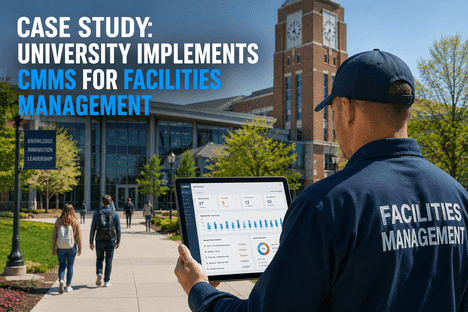
A mid-size research university managing over 6.2 million square feet of campus facilities across academic buildings, laboratories, student housing, athletic complexes, and utility infrastructure had reached a critical threshold with its legacy facilities maintenance model. Paper-based work orders, disconnected preventive maintenance schedules, and reactive response cycles were generating persistent equipment failures across HVAC systems, elevators, electrical distribution, plumbing, and building automation assets — consuming an estimated $1.8 million annually in unplanned repair costs, energy waste from underperforming building systems, and deferred maintenance backlogs that grew faster than the facilities team could address them. Within ten months of deploying ifactory's AI-driven CMMS platform integrated with AI vision inspection across the campus portfolio, the university achieved a 44% reduction in unplanned maintenance events, restored building system uptime to 96%, and recovered over $790,000 in annual facilities expenditure — while improving academic operations continuity, regulatory compliance documentation, and campus sustainability performance simultaneously.
Why Legacy Facilities Maintenance Was Failing This University Campus
The university operated a diverse portfolio of 214 buildings — research laboratories requiring precise environmental control, historic academic halls with aging mechanical infrastructure, high-occupancy student residence facilities, a central utility plant supplying chilled water and steam to the academic core, and athletic and recreational facilities with intensive mechanical and plumbing loads. Facilities management was handled by a team of 64 technicians and trades personnel working across four zones, supported by a legacy CMMS system that required manual work order entry and had no integration with building automation systems, IoT sensors, or inspection data streams.
Three structural failures compounded each fiscal year. First, preventive maintenance compliance was tracked retrospectively — technicians completed and logged work orders days after the service interval, with no automated scheduling enforcement or condition-based triggers. PM compliance across the portfolio averaged 61%, leaving a large fraction of building assets in an unmonitored degradation cycle between service visits. Second, building system failures in research spaces — laboratory HVAC, fume hood exhaust, ultra-low temperature freezer circuits — were generating compliance and safety incidents that required mandatory reporting to institutional review boards and regulatory agencies. Third, the deferred maintenance backlog had grown to an estimated $34 million, with no data-driven prioritization framework to direct limited capital toward the assets posing the highest near-term risk to operations, safety, and academic continuity.
Four Failure Patterns That Drove 81% of All Unplanned Facilities Events
Before deployment, ifactory's facilities analytics team conducted a 90-day baseline audit using historical maintenance records, building automation system logs, energy management data, and an initial AI vision camera survey across the highest-criticality buildings on campus. The audit identified four recurring failure categories responsible for the overwhelming majority of unplanned maintenance events and associated costs — each addressable through a combination of AI-driven condition monitoring and automated CMMS workflow integration.
— Director of Facilities Management, Post-Deployment Review
How ifactory CMMS and AI Vision Cameras Were Deployed Across the University Campus
ifactory deployed its AI Vision Camera platform in combination with the ifactory EAM/CMMS system across the university's highest-criticality building inventory — prioritizing research facilities, the central utility plant, residential high-rises, and buildings with the highest deferred maintenance risk scores identified during the baseline audit. The deployment was designed to close the three structural gaps identified: continuous condition visibility, zero-latency work order generation, and integrated compliance documentation. Facilities directors and VP-level operations leaders building the business case for similar campus deployments can Book a Demo with ifactory's facilities analytics team.
Continuous Automated Inspection Across 214 Buildings — Without Scaling Inspection Labor
One of the most operationally significant capabilities deployed at the university was AI vision camera integration across high-criticality mechanical, electrical, and utility spaces throughout the campus portfolio. Manual visual inspection at university scale — 214 buildings, 6.2 million square feet, mechanical rooms on every floor of every building, elevator machine rooms, exterior envelope components, and laboratory equipment areas — is structurally impossible to perform at the frequency required to detect early-stage anomalies before they progress to failure or compliance events. A thermal hotspot developing in an electrical panel in a research building's basement mechanical room may go undetected for months between manual inspection rounds. A plumbing joint beginning to seep behind a laboratory service wall can cause catastrophic water damage to research equipment and specimen collections before the next scheduled inspection visit. ifactory's AI Vision Camera platform operates continuously — detecting anomalies at the moment they form, not the moment a technician is scheduled to be present.
The AI vision cameras deployed across the university campus detect thermal anomalies, moisture indicators, surface deterioration, mechanical component wear, and safety zone compliance violations with over 99% detection accuracy. Findings route directly into the CMMS work order queue, timestamped and categorized, eliminating the gap between visual anomaly detection and maintenance response. Manual inspection labor time was reduced by 78% across monitored areas following AI vision commissioning — freeing technician capacity for skilled repair and planned preventive maintenance rather than routine observation rounds that could not physically achieve the coverage density required. For full capability details on ifactory's AI Vision Camera platform in facilities environments, visit ifactory's AI Vision Camera page.
From Baseline Assessment to Full Predictive Facilities Operations: The Four-Phase Deployment
The deployment followed ifactory's structured four-phase implementation model, progressing from initial campus assessment through full autonomous predictive maintenance operation. Total time from first camera installation to full autonomous operation across priority buildings was 16 weeks — with measurable unplanned event reduction beginning in week 7 of the supervised pilot phase. The deployment was sequenced to prioritize research facilities, the central utility plant, and highest-occupancy residential buildings, ensuring maximum operational impact in the earliest deployment weeks.
ifactory's facilities analytics team conducted a full campus walkdown across priority buildings, identifying 94 high-priority monitoring points based on failure history, regulatory compliance requirements, and downtime impact. Asset data — equipment specifications, historical maintenance records, PM intervals, warranty status, and compliance schedules — was imported into the ifactory CMMS asset registry. AI vision camera mounting positions were engineered for optimal thermal and visual field of view at each monitoring point, with building management access coordination completed for all mechanical and electrical spaces.
All 94 AI Vision Camera units were installed and commissioned. Each camera collected continuous condition data during normal building operations to establish asset-specific baseline profiles across the range of occupancy loads, seasonal HVAC operating modes, and electrical demand patterns present on a research university campus. ifactory AI models began training on live operational data, with initial anomaly thresholds configured conservatively during the calibration period to prioritize detection accuracy over alert volume.
ifactory threshold logic was activated with facilities supervisor review for each AI-generated work order. Within two weeks, the first confirmed predictive interventions were executed — including a laboratory AHU bearing replacement that avoided a projected 22-hour HVAC failure event in a research building with active grant-funded experiments, and a panel thermal anomaly in a residential high-rise resolved during an off-hours planned window rather than an emergency evening service call. Threshold sensitivity was refined based on confirmed detection outcomes versus false positive rate across the campus asset population.
Automated work order dispatch activated without supervisor review requirement for standard severity anomalies. Compliance documentation integration enabled automatic regulatory record generation from all completed predictive work orders for regulated assets. A 90-day post-deployment performance review confirmed a 44% reduction in unplanned maintenance events, PM compliance improvement from 61% to 94%, and building system uptime recovery to 96% across all monitored facilities.
Measured Outcomes: Ten Months of ifactory CMMS and AI Vision Deployment Across the University Campus
The following performance metrics were measured across a ten-month post-deployment period compared to the 12-month baseline period immediately preceding ifactory implementation. All figures reflect documented outcomes from campus facilities records and ifactory platform analytics. Facilities directors and institutional operations leaders building business cases for similar campus deployments can Book a Demo with ifactory to model projected outcomes for their specific building portfolio and maintenance team structure.
| Performance Metric | Pre-Deployment Baseline | Post-Deployment (10 Months) | Operational Outcome |
|---|---|---|---|
| Unplanned maintenance events (monthly avg) | ~58 events/month | ~33 events/month | 44% reduction in unplanned maintenance events |
| Building system uptime (critical assets) | ~81% | 96% | +15 percentage point uptime recovery |
| PM compliance rate across portfolio | 61% | 94% | +33 percentage point compliance improvement |
| Mean Time to Repair (MTTR) | 5.4 hours average | 2.2 hours average | 59% MTTR reduction via pre-staged planned interventions |
| Planned vs reactive maintenance ratio | 31% planned / 69% reactive | 76% planned / 24% reactive | Fundamental shift to predictive maintenance posture |
| Work order generation latency | 24–48 hour manual entry delay | Under 3 seconds automated dispatch | Zero-latency corrective action initiation |
| Research facility environmental incidents | ~9 reportable events/year | 1 reportable event in 10 months | 89% reduction in regulatory compliance incidents |
| Manual inspection labor time | 100% manual rounds | −78% inspection labor time | AI vision automated detection coverage |
| Elevator unplanned service events | ~14 per year | 2 per year | −86% elevator unplanned service events |
| Annual facilities expenditure recovery | — | $790,000+ recovered | 44%+ of pre-deployment annual unplanned cost recovered |
— VP Facilities and Campus Operations, Post-Deployment Review
What This Deployment Teaches About CMMS and Predictive Maintenance in Higher Education Facilities
The planning gap is more costly than the repair itself. In this deployment, 59% of MTTR improvement came not from faster repair execution but from eliminating the unplanned character of interventions — pre-staged materials, pre-scheduled trades personnel, and pre-identified repair scope transformed the same work from a 5.4-hour emergency event into a 2.2-hour planned activity. University facilities programs frequently misattribute CMMS ROI to technician efficiency when the structural gain is in work planning quality and parts availability at time of dispatch.
AI vision cameras deliver inspection coverage density that neither staffing budgets nor manual inspection schedules can achieve across a large campus portfolio. Instrumenting 94 monitoring points across 214 buildings with dedicated per-asset sensor networks would require capital investment an order of magnitude beyond what was deployed. Strategic placement of AI Vision Camera units at high-risk monitoring points delivers broad-coverage anomaly detection without per-asset sensor infrastructure costs — enabling continuous monitoring of spaces that had previously been observed once per year or not at all.
Deferred maintenance prioritization becomes analytically tractable when condition data replaces complaint volume as the primary input. The university's $34 million deferred maintenance backlog was previously allocated by institutional politics and service request frequency. ifactory's condition scoring across all monitored assets gave facilities leadership a data-driven risk ranking of every deferred item — enabling capital budget decisions based on failure probability and operational consequence rather than the loudest voice at the last planning meeting.
Predictive maintenance ROI in university environments compounds through research continuity protection, compliance incident reduction, and energy performance recovery simultaneously. The documented $790,000 recovery understates total program value when research disruption cost avoidance, regulatory compliance incident reduction, and energy savings from properly maintained HVAC systems are included in the full accounting. Facilities leaders evaluating similar programs can Book a Demo with ifactory to model full-scope ROI for their specific campus asset base.
ifactory AI Vision Camera: Core Capabilities That Drove These Outcomes
The ifactory AI Vision Camera platform deployed in this case study is available for university, healthcare, government, and commercial facilities management applications. The platform is designed as a complete condition monitoring and maintenance intelligence solution — not a standalone camera product. The following capabilities were central to the facilities management outcomes documented in this case study.
University Facilities Management in 2026: The CMMS Intelligence Layer Is the Deciding Factor
This deployment demonstrates that the technology infrastructure required to achieve transformational improvement in university facilities management is commercially available, deployable without disrupting campus operations, and capable of generating measurable ROI within a single fiscal year. The AI vision cameras, IoT sensor integration, and predictive analytics that identified laboratory HVAC bearing degradation 14 days before failure — and electrical panel thermal anomalies months before they could have generated building power disruptions — are production-grade tools operating on active campuses in 2026, not experimental platforms requiring extended pilot cycles before operational value is realized.
What separates university facilities programs that achieve 40%+ unplanned event reduction from those that achieve incremental improvement is not sensor coverage alone — it is the CMMS intelligence layer that converts detected anomalies into dispatched maintenance actions with zero latency and no manual relay. Every hour that elapses between anomaly detection and maintenance dispatch is an hour in which a developing fault continues to progress toward failure, compliance incident, or research disruption. ifactory closes that gap to under three seconds. To understand how ifactory structures this integration for your specific campus configuration, building portfolio, and facilities management workflow, Book a Demo with ifactory's facilities analytics team.