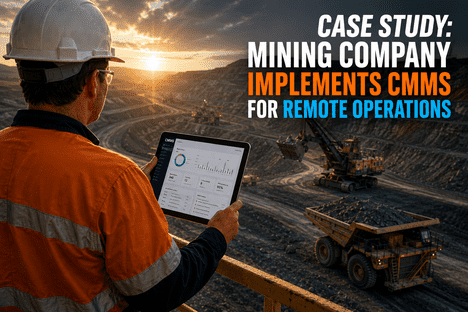
A mid-scale open-pit mining company operating across two remote extraction sites — separated by more than 140 kilometers of unsealed haul road — reached a breaking point with its legacy reactive maintenance model. A combined fleet of haul trucks, drill rigs, excavators, and crushing plant equipment was generating over 18 hours of unplanned downtime every week, with no real-time asset health visibility, no condition-based intervention capability, and maintenance teams dispatched hours after failures had already halted production. Emergency parts airlifts to the remote site, contractor mobilization at premium rates, and cascading production batch losses had pushed annual maintenance expenditure past $741,000. After deploying ifactory's AI-driven CMMS and predictive analytics platform across both sites in 52 days, the operation achieved 94% equipment uptime, reduced unplanned downtime by 83%, eliminated all emergency parts airlifts, and recovered $312,000 in annual maintenance expenditure — without adding headcount or modifying site access infrastructure.
A Remote Open-Pit Mining Operation and a Maintenance Model That Could No Longer Contain the Risk
The operation comprised two geographically separated sites with fundamentally different infrastructure profiles. Site A housed the primary crushing and processing plant — two jaw crushers, one cone crusher, three conveyors spanning 2.4 kilometers, and two vibrating screen decks — alongside the central workshop and maintenance control room. Site B, 140 kilometers away on unsealed road, supported drill-and-blast preparation, primary haul loading, and the mobile fleet's heaviest utilization cycles, but had no fixed workshop, no parts inventory, and no on-site diagnostic capability beyond what a three-person field crew could carry. Maintenance decisions for Site B assets were made from Site A — based on verbal radio reports from field technicians who had no sensor data and no equipment health history at their fingertips.
The combined mobile fleet of 38 heavy units — 14 haul trucks, 6 drill rigs, 4 excavators, and 14 auxiliary vehicles — was managed on manufacturer-recommended calendar service intervals that had never been adjusted for the actual duty cycles, ore hardness profiles, or ambient conditions at either site. An 11-person maintenance team split across both locations managed 96 tracked maintenance assets on a fly-in-fly-out roster with 8-day rotation cycles — creating knowledge continuity gaps every time a rotation turned over. Developing faults communicated verbally between outgoing and incoming crews were frequently incomplete, mischaracterized, or simply forgotten under the pressure of shift handover. The operational and financial consequences were predictable, recurring, and worsening each quarter.
Reactive Maintenance at a Remote Mining Site: Where Each Failure Becomes a Logistics Crisis
Mining equipment failure in a remote location carries a fundamentally different cost structure from the same failure at an accessible industrial facility. A haul truck drivetrain failure 140 kilometers from the nearest workshop does not generate a repair cost — it generates an emergency logistics event: a contractor mobilization call, a parts charter or airlift, a site access run across unsealed road, and a production halt that idles downstream equipment within hours if the affected unit sits on a critical haulage path. The repair itself may cost $8,000. The total event — parts logistics, contractor premium, idle downstream equipment, and lost extraction tonnes — routinely exceeded $22,000 per occurrence at this operation. With 26 haul truck failure events recorded in the year before deployment, the combined annual cost of those events alone approached $180,000.
The fixed plant at Site A generated a parallel failure pattern. Calendar-based PM intervals for crusher bearings and liner assemblies were derived from manufacturer averages that bore no relationship to the actual ore hardness, throughput loading, or ambient temperature conditions at the site. Bearings were being replaced prematurely on some assets while running to failure on others. Conveyor idlers were failing at a rate of 3–4 stoppages per month — each one halting material flow from the primary crusher through to stockpile and generating an average 2.8 hours of unplanned shutdown. The maintenance team was experienced and committed. What the operation lacked was any system capable of connecting real asset condition data to maintenance scheduling — and the financial and operational consequences of that gap were compounding each quarter.
How ifactory's AI-Driven CMMS and Predictive Analytics Were Deployed Across Both Remote Mining Sites
Following evaluation of four industrial maintenance platforms, the operation selected ifactory for its demonstrated capability in remote and disconnected monitoring environments, satellite-cellular hybrid connectivity support, and AI-driven anomaly detection that establishes equipment-specific failure baselines from live sensor data — not generic industry models that fail to account for site-specific load profiles, ore hardness, and ambient operating conditions. The platform was deployed across the full mobile fleet, all fixed plant at Site A, and critical mobile equipment at Site B — unified under a single CMMS dashboard accessible from the Site A control room, the maintenance supervisor's mobile app, and Site B field crew tablets. To see how ifactory structures remote mining CMMS deployments, Book a Demo with ifactory's mining analytics team.
Continuous Automated Inspection Across Mining Equipment — Without Scaling Inspection Labor
One of the most operationally significant capabilities deployed at the mining operation was AI vision camera integration across key inspection zones at the Site A processing plant and critical mobile equipment areas. Manual visual inspection at mining scale — across crusher chambers, conveyor belt runs, screen deck surfaces, drill rig mast components, and haul truck structural assemblies — requires substantial technician time and creates unavoidable coverage gaps between inspection rounds. A crack forming in a crusher liner, a conveyor belt surface separation beginning along a splice joint, or hydraulic fluid seeping from a haul truck actuator can develop from detectable anomaly to operational failure in fewer days than the interval between scheduled manual rounds. ifactory's AI Vision Camera platform operates continuously — detecting anomalies at the moment they form, not the moment a technician is scheduled to walk past.
The AI vision cameras deployed at Site A monitor crusher inlet zones, conveyor belt surfaces and return rollers, screen deck structural components, and mobile equipment parking areas — detecting cracks, surface wear progression, fluid leaks, belt damage, and PPE compliance violations with over 99% detection accuracy. Findings route directly into the CMMS work order queue, timestamped and categorized, eliminating the gap between visual anomaly and maintenance response. Manual inspection rounds were reduced by 80% following AI vision commissioning — freeing technician capacity for skilled repair work rather than routine observation. For full capability details on ifactory's AI Vision Camera platform in industrial environments, visit ifactory's AI Vision Camera page.
Full CMMS and Predictive Analytics Platform Live Across Both Sites in 52 Days
All 96 tracked maintenance assets inventoried and criticality-ranked by downtime impact, failure frequency, and production dependency. Sensor placement architecture designed for Site A fixed plant and mobile fleet. Connectivity assessment confirmed cellular coverage at Site A perimeter and satellite relay requirement for Site B equipment monitoring. Priority deployment plan confirmed with Site A fixed plant and highest-utilization haul trucks designated for Phase 1 deployment.
Vibration, temperature, and motor current sensors installed across both jaw crushers, cone crusher, all three conveyors, and both screen decks during a scheduled weekend maintenance shutdown — zero production interruption. OBD and engine management telematics integrated on 8 priority haul trucks during routine scheduled service windows. AI baseline models began ingesting live operational data from Day 18. Site A maintenance team trained on CMMS dashboard, work order workflow, and alert response during the active deployment window.
Satellite relay hardware installed at Site B and commissioned by Day 36. Telematics integration completed on remaining haul trucks, all drill rigs, and excavators. Site B field crew trained on tablet-based work order access and real-time alert response. Full asset portfolio live on ifactory CMMS by Day 44. AI predictive models transitioned to active alerting by Day 46 with site-specific failure thresholds validated against the first 32 days of live operational data.
ifactory parts demand forecasting module integrated with the operation's existing procurement and inventory system — enabling AI maintenance recommendations to trigger advance parts orders against planned intervention windows automatically. First condition-based haul truck drivetrain intervention completed on Day 49, 13 days ahead of failure prediction threshold, with parts sourced on standard freight rather than emergency airlift. Post-repair inspection confirmed bearing degradation consistent with the AI model's 8–14 day failure window projection.
12 Months of Measured Performance Improvement Across Both Remote Mining Sites
The transition from reactive calendar-based maintenance to AI-driven condition monitoring produced measurable improvements across every tracked performance dimension within the first two post-deployment quarters. Equipment uptime across the combined operation reached 94% — a level never previously recorded. Unplanned downtime events fell by 83%. Emergency parts airlifts were reduced from four per year to zero. And the $312,000 annual maintenance expenditure reduction delivered confirmed platform ROI within eight months of full deployment. The following metrics reflect tracked outcomes from 12 months of operational data across both sites.
| Performance Metric | Before ifactory | After ifactory | Improvement |
|---|---|---|---|
| Overall equipment uptime | ~76% | 94% | +18 percentage points |
| Unplanned downtime hours per week | 18.4 hrs avg | 3.1 hrs avg | −83% reduction |
| Haul truck failure events | ~26 per year | 3 per year | −88% failure events |
| Crusher unplanned stoppages | 6.2 hrs/week avg | 0.7 hrs/week avg | −89% stoppage time |
| Conveyor unplanned stoppages | 3–4 per month | 0–1 per month | −82% stoppage frequency |
| Emergency parts airlifts to Site B | 4 per year | 0 per year | 100% elimination |
| Mean time to detect equipment anomaly | Post-failure (reactive) | 10–18 days pre-failure | Predictive detection window |
| Emergency procurement events | ~38 per year | 4 per year | −89% emergency orders |
| Site B haul truck utilization | 61% effective availability | 88% effective availability | +27 percentage points |
| Annual maintenance expenditure | ~$741,000 | ~$429,000 | −42% cost reduction |
| Annual maintenance savings | — | $312,000 | Net annual saving confirmed |
| Deployment timeline (both sites) | N/A | 52 days | Fully live in 52 days |
Why AI-Driven CMMS Produced Comprehensive Results Across a Remote Multi-Site Mining Operation
Condition-based monitoring eliminated the structural flaw of calendar maintenance in a variable-load mining environment. Haul truck and drill rig degradation rates in open-pit mining vary significantly based on ore hardness, haul gradient, ambient temperature, and operator load technique — variables that calendar service intervals cannot account for. By monitoring actual engine vibration, drivetrain load signatures, and hydraulic pressure profiles continuously, ifactory's AI engine identified each asset's individual degradation trajectory and generated intervention timing based on real condition data — eliminating both over-maintenance of serviceable units and under-maintenance of assets running toward failure in high-load cycles.
Satellite-connected remote monitoring resolved the information asymmetry between Site A and Site B. Prior to deployment, the maintenance supervisor at Site A had no real-time visibility into the condition of equipment operating 140 kilometers away — relying entirely on verbal radio reports from a field crew with no diagnostic tooling. ifactory's satellite-hybrid connectivity gave the Site A control room the same asset visibility for remote Site B equipment as for assets physically on site — enabling proactive parts pre-positioning, contractor scheduling based on actual condition data, and maintenance coordination without emergency response timelines.
Parts demand forecasting eliminated the logistics premium that was the largest single avoidable cost in the prior model. Emergency parts sourcing for remote mining sites carries cost premiums of 40–300% above standard procurement — charter freight, priority supplier fees, and contractor mobilization at weekend rates. ifactory's 10–18 day failure prediction window converted emergency procurement events into planned orders against standard logistics timelines. The $94,000 annual emergency logistics cost embedded in the operation's maintenance budget was reduced to under $8,000 in the 12 months following deployment.
Digital shift handover records eliminated the knowledge continuity gap created by FIFO roster cycles. Under the prior model, maintenance history and equipment condition context transferred between rotations verbally — creating windows where developing faults known to the outgoing crew were not communicated to the incoming team. ifactory's digital work order history and AI-maintained asset health timelines gave each incoming rotation immediate access to the complete recent condition history of every monitored asset, ensuring 8-day roster gaps no longer created institutional amnesia windows that allowed developing faults to progress undetected.
Operational, Financial, and Safety Outcomes Beyond Uptime Improvement
Remote Mining CMMS: The Compounding Value of AI-Driven Maintenance Intelligence Across Distributed Operations
This remote mining operation's transformation from reactive calendar-driven maintenance to an AI-powered CMMS and condition monitoring platform eliminated the structural vulnerabilities that had generated chronic unplanned downtime, unsustainable emergency logistics costs, and information gaps between sites 140 kilometers apart. ifactory's platform gave the operation continuous asset-level visibility across all 96 maintenance items at both sites — and converted that visibility into actionable failure predictions, condition-based work orders, and parts demand forecasts that improved uptime, reduced logistics cost, and enhanced workforce safety performance simultaneously. The 796 recovered annual production hours, elimination of all emergency airlifts, and 94% equipment uptime across both sites are not projections — they are tracked outcomes from 12 months of live operational data across a real remote mining environment. To assess what ifactory's CMMS and predictive analytics deployment would deliver for your remote mining operation, Book a Demo with ifactory's mining analytics team.