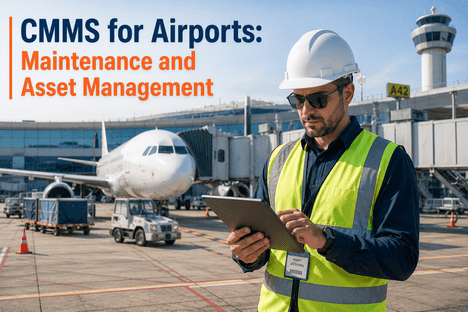
Airports are among the most operationally complex infrastructure environments in the world — managing thousands of assets across terminals, runways, baggage systems, HVAC, elevators, jet bridges, lighting, fuel systems, and security equipment across a 24/7 operational window where downtime is not a scheduling inconvenience but a safety and compliance event. A single failed escalator in a departure terminal delays passengers; a failed baggage conveyor disrupts airline operations; a compromised fire suppression or emergency lighting system puts lives at risk. This case study examines how a major international airport deployed ifactory's AI-driven CMMS platform to centralize asset management, enforce safety compliance, eliminate reactive maintenance cycles, and achieve measurable uptime improvement across a portfolio of over 4,000 maintained assets.
The Operational Maintenance Reality at a Major International Airport
Airport maintenance teams face a challenge unlike almost any other facilities environment: the assets they manage are directly tied to passenger safety, regulatory compliance, airline on-time performance, and national infrastructure security — simultaneously. A failure in a commercial facility costs money. A failure at an airport can ground flights, trigger FAA compliance violations, compromise emergency egress, or endanger aircraft ground operations. The airport in this case study was operating a traditional reactive-to-preventive hybrid model — calendar-based PM schedules managed through spreadsheets, reactive work orders handled via radio and paper log, and no centralized visibility into asset health across terminals.
The maintenance team was managing over 4,000 assets across three terminals, two concourses, and landside operations — including HVAC systems, jet bridges, escalators and elevators, baggage handling conveyors, runway lighting, fuel hydrant systems, fire suppression systems, and emergency backup power. With a 24-hour operational window and no acceptable downtime windows for most critical systems, the team was running perpetual reactive cycles. Preventive maintenance compliance was tracked retrospectively, safety inspection records were stored in physical binders, and work order prioritization was driven by who called loudest — not by asset criticality or failure probability.
What Was Breaking — and Why the Existing Model Could Not Prevent It
Before deploying ifactory's CMMS platform, the airport's maintenance operation was generating predictable failure patterns that the existing system had no mechanism to interrupt. Jet bridge hydraulic systems were failing during peak boarding windows — causing gate reassignments that cascaded into departure delays. Baggage conveyor belt motors were degrading undetected until mechanical failure, triggering baggage claim delays affecting multiple flights simultaneously. HVAC systems in security screening areas were failing during summer peak loads, creating passenger comfort incidents that required terminal-level interventions. Emergency lighting systems were passing annual inspection but failing in quarterly function tests due to battery degradation that calendar-based PM intervals were not designed to detect.
The fundamental problem was not the maintenance team — it was the absence of any system capable of connecting asset condition data to maintenance scheduling. Every intervention was retrospective. The team was skilled and experienced, but skilled technicians operating without real-time asset health data are functionally operating blind. The airport needed a CMMS that could ingest sensor data from critical assets, establish equipment-specific health baselines, generate condition-triggered work orders before failure, and maintain a complete digital compliance record — all without adding complexity that would overwhelm a maintenance team already operating at capacity.
How ifactory's AI-Driven CMMS Platform Was Deployed Across the Airport
ifactory's deployment at the airport followed a structured 60-day implementation architecture that brought the highest-criticality assets — jet bridges, baggage conveyors, HVAC air handling units, and emergency systems — live with full sensor monitoring and predictive alerting in the first 35 days, with the complete 4,000-asset portfolio covered by Day 60. Sensor installation was coordinated during scheduled maintenance windows and low-traffic overnight periods to eliminate any production interruption during deployment. The platform's AI baseline models began training from the first day of sensor connection — establishing equipment-specific anomaly detection thresholds from actual operational data, not manufacturer defaults.
AI vision cameras were commissioned across key inspection zones — jet bridge connection points, baggage handling areas, security equipment corridors, and safety-critical mechanical rooms — providing continuous automated visual inspection that replaced manual rounds with AI-detected anomaly alerts feeding directly into the CMMS work order queue. All existing maintenance history, PM schedules, and compliance documentation were migrated into the ifactory platform during deployment — converting paper records to searchable digital asset histories and establishing a single source of truth for every maintained asset in the airport portfolio. Book a Demo to see the full airport deployment architecture.
Continuous Automated Inspection Across 4,000 Assets — Without Scaling Inspection Labor
One of the most operationally significant capabilities ifactory deployed at the airport was AI vision camera integration across high-criticality inspection zones. Manual visual inspection at airport scale — across baggage handling infrastructure, jet bridge mechanical systems, HVAC equipment, runway support systems, and safety-critical areas — requires substantial technician time and creates inherent coverage gaps between scheduled inspection rounds. A crack forming in a jet bridge structural component between weekly inspection rounds can propagate to failure before the next scheduled visit. A hydraulic fluid seep in a baggage system mechanical room may go undetected for days on a manual inspection schedule. ifactory's AI Vision Camera platform operates continuously — detecting anomalies the moment they form, not the moment a technician is scheduled to walk past.
The AI vision cameras deployed at the airport detect physical defects including cracks, corrosion, surface deterioration, and fluid leaks with over 99% accuracy, and simultaneously monitor PPE compliance across maintenance work zones — generating automated safety alerts when compliance violations occur without requiring dedicated safety supervisors on every shift. Inspection findings route directly into the CMMS work order queue, timestamped and categorized, creating a continuous condition record for every monitored asset. Manual inspection labor time was reduced by 80% following AI vision commissioning. For more on how ifactory's AI vision capability operates in critical infrastructure environments, visit ifactory's AI Vision Camera product page.
Full Deployment Across All Airport Assets in 60 Days — Zero Operational Interruption
All 4,000+ airport assets inventoried and ranked by safety impact, operational criticality, failure frequency, and regulatory compliance dependency. Sensor architecture designed for highest-priority assets — jet bridges, baggage conveyors, HVAC air handling units, emergency power and lighting systems. Network infrastructure assessed for integration compatibility with ifactory platform and airport operations systems.
Sensors installed on highest-criticality assets during scheduled overnight maintenance windows — zero flight operations impact. ifactory platform connected to live sensor streams. AI baseline models begin training from Day 1 of connection. Maintenance team trained on dashboard interface, mobile work order execution, and alert response protocols. Existing PM schedules and compliance records migrated into the platform.
Sensor deployment completed across remaining asset portfolio including HVAC, electrical distribution, elevators, escalators, runway lighting, and security equipment. AI vision cameras commissioned across jet bridge zones, baggage handling areas, mechanical rooms, and safety-critical corridors. Airport operations systems integration validated and activated.
ifactory maintenance priority queue integrated with airport shift operations and work order workflows. AI-generated maintenance recommendations flowing into scheduled work order creation. First condition-based interventions completed — including a jet bridge hydraulic system flagged 19 days before predicted failure threshold and a baggage conveyor motor flagged 14 days before failure. Both resolved during planned overnight windows.
Measured Outcomes Across the Airport Portfolio — First Two Post-Deployment Quarters
The performance outcomes across the airport's first two quarters of full ifactory deployment reflected the compounding value of shifting from calendar-based reactive maintenance to AI-driven condition-based maintenance at portfolio scale. Unplanned downtime in safety-critical systems dropped by 81%, zero regulatory compliance failures were recorded across all FAA and fire code audit windows, and the first confirmed predictive intervention — a jet bridge hydraulic system failure averted 19 days before threshold — was completed at a fraction of the cost of an emergency repair under the prior maintenance model. The following metrics reflect tracked outcomes from the airport deployment.
| Performance Metric | Before ifactory | After ifactory | Improvement |
|---|---|---|---|
| Overall equipment uptime (critical assets) | ~83% | 97% | +14 percentage points |
| Unplanned downtime events per month | ~22 events/month | 4 events/month | −82% event reduction |
| Jet bridge availability during peak operations | ~87% | 99% | +12 percentage points |
| Regulatory compliance audit pass rate | Periodic failures | 100% pass rate | Full compliance achieved |
| Mean time to detect equipment anomaly | Post-failure (reactive) | 14–21 days pre-failure | Predictive detection window |
| Visual inspection manual labor time | 100% manual rounds | −80% time reduction | AI vision automated detection |
| Safety audit preparation time | 3–5 days manual compilation | Same-day digital export | Real-time compliance records |
| Emergency parts procurement events | ~28 per year | 3 per year | −89% emergency orders |
| Annual maintenance expenditure | ~$1.1M | ~$630K | −43% cost reduction |
| PM compliance rate | ~71% | 99% | +28 percentage points |
How ifactory Addresses Airport-Specific Safety and Regulatory Compliance Requirements
Airport maintenance operations exist within a layered regulatory environment that has no equivalent in standard commercial or industrial facilities management. FAA safety inspection standards govern airside equipment. OSHA regulations cover maintenance personnel working in proximity to aircraft operations. Fire code authorities require documented inspection records for suppression, detection, and egress systems. TSA mandates uptime requirements for security screening equipment that directly affect passenger processing throughput. A CMMS deployed in an airport context must not only manage work orders and PM schedules — it must function as a compliance documentation platform that produces audit-ready records on demand.
ifactory's platform was configured during the airport deployment to align PM scheduling with regulatory inspection intervals for every compliance-governed asset class — fire suppression systems, emergency lighting, backup power, runway lighting, and security equipment — and to generate automatic compliance alerts when upcoming inspection windows approached. Every completed work order is timestamped, technician-signed, and linked to the relevant asset's compliance record. Safety audit preparation, previously a multi-day manual document compilation process, is reduced to a same-day digital export from a unified compliance dashboard. Book a Demo to see how ifactory manages compliance documentation for safety-critical infrastructure.
Real-time compliance status dashboards give airport maintenance leadership and safety officers instant visibility into the compliance status of every regulated asset — which systems are current, which are approaching inspection intervals, and which require immediate attention — without requiring manual record searches.
Automated PM scheduling aligned to regulatory intervals ensures that no compliance-governed inspection window is missed due to scheduling gaps or manual tracking errors — eliminating the documentation risk that paper-based systems create between annual audit cycles.
Digital work order sign-off and technician certification tracking creates an auditable chain of custody for every maintenance activity on regulated systems — confirming who performed the work, when, with what parts, and against which compliance requirement.
AI vision PPE and safety zone monitoring provides continuous enforcement of airside and maintenance zone safety requirements — detecting violations in real time without requiring dedicated safety supervision staff on every shift across a 24-hour operational environment.
What This Airport Deployment Reveals About CMMS in Safety-Critical Infrastructure
Asset criticality ranking is not optional in safety-critical environments. When every work order queues in the same flat list, a routine lighting replacement can block a safety system maintenance task. Airport CMMS deployment requires criticality-weighted work order prioritization from Day 1 — driven by safety consequence and regulatory dependency, not queue order.
The ROI case in airport environments is built on risk averted, not just cost saved. A single jet bridge failure during peak boarding is not a $50,000 event — it is a gate reassignment, a departure delay, airline compensation exposure, and a passenger safety incident report. The financial case for predictive maintenance in airport infrastructure is measured in catastrophic event prevention, not just maintenance cost reduction.
Compliance documentation is a maintenance function, not a separate administrative process. Airports that treat compliance record-keeping as a parallel system to work order management create documentation gaps that become regulatory liability. A CMMS that generates compliance records as a native output of every completed work order eliminates this gap structurally.
AI vision enables continuous inspection coverage that staffing cannot. A 4,000-asset airport portfolio across a 24-hour operational window cannot be manually inspected at the frequency required to detect early-stage anomalies before they propagate. AI vision provides the coverage density that inspection labor physically cannot match — at a cost structure that scales without adding headcount.
CMMS for Airports: What Predictive Maintenance Intelligence Delivers at Scale
The airport case study demonstrates what becomes possible when a CMMS platform combines traditional work order management and PM scheduling with AI-driven predictive analytics, continuous AI vision inspection, and digitized compliance documentation — deployed across a safety-critical infrastructure portfolio where failure has consequences that extend far beyond operational cost. The 97% critical asset uptime, 100% regulatory audit pass rate, 81% unplanned downtime reduction, and $470,000 in annual maintenance savings are not modeled projections — they are tracked outcomes from an operational airport deployment operating under real FAA, OSHA, and fire code compliance requirements across a 24-hour, 365-day production environment.
For airport operators, aviation infrastructure managers, and facility teams managing safety-critical asset portfolios, the question is no longer whether AI-driven CMMS delivers measurable value over calendar-based reactive maintenance. The performance gap between those two models is now documented, quantified, and replicable. The question is how quickly that transition can be completed. ifactory deploys across a full asset portfolio — including sensor installation, AI baseline training, AI vision camera commissioning, and compliance system integration — within 60 days, with zero operational interruption during deployment. To assess what ifactory's platform would deliver for your airport or critical infrastructure environment, Book a Demo with ifactory's industrial analytics team.