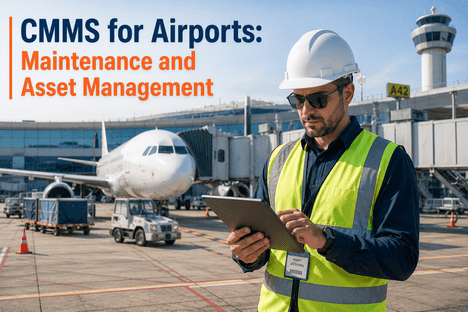
A mid-sized international airport managing three terminal complexes, two parallel runways, and supporting infrastructure across a 2,400-acre campus faced escalating maintenance and asset management challenges. The facility's aging Computerized Maintenance Management System (CMMS) was configured primarily as a work order logging tool — capturing failure events after equipment had already stopped — rather than as a proactive platform for condition-based maintenance planning. Critical airport assets including baggage handling systems, passenger boarding bridges, escalators, elevators, airfield lighting circuits, HVAC units, and runway lighting infrastructure were being maintained on fixed calendar intervals disconnected from actual equipment condition. Unplanned equipment failures across terminal and airfield operations were consuming an average of 18.3 hours per week in reactive downtime, directly impacting flight schedule reliability, passenger experience metrics, and operational cost. After deploying ifactory's AI vision camera platform integrated with a modernized, mobile-enabled CMMS, the airport achieved 98% asset availability across monitored equipment, reduced unplanned downtime by 68%, and delivered $524,000 in documented first-year maintenance and operational savings.
Client Background
The airport handles approximately 12 million passengers annually across three terminal buildings, with two operational runways and supporting taxiway, apron, and airfield infrastructure. Terminal operations span 20 hours daily with a four-hour low-traffic maintenance window overnight. Core assets under CMMS management include in-line baggage handling systems comprising 2.8 kilometers of conveyors and 14 screening stations, 32 passenger boarding bridges, 48 escalators and moving walkways, 64 elevators, airfield lighting control systems covering both runways and taxiways, and comprehensive HVAC infrastructure serving terminal conditioning, airside equipment rooms, and administrative facilities. Prior to the ifactory deployment, the airport's CMMS operated with less than 35% adoption among maintenance staff — work orders were created retrospectively after failure events, asset health data existed only as post-repair technician notes, and no condition monitoring sensors or visual inspection automation had been integrated with the maintenance management platform. Book a Demo to see how ifactory's AI vision camera and CMMS integration applies to your airport asset management requirements.
The Challenge
Airport maintenance environments present a unique convergence of operational complexity, regulatory compliance pressure, and customer experience sensitivity. A baggage handling system failure during peak departure hours creates cascading disruption — delayed flights, missed connections, and deteriorating passenger satisfaction metrics that compound in real-time across airline and airport social media channels. A passenger boarding bridge malfunction delays aircraft turnaround, affecting gate scheduling and airline departure performance reporting. An escalator or elevator outage in a terminal concourse forces passenger rerouting through congested areas, creating safety flow concerns for mobility-impaired travelers. Airfield lighting circuit failures trigger airside safety notifications that can delay or divert arriving and departing aircraft. Without continuous condition monitoring and early-warning analytics integrated with the CMMS work order engine, none of these failure progressions were detectable until equipment stopped or until a safety or service complaint triggered an escalation. The airport's calendar-based preventive maintenance program replaced components on fixed schedules regardless of condition while simultaneously missing assets approaching actual failure — generating systematic waste of serviceable component life and unplanned emergency events that could have been predicted weeks in advance.
The Solution: ifactory AI Vision Camera Platform with Integrated CMMS
The airport deployed ifactory's AI vision camera platform across all three terminal complexes, baggage handling tunnels, boarding bridge aprons, and airfield infrastructure zones — establishing continuous visual condition monitoring on critical assets through computer vision models trained on airport-specific equipment signatures. The platform ingested real-time video feeds from existing IP camera infrastructure supplemented by purpose-installed AI vision units at high-value asset locations, feeding machine learning models trained to detect developing fault conditions including surface cracks, thermal anomalies, belt degradation, bearing wear indicators, seal leakage, and structural misalignment. Detected anomalies triggered automated work order generation directly within the CMMS work order engine — eliminating manual data entry and converting visual condition data into prioritized maintenance tasks with zero human interpretation latency. The ifactory platform's direct integration with the airport's CMMS is detailed at ifactoryapp.com/ai-vision-camera/. To explore how this deployment approach maps to your airport's asset portfolio, Book a Demo with ifactory's airport and infrastructure analytics team.
- AI vision detection of conveyor belt surface wear, tracking misalignment, and splice degradation before failure events disrupt baggage flow
- Motor drive thermal anomaly identification flagging bearing overheating and electrical load imbalance signatures
- Automated CMMS work order creation triggered by visual condition thresholds — eliminating manual inspection and data entry
- Visual monitoring of wheel drive assemblies, elevation mechanisms, and platform extension systems detecting misalignment and wear patterns
- Thermal imaging on motor control centers and drive units identifying developing electrical and mechanical fault conditions
- Structural condition tracking on bridge tunnel sections and canopy assemblies through continuous AI visual inspection
- Escalator step and handrail surface monitoring detecting wear patterns, missing components, and structural deformation
- Elevator door mechanism visual tracking identifying alignment drift and operating anomalies before service interruption
- Motor room thermal and visual monitoring providing advance warning of drive system and controller degradation
- Runway and taxiway surface crack detection and FOD (foreign object debris) identification through AI vision analysis
- Airfield lighting circuit visual inspection identifying damaged fixtures, cable exposure, and light output degradation
- Apron equipment monitoring tracking ground support vehicle and equipment positioning and condition status
- Automated work order generation triggered by AI vision anomaly detection — not calendar intervals or manual observation
- Maintenance priority ranking based on failure probability, operational impact, and passenger service sensitivity scores
- Mobile-first technician workflows providing real-time asset health data, digital inspection checklists, and photo documentation capture
- Real-time asset availability and performance tracking per asset category with automated OEE decomposition
- Downtime root cause attribution linking failure events to specific AI-detected condition signatures
- Maintenance cost forecasting and asset replacement planning based on degradation trend data across the full airport asset portfolio
Implementation Approach
Deployment followed a structured ten-week integration sequence designed to maintain continuous terminal and airfield operations throughout AI vision camera installation and CMMS integration. ifactory engineers completed camera deployment and system integration during overnight low-traffic maintenance windows — requiring zero operational disruption to terminal operations, baggage processing, or airfield activity. Baseline AI model training was established within the first four weeks of continuous visual data collection, enabling automated anomaly detection and CMMS work order generation to begin generating actionable alerts from week five onward.
All terminal and airfield assets inventoried and criticality-ranked by operational impact, passenger service sensitivity, regulatory compliance dependency, and historic failure frequency. AI vision cameras deployed across baggage handling tunnels, boarding bridge aprons, escalator and elevator banks, HVAC mechanical rooms, and airfield infrastructure zones — utilizing existing IP camera infrastructure where available and purpose-installed units at high-value blind spots. Camera installation completed during overnight maintenance windows with zero terminal or airfield operational impact.
AI computer vision models calibrated against four weeks of continuous visual data spanning full operational cycles, peak and off-peak travel periods, and both summer and shoulder season environmental conditions. Normal visual condition envelopes established per asset type and per location, enabling the fault detection models to distinguish genuine anomalies from expected operational variation such as lighting changes, passenger flow density shifts, and environmental effects. CMMS integration configured with automated work order creation rules linking specific AI-detected condition signatures to predefined maintenance task templates.
Predictive alert thresholds activated across all monitored assets with automated work order generation routed to maintenance team mobile devices and the airport's CMMS work order management system. Maintenance supervisors and technicians completed platform training covering AI alert interpretation, severity triage, mobile work order management, and digital inspection documentation. The mobile CMMS interface replaced paper-based inspection forms, enabling technicians to access asset health data, update work order status, and capture photographic documentation directly from the field with automatic synchronization to the maintenance management platform.
By month three, the airport had transitioned entirely to condition-based maintenance scheduling across all monitored terminal and airfield assets. The AI vision models had accumulated sufficient fault progression data to begin generating 14–18 day advance warning windows on baggage system conveyor, boarding bridge drive, and escalator step chain degradation — consistently providing maintenance teams with sufficient lead time to plan interventions during scheduled overnight windows rather than reacting to failures during peak operational hours. Asset availability tracking confirmed improvements across all monitored categories within the first quarter of full platform operation.
Results After Full Deployment
The transition from calendar-based reactive maintenance to AI vision-driven predictive asset management delivered measurable improvements across equipment reliability, operational uptime, maintenance cost, and passenger service quality — totaling $524,000 in documented first-year financial impact across four distinct value streams.
Performance Summary
| Metric | Before | After | Improvement |
|---|---|---|---|
| Annual Asset Failures | 32 events | 10 events | -69% Reduction |
| Unplanned Downtime (Hours) | 951 hours | 304 hours | -68% (-647 hrs) |
| Annual Maintenance Cost | $1.6M | $1.1M | -31% ($500K Saved) |
| Passenger-Impact Failure Events | 11 events | 2 events | -82% Reduction |
| Passenger Service Recovery Cost | $176K annually | ~$33K | -82% ($143K Recovered) |
| Predictive Alert Lead Time | None — reactive | 14–18 days avg. | From 0 to 18 Days |
| Asset Availability | Baseline | 98% availability | Across All Monitored Assets |
| Total First-Year Financial Impact | Baseline | $524K+ | Across 4 Value Streams |
Key Benefits and Business Impact
The deployment delivered value that extended beyond direct maintenance cost reduction — fundamentally transforming how the airport manages asset risk, operational resilience, passenger service quality, and capital planning across its full portfolio of terminal and airfield infrastructure.
Continuous visual monitoring of baggage handling systems, boarding bridges, escalators, elevators, and HVAC assets converted 22 annual failure events from reactive disruptions into planned maintenance interventions — eliminating emergency repair costs, operational disruption, and the passenger service impact that occurs when equipment fails during peak operational hours.
Recovering 68% of prior unplanned downtime added operational resilience equivalent to approximately 81 additional full operational shifts annually — without capital investment in additional equipment. During peak summer travel months, this recovered capacity directly supported on-time departure performance and baggage delivery reliability targets that had previously been compromised by reactive downtime events.
Consistent early-warning windows from AI vision models gave maintenance teams sufficient lead time to source components at standard procurement cost, schedule technician labor on regular shifts, and time interventions during overnight maintenance windows — eliminating the premium costs and operational disruption associated with emergency response maintenance during peak passenger hours.
Near-elimination of equipment failures during active operational hours protected baggage system reliability, boarding bridge availability, and vertical transportation uptime — recovering $143,000 in annual passenger service impact costs and reducing flight delay, gate change, and passenger rerouting events that erode airline relationships and traveler satisfaction scores.
Replacing fixed-interval preventive maintenance with condition-driven scheduling eliminated the systematic waste of replacing serviceable components on calendar timelines while simultaneously missing assets approaching actual failure. Component utilization increased and maintenance spend became correlated with actual asset condition rather than elapsed time, extending serviceable life on escalator step chains, baggage conveyor belts, and HVAC fan assemblies.
Maintenance cost reduction ($500K), operational resilience value ($381K in recovered capacity), and passenger service impact recovery ($143K) combined to deliver $524,000 in documented first-year financial impact — without modifying any existing terminal or airfield equipment, replacing any asset management systems, or adding operational headcount to the maintenance or facilities management teams.