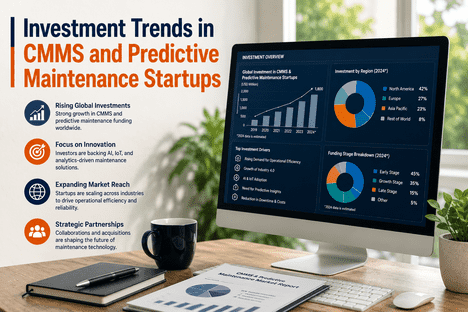
The CMMS and predictive maintenance sector has become one of the most actively funded segments in industrial software, and the numbers behind that momentum tell a story that every maintenance and operations leader needs to understand. The global predictive maintenance market is projected to surge from $10.93 billion in 2024 to over $70 billion by 2032 at a compound annual growth rate of 26.5%, while the CMMS market is on track to grow from $2.4 billion in 2026 to nearly $5.9 billion by 2036 at a 9.3% CAGR. Venture capital is following these growth signals at scale — MaintainX closed a $150 million Series D round in July 2025, Tractian raised $120 million in a Series C led by Sapphire Ventures in December 2024, and UpKeep secured $50 million in Series D funding in early 2025 to accelerate AI-driven maintenance automation. Across the broader preventive and predictive maintenance ecosystem, more than 1,400 investors have completed over 1,800 funding rounds across 1,300+ companies, with average round sizes of $10.4 million. These are not isolated bets — they reflect a structural conviction that the transition from reactive to AI-powered predictive maintenance is one of the most durable investment themes in Industry 4.0. iFactory is the unified platform that enterprise and mid-market operators choose when they want the AI vision monitoring, predictive intelligence, and digital twin capabilities that investors are actively funding into startups — delivered as a single, production-ready solution trusted by 500+ industrial facilities globally. Book a Demo to see how iFactory maps to the capabilities reshaping maintenance investment in 2026.
See the Predictive Maintenance Platform Trusted by 500+ Facilities
iFactory delivers AI vision monitoring, predictive maintenance, digital twin simulation, and IIoT analytics in one unified platform — purpose-built for industrial operations. First sensors operational in 4 weeks.
Why Investors Are Pouring Capital Into CMMS and Predictive Maintenance
The investment rationale behind CMMS and predictive maintenance startups is grounded in a problem with an enormous and quantifiable cost profile. Unplanned equipment downtime costs the average Fortune 500 company $2.8 billion per year — approximately 11% of annual revenue — and the per-hour cost of unplanned downtime roughly doubled between 2019 and 2024. Despite this, 59% of facilities still operate without any centralized CMMS or work order management system, and only 27% of maintenance teams have deployed predictive maintenance as their primary strategy. That gap between the cost of inaction and the breadth of underdeployment is precisely what has made this sector one of the most consistently funded verticals in industrial technology. Investors are not betting on a technology that might work — they are backing platforms that are already demonstrating 25–30% maintenance cost reductions and 35–50% downtime reductions in documented deployments.
The transition from time-based to condition-based and AI-driven maintenance is also structurally irreversible. As IIoT sensor infrastructure becomes cheaper and more standardized, as AI models trained on industrial failure data mature, and as ESG and compliance reporting requirements drive the need for automated data collection, the case for remaining on manual maintenance logs and calendar-based schedules weakens with every production cycle. 95% of organizations that have adopted predictive maintenance report positive ROI, with 27% achieving full platform cost amortization within the first year. These are the numbers that are pulling capital into the sector at accelerating rates through 2025 and 2026.
Predictive Maintenance Market Growth
The global predictive maintenance market reached $10.93 billion in 2024 and is projected to grow to over $70 billion by 2032 at a CAGR of 26.5% — one of the fastest-growing sectors in industrial software investment globally.
CMMS Market Expansion
The CMMS market is projected to reach $2.4 billion in 2026 and expand to $5.9 billion by 2036, growing at 9.3% CAGR — driven by enterprises converting maintenance from a reactive cost center into a governed operational discipline.
Downtime Cost Pressure
$2.8 billion in annual downtime costs for the average Fortune 500 company creates a structural, board-level mandate for operational improvement — and positions every dollar invested in predictive maintenance as a direct offset to the most visible line item on executive dashboards.
Workforce & Knowledge Risk
With nearly 70% of the maintenance workforce over 50, the US alone expects approximately 159,800 maintenance and repair openings per year through 2034. Investors see AI-powered CMMS platforms as the knowledge preservation and workflow automation layer that addresses this unavoidable transition.
IIoT Infrastructure Maturity
35% of maintenance professionals now use IIoT sensors extensively, with 41% testing or considering deployment. This growing sensor infrastructure creates the data substrate that AI-powered predictive maintenance platforms require — and makes late-adopter catch-up investments even more urgent.
ESG & Compliance Mandates
Expanding ISO 50001, EPA, and ESG reporting requirements are creating demand for automated compliance data collection that CMMS platforms are uniquely positioned to deliver — adding a regulatory compliance use case on top of the pure operational efficiency investment thesis.
Notable CMMS & Predictive Maintenance Funding Rounds: 2024–2025
The following rounds represent the largest and most strategically significant capital deployments in the CMMS and predictive maintenance sector over the past 18 months — and collectively define where the market is heading.
| Company | Round | Amount | Lead Investor(s) | Strategic Focus |
|---|---|---|---|---|
| MaintainX | Series D | $150M | Bessemer Venture Partners, Bain Capital Ventures | AI machine health monitoring, EAM capabilities, predictive maintenance |
| Tractian | Series C | $120M | Sapphire Ventures | Manufacturing AI, industrial monitoring, predictive maintenance hardware + software |
| UpKeep | Series D | $50M | Undisclosed | AI-driven maintenance automation, international CMMS market expansion |
| Augury | Multiple rounds | $300M+ | Various institutional | Industrial AI for machine health, manufacturing predictive intelligence |
| SAP / Maintenance Connection | Acquisition | Undisclosed | SAP | Cloud CMMS integration into enterprise ERP, utilities and manufacturing focus |
Five Investment Themes Defining the CMMS and Predictive Maintenance Startup Landscape
Venture capital flowing into CMMS and predictive maintenance is not indiscriminate. The rounds of 2024–2025 reflect five distinct investment theses that collectively describe where the market is heading — and what capabilities operations teams should be evaluating when assessing platforms for long-term strategic fit. iFactory is built at the convergence of all five, delivering AI vision monitoring, predictive maintenance models, digital twin simulation, and automated compliance reporting within a single platform that connects to your existing operational technology stack. Book a Demo to see how iFactory's capability architecture maps to the investment themes reshaping the maintenance sector.
AI-Native Failure Prediction Replacing Rule-Based Alerts
Early-generation CMMS platforms issued alerts based on fixed thresholds — vibration above X, temperature above Y. Investors are now backing platforms that use machine learning models trained on equipment-specific behavior to detect deviation patterns weeks before they produce a failure event. Tractian's $120M Series C and Augury's $300M+ total raise reflect the conviction that ML-driven anomaly detection — with accuracy rates of 91–96% — represents a fundamentally different category of maintenance intelligence than threshold alerting. iFactory's pre-trained AI models cover pump, compressor, and turbine failure modes with failure prediction accuracy exceeding 94% and a false alert rate below 3%, operating from day one before facility-specific refinements accumulate.
Computer Vision and AI Cameras as a Maintenance Intelligence Layer
The global industrial machine vision market is growing from $17.47 billion in 2026 to a projected $33.4 billion by 2034, and investors are backing platforms that extend predictive maintenance beyond sensor data into the visual dimension. AI vision cameras deployed on industrial infrastructure perform continuous monitoring for corrosion, leaks, structural anomalies, and equipment degradation — between manual inspection cycles and at a fraction of the cost. iFactory's AI Vision Monitoring module applies computer vision across pipeline infrastructure, wellhead equipment, and processing units, detecting leaks and anomalies faster than any manual inspection schedule. The AI camera market is separately growing from $14.1 billion in 2026 to $38.7 billion by 2034 at a 15.3% CAGR, reflecting the scale of enterprise investment in visual intelligence for industrial operations.
CMMS as a Unified Operations Platform, Not Just a Records System
The CMMS platforms attracting the largest rounds in 2024–2025 share a common characteristic: they have moved beyond work order records management into unified operational intelligence. MaintainX's $150M Series D specifically targeted AI machine health monitoring and enterprise asset management capabilities — expanding the platform's addressable function from records to decisions. The CMMS market itself is transitioning from systems that document what happened to engines that determine what should happen next, triggering condition-based work orders from sensor signals, routing tasks by technician certification, and forecasting parts demand ahead of planned interventions. iFactory's eight AI-powered modules operate from this unified platform architecture — connecting SCADA, historian, CMMS, and workforce data into a single intelligence layer.
Digital Twin Simulation as a Standard Maintenance Capability
Physics-based digital twins — virtual replicas of physical assets synchronized with live sensor data — have moved from R&D projects at large aerospace and energy companies to standard expectations in enterprise maintenance platforms. Investors are backing platforms that deliver digital twin functionality as part of a broader maintenance intelligence suite rather than as a standalone engineering tool. The ability to test maintenance interventions virtually before touching a physical asset, simulate production scenarios against current equipment health, and forecast failure timing through physics-based modeling rather than pure statistical correlation is becoming a baseline expectation for enterprise buyers. iFactory's Digital Twin Simulation module provides this capability across wells, pipelines, and processing equipment — synchronized in real time with live operational data for scenario testing and outcome forecasting.
Automated ESG and Compliance Reporting as a Revenue Driver
Expanding regulatory requirements around methane emissions, VOC monitoring, GHG Protocol reporting, and ISO 50001 compliance are creating a new and durable revenue stream for CMMS platforms that can automate the data collection and documentation these frameworks require. Operators who still rely on manual consolidation of compliance data are carrying audit risk and labor overhead that AI-integrated CMMS platforms can eliminate entirely. 40% of manufacturing companies now apply predictive maintenance alongside preventive strategies specifically to meet ESG and reliability reporting mandates. iFactory aggregates methane, VOC, and flaring data from IIoT sensor networks and auto-generates EPA and state-level compliance reports — removing manual data consolidation entirely and keeping reports audit-ready the moment a reporting period closes.
CMMS and Predictive Maintenance: Adoption Statistics That Define the Opportunity
The following benchmarks frame the gap between current adoption levels and the outcomes that AI-powered platforms are delivering — and explain why investor conviction in this sector continues to accelerate.
| Metric | Current State | With AI-Powered CMMS / PdM | Impact |
|---|---|---|---|
| Facilities using CMMS | 59% (41% without any system) | 100% centralized work order data | Eliminates data blindspot |
| Predictive maintenance adoption | 27% of maintenance teams | Full condition-based monitoring | 25–30% cost reduction |
| AI adoption in maintenance | 32% fully/partially implemented | 65% expected to adopt within 12 months | Market doubling in 24 months |
| Unplanned downtime | $2.8B avg. annual Fortune 500 cost | 35–50% downtime reduction | $980M–$1.4B recoverable per company |
| Predictive maintenance ROI | Positive ROI: 95% of adopters | Full amortization within 12 months: 27% | 10× ROI possible at full deployment |
What the Investment Landscape Means for Maintenance and Operations Leaders
The surge in venture capital flowing into CMMS and predictive maintenance startups carries a practical implication for maintenance and operations teams that goes beyond market statistics. When Tractian raises $120 million to advance industrial AI monitoring and MaintainX raises $150 million to expand AI machine health capabilities, it is because enterprise buyers are actively purchasing these capabilities — and the ROI evidence is strong enough to sustain that purchasing cycle. For operations leaders still evaluating whether AI-powered maintenance is ready for production deployment, the funding rounds are the most credible signal available: the technology is mature, the outcomes are documented, and the competitive gap between facilities that have adopted it and those that have not is widening every quarter.
The practical question for maintenance leaders is not whether to adopt AI-powered CMMS and predictive maintenance — the statistical and financial case is closed. The decision is which platform to build that foundation on, and whether to assemble capabilities from multiple funded startups or deploy a unified platform that integrates all of them. iFactory delivers the full capability stack — predictive maintenance, AI vision monitoring, digital twin simulation, IIoT analytics, OEE tracking, and automated ESG compliance reporting — in a single platform that connects to existing SCADA, DCS, and historian infrastructure without requiring system replacement. Book a Demo and see how iFactory's unified architecture compares to point solutions across the funded startup landscape.
"The investment activity in CMMS and predictive maintenance is not a leading indicator — it's a lagging confirmation of operational reality. Facilities that have deployed AI-powered condition monitoring are consistently delivering 30–50% downtime reductions and 25% maintenance cost savings. That performance data is what is driving both the enterprise purchasing decisions and the venture capital rounds. For any maintenance leader who is still treating AI adoption as a future-state planning item, the runway for that delay is narrowing fast."
One Unified Platform vs. Multiple Funded Point Solutions: The Architecture Decision
The investment landscape has produced a competitive field of well-funded point solutions — standalone predictive maintenance sensors, standalone CMMS platforms, standalone AI vision systems, and standalone digital twin tools. For enterprise operators, assembling these into a coherent operational picture requires custom integration work, multiple vendor relationships, separate data pipelines, and a significant internal engineering overhead. iFactory was designed to eliminate that fragmentation by delivering all eight AI-powered modules — including the predictive maintenance, computer vision, digital twin, and compliance automation capabilities that investors are individually funding at scale — in a single platform that installs in four weeks and connects to existing OT infrastructure without rip-and-replace. The result is an operational intelligence layer that gets more accurate and more valuable with every production cycle it observes, rather than a collection of disconnected tools that each require separate management and maintenance. Book a Demo to compare iFactory's unified capability set against the point solution landscape directly.
Predictive Maintenance — AI Failure Detection
Pre-trained ML models detect compressor, pump, and turbine degradation 3–4 weeks before failure using vibration, temperature, and pressure signatures. Failure prediction accuracy exceeds 94% with a false alert rate below 3% — from day one, before facility-specific refinements accumulate. Comparable to capabilities backed by $120M+ rounds in the funded startup landscape.
AI Vision Monitoring — Computer Vision on Industrial Assets
Computer vision deployed across pipeline infrastructure, wellhead equipment, and processing units detects leaks, corrosion, and structural anomalies faster than manual inspection. Continuous visual monitoring fills the coverage gap between scheduled inspection rounds — delivering the capabilities that the $14B+ AI camera market is scaling to address.
Digital Twin Simulation — Physics-Based Virtual Replicas
Physics-accurate digital twins of wells, pipelines, and processing equipment synchronized in real time with live sensor data. Operators test maintenance scenarios, simulate production outcomes, and forecast failure timing virtually — before any intervention touches the physical asset. Delivers the simulation depth that major industrials have historically required dedicated engineering platforms to achieve.
ESG & Compliance Automation — Zero Manual Reporting
IIoT sensor network aggregation of methane, VOC, and flaring data with auto-generated EPA GHG, EPA Methane Emissions, and state-level compliance reports. Zero manual data consolidation — reports are audit-ready the moment the reporting period closes. Addresses the compliance automation investment theme that is adding regulatory moat value to CMMS platforms in 2025–2026 rounds.
Turning Investment Trends Into Operational Decisions: Where iFactory Fits
The investment data is clear: CMMS and predictive maintenance technology is in the middle of a capital-intensive maturation cycle that is rapidly separating facilities deploying AI-powered condition monitoring from those still operating on reactive and calendar-based models. The $300M+ raised by Augury, the $150M raised by MaintainX, the $120M raised by Tractian, and the $50M raised by UpKeep are not outlier events — they are recurring signals that enterprise buyers are purchasing these capabilities at scale and delivering documented ROI. For operations teams, the practical conclusion is straightforward: the window for treating AI-powered maintenance as a future planning item has closed. The operational and competitive advantages of deployment are compounding monthly, and the cost of delay is measured in the same units as the Fortune 500 downtime figures — hundreds of millions of dollars per year in recoverable losses. iFactory delivers the complete platform that makes these outcomes achievable — predictive maintenance, AI vision monitoring, digital twin simulation, IIoT analytics, and automated compliance reporting — without the integration complexity of assembling point solutions. Book a Demo to see where iFactory delivers the fastest measurable ROI across your specific asset portfolio.
Frequently Asked Questions
Q: How large is the CMMS market in 2026 and what is driving its growth?
The CMMS market is valued at approximately $2.4 billion in 2026 and projected to reach $5.9 billion by 2036, growing at a 9.3% CAGR. Growth is driven by enterprises converting maintenance from a reactive cost center into a governed operational discipline — particularly through the integration of AI, IIoT sensors, and condition-based work order management into CMMS platforms that have historically been records systems.
Q: Which predictive maintenance startups have raised the most significant funding rounds recently?
The most significant recent rounds include MaintainX's $150M Series D in July 2025, Tractian's $120M Series C in December 2024 led by Sapphire Ventures, UpKeep's $50M Series D in early 2025, and Augury's cumulative raise of over $300M. These rounds collectively reflect institutional conviction in AI-driven industrial maintenance as one of the highest-conviction investment themes in operational technology.
Q: What ROI does predictive maintenance deliver compared to traditional maintenance approaches?
95% of organizations that have adopted predictive maintenance report positive ROI, with 27% achieving full platform cost amortization within the first year. Documented outcomes include 25–30% maintenance cost reductions, 35–50% unplanned downtime reductions, and up to 10× ROI at full deployment maturity — compared to calendar-based maintenance that misses 60–70% of actual equipment degradation patterns.
Q: How does iFactory compare to the funded predictive maintenance startups in its capabilities?
iFactory delivers the full capability stack that investors are individually funding across multiple startups — AI failure prediction, computer vision monitoring, digital twin simulation, IIoT analytics, and automated ESG compliance reporting — in a single unified platform. Where funded startups typically address one dimension of the maintenance intelligence problem, iFactory connects all eight AI-powered modules into a single intelligence layer trusted by 500+ industrial facilities globally.
Q: How quickly can iFactory's predictive maintenance and AI vision capabilities be deployed?
iFactory connects to existing SCADA, DCS, PLC, and historian systems via OPC-UA, MQTT, and REST APIs — no infrastructure replacement required. Most facilities achieve live predictive monitoring within four weeks. Pre-trained AI models for pump, compressor, and turbine failure modes activate immediately, with facility-specific refinement beginning from day one of live data collection.
500+ Facilities. One Unified Platform. Predictive Intelligence Live in 4 Weeks.
iFactory delivers every capability that investors are separately funding across the CMMS and predictive maintenance startup landscape — in a single platform that connects to your existing OT infrastructure without system replacement.