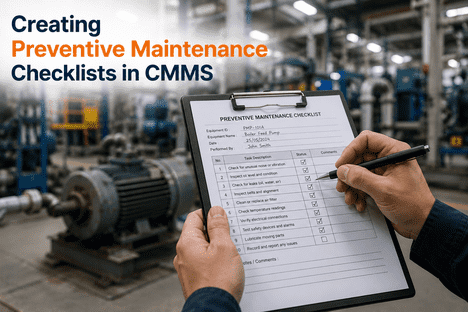
Preventive maintenance checklists are the operational backbone of every high-performing CMMS program — they are the structured, repeatable instructions that ensure every technician performs every task on every asset with the same precision, regardless of experience level, shift, or how many times the job has been done before. Yet most organizations that struggle with PM compliance, high reactive maintenance ratios, and inconsistent asset reliability can trace the root cause directly to poorly designed, incomplete, or outdated checklists that technicians cannot execute effectively in the field. Creating preventive maintenance checklists in CMMS correctly — with the right task structures, frequency logic, resource requirements, and condition-based triggers — is one of the highest-leverage investments a maintenance organization can make in 2026, delivering measurable improvements in schedule compliance, technician productivity, asset availability, and overall equipment effectiveness that persist for the life of the asset register.
Why CMMS Preventive Maintenance Checklists Determine Reliability Outcomes
Checklists Are the Interface Between Planning and Execution
A preventive maintenance program can be theoretically sound — correct frequencies, appropriate task types, right asset coverage — and still fail consistently if the CMMS checklists that technicians execute in the field are vague, missing critical inspection steps, or disconnected from the actual failure modes the PM program is designed to prevent. Checklist quality is the single most controllable variable determining whether a PM program delivers its designed reliability outcomes or simply generates paperwork. For organizations ready to build best-practice checklists that integrate with real-time condition data, Book a Demo to see how iFactory's platform supports intelligent PM checklist management.
Industry 4.0 Is Transforming What CMMS Checklists Can Do
In 2026, the most competitive maintenance organizations are deploying CMMS checklists that are dynamically triggered by IoT sensor readings and AI vision alerts — not static calendar intervals. When iFactory's AI vision camera detects a thermal anomaly on a motor drive, it does not merely create a work order; it populates a specific, pre-configured checklist with the relevant inspection steps, attaches the annotated image evidence, and routes it to the appropriately skilled technician within minutes of detection. This is the architecture that separates condition-based maintenance from traditional time-based PM programs.
The Complete CMMS Preventive Maintenance Checklist Builder
PM Checklist Quality: Manual vs. AI-Enhanced CMMS Approach
| Checklist Dimension | Traditional Manual Checklists | AI-Enhanced CMMS Checklists (iFactory) |
|---|---|---|
| Trigger Mechanism | Fixed calendar interval regardless of asset condition | Condition-based triggers from IoT and AI vision alerts + calendar backup |
| Visual Evidence | Technician-captured photo on paper or basic mobile form | AI-annotated defect images pre-loaded in checklist before technician arrival |
| Finding Capture | Free-text comments; unstructured; difficult to analyze at scale | Structured defect classification with auto-generated corrective work orders |
| Measurement Trending | Manual trend review by reliability engineer; infrequent | Automated trend analysis with ML anomaly detection on measurement history |
| Checklist Optimization | Annual review if resources allow; based on engineer judgment | Continuous ML-driven analysis of finding frequency vs task effort for data-based PM optimization |
| Inspection Coverage Between PMs | Zero visibility between scheduled PM rounds | Continuous AI vision monitoring generating findings between PM intervals |
| Compliance Documentation | Paper records or basic digital sign-off; manual audit preparation | Timestamped digital records with measurement history; audit-ready on demand |
Implementation Pathway: Building Best-Practice CMMS PM Checklists in 5 Phases
PM Checklist Audit and Gap Assessment
Review every existing PM checklist in the CMMS against three criteria: Does each task trace to a documented failure mode? Does the checklist capture quantitative measurement data? Are resources, parts, and safety procedures fully specified? Tasks that fail all three criteria are candidates for elimination or complete redesign. Most organizations performing this audit discover that 30–40% of existing checklist tasks are not contributing meaningfully to reliability outcomes.
Failure Mode Library Development by Equipment Class
For each equipment class in the asset register, document the top 5–10 failure modes by consequence and frequency — drawing on CMMS work order history, reliability engineering analysis, OEM maintenance documentation, and technician experience. Each failure mode becomes the design driver for one or more specific checklist tasks, ensuring that the PM program's task library is grounded in the actual failure physics of the equipment it maintains.
Checklist Template Build and CMMS Configuration
Build standardized PM checklist templates for each equipment class incorporating failure-mode-driven tasks, measurement capture fields with alert thresholds, resource and parts attachments, safety procedure integration, and conditional logic that generates corrective work orders on threshold breaches. Configure trigger logic in the CMMS — time, meter, and condition-based — for each template, and establish the asset-to-template mapping that determines which checklist is generated for which asset under which conditions.
AI Vision Integration and Condition Trigger Configuration
Connect iFactory's AI vision camera platform to the CMMS via API and configure the alert-to-checklist mapping rules that translate specific vision anomaly types into targeted PM checklist templates. Validate that triggered checklists arrive in the CMMS with correct asset linkage, pre-populated visual evidence, appropriate priority classification, and accurate resource requirements before enabling live condition-based PM generation. For step-by-step guidance on this integration, Book a Demo with iFactory's integration specialists.
Performance Governance and Continuous Checklist Optimization
Establish a quarterly PM checklist review process that analyzes finding frequency rates by task, planned versus actual labor hours, corrective work order conversion rates, and false-positive alert rates from AI vision triggers. Tasks that never generate findings may be candidates for frequency reduction or elimination. Tasks that consistently generate significant findings may need higher frequency or additional measurement steps. This governance process transforms the PM checklist library from a static document into a continuously improving reliability tool that gets more precise and more effective with every operational quarter.
What Reliability Engineers Say About CMMS Checklist Design in 2026
The most common mistake maintenance organizations make when building PM checklists in a CMMS is copying and pasting existing paper-based task lists into the digital system without redesigning them for the capabilities the CMMS actually provides. A paper checklist that says "check motor" is a compliance-generation exercise. A CMMS checklist that says "measure motor winding resistance — record in MΩ, flag if below 10 MΩ, auto-generate corrective work order if below 1 MΩ" is a reliability management tool. The platform capability gap between these two approaches is enormous, but realizing it requires intentional checklist engineering, not just digitization.
The second evolution that leading maintenance organizations are implementing in 2026 is the integration of AI vision condition data as a continuous inspection layer that supplements and enriches CMMS PM checklists. When iFactory's AI vision platform feeds anomaly data into the CMMS between scheduled PM rounds, it effectively converts a monthly inspection program into a continuous monitoring program with human verification triggered by machine intelligence. The reliability improvement from this architecture is qualitatively different from anything a calendar-based PM program alone can achieve.
Core Benefits of Best-Practice CMMS PM Checklists
Consistent Execution Across All Technician Skill Levels
Well-designed CMMS checklists encode the knowledge of your best reliability engineers into standardized task instructions that every technician — regardless of experience level — can execute with consistent quality, eliminating the performance variability that undermines PM program effectiveness.
Quantitative Asset Health Data Collection
Measurement-capture checklists build a structured database of asset condition readings over time — vibration levels, temperatures, pressures, insulation values — that enables trend analysis, early degradation detection, and data-driven PM interval optimization that paper-based programs cannot support.
Automated Corrective Maintenance Escalation
CMMS checklists with threshold-based corrective work order generation ensure that every significant finding captured during a PM round is automatically converted into a scheduled corrective action — closing the loop between inspection and repair without requiring manual follow-up by planners or supervisors.
Regulatory Compliance and Audit Readiness
Digital CMMS checklists generate timestamped, technician-attributed completion records for every task — creating the traceable audit trail that ISO 9001, ISO 55001, OSHA, and industry-specific regulatory frameworks require for maintenance activity documentation.
Condition-Based PM Optimization Over Time
CMMS measurement history from PM checklists, combined with AI vision monitoring data from iFactory's platform, enables ML-driven analysis that identifies which PM tasks are most predictive of failure and optimizes checklist frequency to match actual asset degradation rates rather than conservative OEM interval assumptions.
Mobile Field Execution and Real-Time Completion
CMMS mobile checklist apps enable technicians to receive, execute, and close PM work orders entirely from the field — capturing measurements, attaching photos, recording parts usage, and generating findings in real time without returning to a workstation, dramatically improving data completeness and schedule compliance rates.
Conclusion: CMMS PM Checklists as the Foundation of Operational Excellence
Creating preventive maintenance checklists in CMMS is not an administrative task — it is a precision reliability engineering exercise that determines whether a maintenance organization's PM investment translates into measurable asset availability, reduced unplanned downtime, and sustainable maintenance cost performance. The organizations achieving best-in-class reliability outcomes in 2026 are those that have built checklist libraries grounded in failure mode analysis, configured with quantitative measurement capture, resourced with complete parts and skills planning, and enhanced with AI vision condition data that provides continuous inspection coverage between scheduled PM rounds.
iFactory's AI vision camera platform is the Industry 4.0 layer that elevates CMMS PM checklists from static task lists to dynamic, evidence-based reliability tools. By continuously monitoring asset visual condition and automatically triggering targeted, pre-populated CMMS checklists when anomalies are detected, iFactory closes the coverage gap that every calendar-based PM program leaves open — delivering the continuous monitoring capability that transforms maintenance from a scheduled activity into a real-time operational intelligence system. To see how iFactory's AI vision platform integrates with your CMMS to build a condition-based PM checklist program, Book a Demo with our industrial reliability team.