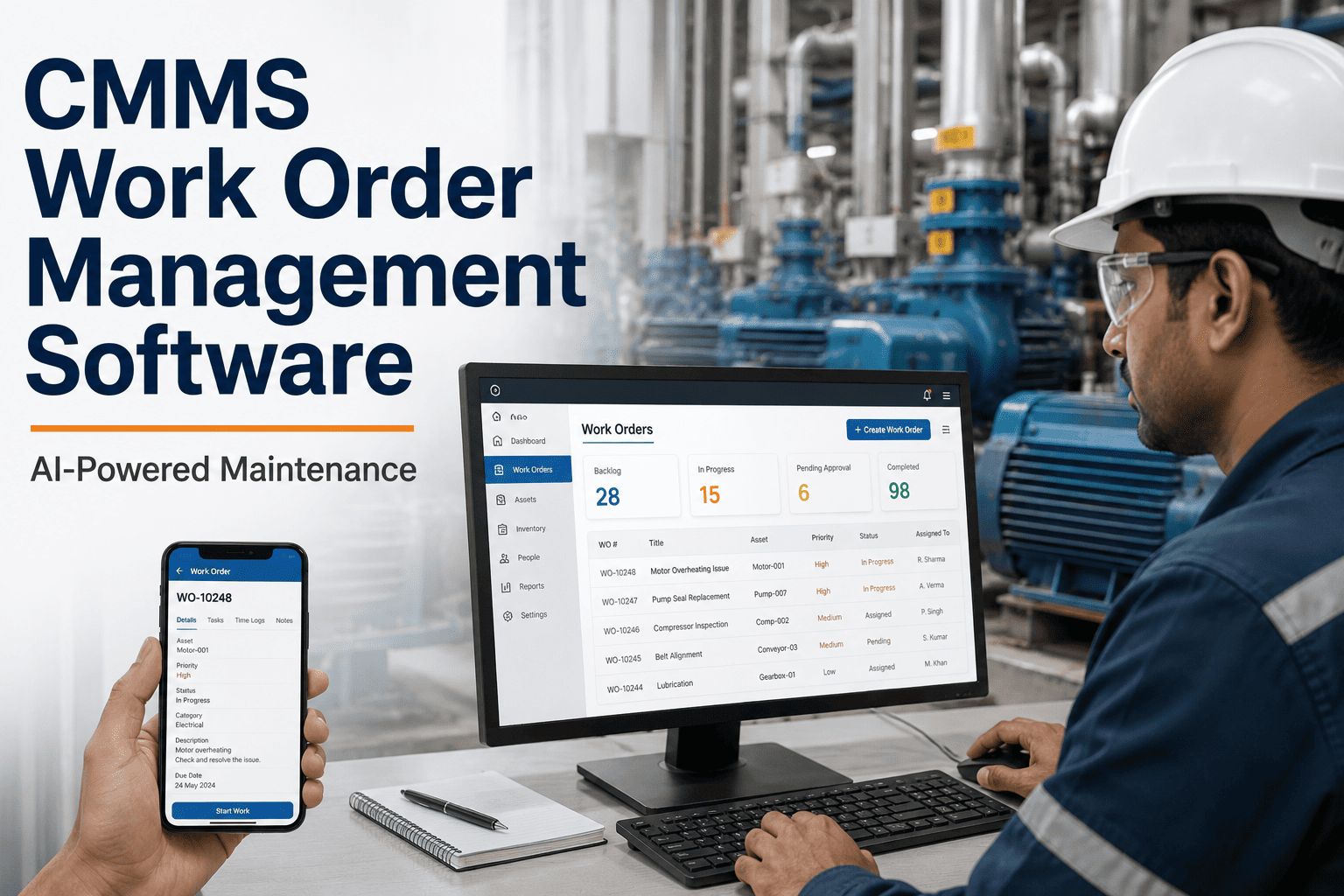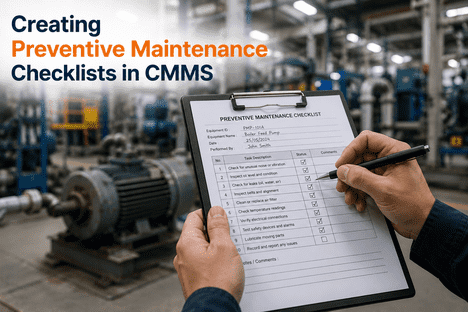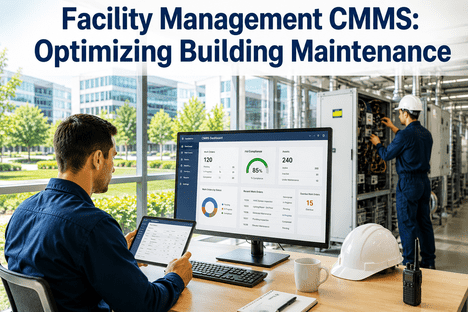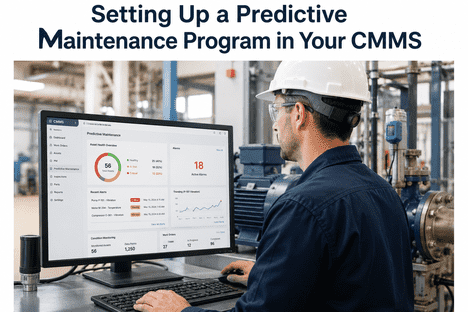
Setting up a predictive maintenance program inside your CMMS is the most impactful operational transformation available to maintenance-driven organizations in 2026. Most facilities that have deployed a computerized maintenance management system are still using it primarily as a reactive work order tracker and scheduled PM calendar—which means they are capturing only a fraction of the value the platform can deliver. A true predictive maintenance program integrates real-time condition data from IoT sensors, AI vision cameras, and vibration monitoring systems directly into the CMMS, allowing the system to trigger work orders based on what an asset is actually doing, not what the calendar says. The result is a fundamental shift from guesswork-based interval scheduling to evidence-driven intervention—reducing unplanned downtime, extending asset lifespan, and cutting total maintenance costs by 20 to 35 percent in facilities that execute the program correctly. Organizations that Book a Demo with iFactory consistently discover that their existing CMMS infrastructure is already capable of supporting predictive intelligence—it simply needs the right condition monitoring layer feeding it live asset health signals.
Transform Your CMMS into a Predictive Maintenance Engine
iFactory's AI Vision Camera platform delivers real-time asset condition intelligence directly into your CMMS workflow—automating work order generation, eliminating manual inspection rounds, and driving measurable reductions in unplanned downtime and maintenance costs.
Why Most CMMS Implementations Stall at Preventive Maintenance
When organizations deploy a CMMS, the initial focus almost always lands on digitizing existing paper-based PM schedules and work order processes. This is a necessary first step, but it creates a false sense of progress. A CMMS running only time-based PMs is not a predictive maintenance system—it is a digital version of the same interval-based guessing that has always characterized traditional maintenance. The core limitation is data: a CMMS cannot predict failures it cannot see. Without a live feed of asset condition data—vibration signatures, thermal profiles, visual anomalies, pressure deviations—the system has no basis for knowing whether an asset scheduled for a 90-day PM is currently healthy or on the verge of failure. The transition to predictive maintenance requires connecting the CMMS to a condition monitoring layer that provides continuous, structured asset health signals. iFactory's AI Vision Camera is purpose-built to serve as this layer, delivering automated visual and thermal condition alerts directly into your CMMS as actionable work orders.
Reactive
Work orders generated after failure. Maximum downtime, maximum cost. CMMS used only as a repair log.
Preventive
Time-based PM schedules in CMMS. Reduces some failures but over-maintains healthy assets and misses stress-driven degradation.
Condition-Based
CMMS triggered by sensor threshold breaches. Faster detection, reduced unnecessary PMs. Requires IoT integration.
Predictive AI
AI models forecast remaining useful life. CMMS auto-generates work orders weeks before failure. Maximum asset availability.
The 6-Step Framework for Setting Up a Predictive Maintenance Program in Your CMMS
Building a predictive maintenance program is not a single technology deployment—it is a structured transformation of how your organization collects, interprets, and acts on asset health data. The following six-step framework is designed for maintenance teams operating any major CMMS platform and provides a proven sequence for moving from interval-based PM to fully condition-driven predictive maintenance without disrupting ongoing operations.
Conduct a Critical Asset Prioritization Audit
Not every asset in your facility justifies the investment of full predictive monitoring. The first step is to rank your asset population by criticality—defined as the combination of failure consequence (production impact, safety risk, repair cost) and failure probability (based on age, operating conditions, and maintenance history in your CMMS). Focus initial predictive investment on assets where unplanned failure causes the greatest operational and financial damage. Your CMMS asset register is the foundation for this analysis; if asset criticality scores are not already coded in your system, this audit creates the baseline for everything that follows.
Define Failure Modes and Leading Indicator Parameters for Each Asset
For each prioritized asset, document the specific failure modes it is susceptible to and identify the measurable physical parameters that change before each failure occurs. Bearing failures are preceded by vibration spectrum changes and temperature rise. Electrical faults manifest as thermal hotspots visible to infrared cameras. Structural fatigue appears as surface cracks detectable by AI vision systems. Seal failures produce fluid leaks identifiable visually before they progress to full leakage. This failure mode mapping determines which condition monitoring technologies need to be deployed and what threshold values your CMMS alert logic should reference when generating predictive work orders.
Deploy Condition Monitoring Technologies and Connect to a Data Pipeline
With failure modes defined, deploy the appropriate condition monitoring technologies for each asset class. iFactory's AI Vision Camera addresses the broadest range of failure modes in a single platform—detecting surface anomalies, thermal hotspots, fluid leaks, positional deviations, and motion irregularities simultaneously without requiring internal sensor retrofitting. For rotating equipment, supplement with vibration sensors. For fluid systems, add pressure and flow IoT transmitters. Edge computing nodes process sensor data locally, and an API or middleware layer structures the condition alerts into the data format your CMMS expects. Maintenance teams exploring this integration architecture often Book a Demo to evaluate how iFactory's plug-and-play CMMS connectors reduce integration time from months to days.
Configure CMMS Alert Logic and Auto Work Order Generation Rules
This step is where predictive maintenance becomes operational inside the CMMS. Define the condition thresholds and AI confidence levels that should trigger different classes of maintenance response. A minor vibration deviation might generate an advisory alert for the technician to inspect on the next available round. A thermal anomaly crossing a critical threshold should auto-generate a high-priority corrective work order with the asset ID, fault description, photographic evidence from the AI Vision Camera, and recommended action pre-populated. Configure escalation rules for conditions that deteriorate rapidly. Establish work order templates for each failure mode so that technicians receive standardized, actionable instructions rather than generic alerts requiring interpretation.
Establish Condition-Based PM Intervals to Replace Fixed Schedules
Once condition data is flowing and alert logic is validated, begin transitioning high-criticality assets from fixed-interval PMs to condition-based intervals. Instead of lubricating a bearing every 30 days regardless of its health status, the CMMS schedules lubrication when vibration trending indicates the lubricant film is degrading. Instead of inspecting a heat exchanger every quarter, the AI Vision Camera triggers an inspection work order when surface fouling signatures reach a defined threshold. This transition is the highest-ROI action in the entire program: eliminating unnecessary PMs on healthy assets frees technician time for higher-value work and reduces consumables cost, while ensuring degrading assets receive attention before failure rather than after.
Measure, Report, and Continuously Improve Program Performance
A predictive maintenance program is not a set-and-forget deployment. Establish a monthly review cadence using CMMS reporting to track key performance indicators: mean time between failures (MTBF), mean time to repair (MTTR), planned vs. unplanned maintenance ratio, PM compliance rate, and cost per work order. Compare these metrics against the pre-program baseline established in Step 1. As the AI models in iFactory's platform accumulate asset-specific operating data, detection accuracy improves and alert thresholds can be refined. Use CMMS failure history to validate or adjust the failure mode parameters defined in Step 2. Sites that treat the program as a living system rather than a static configuration achieve compounding improvements in asset availability year over year.
Condition Monitoring Technologies That Power Predictive CMMS Programs
The effectiveness of a predictive maintenance program in your CMMS is directly proportional to the quality and coverage of the condition monitoring data feeding into it. Each technology addresses specific failure mode categories, and the combination of multiple monitoring approaches within a unified data pipeline provides the broadest possible fault coverage across your asset population.
iFactory's AI Vision Camera provides 24/7 automated visual surveillance across asset zones, detecting a broader range of failure precursors than any single-parameter sensor. Deployed on critical assets, it delivers structured condition alerts with photographic evidence directly into the CMMS as work orders—eliminating manual inspection rounds and reducing mean time to detect anomalies from hours to under 60 seconds. It operates non-invasively on legacy equipment without requiring internal retrofitting, making it the most versatile entry point for any predictive maintenance program. Explore the full specification at the iFactory AI Vision Camera product page.
Vibration sensors mounted on motors, pumps, compressors, and gearboxes capture frequency-domain signatures that identify developing faults weeks before they reach failure. High-frequency data collection at the edge prevents the averaging problem that causes legacy CMS platforms to miss intermittent faults. CMMS integration maps vibration threshold breaches directly to asset IDs and auto-generates prioritized work orders with recommended corrective actions for the assigned technician.
Industrial IoT sensors monitoring pressure, flow, temperature, and electrical current provide the process-level context that AI models need to distinguish between normal operating variation and genuine fault signatures. Edge computing nodes process this data locally at sub-second intervals, ensuring no transient anomaly is lost to averaging. iFactory integrates these sensor streams alongside AI Vision Camera data in a unified condition intelligence layer that communicates with the CMMS via OPC-UA, MQTT, or REST API.
Predictive vs. Preventive Maintenance: The CMMS Performance Impact
The business case for upgrading a CMMS from preventive to predictive maintenance is supported by consistent data across manufacturing, process, and heavy industries. The comparison below illustrates the operational and financial performance differences between facilities running traditional time-based PM programs and those that have fully integrated condition-based predictive intelligence into their CMMS workflows.
| Performance Metric | Traditional Preventive (Time-Based) | Predictive Maintenance with iFactory AI | Improvement Delta |
|---|---|---|---|
| Unplanned Downtime Events | 8–15 events per year per site | 1–3 events per year per site | Up to 80% Reduction |
| Mean Time to Detect Fault | 4–48 hours (manual inspection) | Under 60 seconds (AI continuous) | 99% Faster Detection |
| Unnecessary PM Work Orders | 30–40% of total PMs | Under 10% with condition-based intervals | 25–30% WO Cost Saving |
| Total Maintenance Cost | Baseline | 20–35% below baseline | Significant Cost Reduction |
| Asset Lifespan Extension | OEM design life only | 20–40% extension on monitored assets | Major CapEx Deferral |
| CMMS Work Order Accuracy | Calendar-based, often wrong | Condition-triggered, evidence-backed | Near 100% Justified WOs |
How iFactory AI Vision Camera Integrates with Your CMMS
iFactory's AI Vision Camera platform is architected specifically for seamless integration with all major CMMS and EAM systems. The integration pipeline operates in four stages: continuous asset surveillance by the AI Vision Camera; real-time fault detection and classification by trained computer vision models at the edge; structured condition alert generation with asset ID, fault type, severity score, and photographic evidence; and automatic push to the CMMS via API as a pre-populated work order. This pipeline eliminates the manual handoff between condition detection and maintenance execution that costs facilities 2 to 4 hours of engineer time per incident. Maintenance leads evaluating this integration for their SAP PM, IBM Maximo, Infor EAM, Fiix, or UpKeep environment are encouraged to Book a Demo to see a live demonstration of the CMMS connector in action.
Predictive Maintenance Maturity Roadmap for CMMS Users
The transition from reactive maintenance to a fully predictive, AI-driven program is a multi-phase journey. The roadmap below provides a structured view of the three maturity levels, the CMMS capabilities required at each stage, and the realistic ROI timelines that facilities have achieved when following a disciplined implementation sequence.
CMMS Digitization and Asset Data Quality
Goal: Data Readiness
- Complete CMMS asset register with criticality scores
- Digitize all paper-based PM schedules
- Establish maintenance history baselines
- Define failure modes for top 20 critical assets
- Identify and close sensor coverage gaps
Condition Monitoring and CMMS Connection
Goal: Condition-Based Triggers
- Deploy AI Vision Camera on critical assets
- Install vibration and IoT sensor networks
- Connect condition data to CMMS via API
- Configure auto work order generation rules
- Begin replacing fixed PMs with condition-based intervals
Full Predictive AI and Autonomous CMMS
Goal: Maximum Asset Availability
- AI models forecasting remaining useful life per asset
- CMMS auto-scheduling maintenance by RUL projection
- Spare parts ordering triggered by predictive alerts
- KPI dashboards tracking MTBF, MTTR, and PM ratio
- Continuous model improvement via CMMS feedback loop
"We had a solid CMMS in place for years, but we were still averaging three to four unplanned equipment failures per month on our production lines. After deploying iFactory's AI Vision Camera and connecting the condition alerts to our work order system, we eliminated unplanned failures on every monitored asset within six months. The CMMS went from being a glorified spreadsheet to an actual predictive maintenance engine. The payback period was under four months when we accounted for avoided downtime losses alone."
Setting Up Predictive Maintenance in Your CMMS — Frequently Asked Questions
What is the difference between predictive maintenance and preventive maintenance in a CMMS?
Preventive maintenance is scheduled based on fixed time intervals or usage cycles regardless of actual asset condition. Predictive maintenance uses real-time condition data—vibration, thermal, visual, and process parameters—to determine when an asset actually needs intervention. In a CMMS, this means work orders are triggered by AI condition alerts rather than calendar dates, resulting in dramatically fewer unnecessary PMs and near-elimination of failure-driven reactive repairs.
How long does it take to see ROI from a predictive maintenance program?
Facilities that follow a structured implementation sequence typically see measurable ROI within 3 to 6 months, driven primarily by the prevention of even one or two unplanned downtime events that the predictive system catches early. Full program ROI, including reduced PM labor, extended asset life, and lower consumables costs, compounds significantly over 12 to 24 months as more assets come under predictive coverage and AI model accuracy improves.
Which CMMS platforms does iFactory integrate with for predictive maintenance?
iFactory integrates with all leading CMMS and EAM platforms including SAP Plant Maintenance, IBM Maximo, Infor EAM, Fiix, UpKeep, and custom-built maintenance systems. Integration is achieved via OPC-UA, MQTT, or REST API, with pre-built connectors that map iFactory condition alerts to your existing work order structure and asset register taxonomy without requiring custom development in most deployments.
Can predictive maintenance be applied to legacy equipment without existing sensors?
Yes. iFactory's AI Vision Camera is specifically designed to provide predictive monitoring on legacy assets without requiring internal sensor retrofitting. By analyzing visual and thermal signatures externally, the platform delivers meaningful fault detection on equipment that would otherwise require expensive disassembly and internal hardware installation to monitor. This makes it the most practical entry point for predictive maintenance programs in facilities with large populations of older assets.
What CMMS data is needed before starting a predictive maintenance program?
At minimum, you need a complete asset register with unique asset IDs, basic equipment specifications, and existing maintenance history (work orders, failure records, PM completion data). Criticality scores and failure mode documentation significantly accelerate program setup. If your CMMS asset data is incomplete or inconsistent, a data quality audit should be the first step before deploying any condition monitoring technology.
How does an AI Vision Camera generate CMMS work orders automatically?
iFactory's AI Vision Camera continuously analyzes asset images and thermal data against trained fault detection models. When a fault signature—such as a surface crack, thermal hotspot, fluid leak, or positional anomaly—exceeds the configured confidence threshold, the platform automatically generates a structured alert containing the asset ID, fault classification, severity score, timestamp, and photographic evidence. This alert is pushed to the CMMS via API and auto-populates a work order ready for technician assignment, with no manual data entry required.
How do you measure the success of a predictive maintenance program?
Key performance indicators tracked through the CMMS include: mean time between failures (MTBF) per asset class, mean time to repair (MTTR), ratio of planned to unplanned maintenance work orders, PM compliance rate, cost per work order, and total maintenance cost as a percentage of asset replacement value. Comparing these metrics against pre-program baselines at 3, 6, and 12-month intervals provides a rigorous, data-driven picture of program effectiveness and guides continuous improvement decisions.
What industries benefit most from predictive maintenance integrated with CMMS?
Any industry operating capital-intensive assets with high downtime costs benefits significantly. The highest-value deployments are in manufacturing (automotive, electronics, food and beverage), heavy industry (steel, cement, mining), process industries (petrochemical, power generation), and logistics (conveyor systems, automated warehousing). In each sector, the combination of AI Vision Camera condition monitoring with CMMS work order automation produces compounding improvements in asset availability and maintenance cost efficiency year over year.
Start Your Predictive Maintenance Program with iFactory
Our industrial AI team will assess your current CMMS setup, identify the highest-value predictive monitoring integration points, and deliver a structured ROI projection showing exactly how much unplanned downtime and maintenance cost you can eliminate from your operation.