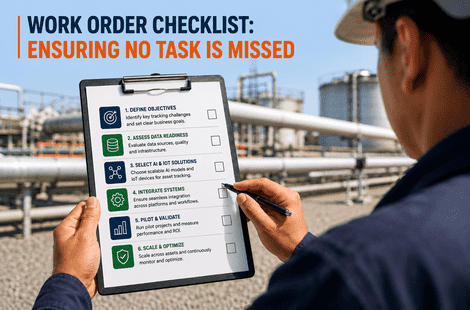
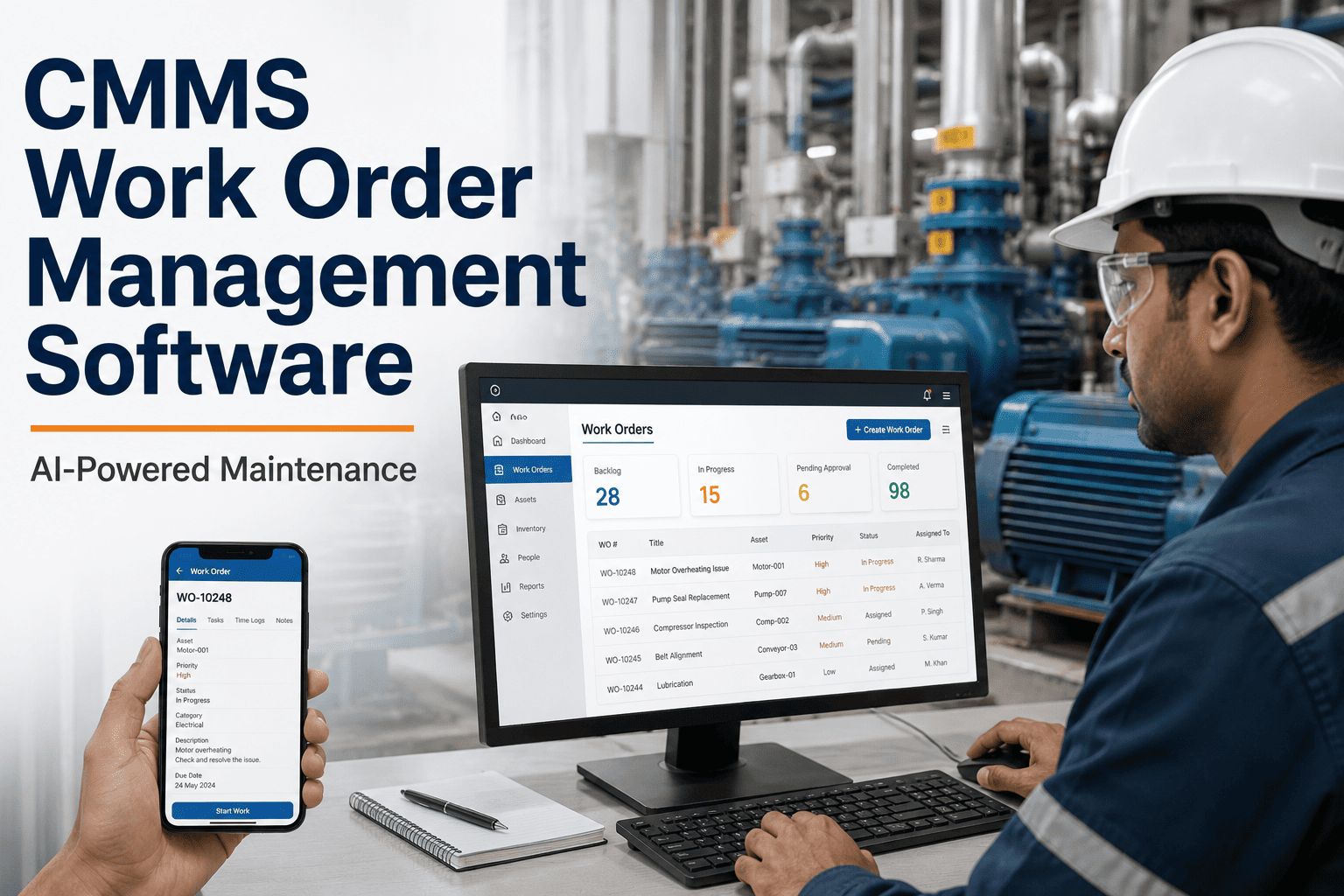
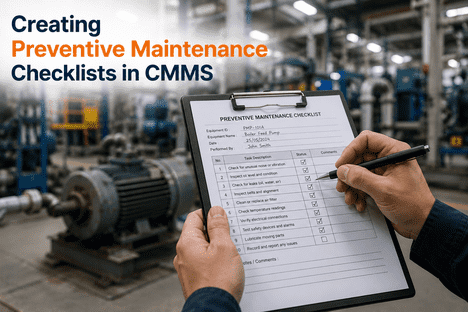
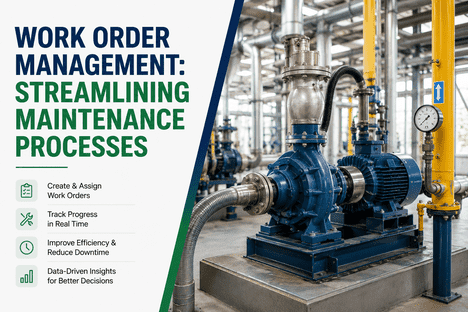
In industrial maintenance environments, a missed task on a work order is not a paperwork error — it is a reliability risk, a compliance gap, and a direct contributor to unplanned downtime. Work order checklists that lack structure, traceability, and AI-driven completeness checks consistently produce the same outcome: tasks omitted under shift pressure, technician handoff failures, and asset histories that cannot support meaningful predictive or preventive maintenance decisions. This work order checklist gives maintenance managers, reliability engineers, CMMS administrators, and operations leads a validated framework to ensure every task is captured, assigned, executed, and closed with full documentation before the next work cycle begins. Teams that Book a Demo with iFactory receive a facility-specific work order workflow assessment and AI readiness roadmap before any platform commitment is made.
WORK ORDER MANAGEMENTAI-POWERED CMMSZERO MISSED TASKS
Eliminate Missed Maintenance Tasks With AI-Automated Work Orders and CMMS Integration
iFactory's AI-powered CMMS automatically generates work orders from sensor-detected anomalies and visual inspection findings — with annotated evidence, priority assignment, technician routing, and audit-ready closure documentation built in from the first alert.
Why Structured Work Order Checklists Are Critical to Maintenance Compliance and Asset Reliability
Incomplete Work Orders Break Reliability Decisions Downstream
When a reliability engineer attempts to perform root cause analysis or calculate mean time between failures, they are entirely dependent on the accuracy and completeness of historical work orders. Vague or partial records produce flawed MTBF calculations, misallocated maintenance budgets, and capital expenditure decisions built on unreliable data. A structured work order checklist is the first line of defense against the compounding data quality failures that erode long-term asset performance programs.
AI-Powered Work Order Automation Closes the Gap Between Detection and Action
Manual work order creation from inspection findings or sensor alerts introduces delays, transcription errors, and missing context that reduce the value of detection investments. AI systems that automatically generate work orders with embedded diagnostic evidence, task checklists, parts requirements, and technician assignments eliminate the handoff gap between when a problem is identified and when a qualified technician begins work with the full information needed to complete every task correctly.
1. Work Order Initiation and Asset Identification
2. Task Scope Definition and Pre-Work Safety Checks
3. Technician Assignment and Competency Validation
4. In-Field Task Execution and Real-Time Data Capture
5. Work Order Closure and CMMS Verification
6. Feedback Loop, Asset History Update, and Predictive Model Integration
Proven 4-Phase Work Order Excellence Roadmap
01
Workflow Audit & Gap Assessment
Map existing work order initiation, assignment, execution, and closure workflows against this checklist to produce a prioritized gap list identifying where missed tasks, data quality failures, and compliance risks are most concentrated.
02
CMMS Integration & Automation Setup
Configure AI-automated work order generation, mobile task capture, parts availability checks, safety documentation attachment, and bi-directional sync with SAP PM, Maximo, or Infor EAM to eliminate manual handoff gaps.
03
Technician Training & Mobile Rollout
Deploy mobile CMMS access for field technicians with role-specific training on real-time task capture, photo evidence requirements, AI alert interpretation, and shift handoff protocols — closing the data entry gaps that incomplete work orders create.
04
Continuous Improvement & Model Feedback
Operationalize work order outcome feedback into AI retraining pipelines, monitor cycle time and backlog KPIs, and expand automated work order generation to additional asset classes and detection modalities as model accuracy improves.
READY TO DEPLOYAI WORK ORDER AUTOMATION
From Missed Tasks to Complete, Audit-Ready Work Orders in Under 90 Days
iFactory's AI platform maps every work order checklist dimension to your CMMS, sensor infrastructure, and compliance framework — delivering automated task generation, mobile capture, and closure documentation before any missed task becomes a maintenance liability.
Expert Perspective: What Incomplete Work Orders Cost Beyond the Obvious Rework
The maintenance teams that struggle most with AI adoption are almost always the same teams with incomplete work order histories. When we begin a predictive model training engagement and discover that 40% of historical work orders have no failure mode recorded, no actual parts listed, and were closed the same hour they were opened — we know the AI will underperform, and we know exactly why. The discipline of completing every checklist item on every work order is not bureaucracy. It is the data infrastructure that makes every future maintenance decision better than the last one. Fix the work order process first, and the AI investment pays for itself far faster than the other way around.
Reliability Engineering & AI Implementation Lead — Industrial Manufacturing & Process Operations, 2025–2026
40%Reduction in Repeat Failures with Complete Work Order Data
3×Faster AI Model Accuracy Improvement with Closed-Loop Feedback
30–40%Less Technician Assessment Time When AI Context Is Pre-Delivered
100%Audit-Ready Work Order Closure with iFactory AI Documentation
Conclusion: A Complete Work Order Checklist Is the Foundation of AI-Ready Maintenance
No AI predictive maintenance program, no CMMS investment, and no sensor deployment delivers its intended value on top of an incomplete work order foundation. The six checklist phases above — from initiation and asset identification through task execution, closure, and AI feedback integration — reflect the operational discipline that separates maintenance teams producing measurable reliability improvements from those continuously fighting the same failures under different work order numbers. Every missed task is a gap in the asset history that the next AI model trains on, every unclosed work order is a compliance exposure that surfaces at the worst time, and every incomplete record is a data point that makes the next maintenance decision slightly less accurate. Maintenance teams ready to benchmark their current work order processes against this validated framework are encouraged to Book a Demo with iFactory and receive a facility-specific work order workflow assessment and AI integration roadmap before any platform commitment is made. iFactory's AI platform delivers automated work order generation from AI vision detection, mobile real-time task capture, configurable closure approval workflows, and bi-directional CMMS integration with SAP PM, IBM Maximo, and Infor EAM — built for maintenance operations that cannot afford a missed task on a critical asset.
Work Order Checklist — Frequently Asked Questions
1. What is the most common cause of missed tasks on industrial work orders?
The most common cause is end-of-shift batch logging instead of real-time task capture — technicians completing work without recording each step immediately lose detail accuracy and frequently omit secondary tasks observed during execution. Mobile CMMS with mandatory real-time capture is the most effective single intervention for reducing missed task rates.
2. How does iFactory AI automatically generate work orders from inspection findings?
iFactory AI Vision Camera detects defects — cracks, corrosion, thermal hotspots, PPE violations, and mechanical faults — with 99.4% accuracy and automatically creates a CMMS work order populated with the annotated detection image, defect classification, severity rating, asset ID, and recommended task list. The work order is routed to the assigned technician via push notification with all diagnostic context included before dispatch.
3. Can iFactory integrate work order data with SAP PM and IBM Maximo for bi-directional sync?
Yes — iFactory provides pre-built connectors for SAP PM, IBM Maximo, and Infor EAM with bi-directional sync for work order creation, status updates, technician assignments, parts consumption, and closure confirmation — ensuring that AI-generated work orders and manually created orders share a single source of truth across both systems.
4. How does a structured work order checklist improve predictive maintenance model accuracy?
Predictive maintenance AI models are trained on historical work order data — specifically on actual failure modes, repair types, parts replaced, and time-to-failure records. Complete, structured work orders produce labeled training data with the detail needed for high-accuracy failure prediction. Incomplete or misclassified work orders produce vague or incorrect training labels that degrade model performance even on high-quality sensor data.
5. What is the minimum work order documentation standard required before deploying iFactory AI?
A validated asset register, a minimum of two years of work order history with failure mode and parts data, and an active CMMS with API connectivity are the core prerequisites. iFactory's onboarding team performs a work order data quality assessment during pre-deployment and provides a structured remediation plan for facilities with incomplete historical records.
GET STARTEDZERO MISSED TASKS FROM DAY ONE
Get a Facility-Specific Work Order Workflow Assessment and AI Readiness Roadmap
iFactory's maintenance AI engineers will map every checklist phase to your CMMS, asset data, and compliance requirements — delivering a prioritized gap assessment and automation pilot plan at zero cost before any platform commitment is made.