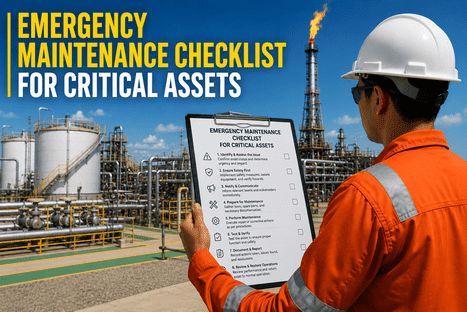
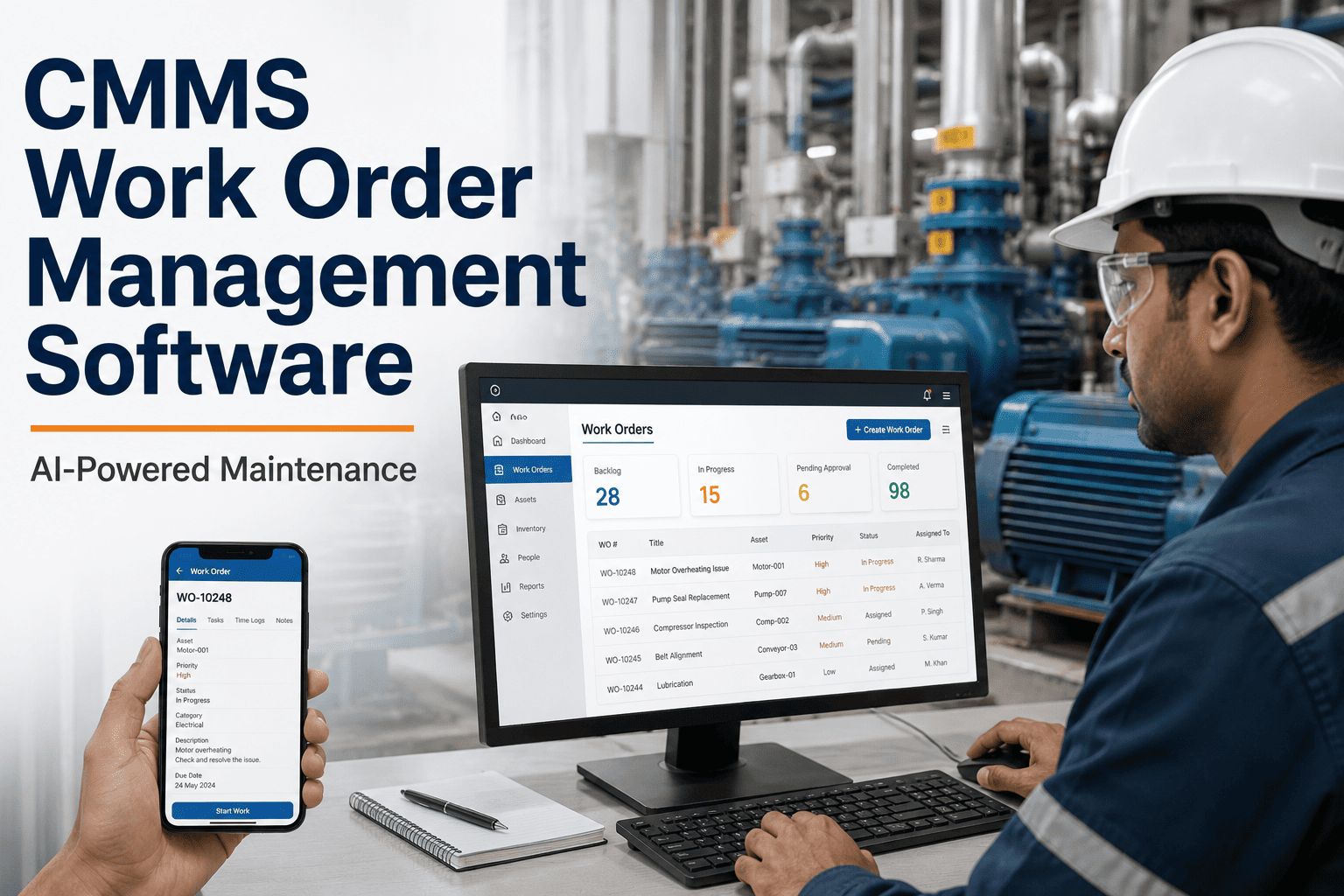
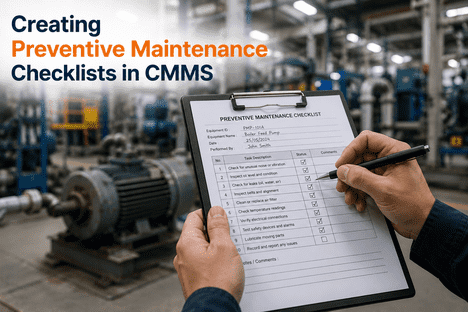
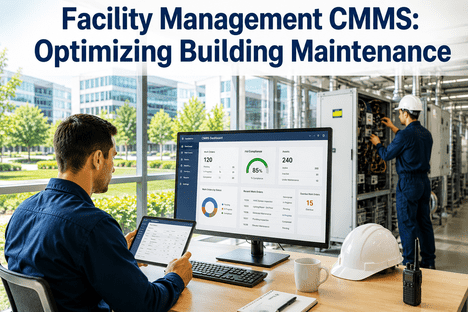
Emergency Maintenance Checklist for Critical Assets
By Austin on June 4, 2026
When a critical asset fails without warning, the difference between a two-hour recovery and a two-day shutdown comes down entirely to whether a structured emergency maintenance process was in place before the failure occurred. Emergency maintenance on critical assets — rotating machinery, pressure systems, electrical infrastructure, production-line equipment, and safety-critical instrumentation — demands a pre-defined, phase-by-phase response that activates the right personnel, work orders, parts, and safety protocols the moment a failure is detected. This emergency maintenance checklist for critical assets gives maintenance managers, reliability engineers, CMMS administrators, and HSE leads the validated sequence to minimize downtime, reduce emergency repair costs, and ensure every response action is documented for compliance. Emergency repairs cost an average of 4.8 times more than planned interventions when unstructured response processes delay isolation, parts sourcing, and technician dispatch. Teams that Book a Demo with iFactory receive a facility-specific critical asset risk assessment and AI-readiness roadmap before any platform commitment is made.
Stop Emergency Failures Before They Start — AI Vision Monitoring for Critical Assets
iFactory's AI Vision Camera platform detects cracks, corrosion, thermal hotspots, and mechanical faults on critical assets 24/7 — automatically generating CMMS work orders with annotated evidence before an undetected defect becomes an emergency shutdown costing multiples of the intervention cost.
Why a Structured Emergency Maintenance Checklist Determines Recovery Outcomes
Unstructured Emergency Response Multiplies Downtime and Repair Costs
Facilities without a defined emergency maintenance checklist consistently experience longer mean-time-to-repair on critical asset failures — not because technicians lack skill, but because the first 30 minutes of an unstructured response are consumed by escalation confusion, missing safety documentation, unavailable parts, and incorrect failure diagnosis. A pre-validated emergency checklist compresses the response initiation window from hours to minutes by removing every decision that can be made in advance. AI-powered detection that triggers an automated work order before the failure reaches critical stage eliminates the emergency entirely for the majority of detectable failure modes.
Critical Asset Failures Without AI Monitoring Create Blind Spots That Checklists Cannot Close
A well-structured emergency maintenance checklist handles response after detection — but for critical assets with visual failure modes including surface cracks, corrosion progression, thermal anomalies, and mechanical wear, the detection gap is where most emergency events originate. Equipment failures show detectable warning signs 30 to 60 days before breakdown, yet most facilities only inspect critical assets on periodic manual rounds. iFactory's AI Vision Camera provides continuous visual monitoring that converts detectable precursors into planned work orders, reducing the volume of genuine emergency events that the checklist must handle.
4.8×Higher Cost of Emergency vs Planned Maintenance
67%Reduction in Emergency Repairs with AI Predictive Monitoring
30–60Days of Advance Warning for Detectable Failure Modes
99.4%iFactory AI Vision Defect Detection Accuracy
1. Critical Asset Register and Failure Mode Documentation
2. Emergency Detection, Alert Routing, and Escalation Protocols
3. Isolation, Lockout/Tagout, and Site Safety Readiness
4. Emergency Parts, Inventory, and Contractor Readiness
5. Emergency Response Execution and Real-Time Documentation
6. Post-Emergency Review, Root Cause Analysis, and Recurrence Prevention
Regulatory Compliance Documentation for Critical Asset Emergency Maintenance
Emergency maintenance events on critical assets generate regulatory documentation obligations across multiple frameworks. The following table maps key compliance requirements to iFactory's AI-assisted documentation capabilities.
Regulatory Framework
Documentation Requirement
iFactory AI Capability
OSHA 1910.147 (Lockout/Tagout)
Documented energy isolation procedures and technician authorization records for each critical asset
Pre-attached LOTO procedures on CMMS asset records with digital authorization and timestamp at work order initiation
ISO 55000 (Asset Management)
Immutable maintenance event records with full audit trail from detection to closure
Automated, tamper-evident work order records with AI detection evidence, task logs, and closure documentation
OSHA PSM / EPA RMP (Process Safety)
Emergency repair records for process safety equipment with cause analysis and corrective action documentation
RCA templates integrated with AI detection records and CMMS work order closure; exportable in regulatory audit format
GMP / FDA 21 CFR Part 11
Electronic maintenance records with digital signatures and audit trail for regulated equipment
Digital-signature work order closure with immutable log, timestamped AI evidence, and compliance report generation
Classify all assets by criticality tier, complete FMEA documentation for Tier-1 assets, and map existing AI vision and IoT sensor coverage against critical asset locations to identify detection gaps requiring immediate remediation.
02
CMMS Configuration & AI Alert Integration
Configure graduated alert thresholds, load escalation matrices, attach isolation and PPE documentation to critical asset records, and activate automated emergency work order generation from AI vision detection and IoT sensor threshold breaches.
03
Parts, Contractor & Permit Readiness
Validate critical spare parts inventory against Tier-1 failure scenarios, load approved contractor lists with response SLAs, and pre-configure permit-to-work workflows for hot work, confined space, and high-voltage emergency scenarios.
04
Continuous Improvement & AI Model Feedback
Operationalize post-emergency RCA workflows, feed emergency event outcome data into AI model retraining pipelines, and monitor emergency KPIs monthly to continuously improve detection lead time and reduce emergency event frequency.
Expert Perspective: What Separates Facilities That Contain Critical Asset Emergencies From Those That Don't
The facilities that recover fastest from critical asset emergencies are not the ones with the largest maintenance teams — they are the ones where every decision that can be pre-made has already been made. Isolation procedure attached to the asset record. Parts staged. Contractor on speed dial with an SLA. Escalation matrix loaded into the CMMS. When those elements are in place, a critical failure becomes a structured execution problem rather than a diagnostic and logistics scramble. The second differentiator is AI detection coverage. The best emergency checklist in the world cannot substitute for a 45-day early warning that converts a potential emergency into a scheduled work order. Facilities that combine structured response protocols with continuous AI visual monitoring on their Tier-1 assets are reporting emergency repair ratios dropping from 35–40% of total maintenance budget to under 12% within 18 months.
Reliability & Maintenance Program Director — Industrial Manufacturing & Process Operations, 2025–2026
67%Fewer Emergency Repairs with AI Predictive Monitoring
45–120hrsBearing Failure Pre-Detection Lead Time
55%Reduction in Critical Asset Audit Findings
<60sAI Detection to Emergency Work Order Generation
PROTECT YOUR CRITICAL ASSETSAI-POWERED DETECTION
From Emergency Reactive Response to AI-Driven Critical Asset Protection
iFactory's engineering team maps every checklist dimension to your critical asset inventory, CMMS, and compliance framework — delivering automated AI detection, emergency work order routing, and audit-ready documentation before the next unplanned failure event occurs.
Conclusion: Structure Your Emergency Maintenance Response Before the Next Critical Asset Failure
Emergency maintenance on critical assets is an organizational test that no facility can afford to fail unprepared — and the preparation happens entirely before the event, not during it. The six checklist phases outlined here reflect the implementation sequence that consistently delivers the fastest recovery times, the lowest emergency repair cost ratios, and the strongest compliance documentation outcomes across industrial manufacturing, process operations, and infrastructure environments. Critical asset register and failure mode documentation create the foundation. Detection, alert routing, and isolation readiness determine how fast the response activates and how safely it proceeds. Parts, contractor, and permit readiness determine whether the right resources arrive in time to matter. Real-time documentation and post-emergency analysis convert each event into a dataset that makes the next failure less likely. Maintenance teams ready to benchmark their current emergency preparedness against this validated framework are encouraged to Book a Demo with iFactory and receive a facility-specific critical asset risk assessment before any deployment commitment is made. iFactory's AI Vision Camera platform delivers 99.4% defect detection accuracy, under-60-second automated emergency work order generation, CMMS integration with SAP PM and IBM Maximo, on-premise edge AI processing, and audit-ready compliance documentation — built for facilities that cannot afford the cost of an undetected critical asset failure.
Emergency Maintenance Checklist for Critical Assets — Frequently Asked Questions
Deploying continuous AI-powered monitoring on Tier-1 critical assets is the single highest-impact step, because it converts the 30 to 60 day pre-failure detection window into planned work orders rather than emergency responses. Most critical asset failure modes produce detectable visual or thermal precursors long before catastrophic failure — AI vision monitoring captures them; periodic manual rounds typically do not.
When iFactory AI Vision detects a defect exceeding a Critical or Emergency threshold — thermal hotspot, structural crack, corrosion, mechanical guard removal, or PPE violation — it automatically creates a CMMS work order within 60 seconds, populated with annotated detection image, defect classification, asset ID, severity rating, and recommended action, routed to the assigned on-call technician via push notification without requiring any human triage step.
Yes — iFactory provides pre-built connectors for SAP PM, IBM Maximo, and Infor EAM with bi-directional sync for work order creation, status updates, parts consumption, and closure records. AI-generated emergency work orders sync directly into your existing CMMS environment without requiring platform replacement or parallel systems management.
iFactory produces immutable, timestamped, and digitally signed emergency maintenance records meeting OSHA 1910.147, ISO 55000, OSHA PSM/EPA RMP, and GMP/FDA 21 CFR Part 11 documentation requirements — including AI detection evidence, task execution logs, isolation records, and post-repair verification imagery — exportable in regulatory audit format without manual report compilation.
Most facilities reach first production AI detection on priority critical assets within 3 to 6 months from initial assessment, with CMMS integration, alert threshold configuration, and technician training included. Facilities with existing ONVIF-compliant camera infrastructure and a live CMMS typically complete the pilot phase faster. iFactory's onboarding team provides a pre-deployment gap assessment mapping existing coverage against critical asset monitoring requirements.
GET STARTEDPROTECT YOUR CRITICAL ASSETS TODAY
Get a Facility-Specific Critical Asset Risk Assessment and AI Emergency Detection Roadmap
iFactory's AI engineering team maps every checklist phase to your critical asset inventory, CMMS environment, and compliance requirements — delivering a prioritized gap assessment and detection pilot plan at zero cost before any platform commitment is made.