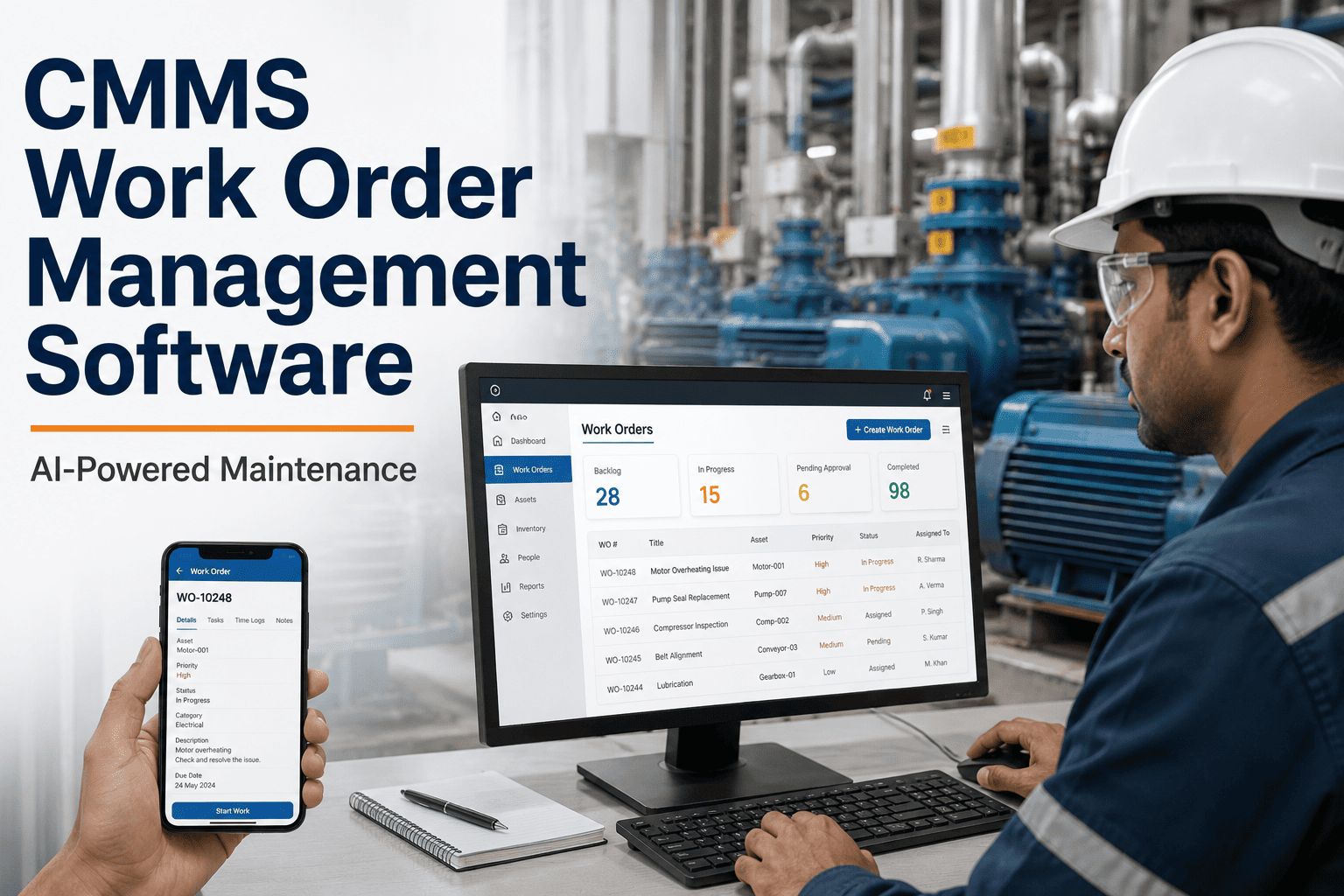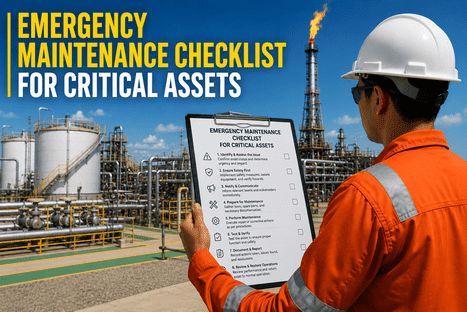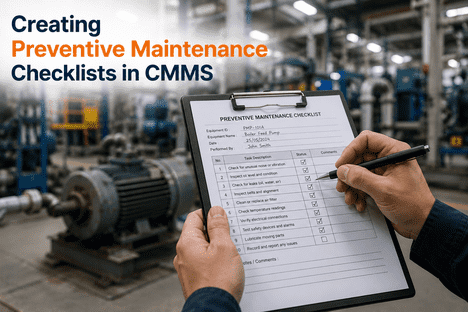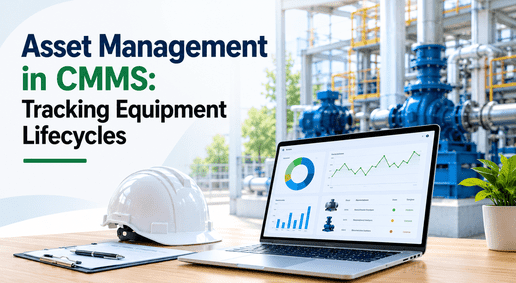
Manufacturing equipment failures do not announce themselves — they accumulate quietly through missed inspections, ignored wear indicators, and deferred lubrication cycles until the moment a production line stops without warning. A structured preventive maintenance checklist for manufacturing equipment is the operational discipline that breaks this pattern, ensuring that every asset on every shift receives the systematic attention it needs to operate reliably, safely, and at full productive capacity. In 2026, best-practice PM checklists go further than paper routes and calendar reminders — they integrate with CMMS work order systems, IoT sensor networks, and AI vision platforms that monitor equipment condition continuously between inspection rounds, triggering additional checklist tasks the moment anomalies are detected. This guide delivers a complete, equipment-class-specific preventive maintenance checklist for manufacturing environments, structured for CMMS deployment and enhanced with the AI-driven condition monitoring capabilities that define Industry 4.0 maintenance excellence.
Why Preventive Maintenance Checklists Are the Foundation of Manufacturing Reliability
Unstructured PM Is the Root Cause of Most Manufacturing Downtime
Industry data consistently shows that 70–80% of manufacturing equipment failures are preventable with adequate PM execution — yet most organizations operating without structured CMMS checklists achieve PM compliance rates below 65%, leaving a substantial portion of their asset fleet undertreated. The consequence is not just equipment failure — it is the 3–5× cost premium of reactive repair versus planned maintenance, the production losses from unscheduled downtime, and the quality defects that degraded equipment introduces into the production process. For organizations ready to build structured PM checklists integrated with real-time AI condition data, Book a Demo to see how iFactory's platform supports evidence-based PM execution.
AI Vision Is Transforming Manufacturing PM in 2026
The most competitive manufacturing operations in 2026 are not waiting for the monthly PM round to detect equipment degradation — they are deploying AI vision cameras that monitor equipment continuously, flagging thermal anomalies, surface defects, misalignments, and contamination the moment they emerge. When iFactory's AI vision platform detects an anomaly on a conveyor drive, press frame, or assembly robot, it generates a targeted CMMS PM checklist pre-populated with the defect evidence, routes it to the correct technician, and initiates the maintenance response in minutes rather than weeks. This architecture closes the inspection gap that all calendar-based PM programs leave open.
Preventive Maintenance Checklist for Manufacturing Equipment: By Equipment Class
PM Checklist Execution: Manual vs. AI-Enhanced Manufacturing Approach
| PM Execution Dimension | Traditional Manual Checklist | AI-Enhanced CMMS Checklist (iFactory) |
|---|---|---|
| Inspection Trigger | Fixed calendar interval regardless of equipment condition | Calendar PM + iFactory AI vision anomaly alerts generating targeted checklists on demand |
| Condition Coverage Between PMs | Zero visibility between monthly or quarterly inspection rounds | Continuous AI visual monitoring detecting defects as they emerge between PM intervals |
| Work Order Evidence Quality | Technician text description; no visual documentation standard | AI-annotated defect image pre-loaded in CMMS checklist before technician arrival |
| Measurement Data Capture | Free-text field or paper form; inconsistent between technicians | Structured numeric capture fields with alert thresholds and automatic corrective WO generation |
| Safety System Test Records | Paper logbook; lost or illegible during audits | Timestamped digital CMMS records with technician attribution; audit-ready on demand |
| PM Interval Optimization | Fixed OEM recommendations; rarely adjusted | ML-driven interval analysis based on actual measurement trends and finding frequency data |
| Unplanned Downtime Impact | 10–20% reduction from baseline with calendar PM alone | 30–45% reduction with AI vision condition monitoring + structured CMMS PM execution |
5-Phase Roadmap: Implementing AI-Enhanced PM Checklists in Manufacturing
Equipment Registry Completion and Criticality Classification
Conduct a physical walkdown of every production area to document every maintainable asset with a unique CMMS ID, equipment class, manufacturer, model, criticality rating, and OEM PM requirements. Classify every asset as A (production-critical, no redundancy), B (important with partial redundancy), or C (non-critical). Criticality classification drives PM checklist frequency, inspection depth, and scheduling priority — it must be established before any PM program design work begins.
Failure Mode Analysis and Checklist Task Design by Equipment Class
For each equipment class in scope — rotating equipment, conveyors, hydraulics, machine tools, electrical systems, robotics — document the top 5–8 failure modes by consequence and frequency using CMMS work order history, OEM maintenance manuals, and reliability engineering input. Design PM checklist tasks that directly address each failure mode with action-oriented language, quantitative measurement capture fields, pass/fail thresholds, and conditional logic that generates corrective work orders automatically on threshold breach.
CMMS Configuration and Trigger Logic Setup
Build standardized PM checklist templates in the CMMS for each equipment class with complete resource requirements (skill codes, labor hours), parts and consumables bills of materials, embedded safety procedures, and trigger configuration combining calendar intervals, meter-based thresholds, and condition-based alerts. Configure the asset-to-template mapping that determines which checklist is generated for which asset under which trigger conditions, and validate the scheduling engine populates work orders with correct resources and parts before go-live.
iFactory AI Vision Integration for Condition-Based PM Triggering
Deploy iFactory's AI vision cameras at priority monitoring positions on critical production equipment and configure API integration with the CMMS to enable condition-triggered PM checklist generation. Map specific AI vision alert types to targeted checklist templates — thermal hotspot alerts to electrical inspection checklists, surface defect alerts to structural assessment checklists, misalignment detections to alignment correction checklists. Validate that triggered checklists arrive pre-populated with annotated visual evidence and correct resource requirements before enabling live automated generation. Book a Demo to see this integration configured for your equipment types.
Performance Governance and Quarterly Checklist Optimization
Establish a quarterly PM checklist review process analyzing finding frequency by task, planned versus actual labor hours, corrective work order conversion rates, and AI vision alert false-positive rates. Tasks that consistently generate significant findings may need higher frequency or expanded measurement scope. Tasks generating no findings across multiple cycles are candidates for frequency reduction or elimination. This continuous optimization process progressively improves the PM program's reliability return per labor dollar invested, converging toward the precision-calibrated checklist library that characterizes world-class manufacturing maintenance organizations.
What Manufacturing Reliability Engineers Say About PM Checklist Quality in 2026
The most impactful change a manufacturing maintenance organization can make to its preventive maintenance program is not increasing PM frequency — it is redesigning checklist tasks from compliance checkboxes into measurement-capture instruments. A PM checklist that says "check motor" generates a green tick and contributes nothing to the maintenance history database. A PM checklist that says "measure motor bearing temperature — record in °C, flag if above 70°C, generate corrective work order if above 85°C" contributes a quantitative data point that feeds trend analysis, validates AI anomaly detection thresholds, and enables failure prediction based on accumulated measurement history. This redesign requires investment but the return — in early failure detection, eliminated reactive repairs, and continuously improving failure prediction accuracy — compounds every quarter.
The second most impactful change in 2026 is integrating AI vision monitoring as the continuous inspection layer between PM rounds. Manufacturing equipment degrades between inspection cycles — thermal anomalies develop on motor drives, contamination accumulates on precision slides, and surface cracks propagate on press frames in the weeks between technician visits. iFactory's AI vision camera closes this monitoring gap, providing the continuous visual condition data that makes the PM program truly comprehensive rather than periodically current. When AI vision is connected to the CMMS, the first evidence of a developing failure is not the next scheduled PM visit — it is a targeted, pre-populated checklist generated within minutes of the AI detecting the anomaly.
Core Benefits of Structured PM Checklists for Manufacturing Equipment
Extended Asset Service Life and Reduced Capital Replacement Cost
Manufacturing equipment maintained to structured PM checklist standards consistently achieves 20–40% longer operational service life than equipment maintained reactively — the direct result of catching and correcting early-stage degradation before it escalates to the secondary damage that drives premature replacement. Each asset life extension that PM enables represents a capital cost deferral that contributes directly to manufacturing profitability.
Production Quality Improvement from Equipment Precision
Degraded manufacturing equipment produces degraded quality. Machine tool spindle runout, conveyor belt slippage, robot joint backlash, and hydraulic pressure variation all introduce dimensional variation and surface quality defects that PM checklists — when correctly designed for measurement capture — detect and correct before they reach production output. PM compliance and product quality compliance are not separate disciplines; they are the same operational standard expressed at different points in the production chain.
Regulatory and Safety Compliance Documentation
CMMS PM checklists generate the timestamped, technician-attributed digital records of safety system testing, equipment calibration, and maintenance activity that OSHA, ISO 9001, ISO 45001, and customer audit programs require. Paper-based records that cannot be retrieved on demand during an audit create compliance exposure that structured CMMS documentation eliminates entirely.
Workforce Knowledge Retention and Standardization
Well-designed CMMS PM checklists encode the institutional knowledge of experienced reliability engineers into standardized task instructions that every technician — including new hires — can execute at consistent quality. This knowledge preservation protects manufacturing reliability against the impact of skilled technician retirements and workforce transitions that are reshaping the maintenance labor market in 2026.
Maintenance Cost Visibility and Budget Justification
Structured PM checklists with complete parts and labor recording in the CMMS build the asset cost history that enables evidence-based maintenance budgeting, lifecycle cost analysis, and repair versus replace decision-making. Organizations with mature CMMS PM programs can precisely quantify the ROI of each PM investment against the avoided cost of the reactive failures it prevents — making maintenance budget defense straightforward rather than subjective.
OEE Improvement Across Availability, Performance, and Quality
Structured PM execution that prevents equipment failures directly improves all three OEE components — availability rises as unplanned downtime falls, performance improves as degraded equipment is maintained before speed losses accumulate, and quality improves as defects are caught and corrected at the equipment before they manifest in production output. PM compliance and OEE performance are causally connected through the same underlying equipment reliability that structured checklists maintain.
Conclusion: PM Checklists as the Operational Standard for Manufacturing Excellence
A preventive maintenance checklist for manufacturing equipment is not a bureaucratic compliance exercise — it is the operational standard that determines whether a manufacturing facility achieves the asset availability, product quality, and maintenance cost performance that global competitive markets demand in 2026. The equipment-class-specific checklists above provide the technical foundation for a best-practice PM program: measurement-capture tasks grounded in failure mode analysis, safety procedure integration, quantitative pass/fail criteria, and CMMS-structured resource requirements that enable consistent execution regardless of technician experience level.
iFactory's AI vision camera platform elevates this foundation by providing the continuous visual condition monitoring layer that closes the inspection gap between PM rounds — detecting developing anomalies on manufacturing equipment as they emerge and automatically triggering targeted, pre-populated CMMS checklists that convert every AI detection into a planned, resourced maintenance intervention. To see how iFactory's AI vision platform integrates with your CMMS to deliver condition-based PM checklists across your manufacturing equipment fleet, Book a Demo with our industrial reliability team today.