CMMS Implementation Checklist: Steps to Get Started
By Austin on June 4, 2026
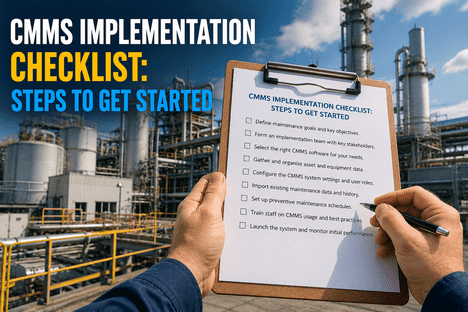
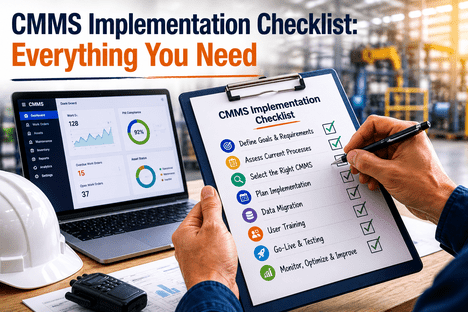
Implementing a Computerized Maintenance Management System is one of the most consequential technology decisions a maintenance organization can make — and also one of the most commonly mismanaged. A CMMS implementation done correctly transforms maintenance from a reactive, paper-dependent function into a data-driven, AI-enabled operational system that delivers measurable improvements in asset availability, workforce productivity, spare parts efficiency, and total maintenance cost within months of go-live. A CMMS implementation done poorly produces an expensive software license, a half-populated asset register, and a maintenance team that reverts to spreadsheets within six months. The difference between these outcomes is not the platform selected — it is the rigor of the implementation process. This checklist provides a structured, step-by-step roadmap for CMMS implementation in 2026, covering every phase from stakeholder alignment and data migration through IoT integration, AI vision connectivity, and continuous improvement governance — giving maintenance leaders the framework they need to get started correctly and deliver lasting operational results.
Connect iFactory AI Vision to Your CMMS From Day One of Implementation
iFactory's AI vision camera integrates directly with your CMMS to deliver real-time visual condition monitoring, automated work order generation, and OEE tracking — building the condition-based maintenance foundation your implementation needs to succeed.
Why Most CMMS Implementations Fail — and How This Checklist Prevents It
The Most Common Implementation Failure Points
Industry research consistently identifies the same failure patterns in CMMS implementations: incomplete asset registers that make work order tracking unreliable, PM task libraries copied from paper without being redesigned for digital execution, data migration errors that corrupt maintenance history, and change management shortfalls that leave frontline technicians resistant to adoption. Each failure point is entirely preventable with structured planning. Organizations that follow a disciplined implementation checklist achieve go-live on time at twice the rate of those that approach implementation as an IT project rather than an operational transformation. For guidance on avoiding these pitfalls, Book a Demo with iFactory's implementation specialists.
What a Successful 2026 CMMS Implementation Looks Like
A best-practice CMMS implementation in 2026 is not simply getting the software running — it is establishing the data infrastructure, process disciplines, and technology integrations that allow the CMMS to function as the operational intelligence hub for maintenance management. This means a complete, criticality-classified asset register; a PM task library grounded in failure mode analysis; IoT and AI vision integrations that feed condition data directly into work order workflows; mobile deployment that puts checklists in technicians' hands; and a governance framework that continuously improves system data quality and checklist effectiveness over time.
60–70%Of CMMS implementations fail to deliver expected ROI within 2 years due to incomplete data and process setup
25–35%Reduction in total maintenance cost achievable within 18 months of a correctly executed CMMS implementation
90–180Days from kickoff to go-live for a well-planned single-site CMMS implementation with clean data
3–6×ROI within first year for implementations that include IoT and AI vision condition monitoring integration
Phase 1: Stakeholder Alignment and Project Scoping
Phase 2: Asset Register Build and Data Migration
Phase 3: PM Program Design and Checklist Configuration
Phase 4: IoT and AI Vision Integration Configuration
Phase 5: Work Order Workflow and Scheduling Configuration
Phase 6: Mobile Deployment and User Training
AI VISION + CMMSCONDITION-BASED MAINTENANCEPREDICTIVE MAINTENANCE
Implement Your CMMS with AI Vision Condition Monitoring Built In from the Start
iFactory's AI vision camera platform integrates with your CMMS during implementation — delivering real-time visual condition monitoring, automated condition-triggered work orders, and OEE data that transforms your CMMS from a scheduling tool into a live operational intelligence system.
CMMS Implementation Outcomes: Basic vs. AI-Integrated Approach
Implementation Dimension
Basic CMMS Implementation
AI-Integrated CMMS Implementation (iFactory)
Work Order Triggers
Calendar PM triggers and manual corrective requests only
Calendar PM + IoT condition thresholds + AI vision anomaly alerts via API
Asset Condition Visibility
Visual inspection at PM intervals; blind between rounds
Continuous AI vision monitoring with real-time anomaly detection between PM intervals
Work Order Data Quality
Technician-entered text descriptions of findings
Structured defect data with AI-annotated image evidence pre-loaded in work order
PM Schedule Intelligence
Fixed intervals based on OEM recommendations
Condition-adjusted intervals based on actual asset degradation rate data
OEE Integration
Manual OEE data entry or separate OEE system
Automated OEE capture from iFactory vision platform feeding CMMS asset performance records
Unplanned Downtime Reduction
10–20% improvement within 18 months
30–45% improvement within 18 months with condition monitoring integration
Implementation Complexity
Software deployment and data migration only
Software + API integration + sensor/camera deployment + threshold configuration
Post-Go-Live: 5 Steps to CMMS Performance Maturity
01
30-Day Data Quality Stabilization
The first 30 days post-go-live are the highest-risk period for data quality degradation — technicians revert to paper workarounds, work orders are closed without complete data, and parts usage goes unrecorded. Assign a dedicated super-user to monitor work order completion quality daily, provide immediate coaching for data gaps, and escalate systemic usability issues to the system administrator within the first week of discovery. Data quality habits established in the first 30 days persist for years.
02
60-Day PM Compliance and Scheduling Performance Review
At 60 days post-go-live, conduct the first formal PM compliance review — analyzing schedule attainment rate, backlog age profile, parts availability failures, and skill mismatch incidents. Most implementations surface 3–5 systemic issues in this review that, if addressed, will dramatically improve scheduling performance in months 3–6. These typically include labor hour estimation inaccuracies in PM templates, parts reorder points set too low, and PM task sequences that do not match field execution reality.
03
90-Day AI Vision Condition Data Validation and Threshold Tuning
At 90 days, review the performance of all AI vision and IoT condition monitoring integrations — analyzing alert volumes by asset, false positive rates, technician acceptance of AI-triggered work orders, and correlation between AI alerts and confirmed defect findings. Tune alert thresholds based on 90 days of operational data, adjust alert-to-checklist mapping rules where mismatches are identified, and document the first confirmed AI-enabled failure preventions for the business case refresh. For iFactory AI vision threshold tuning support, Book a Demo with our customer success team.
04
6-Month KPI Performance Assessment and Phase 2 Planning
At six months, conduct a formal KPI assessment against the business case targets established at project initiation — PM compliance rate, planned versus reactive maintenance ratio, unplanned downtime frequency, maintenance cost per unit, wrench time, and first-time fix rate. Document the financial value of confirmed maintenance interventions enabled by AI vision alerts. Use this assessment to build the Phase 2 business case for expanding CMMS scope to additional facilities, asset classes, or integration points not included in the initial implementation.
05
Continuous Improvement Governance and Checklist Optimization Cadence
Establish a quarterly governance cadence that reviews PM checklist effectiveness (finding frequency rates versus task labor cost), asset register completeness, spare parts inventory accuracy, and AI vision model performance. Each quarterly review produces a prioritized list of system improvements — new checklist tasks for emerging failure modes, retired tasks that have never generated findings, threshold adjustments, and asset hierarchy corrections. This governance process is what separates CMMS implementations that continuously improve from those that plateau and eventually stagnate.
Expert Review
What Implementation Leaders Say About CMMS Success in 2026
The single biggest mistake organizations make when implementing a CMMS is treating it as a software deployment project rather than an operational transformation program. The technology is the easy part — modern CMMS platforms are intuitive, configurable, and well-documented. The hard part is the data: building a complete, accurate asset register from scratch, designing PM checklists that actually capture meaningful measurement data rather than generating compliance checkboxes, and establishing the change management structure that gets frontline technicians using the mobile app correctly from day one. Every hour invested in asset register quality and checklist design before go-live returns ten hours saved in post-go-live rework and system cleanup.
The organizations achieving the highest CMMS ROI in 2026 are those that integrate AI vision condition monitoring into the implementation from the outset — not as a Phase 3 add-on. When iFactory's AI vision camera is connected to the CMMS during initial implementation, every maintenance work order from day one can include visual condition evidence, every PM trigger can be validated against real asset health data, and the CMMS begins building the condition-performance correlation dataset that enables predictive maintenance optimization within the first operational year.
CMMS implementations that include AI vision condition monitoring integration from go-live achieve 30–45% unplanned downtime reductions within 18 months — more than double the outcome of software-only implementations that add condition monitoring as a later phase.
Core Benefits of a Correctly Executed CMMS Implementation
Planned Maintenance Ratio Improvement
A properly implemented CMMS with structured PM scheduling and AI vision condition triggers shifts the maintenance workload from reactive emergency response to planned, resource-allocated interventions — moving organizations from the industry-average 40–50% planned maintenance ratio toward the 80%+ benchmark that characterizes world-class maintenance programs.
Maintenance Cost Visibility and Control
Complete work order cost tracking — labor hours, parts consumption, contractor costs, and downtime losses — gives maintenance leaders the data visibility to identify cost drivers, challenge budget assumptions, benchmark against industry peers, and make evidence-based decisions about repair versus replace thresholds for aging assets.
Asset Availability and OEE Improvement
The combination of structured PM scheduling, AI vision condition monitoring, and condition-triggered work order generation directly improves all three OEE components — availability rises as unplanned downtime falls, performance improves as degraded assets are maintained before speed losses accumulate, and quality improves as defects are caught before production runs.
Regulatory Compliance and Audit Readiness
CMMS implementation creates the timestamped, technician-attributed digital record of every maintenance activity that ISO 9001, ISO 55001, OSHA, and industry-specific regulatory frameworks require — replacing paper-based records that are incomplete, illegible, and impossible to audit at scale with on-demand, searchable compliance documentation.
Technician Productivity and Wrench Time
A fully implemented CMMS with pre-planned work orders, parts kitted before job start, and mobile checklists that eliminate workstation returns raises technician productive wrench time from the 25–35% industry average toward the 55–65% benchmark achievable with mature CMMS scheduling — effectively adding productive maintenance capacity without increasing headcount.
Continuous Improvement Data Foundation
A correctly implemented CMMS accumulates the structured failure history, maintenance cost data, parts consumption patterns, and condition measurement trends that enable the AI-driven predictive maintenance optimization that delivers the highest long-term reliability and cost performance gains — making every correctly entered work order an investment in future operational intelligence.
Conclusion: Your CMMS Implementation Is the Foundation of Operational Excellence
A CMMS implementation done correctly is not a technology project with a go-live date — it is the beginning of a continuous operational improvement journey that compounds in value with every work order completed, every PM checklist executed, and every condition monitoring alert resolved. The organizations achieving best-in-class maintenance performance in 2026 are those that invested in getting the implementation fundamentals right: a complete asset register, failure-mode-grounded PM checklists, AI vision condition monitoring integrated from day one, and a governance cadence that continuously improves system data quality and checklist effectiveness over time.
iFactory's AI vision camera platform is designed to integrate with your CMMS during implementation — not after — so that condition-based maintenance intelligence is built into your operational foundation from the first work order. Whether you are implementing a CMMS for the first time or re-implementing a system that failed to deliver its promised ROI, the checklist above provides the structured pathway to get it right. To see how iFactory's platform connects to your CMMS implementation plan and accelerates the path to condition-based maintenance excellence, Book a Demo with our industrial implementation team.
1. How long does a typical CMMS implementation take from start to go-live?
A well-planned single-site CMMS implementation with clean data typically takes 90–180 days from project kickoff to go-live. The primary variables that extend timelines are asset register data quality (a physical walkdown of a large facility can take 4–6 weeks), legacy data migration complexity, IoT and AI vision integration configuration, and the depth of change management required to achieve frontline technician adoption. Multi-site implementations typically run 6–18 months depending on scope.
2. What is the most important thing to get right in a CMMS implementation?
The asset register is the single most important implementation deliverable — every work order, PM schedule, spare parts record, and cost analysis depends on the accuracy and completeness of asset data. Organizations that compromise on asset register quality to accelerate go-live consistently spend more time correcting data errors post-implementation than they saved by rushing. A complete, criticality-classified asset register with accurate equipment hierarchy and BOM linkages is the non-negotiable foundation of a high-performing CMMS.
3. How does iFactory's AI vision camera integrate with CMMS platforms during implementation?
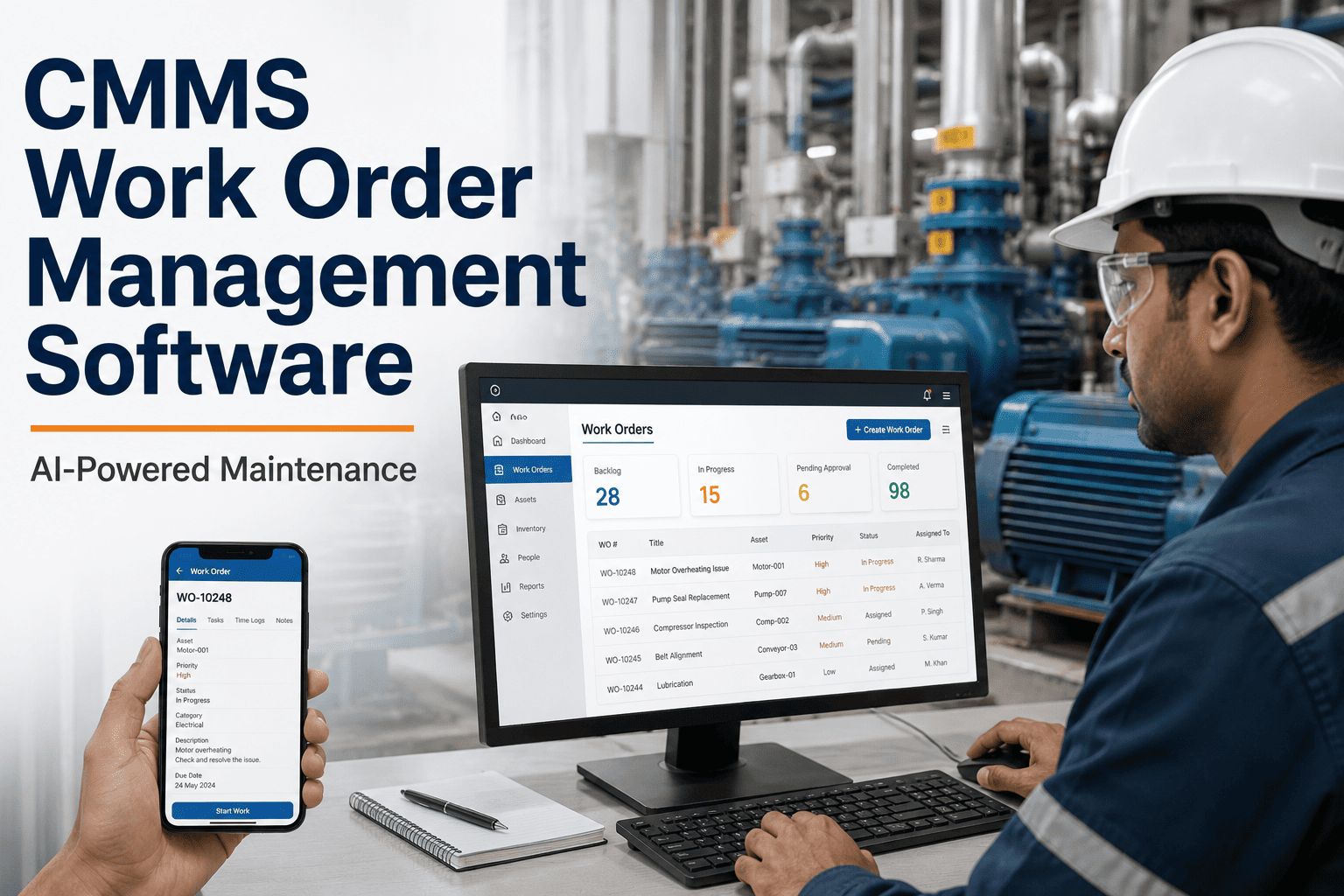
iFactory's AI vision platform connects to CMMS systems via REST API during the IoT integration phase of implementation. The integration maps AI vision alert types to specific CMMS asset records and work order templates, so that when the AI vision camera detects an anomaly — thermal hotspot, surface defect, misalignment, contamination — a structured work order is automatically generated in the CMMS pre-populated with the annotated image evidence, defect classification, severity score, and recommended task scope. The platform supports IBM Maximo, SAP PM, Infor EAM, UpKeep, Fiix, and custom CMMS environments.
4. What KPIs should be tracked to measure CMMS implementation success?
The core post-implementation KPIs are: PM schedule compliance rate (target 85–95%), planned versus reactive maintenance ratio (target 80% planned), technician wrench time (target 55%+), unplanned downtime frequency and duration, maintenance cost per unit of production, backlog age profile, first-time fix rate, and parts availability at job start. These metrics should be baselined before go-live and tracked monthly for the first year to quantify business impact and identify performance gaps requiring attention.
5. Should AI vision condition monitoring be included in the initial CMMS implementation or added later?
Including AI vision condition monitoring in the initial implementation consistently delivers better outcomes than adding it as a later phase. When condition monitoring is integrated from go-live, the CMMS immediately begins accumulating the condition-correlated maintenance history that enables predictive maintenance optimization — assets are linked to their condition monitoring data from the first work order. Post-implementation additions require retroactive data mapping, asset register updates, and re-training of maintenance teams, all of which add cost and delay the transition from calendar-based to condition-based maintenance.
GET STARTEDCMMS + AI VISION
Start Your CMMS Implementation with AI Vision Intelligence Built In
iFactory's AI vision camera platform integrates with your CMMS from day one — delivering continuous visual condition monitoring, automated work order generation, and real-time OEE data that transforms your implementation from a scheduling system into a live asset intelligence platform.