HVAC systems account for approximately 40% of total energy consumption in commercial buildings, yet they remain one of the most under-monitored asset classes in facility operations. For facilities managers responsible for maintaining occupant comfort, equipment reliability, and energy budgets, a structured HVAC maintenance approach is no longer optional — it is foundational to operational performance. Traditional reactive maintenance — waiting for a chiller failure or air handler breakdown before acting — drives up costs, shortens equipment life, and creates avoidable occupant disruptions. This checklist provides facilities managers with a comprehensive framework for transitioning from reactive HVAC maintenance to a predictive, data-driven strategy that reduces downtime, lowers energy consumption, and extends asset lifespan.
Why HVAC Maintenance Matters for Facilities Managers
Commercial HVAC Systems Operate at the Edge of Failure Every Day
A single chiller or cooling tower failure in a commercial building can trigger occupant complaints, equipment damage, and emergency repair costs that run three to ten times higher than planned maintenance. AI-driven predictive maintenance changes this calculus fundamentally, identifying anomalies weeks before failure so facilities managers can plan interventions during scheduled maintenance windows rather than emergency responses. iFactory's continuous vibration and thermal monitoring platform transforms your HVAC operations from reactive to predictive.
Energy Efficiency and Compliance Pressure Demand AI-Grade Visibility
Regulatory pressure around energy benchmarking, refrigerant management, and indoor air quality compliance is intensifying across commercial real estate and industrial facilities. AI-powered HVAC monitoring — covering chiller plants, AHUs, cooling towers, and VAV systems — provides the real-time visibility that makes proactive energy management and compliance achievable. Without it, facilities managers are flying blind on the systems that consume the largest share of their operational budget.
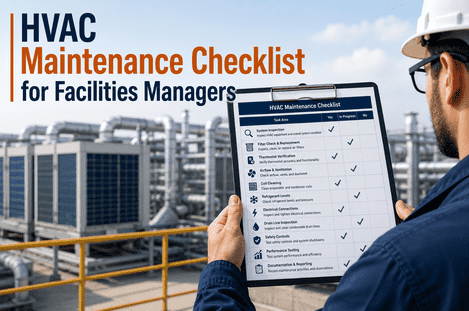
HVAC Maintenance Checklist for Facilities Managers
AI vs. Traditional HVAC Monitoring: Facilities Comparison
| Capability | Traditional / Manual | AI-Powered (iFactory) |
|---|---|---|
| Equipment Failure Detection | Operator-initiated on alarm; reactive shutdowns | AI vibration + thermal analysis with 3–6 week failure lead time |
| Energy Optimization | Periodic manual tuning of setpoints and schedules | Continuous AI optimization of chiller sequencing and ventilation |
| Indoor Air Quality Monitoring | Spot checks with handheld sensors | Real-time sensor network with AI-driven ventilation adjustments |
| Filter and Coil Maintenance | Calendar-based replacement regardless of condition | AI condition-based prediction using pressure-drop trend analysis |
| Refrigerant Leak Detection | Fixed detector threshold alarms; manual investigation | AI anomaly models with sub-1% sensitivity and automated alerting |
| Visual Equipment Inspection | Manual walk-throughs with flashlight and clipboard | AI vision camera with automated thermal and visual defect detection |
| Compliance Documentation | Manual record assembly before audits | Auto-generated, timestamped compliance dossiers on demand |
AI Implementation Pathway: 5 Phases for Facilities Managers
HVAC Asset Inventory and Sensor Data Audit
Map every sensor, BMS endpoint, and equipment tag across your HVAC systems. Identify gaps — older air handlers with no vibration sensors, zones without CO2 monitoring, and chillers running without efficiency tracking — and prioritize sensor retrofits before any AI model training begins.
Edge and Connectivity Architecture Setup
Deploy on-site edge AI nodes for real-time chiller and compressor monitoring functions. Establish secure data flows from BMS and IoT sensor networks to analytics platforms. Validate network bandwidth for cloud-based energy optimization and configure data compression for high-frequency sensor streams.
Baseline Model Training and Threshold Validation
Train predictive maintenance, energy optimization, and IAQ monitoring models on 90+ days of historical operational data. Validate anomaly detection sensitivity and false-positive rates against known historical events — chiller failures, filter clogging events, and IAQ excursions — before any live advisory deployment.
Advisory Mode Pilot on Highest-Value Assets
Launch AI monitoring in read-only advisory mode on your highest-consequence HVAC assets — central chiller plant, critical AHU serving sensitive zones, or the main boiler. Run parallel with existing BMS operations for 30–60 days to build facilities team confidence and refine alert logic before enterprise deployment.
Facility-Wide Rollout and Continuous Model Optimization
Expand AI coverage to all HVAC systems, integrate with onshore and remote monitoring dashboards, and connect to CMMS and energy management platforms. Establish a model governance process for retraining as equipment ages, occupancy patterns shift, and building codes evolve. Book a Demo to see iFactory's HVAC rollout methodology in detail.
What Facilities Managers Say About HVAC AI Implementation
Based on iFactory deployments across commercial and industrial facilities, the most consistent barrier to HVAC AI readiness is not technology access — it is the fragmented state of sensor infrastructure on existing building systems that were not designed with digital integration in mind. Facilities attempting to deploy AI without first resolving BMS data gaps, poorly calibrated temperature sensors, or zone-level monitoring blind spots will find model accuracy degraded within the first operational quarter.
The second most frequent challenge is cultural: on-site facilities engineers and HVAC technicians operate under extreme uptime accountability and are appropriately skeptical of AI recommendations that diverge from trained procedure. Deployments that enforce a structured advisory mode period — where AI outputs are visible but not operationally binding — see significantly faster acceptance curves and fewer rollback events than those that move straight to automated control.
Core Benefits of AI on Commercial and Industrial HVAC Systems
Real-Time Equipment Health Visibility
Replace shift-based manual rounds with continuous AI-generated equipment health dashboards covering chillers, AHUs, cooling towers, and boilers — accessible to facilities teams and building operations managers simultaneously.
Predictive Maintenance on Critical HVAC Assets
AI vibration and thermal analysis identifies compressor, fan, and pump degradation weeks ahead of failure — converting costly emergency service calls into planned maintenance that protects both equipment life and occupant comfort.
Automated Visual Inspection with AI Vision Cameras
AI computer vision processing of thermal and visible-spectrum camera feeds replaces manual equipment inspections, detecting refrigerant leaks, belt wear, heat exchanger fouling, and electrical hotspots with higher consistency than human walk-throughs.
ASHRAE and EPA Compliance Readiness
Digital, timestamped records of filter changes, refrigerant usage, IAQ measurements, and damper tests generate audit-ready compliance dossiers that paper-based systems cannot produce on demand — reducing audit preparation time from days to hours.
Energy Optimization Across HVAC Portfolio
AI energy models continuously optimize chiller sequencing, ventilation rates, and setpoint schedules — reducing energy consumption without capital investment by extracting more efficiency from existing HVAC infrastructure.
Scalable Digital Twin Foundation
Each AI deployment builds toward a fully instrumented HVAC digital twin — an always-current virtual model of the building's mechanical systems supporting retrofit planning, space utilization analysis, and energy simulation without physical verification.
Conclusion: Building AI-Ready HVAC Operations
AI readiness for commercial and industrial HVAC systems is not a single technology decision — it is a structured organizational journey that begins with sensor infrastructure, builds through predictive model deployment, and matures into a fully integrated digital twin operation. The facilities that move through this journey deliberately, addressing data gaps and team change management in parallel with technology deployment, will establish durable energy efficiency, equipment reliability, and compliance performance advantages over those still operating on manual maintenance cycles.
iFactory's AI platform is purpose-built for the complexity of commercial and industrial HVAC operations — integrating with existing BMS, SCADA, and CMMS systems while delivering the predictive intelligence that aging legacy infrastructure cannot provide. Whether you are assessing readiness on a single building or planning AI deployment across an entire facility portfolio, iFactory provides the domain expertise, edge-ready architecture, and structured deployment methodology to ensure measurable operational results from day one.