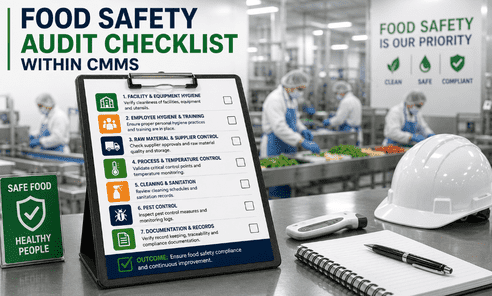
Food safety compliance in food and beverage manufacturing, processing, and packaging facilities depends on more than inspection day performance — it depends on whether your CMMS (Computerized Maintenance Management System) is structurally configured to sustain audit-ready documentation every day of the year. This food safety audit checklist within CMMS gives maintenance managers, quality assurance supervisors, sanitation leads, and plant reliability engineers a practical, phase-by-phase framework to assess whether their existing CMMS setup supports — or undermines — food safety audit outcomes. Facilities that run this checklist against their current CMMS configuration before their next GFSI, SQF, BRCGS, or FSSC 22000 audit consistently reduce non-conformances related to maintenance records, calibration traceability, and sanitation verification. Operations teams ready to benchmark their CMMS food safety configuration against real-world audit requirements can Book a Demo with iFactory AI for a guided facility-specific gap review.
Why CMMS Configuration Determines Food Safety Audit Outcomes
Maintenance Documentation Is the Most Frequently Cited Audit Gap
GFSI-benchmarked audits consistently cite incomplete maintenance records as a top-tier non-conformance across food facilities. When work orders lack traceable links to specific asset IDs, sanitation events, and inspection findings, even a well-maintained plant generates documentation that fails audit scrutiny. Book a Demo to see how iFactory AI structures CMMS food safety configuration before audit season begins.
Sanitation and Calibration Workflows Require CMMS-Backed Traceability
Food safety auditors expect every sanitation event, every instrument calibration, and every preventive maintenance action to produce a verifiable digital record linked to the correct asset, standard operating procedure, and responsible technician. Facilities that configure their CMMS to produce these records as a byproduct of normal operations — rather than as a pre-audit scramble — eliminate the most common root cause of documentation-related findings.
Expert Perspective: What a CMMS Food Safety Audit Reveals About Facility Readiness
Every food facility we audit for CMMS readiness reveals the same pattern — calibration records scattered across spreadsheets, sanitation logs stored as PDFs on shared drives, and work orders that close without linking to the affected production batch. The food safety audit itself becomes the first time all this documentation converges. Facilities that configure their CMMS to produce audit-ready documentation as a routine operational output — rather than as a compliance scramble — are the ones that consistently pass GFSI audits with minimal non-conformances. The ones that skip CMMS configuration review spend audit week chasing paper.
Conclusion: CMMS Configuration Is Food Safety Audit Infrastructure — Not a Compliance Add-On
Food safety audit readiness in food and beverage facilities is fundamentally a CMMS configuration question. The six assessment phases in this checklist reflect what separates facilities that approach audits with confidence from those that treat each audit as a documentation crisis. Asset register completeness for food contact equipment, sanitation PM scheduling aligned to hygienic zones, calibration traceability for CCP instruments, and work order audit trail integrity are the four most consistent predictors of audit outcome — and all four are fully controllable through deliberate CMMS configuration before the audit window opens. Food safety and maintenance leaders who complete this assessment, close the identified CMMS gaps, and align their maintenance management system with audit documentation requirements produce better compliance outcomes than facilities that invest in audit preparation activities that bypass the CMMS entirely. Teams ready to evaluate their CMMS food safety configuration against current facility requirements are encouraged to Book a Demo with iFactory AI before the next audit cycle begins.