Inspection Checklist Template for Safety Compliance
By Austin on June 4, 2026
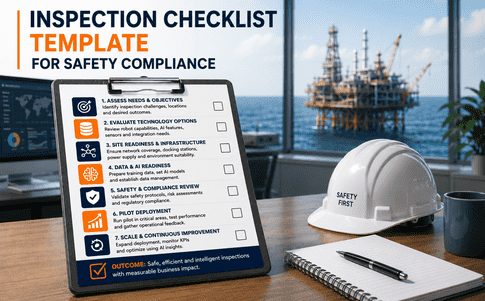
For industrial facilities, safety compliance is no longer a clipboard exercise — it is a continuous, data-driven process that separates operations with measurable uptime from those facing regulatory shutdowns, unplanned failures, and audit liabilities. This inspection checklist template for safety compliance provides maintenance engineers, reliability teams, and EHS managers with a validated sequence covering visual defect detection, PPE compliance verification, CMMS work order integration, and AI-powered predictive maintenance readiness. Facilities that Book a Demo with iFactory receive a facility-specific AI readiness score and a phased safety compliance roadmap before any platform commitment is made.
SAFETY COMPLIANCEAI INSPECTION 2026
Transform Your Safety Inspections With AI Vision — 99.4% Defect Detection Accuracy
iFactory's AI Vision Camera platform delivers real-time defect detection, PPE compliance monitoring, automated CMMS work orders, and audit-ready documentation — all from your existing camera infrastructure with zero cloud dependency.
Why a Structured Inspection Checklist Is the Foundation of Safety Compliance
Manual Inspections Miss Critical Defects Before They Escalate
Traditional clipboard-based safety inspections rely on inspector availability, shift fatigue, and subjective judgment — conditions that produce inconsistent findings and missed defects. Facilities that replace manual rounds with AI vision-assisted checklists report a 45% reduction in unplanned line stops from visual defects. A structured checklist template ensures every inspection point is captured, documented, and linked to a corrective work order automatically.
Compliance Documentation Gaps Create Regulatory and Audit Exposure
OSHA, ISO 55000, and GMP frameworks require timestamped, traceable inspection records with a full audit trail from finding to remediation. Paper logs and disconnected spreadsheets cannot produce this evidence on demand. AI-powered inspection checklists generate immutable, geotagged records with digital signatures — meeting regulatory documentation requirements without additional paperwork or manual record consolidation after the fact.
Map all existing inspection workflows, camera coverage zones, CMMS integrations, and compliance documentation gaps against this checklist to produce a prioritized remediation backlog.
02
AI Vision Deployment & Integration
Deploy edge AI inference on NVIDIA hardware, configure multi-spectral camera coverage, and establish bi-directional CMMS integration for automated work order creation from inspection findings.
03
Compliance Documentation Framework
Activate immutable inspection records, auto-generated compliance reports, and audit-ready documentation aligned with OSHA, ISO 55000, GMP, and industry-specific standards.
04
Continuous Model Improvement
Operationalize technician feedback loops, model retraining pipelines, and KPI dashboards to continuously improve detection accuracy and expand coverage to additional asset classes.
Expert Perspective: What Separates Compliant Facilities from Audit Liabilities
Facilities that pass regulatory audits consistently are not necessarily the ones with the most advanced sensors — they are the ones with structured, documented, and traceable inspection workflows. We have seen operations with expensive IoT deployments fail audits because there was no audit trail connecting a detected fault to a completed work order. The checklist and CMMS integration discipline always comes first. AI vision accelerates the detection piece dramatically, but the documentation framework is what makes the audit evidence legally defensible.
EHS Compliance Program Director — Industrial Manufacturing & Process Operations
99.4%Defect Detection Accuracy
80%Reduction in Inspection Time
55%Fewer GMP Audit Findings
150+Assets Inspected per Shift
READY TO DEPLOYAI SAFETY INSPECTION
From Inspection Checklist to Audit-Ready AI Compliance in Under 90 Days
iFactory's engineering team maps every checklist dimension to your existing camera infrastructure, CMMS, and compliance framework — delivering a pilot scope and documentation roadmap before any platform commitment.
Conclusion: Build a Safety Compliance Inspection Program That Holds Up Under Audit
Safety compliance inspection is not a task that ends when the clipboard is filed — it is a continuous, documented, and data-linked process that must connect every detected defect to a traceable corrective action before a regulatory inspector or an incident report asks for the evidence. The six readiness dimensions and four-phase roadmap outlined in this checklist reflect the implementation sequence that consistently delivers measurable reductions in unplanned failures, regulatory audit findings, and PPE incident rates. Maintenance engineers, EHS managers, and IT leaders ready to benchmark their inspection program against this validated framework are encouraged to Book a Demo with iFactory and receive a facility-specific AI vision readiness assessment before any deployment commitment is made. iFactory's AI Vision Camera platform delivers 99.4% defect detection accuracy, automated CMMS work order creation, immutable compliance documentation, and on-premise edge AI processing — built for industrial facilities that demand safety compliance evidence as reliable as the equipment it protects.
Inspection Checklist for Safety Compliance — Frequently Asked Questions
1. What is the most common failure point in industrial safety inspection checklists?
The most common failure is the gap between inspection finding and corrective work order — findings that are recorded on paper or in disconnected systems but never linked to a CMMS work order, creating an audit trail that breaks at the remediation step. AI-powered inspection platforms close this gap by automatically generating work orders from detected defects with annotated image evidence.
2. How does iFactory AI Vision support OSHA and ISO 55000 compliance documentation requirements?
Every iFactory AI inspection produces a timestamped, geotagged, and digitally signed record stored in an immutable audit log — meeting OSHA, ISO 55000, and GMP documentation requirements without additional paperwork or manual record-keeping. Compliance reports are auto-generated on schedule for regulatory submissions.
3. Can iFactory AI Vision work with existing cameras or does it require new hardware?
iFactory AI Vision integrates with existing ONVIF-compliant cameras via RTSP streams, meaning most facilities can activate AI-powered inspection without replacing their camera infrastructure. Additional thermal and 3D depth sensor inputs can be added where multi-spectral coverage is required for complete defect detection.
4. How accurate is AI vision-based PPE compliance detection compared to manual audits?
iFactory AI Vision achieves 99.4% detection accuracy for PPE violations including hard hats, high-visibility vests, safety glasses, and gloves — operating 24 hours per day across all zones simultaneously. Manual spot-checks conducted twice per shift typically capture less than 30% of actual violation events in dynamic production environments.
5. What is the typical time to first production inspection deployment with iFactory?
Most iFactory AI Vision deployments reach the first production inspection model within 3 to 6 months from initial assessment, including CMMS integration, compliance documentation framework setup, and technician training. Facilities with existing ONVIF camera infrastructure and a live CMMS typically complete the pilot phase faster than the industry average.
START YOUR JOURNEYGET YOUR READINESS SCORE TODAY
Get a Facility-Specific Safety Inspection Readiness Score & AI Roadmap
iFactory's AI vision engineers will map every checklist item to your existing camera infrastructure, CMMS, and compliance requirements — delivering a prioritized gap assessment and pilot plan at zero cost before any platform commitment.