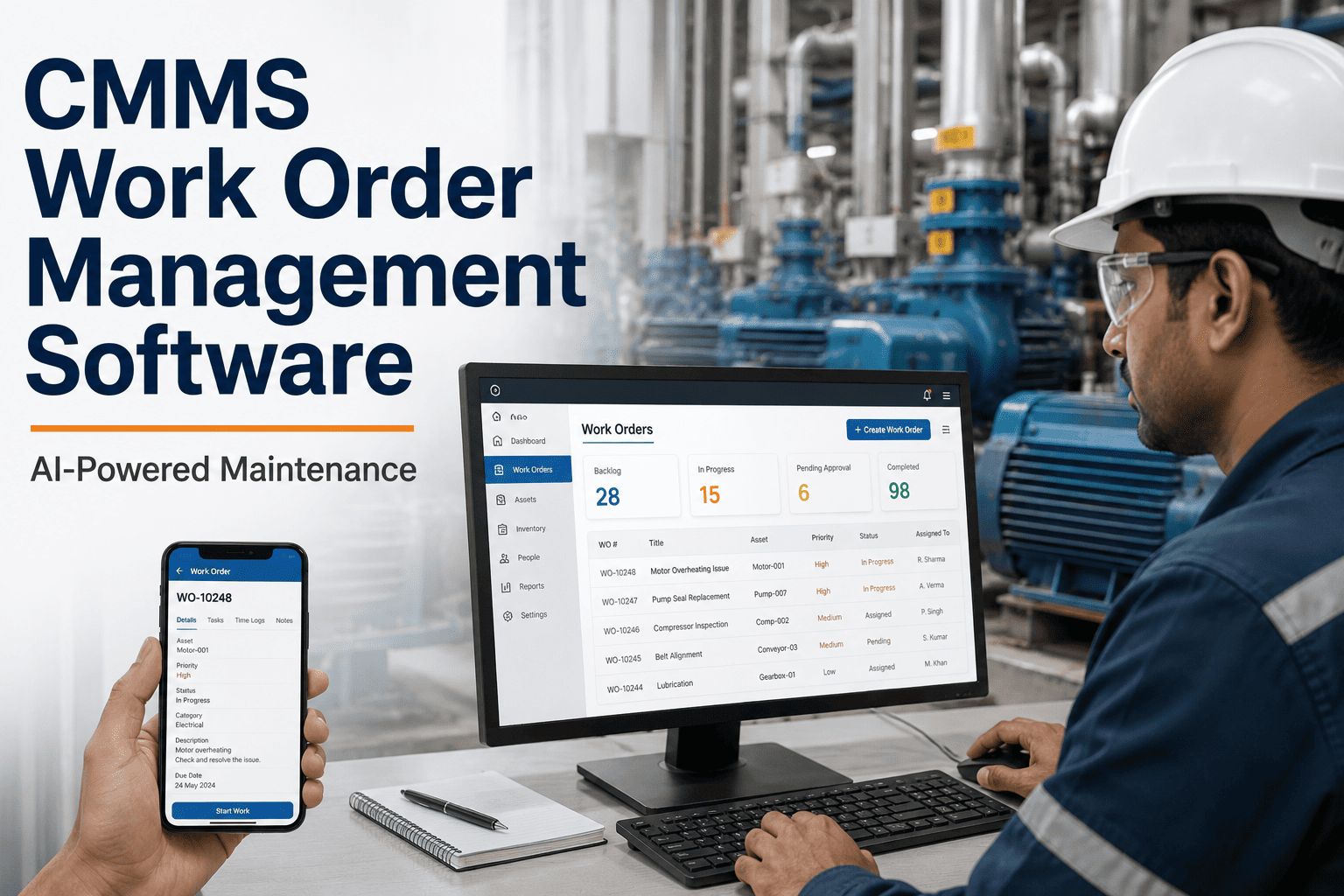
The Computerised Maintenance Management System market is undergoing its most consequential transformation since the shift from paper-based maintenance records to digital work order systems in the 1990s. In 2026, the convergence of artificial intelligence, Industrial IoT sensor networks, digital twin simulation, and mobile-first field operations is reshaping what a CMMS is capable of delivering — and raising the performance bar for every maintenance organisation that depends on one. The global CMMS market, valued at approximately $1.2 billion in 2024, is forecast to exceed $2.1 billion by 2030 at a compound annual growth rate above 9%, driven by accelerating adoption of predictive maintenance, Industry 4.0 integration requirements, and tightening regulatory compliance obligations across manufacturing, utilities, healthcare, and asset-intensive industrial sectors. The organisations gaining the most from this market shift are not simply upgrading their CMMS software — they are deploying AI-powered platforms that turn maintenance data into operational intelligence, reduce unplanned downtime by 30–50%, and generate audit-ready compliance documentation automatically. This article examines the seven trends defining the CMMS market in 2026, the technology predictions that will shape the next three years, and how iFactory's AI-powered CMMS platform is positioned at the intersection of every major market development. Book a Demo to see how iFactory's platform maps to the 2026 CMMS capabilities your maintenance programme needs.
2026 CMMS Market Trends and Predictions
Seven trends reshaping the global CMMS market in 2026 — and how AI-powered maintenance management platforms are delivering the predictive, IoT-integrated, and compliance-automated outcomes that the next generation of asset-intensive operations demands.
Why 2026 Is a Pivotal Year for CMMS Technology Adoption
Three converging forces are making 2026 a decisive year for CMMS investment across every asset-intensive sector. First, the maturation of industrial IoT hardware — sensors capable of streaming vibration, temperature, pressure, and current data continuously at a cost point that has dropped 70% since 2020 — has made condition monitoring accessible at scale for the first time. Second, AI model performance for industrial maintenance prediction has reached a level of accuracy that justifies operational trust: modern AI-powered CMMS platforms are achieving failure prediction accuracy above 94% with false alert rates below 3%, eliminating the alarm fatigue problem that undermined earlier predictive analytics deployments. Third, regulatory pressure across manufacturing, healthcare, food processing, and pharmaceutical sectors is creating compliance documentation obligations that manual CMMS record-keeping cannot meet at scale — driving adoption of automated audit trail and report generation capabilities. Together, these forces are separating the CMMS market into two tiers: platforms that deliver AI-powered predictive intelligence and automated compliance, and platforms that remain sophisticated digital filing cabinets. Maintenance organisations that make CMMS investment decisions in 2026 are choosing which tier their operations will operate in for the next five years. Book a Demo to assess where iFactory's platform positions your maintenance programme in this market shift.
Seven CMMS Market Trends Defining 2026
These trends are drawn from deployment data, industry analyst research, and maintenance technology adoption patterns across manufacturing, utilities, healthcare, and infrastructure sectors globally in 2025–2026.
AI Predictive Maintenance Becomes the Baseline Expectation
In 2024, AI predictive maintenance was a premium differentiator in CMMS selection. By 2026, it has become a baseline requirement. Over 68% of maintenance leaders now list predictive failure detection as a primary evaluation criterion — up from 31% in 2022. Platforms that deliver only time-based PM scheduling without condition-based AI are losing competitive ground to integrated platforms that connect IoT sensor data to maintenance work order generation automatically. iFactory's pre-trained AI models for pump, compressor, motor, and HVAC failure modes activate immediately without requiring 12-month training datasets.
IoT Integration Depth Replaces Sensor Count as the Key Metric
The 2026 CMMS market has moved beyond the question of how many sensors a platform can connect — to how deeply sensor data is integrated with maintenance workflows. Leading platforms in 2026 are not simply displaying IoT sensor readings on dashboards; they are using sensor streams to trigger work orders, adjust PM intervals dynamically, update digital twin models in real time, and generate predictive maintenance alerts that route directly to technician mobile devices. The quality of the analytics layer applied to IoT data — not the breadth of sensor connectivity — is the competitive differentiator in 2026.
Mobile-First CMMS Replaces Desktop-Centric Workflows
The proportion of maintenance work orders being created, managed, and closed on mobile devices has exceeded 60% across manufacturing and utilities sectors in 2026 — a threshold that makes mobile experience a primary CMMS selection criterion rather than a secondary consideration. Facilities that have deployed mobile-first CMMS access report work order documentation completeness rates exceeding 97%, compared to 58–65% for facilities using desktop-centric systems with paper-to-digital transcription workflows. The productivity and data quality gains from mobile deployment are driving accelerated migration away from legacy CMMS platforms regardless of sunk costs.
Compliance Automation Drives CMMS Adoption in Regulated Sectors
In pharmaceutical, medical device, food and beverage, and utilities sectors, CMMS adoption is being driven as much by compliance documentation requirements as by maintenance efficiency goals in 2026. ISO 13485, FDA 21 CFR Part 820, SQF Edition 9, and BRC Issue 9 all require documented maintenance evidence that manual record-keeping systems cannot produce at the volume and completeness that regulatory audits increasingly demand. CMMS platforms with built-in audit trail functionality, electronic record integrity controls, and pre-formatted compliance report generation are capturing adoption share rapidly from spreadsheet and paper-based maintenance programmes.
Digital Twin Integration Moves from R&D to Operational Standard
Digital twin capability — virtual replicas of physical assets synchronised with live sensor data — has crossed from research project to operational standard in 2026 for facilities with high-value or high-criticality asset portfolios. The practical applications driving adoption are maintenance scenario simulation (testing a maintenance intervention on the virtual asset before applying it to the physical one), remaining useful life prediction (projecting asset degradation trajectory from current condition data), and maintenance timing optimisation (identifying the most cost-effective intervention window based on production schedules and parts availability). CMMS platforms with integrated digital twin modules are commanding significant premium positioning in the 2026 market.
ESG and Emissions Compliance Integration Becomes a CMMS Capability
Environmental, social, and governance reporting obligations are creating a new category of CMMS capability demand in 2026: the ability to aggregate asset-level emissions data — energy consumption, refrigerant leaks, process gas releases, and water usage — and generate regulatory compliance reports automatically. Facilities that have historically maintained separate EMS (environmental management system) and CMMS platforms are converging these functions as maintenance events become primary data sources for ESG reporting. CMMS platforms with native ESG data aggregation and report generation capabilities are positioned at the leading edge of this market development.
iFactory's AI-powered CMMS platform is built at the intersection of every trend in this analysis — delivering predictive maintenance, deep IoT integration, mobile-first field operations, compliance automation, digital twin simulation, ESG data aggregation, and cloud SaaS architecture in a single unified deployment. Book a Demo to see how iFactory performs against your current CMMS capability gaps.
Five CMMS Technology Predictions for 2026–2029
Beyond the trends already observable in the 2026 market, these five technology developments are projected to reshape CMMS capability and adoption patterns over the next three years — based on current R&D trajectories, early adopter deployment results, and maintenance technology vendor roadmap analysis.
Autonomous Maintenance Work Order Generation Will Become Standard
By 2028, the leading CMMS platforms will generate, assign, and schedule the majority of preventive and predictive maintenance work orders autonomously — without manual planner intervention — using AI models that integrate IoT condition data, technician availability, spare parts stock levels, and production schedules simultaneously. Human planners will shift from work order generation to exception management and optimisation review, reducing planning overhead by an estimated 60–70% at facilities with mature IoT sensor coverage.
Natural Language Interfaces Will Replace Form-Based Work Order Entry
Conversational AI interfaces — allowing technicians to report equipment faults, request parts, and close work orders through natural language voice or text interaction — are moving from pilot deployment to production standard across leading CMMS platforms in 2026–2027. The data quality and documentation completeness advantages of natural language interfaces over structured form completion are significant, particularly for field technicians whose primary job function is technical rather than administrative. Expect natural language CMMS interaction to be a standard feature rather than a premium add-on by 2028.
Maintenance Cost Modelling Will Become a Core CMMS Analytics Function
Asset lifecycle cost modelling — projecting total maintenance cost, replacement cost, and production impact cost over a 3–10 year horizon for every asset in the register — is emerging as a core CMMS analytics function rather than a separate asset management tool. The combination of AI-projected failure trajectory, maintenance cost history from work order records, and production impact data from OEE tracking gives CMMS platforms the data to generate defensible replacement vs. maintain analyses automatically, transforming capital expenditure planning from a periodic manual exercise to a continuously updated asset intelligence output.
AI Vision Integration Will Expand CMMS Inspection Capability
AI Vision Camera systems — already deployed for product quality inspection in manufacturing — are being integrated with CMMS platforms to automate equipment inspection workflows. Instead of a technician walking a predetermined route and manually recording equipment condition observations, AI Vision cameras mounted at fixed points or carried on inspection robots continuously assess equipment condition, generate visual inspection records, and trigger CMMS maintenance work orders when anomalies are detected. iFactory's AI Vision Camera platform is already delivering this integration, connecting visual inspection data directly to CMMS work order management for automated condition-based maintenance triggering.
Cross-Facility Federated Learning Will Improve AI Model Accuracy
The next generation of AI-powered CMMS platforms will use federated machine learning — training failure prediction models on anonymised data aggregated across thousands of facilities without sharing proprietary operational data — to achieve prediction accuracy levels that single-facility training datasets cannot reach. Facilities with unusual asset configurations or limited failure history will benefit disproportionately from federated learning, as their local models will draw on global failure pattern libraries rather than being constrained to local historical data. This is a structural accuracy advantage for cloud SaaS CMMS platforms over on-premise installations that cannot participate in federated learning networks.
2026 CMMS Market Statistics and Benchmarks
These data points represent current market research, deployment benchmarks, and maintenance performance outcomes from AI-powered CMMS deployments across manufacturing, utilities, and industrial sectors in 2025–2026.
How iFactory Addresses Every 2026 CMMS Market Trend
iFactory's AI-powered CMMS platform is designed to deliver on every major capability requirement that the 2026 CMMS market is demanding — combining predictive maintenance, IoT analytics, digital twin simulation, mobile-first operations, compliance automation, and AI vision integration in a single deployment that goes live in weeks rather than months.
| 2026 Market Trend | iFactory Capability | Measured Outcome |
|---|---|---|
| AI Predictive Maintenance | Pre-trained failure models for pumps, compressors, motors, and HVAC detecting degradation 3–4 weeks before failure on IoT sensor data | 94%+ prediction accuracy |
| Deep IoT Integration | OPC-UA, MQTT, Modbus TCP, and REST API connections to existing sensor networks, SCADA, DCS, and historian systems without custom data plumbing | Live in 4 weeks |
| Mobile-First Operations | Native mobile app for work order creation, task completion, parts requests, and inspection recording with offline capability for low-connectivity environments | 99% documentation completeness |
| Compliance Automation | 21 CFR Part 11 audit trail, ISO 13485 and GFSI compliance report generation, and electronic record integrity controls for regulated manufacturing sectors | Audit reports in minutes |
| Digital Twin Simulation | Physics-accurate virtual asset replicas synchronised with live sensor data for maintenance scenario testing, RUL projection, and intervention timing optimisation | 25% maintenance cost reduction |
| AI Vision Integration | AI Vision Camera platform connects visual inspection data directly to CMMS work order management — automating condition-based maintenance triggering from visual anomaly detection | 100% inspection coverage |
| ESG Data Integration | Asset-level energy consumption, emissions event, and process gas release data aggregated automatically with compliance report generation for EPA and ISO 50001 requirements | Zero manual consolidation |
| Cloud SaaS Architecture | Multi-site cloud deployment with continuous AI model improvement from cross-facility learning, automatic feature updates, and infrastructure scaling as IoT data volumes grow | 70% lower TCO vs. on-premise |
How iFactory Goes Live in 4 Weeks
The most common barrier to CMMS migration in 2026 is not budget — it is deployment risk and integration complexity. iFactory's four-phase deployment methodology removes both barriers by connecting to existing operational technology infrastructure as it stands, without requiring system replacement, and delivering live predictive monitoring within the first month. Maintenance managers evaluating deployment timelines can Book a Demo for a facility-specific deployment scoping session.
Infrastructure Assessment
iFactory maps existing SCADA, DCS, PLC, and sensor connections. Integration points are identified and documented without touching live control systems or disrupting current operations.
Data Source Connection
OPC-UA, MQTT, and REST API connections are configured for direct data ingestion from existing operational technology. Asset hierarchy, PM schedules, and work order workflows are configured in the CMMS platform.
AI Model Activation
Pre-trained failure prediction models activate on priority assets. IoT baseline collection begins. Predictive alert thresholds are calibrated. Mobile app deployment and user training completed.
Operations Handoff
Live dashboards, predictive alert workflows, compliance report templates, and KPI baselines commissioned. Full operations team handoff to autonomous monitoring mode with ongoing iFactory support.
The 2026 CMMS Investment Decision Is a Five-Year Operational Architecture Choice
The CMMS platform decision made in 2026 is not a software purchase — it is an operational architecture choice that will define maintenance performance, compliance capability, and asset intelligence for the next five years. Organisations that select AI-powered platforms with deep IoT integration, mobile-first operations, digital twin capability, and automated compliance documentation will compound those advantages with every month of operational data that accumulates in the system. Organisations that remain on time-based, desktop-centric, manually-documented CMMS platforms will face growing performance, compliance, and cost gaps relative to facilities that made the transition in 2026.
iFactory's AI-powered CMMS and AI Vision Camera platform is positioned at the leading edge of every market trend identified in this analysis — delivering predictive maintenance accuracy above 94%, IoT integration live in four weeks, mobile-first work order management with 99% documentation completeness, automated compliance reporting for ISO 13485, FDA, and GFSI requirements, digital twin simulation for maintenance scenario planning, and AI Vision Camera integration for automated visual inspection. For maintenance organisations evaluating the 2026 CMMS market, iFactory represents the platform architecture that the next five years of operational excellence is built on. Book a Demo to see where iFactory delivers the fastest measurable ROI for your specific asset portfolio and compliance requirements.
The AI-Powered CMMS Built for 2026 and Beyond
See how iFactory's unified platform delivers predictive maintenance, IoT analytics, digital twin simulation, AI vision inspection, and automated compliance documentation — live in 4 weeks, across every asset in your portfolio.