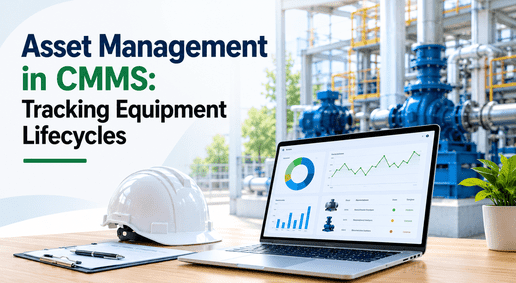
In the era of Industry 4.0, asset management within a Computerized Maintenance Management System (CMMS) has evolved far beyond simple work order logging. Modern CMMS platforms now serve as the digital backbone for tracking the complete equipment lifecycle—from procurement and commissioning through preventive maintenance, calibration, and eventual decommissioning. Yet most manufacturers underutilize this capability, treating their CMMS as a reactive ticketing system rather than a strategic asset stewardship engine. iFactory's AI-driven vision intelligence transforms your CMMS into a proactive lifecycle command center: capturing real-time equipment condition data directly from the production floor, correlating visual anomalies with maintenance histories, and triggering work orders the moment a degradation pattern is detected. Maintenance teams who Book a Demo are discovering that hidden lifecycle gaps—missed PM windows, untracked overhauls, and phantom inventory—are silently eroding equipment reliability and inflating operational costs across their entire asset base.
Is Your CMMS Capturing the Full Equipment Lifecycle?
Deploy AI-driven visual asset tracking, automated condition monitoring, and predictive maintenance triggers—all unified inside your existing CMMS ecosystem.
What Asset Lifecycle Management in CMMS Means for Reliability Excellence
Managing equipment lifecycles through a CMMS is fundamentally about closing the gap between planned maintenance theory and shop-floor reality. A typical plant maintains hundreds of assets across multiple criticality tiers, each with its own PM schedule, spare parts profile, and degradation curve. Traditional CMMS implementations rely on manual data entry and calendar-based triggers, which structurally miss early-stage equipment deterioration that manifests visually—oil leaks, corrosion, misalignment, or surface fatigue. AI-enhanced lifecycle tracking shifts this paradigm by layering computer vision data onto your existing asset hierarchy. When reliability engineers schedule a technical walkthrough, they see how visual condition scoring at each inspection point feeds directly into the asset's lifecycle record, enabling true condition-based maintenance within the familiar CMMS interface.
Visual Asset Health Scoring
Deploy AI cameras at critical assets to automatically score visual condition indicators—surface defects, lubricant discoloration, fastener looseness—and log them directly into the CMMS asset record.
Automated Work Order Triggers
When the vision AI detects a degradation threshold breach, it generates a structured work order in the CMMS with photographic evidence, location data, and recommended corrective action.
Lifecycle Cost Analytics
Correlate visual condition trends with maintenance history, spare part consumption, and downtime records to calculate true lifecycle cost per asset and optimize replacement timing.
PM Compliance Verification
Use AI vision to confirm that PM tasks were actually performed—verify lubricant levels, filter conditions, and safety guard positions—closing the compliance loop in your CMMS.
Spare Parts Predictive Replenishment
Track component wear visually and predict remaining useful life. Auto-trigger spare part requisitions in the CMMS when replacement windows approach, eliminating emergency procurement.
Decommissioning Decision Support
Aggregate years of visual condition history, repair frequency, and performance degradation to provide data-backed recommendations for asset retirement or capital replacement.
Our CMMS was full of data but empty of insight—we knew when PMs were scheduled but not whether the asset was actually healthy. iFactory's vision layer turned every inspection point into a structured data event. We caught a bearing degradation six weeks before failure because the AI spotted the grease discoloration that our manual rounds kept missing. That single catch paid for the entire deployment.
Solving the Blind Spots in Equipment Lifecycle Tracking
Operating a maintenance organization without deep lifecycle analytics leads to "Silent Failures"—assets that degrade slowly over months until a sudden breakdown—and "PM Waste"—performing calendar-based maintenance on healthy equipment while failing assets go unnoticed. iFactory's vision-based CMMS augmentation solves this by creating a continuous visual audit trail for every critical asset. If you are struggling with incomplete lifecycle records or unexpected equipment failures, you can book a maintenance operations audit today.
Problem 1 — Incomplete Condition History
Most CMMS asset records contain work order dates and technician notes but lack objective condition evidence. Without visual baselines, it is impossible to track the rate of degradation across consecutive PM cycles. iFactory's AI captures timestamped images at each inspection point, applies a condition score, and appends it directly to the asset lifecycle timeline, creating an irrefutable degradation curve.
Problem 2 — Delayed Failure Detection
Traditional CMMS alerts are triggered by time or usage thresholds, not by actual asset health. A pump may be vibrating for weeks before its next PM catches the issue. iFactory's continuous visual monitoring detects physical failure precursors—seal leaks, belt fraying, coupling misalignment—within hours of onset, triggering CMMS work orders in real time rather than at the next calendar interval.
Problem 3 — Audit Compliance Gaps
Regulatory audits require proof that maintenance was performed correctly and consistently. Paper-based checklists and manual photo logs are time-consuming to compile and easy to falsify. iFactory's vision AI records every maintenance event with verifiable imagery, time stamps, and condition scores, producing audit-ready lifecycle documentation that satisfies ISO 55000 and FDA requirements.
Reduce unplanned downtime by 35% by detecting visual failure precursors before they escalate into breakdowns.
Eliminate 22% of unnecessary PM tasks by replacing calendar triggers with actual asset condition data.
Achieve 100% audit-ready lifecycle documentation with automatically captured visual evidence per asset.
Reduce manual inspection time by 40% through automated visual scoring and CMMS data integration.
The ROI of Intelligence: KPI Gains from Vision-Enhanced CMMS
Optimizing your equipment lifecycle tracking isn't just a maintenance win—it directly improves your Overall Equipment Effectiveness (OEE). The benchmarks below represent the average gains achieved across industrial deployments of iFactory's vision-augmented CMMS platform. Maintenance and reliability managers who Book a Demo are securing these lifecycle stability gains within their first quarter of deployment.
Stop Guessing Your Asset Health. Start Tracking Real Lifecycles Today.
iFactory gives maintenance teams continuous visual condition monitoring, automated CMMS work order generation, and audit-ready lifecycle documentation—all unified in one platform.
Frequently Asked Questions: Asset Management in CMMS
How does iFactory integrate vision data into legacy CMMS platforms?
iFactory connects to any CMMS with an open API or database connector. Our edge AI cameras capture condition data and push it as structured asset records, work order attachments, or custom field values directly into your existing system without replacing your current CMMS investment.
Can the AI distinguish between normal wear and failure conditions?
Yes. The vision model is trained on thousands of industrial asset images spanning normal operation, expected wear patterns, and failure precursors. Each detection includes a confidence score and a severity classification, allowing your CMMS to filter between informational logs and actionable alerts.
What is the typical ROI timeline for vision-enhanced CMMS deployment?
Most industrial sites achieve full return on investment within 4 to 8 months. The ROI is driven by three factors: avoided unplanned downtime, elimination of unnecessary PM tasks, and reduced emergency spare parts procurement. The first prevented failure typically covers the deployment cost.
Does the platform support multi-site asset hierarchy rollups?
Absolutely. iFactory is designed for enterprise-scale deployments. The platform supports hierarchical asset structures across plants, production lines, and individual equipment. Condition data from each site rolls up into a unified lifecycle dashboard while maintaining site-specific CMMS synchronization.
How does visual condition scoring work for rotating equipment?
For rotating assets like pumps, motors, and gearboxes, iFactory's AI analyzes surface-level indicators including lubricant leakage around seals, coupling alignment markers, housing crack propagation, and fastener torque indicators. Each visual indicator is scored independently and aggregated into an overall asset health index.
Can iFactory handle different asset criticality tiers?
Yes. The platform supports configurable inspection frequencies and alert thresholds based on asset criticality. Critical assets can be monitored continuously or at every operator round, while lower-tier assets can follow reduced inspection schedules—all managed through the CMMS integration layer.
Is iFactory compatible with existing preventive maintenance schedules?
Yes. Rather than replacing your PM program, iFactory augments it. The vision AI performs "Condition Verification" at each scheduled PM event, confirming that the maintenance was effective and that no new degradation has started since the last intervention. This creates a closed-loop verification cycle.
How long does it take to set up vision monitoring for a single asset?
A standard iFactory camera deployment for a single asset takes approximately 45 minutes. This includes physical mounting, network configuration, and an initial "Learning Pass" where the AI baselines the asset's normal visual condition. Full site rollouts typically complete within 2 to 4 weeks. Request an implementation roadmap here.