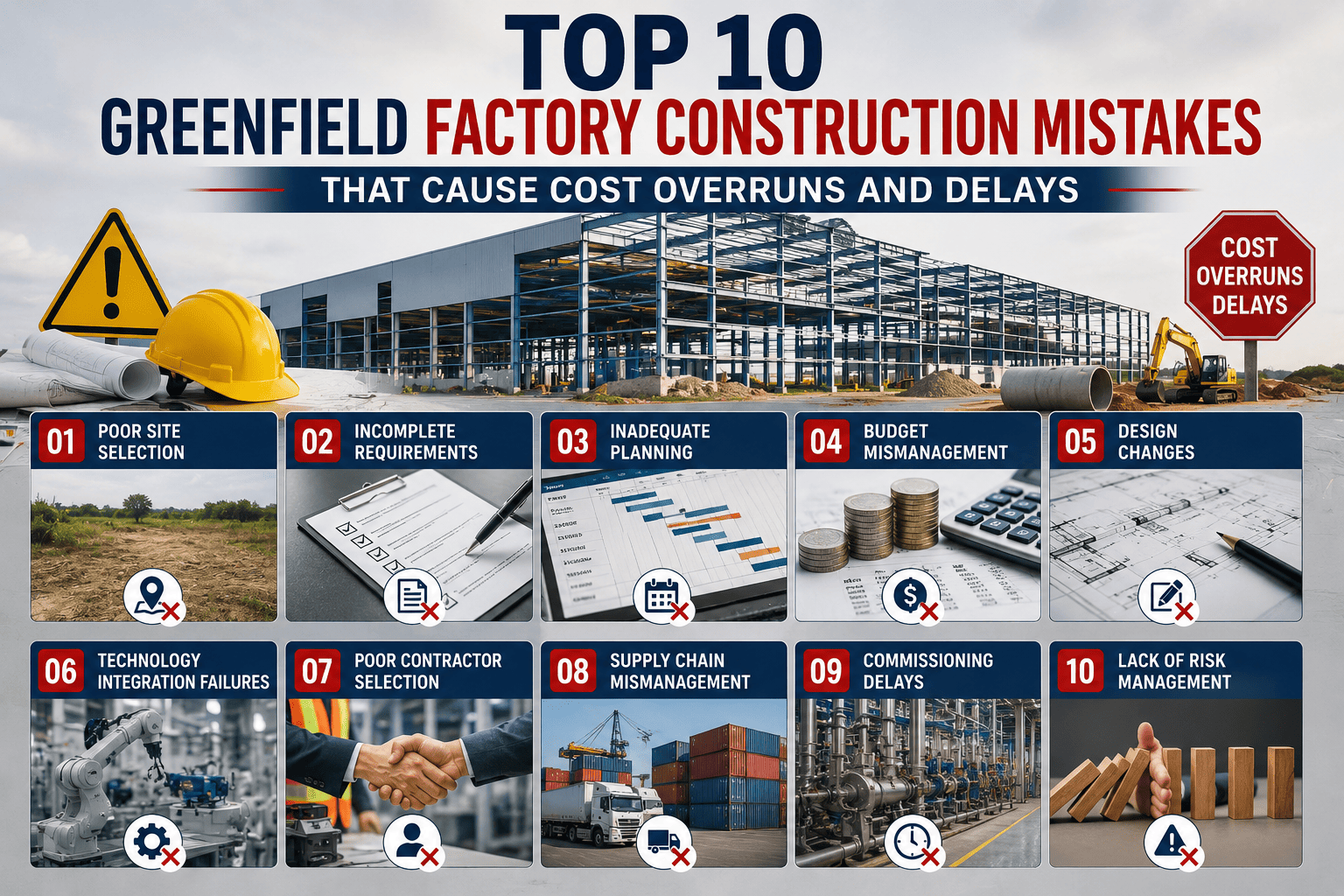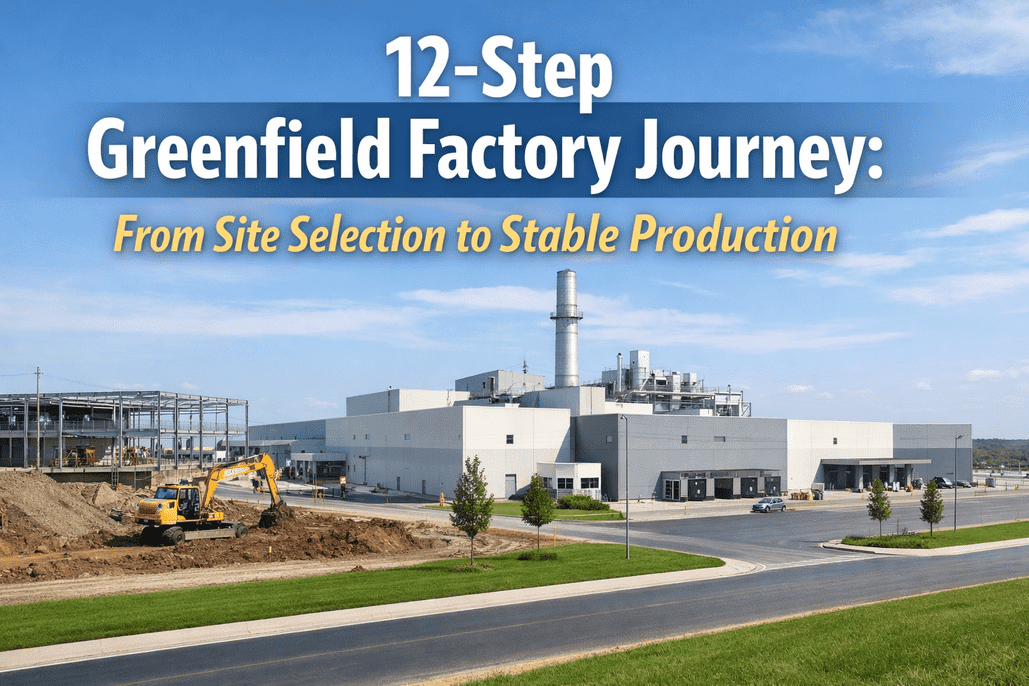
Building a greenfield factory takes 3-5 years from first concept to stable production. 90% of large industrial projects exceed their budgets. Nearly half miss their deadlines. And once a greenfield construction project falls behind, teams almost never fully recover. The difference between the projects that succeed and those that spiral into cost overruns is not luck — it's a structured, phase-gated journey with clear milestones, decision points, and risk controls at every step. This guide breaks the full greenfield lifecycle into 4 phases and 12 steps — from manufacturing strategy through stable production — with the digital twin, AI, and smart factory accelerators that compress timelines and de-risk each stage. Whether you're building a $50M specialized facility or a $500M mega-factory, this is the playbook. Book a consultation to discuss where you are in the journey.
Manufacturing Strategy & Business Case
Every greenfield project begins with a strategic question: Why build new capacity, and what must it achieve? This step defines the product portfolio, target volumes, quality standards, market positioning, and financial model that justify the investment. The manufacturing strategy determines whether to build one large facility or multiple smaller ones, which processes to automate vs. manual, and what level of smart factory technology to embed from day one.
Site Selection & Due Diligence
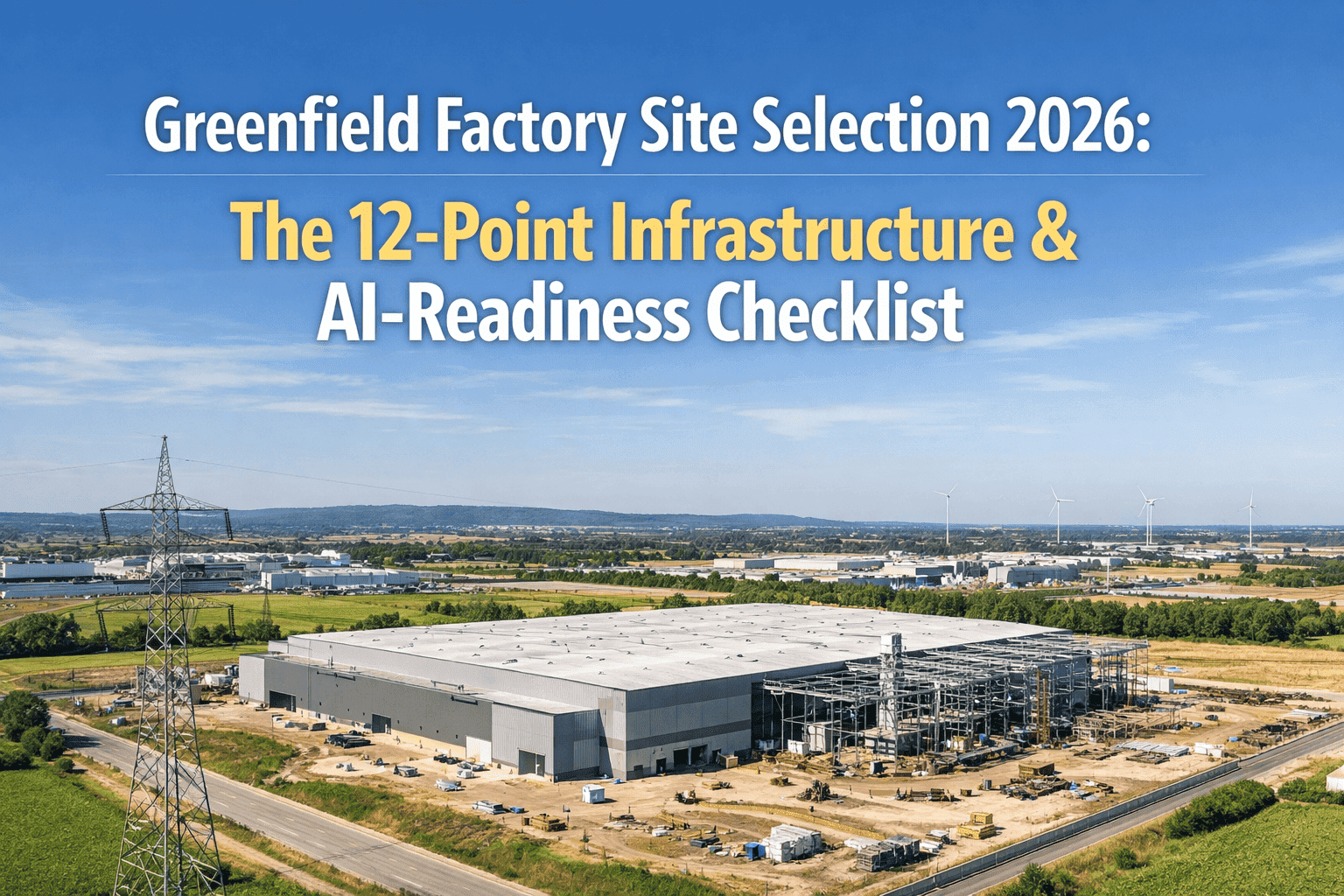
Site selection is the single highest-leverage decision in the entire greenfield journey. It determines workforce availability, logistics costs, utility infrastructure, regulatory burden, and incentive eligibility for the life of the facility. For AI-first factories, site requirements go beyond traditional criteria — you need power capacity for edge computing (2-3x a traditional plant), 5G/fiber connectivity, and proximity to technical talent pools.
Factory Design & Engineering
Factory design translates the manufacturing strategy into physical and digital architecture. Layout, material flow, utility routing, safety zones, automation cell placement, and IT/OT infrastructure are defined during FEED (Front-End Engineering Design). Decisions made here lock in 80% of the facility's lifetime operating costs. Digital twin simulation during design allows teams to test hundreds of layout configurations virtually — identifying bottlenecks before they're built into concrete.
In the planning phase? Book a 30-minute strategy call — we'll review your manufacturing strategy, site options, and design approach to identify risks and acceleration opportunities.
Sourcing & Industrial Procurement
Execution begins with procurement — the longest lead-time activity in the entire project. Custom production equipment can take 12-18 months from order to delivery. Construction materials, automation systems, control hardware, and digital infrastructure must all be sourced and scheduled to arrive in the right sequence. A dock-time bottleneck can cascade delays across the entire project.
Construction & Base Build
The physical construction phase — building shell, MEP (mechanical, electrical, plumbing), cleanroom if required, utility systems, and site infrastructure. Construction capacity for new factories is constrained in 2026, especially by skilled labor shortages. Cost overruns are most common in this phase due to unrealistic timelines, long material lead times, and insufficient contingency planning. Digital twin progress tracking provides real-time visibility into construction status vs. plan.
Equipment Installation & Integration
Production equipment, automation systems, robots, and digital infrastructure are installed and connected. Dependencies on base-build readiness (power, water, HVAC, drains) must be mapped precisely — equipment cannot be installed until lateral systems are ready. Heavy or expensive equipment requires professional rigging and orchestrated move-in paths. Preassembly and integration testing at an offsite location or dedicated factory section can accelerate the timeline significantly.
In the execution phase and facing procurement delays or construction bottlenecks? Schedule a project review call — we specialize in helping greenfield teams recover timelines and de-risk integration.
Virtual Commissioning & FAT
Before physical startup, complex manufacturing control systems are tested in a digital twin environment — reducing startup risk and timeline. Factory Acceptance Testing (FAT) verifies equipment at the vendor's facility against specifications. Virtual commissioning allows teams to debug control logic, test edge cases, and train operators before the equipment arrives on-site. Planning includes defining test procedures, checklists, and as-built documentation well in advance.
Site Acceptance Testing (SAT) & Commissioning
Physical commissioning ensures all installed equipment, systems, and components operate according to design requirements. Mechanical commissioning confirms proper function without process fluids first, then with fluids and chemicals. Electrical commissioning includes panel energization, communication checks, loop checks, and wiring verification. Integration testing verifies that field devices are correctly reflected on dashboards and can be controlled from central locations.
Product Qualification & Process Validation
For regulated industries (pharma, medical devices, food, automotive), product qualification verifies that the new facility can consistently produce products meeting all quality specifications and regulatory requirements. This includes IQ (Installation Qualification), OQ (Operational Qualification), and PQ (Performance Qualification) protocols. For non-regulated industries, this step validates that production output meets quality targets, dimensional tolerances, and customer specifications before full-rate production begins.
Production Ramp-Up & Yield Optimization
The first 90 days of production are the most critical — and most dangerous — of any greenfield project. Output targets, quality metrics, and equipment reliability are all simultaneously ramping. AI analytics identify yield killers in real-time: which machines drift first, which processes generate the most scrap, where bottlenecks form as volume increases. Predictive maintenance prevents the early-life failures that plague new equipment installations.
Workforce Onboarding & Stabilization
Workforce readiness — not availability — is what makes or breaks ramp-up. Most greenfield projects struggle because hiring happens too late, role clarity is weak, and productivity assumptions are unrealistic. Structured onboarding with AR/AI-guided training accelerates time-to-competency. The "post go-live churn" — where new hires leave within 90 days — must be managed with retention strategies, clear career paths, and performance feedback loops.
Continuous Optimization & Lessons Learned
Once stable production is achieved, the focus shifts to continuous optimization — a part of the journey that never ends. AI models retrained on 6-12 months of production data deliver a second wave of improvements. Energy optimization, predictive quality, and autonomous scheduling become possible once baseline performance is established. A formal lessons-learned capture ensures the next greenfield project starts from a higher baseline. Continuous optimization during commissioning phases reduces operational issues by 25% and overall project costs by 15%.
In ramp-up and hitting yield or quality walls? Book a 30-minute optimization call — we'll review your OEE data and identify the fastest path to stable production.
Timeline Overview: 12 Steps at a Glance
| Step | Activity | Phase | Duration | Critical Risk | iFactory Role |
|---|---|---|---|---|---|
| 01 | Manufacturing Strategy | Planning | 2–4 mo | Unrealistic volume assumptions | Scenario modeling |
| 02 | Site Selection | Planning | 3–6 mo | Infrastructure gaps for AI/IoT | Readiness checklist |
| 03 | Factory Design | Planning | 4–8 mo | Layout bottlenecks locked in | Digital twin simulation |
| 04 | Sourcing & Procurement | Executing | 6–18 mo | Long-lead equipment delays | Vendor evaluation |
| 05 | Construction | Executing | 12–24 mo | Cost overruns, labor shortages | Progress tracking |
| 06 | Equipment Installation | Executing | 3–12 mo | Integration failures | CMMS pre-configuration |
| 07 | Virtual Commissioning / FAT | Startup | 2–4 mo | Insufficient test coverage | Digital twin validation |
| 08 | SAT & Commissioning | Startup | 2–6 mo | Cascading punch lists | Day-1 CMMS activation |
| 09 | Product Qualification | Startup | 2–6 mo | Quality spec failures | Process analytics |
| 10 | Production Ramp-Up | Ramp-Up | 3–12 mo | Yield collapse at volume | AI ramp analytics |
| 11 | Workforce Stabilization | Ramp-Up | 3–6 mo | Post go-live churn | AR training platform |
| 12 | Continuous Optimization | Ramp-Up | Ongoing | Complacency after launch | Continuous improvement engine |
Where Are You in the 12-Step Journey?
Whether you're at Step 1 or Step 10, iFactory provides the digital infrastructure, AI analytics, and consulting expertise to accelerate your greenfield project and de-risk every phase.
Frequently Asked Questions
Don't Navigate the Journey Alone
90% of mega-projects exceed their budgets. iFactory's 12-step framework, digital twin tools, and AI analytics ensure yours doesn't. Start the conversation today.