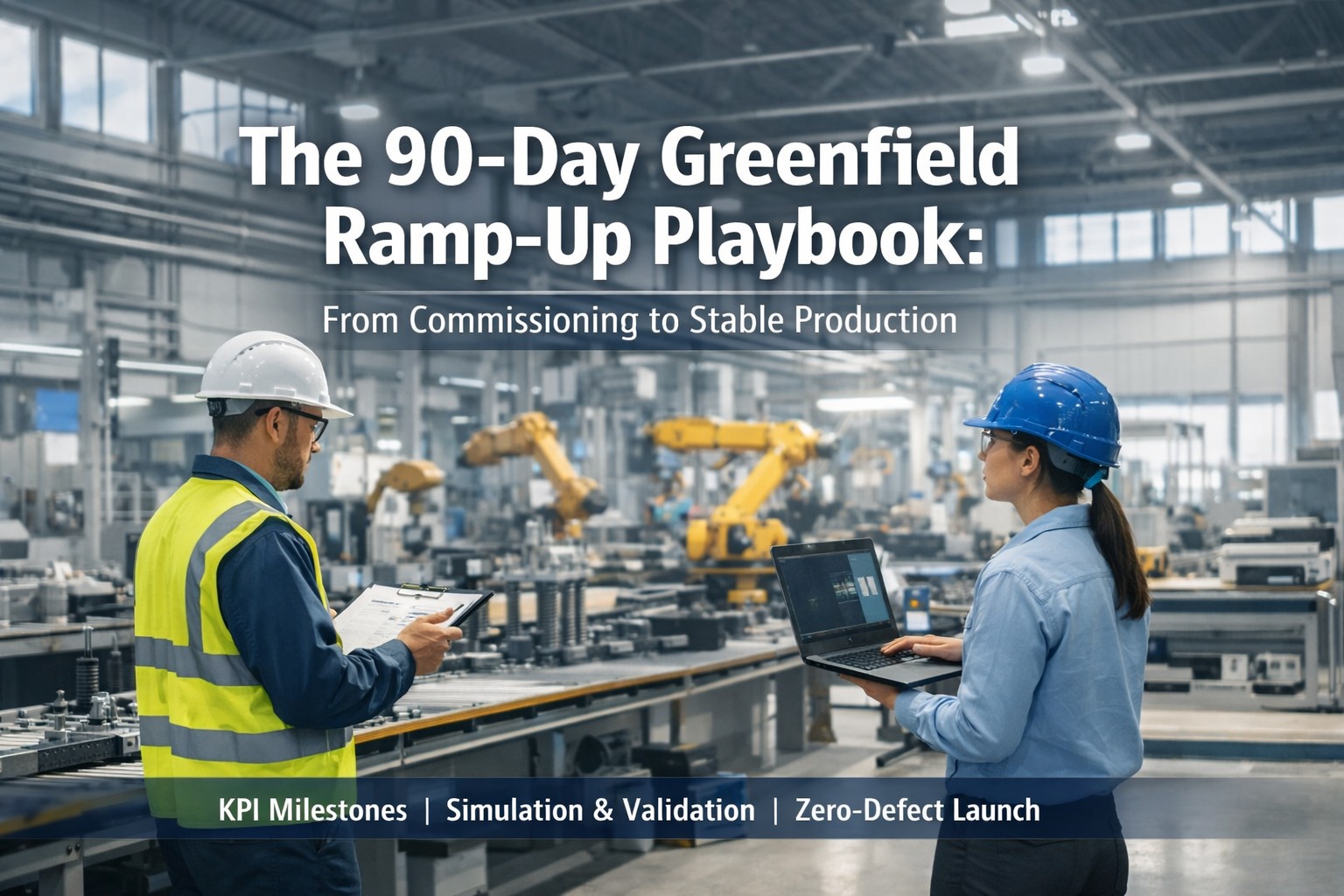
The 90-Day Greenfield Ramp-Up Playbook: From Commissioning to Stable Production

By James C on February 28, 2026

90-day-greenfield-ramp-up-playbook

The factory is built. Equipment is installed. The ribbon has been cut. Now comes the hardest part — turning a brand-new facility into a stable, profitable production machine in 90 days. Most greenfield plants take 6–24 months to ramp. The ones that follow a structured playbook? They hit stable OEE in 90 days and never look back. Here's the complete week-by-week ramp-up framework for 2026.

The 90-Day Playbook
Commissioning to Stable Production
A structured, KPI-driven roadmap that compresses what typically takes 6–24 months into a 90-day sprint to full production readiness.
Day 1–30
Commissioning & Validation

Day 31–60
Production Qualification

Day 61–90
Stable Production & Optimization

Why Most Greenfield Ramp-Ups Fail

Deloitte's greenfield factory framework identifies the ramp phase as the most underestimated stage of the entire project. After investing 3–5 years in planning, design, and construction, companies often lack a structured production startup methodology. The result? Months of firefighting, quality escapes, delayed customer shipments, and spiraling costs.

70%
of unplanned downtime in new facilities traces back to poor visibility into equipment performance during the first 90 days
40%
typical OEE score for factories just starting to track performance — meaning 60% of production capacity is wasted
6–24 mo
average time from commissioning to stable production without a structured ramp-up framework

The difference between a 6-month ramp and a 90-day ramp isn't luck — it's a system. Below is the week-by-week playbook that gets you from first power-on to stable, profitable production.

Phase 1: Commissioning & Validation (Days 1–30)

The first 30 days are about proving every system works as designed — individually and together. No production pressure. No customer orders. Just methodical validation with rigorous documentation.

Phase 1
Commissioning & Validation
Days 1–30
Week 1–2 Equipment Power-On & Dry Runs

Power on every machine and system individually. Run dry cycles (no material) to verify mechanical function, safety interlocks, and sensor connectivity. Document every fault, alarm, and deviation.

100% safety interlock verification
All sensors reporting to CMMS
Zero critical alarms unresolved
Week 2–3 Integrated System Testing

Test equipment interactions — material handoffs between stations, conveyor synchronization, robotic cell coordination. Run simulated production sequences end-to-end. Validate communication between MES, CMMS, and ERP systems.

All station-to-station handoffs validated
MES-CMMS-ERP data flow confirmed
Cycle time within 20% of design target
Week 3–4 First Article Production & Baseline

Produce the first physical parts using production-intent materials. Run First Article Inspection (FAI) against engineering specs. Establish OEE baseline data — this is your Day 30 benchmark for improvement.

FAI passed on all critical dimensions
OEE baseline established (target: 40–50%)
Initial sensor baselines captured for AI models
Day 30 Gate
Go / No-Go Decision: All equipment commissioned, safety verified, first article approved, OEE baseline recorded, sensor data flowing to CMMS. If any critical item is unresolved — do not proceed to Phase 2.

Phase 2: Production Qualification (Days 31–60)

Now the factory starts producing real parts at increasing volume. The goal isn't full speed — it's repeatable quality. Every defect is a learning opportunity. Every downtime event feeds your AI models.

Phase 2
Production Qualification
Days 31–60
Week 5–6 Low-Rate Initial Production (LRIP)

Run production at 25–50% of design capacity. Focus on process stability, not speed. Track every quality escape, every unplanned stop, every cycle time deviation. Begin training operators on standardized work instructions.

Production at 25–50% capacity
First Pass Yield tracking active
Operator certification program launched
Week 7–8 Process Capability & Quality Lock-In

Increase to 50–75% capacity. Run Statistical Process Control (SPC) on critical characteristics. Validate Cpk targets. Conduct process capability studies. Lock in quality parameters — this is where six-sigma foundations are built.

OEE target: 55–65%
Cpk ≥ 1.33 on critical characteristics
Unplanned downtime < 15% of run time
Day 60 Gate
Production Qualification Complete: Process capability proven (Cpk ≥ 1.33), quality systems validated, predictive maintenance models beginning to produce actionable alerts, OEE trending upward week-over-week.

Phase 3: Stable Production & Optimization (Days 61–90)

The final 30 days are about reaching and sustaining target production rates. AI models have 60 days of data and are starting to deliver real predictive value. The factory transitions from startup mode to continuous improvement mode.

Phase 3
Stable Production & Optimization
Days 61–90
Week 9–10 Full-Rate Production

Scale to 75–100% of design capacity. Run sustained production shifts. Monitor OEE in real time. AI-driven work order generation becomes operational — anomalies detected, diagnosed, and dispatched automatically via CMMS.

Production at 75–100% capacity
OEE target: 65–75%
AI predictive alerts active
Week 11–12 Optimization & Handoff

Refine predictive models with accumulated data. Conduct Kaizen events on top 3 downtime causes. Document lessons learned for future ramp-ups. Transition from startup team to steady-state operations team.

OEE target: 75%+ (world-class trajectory)
Top 3 downtime causes addressed
Ramp-up playbook documented for next facility
Day 90 Gate
Stable Production Achieved: OEE at 75%+, quality at six-sigma trajectory, predictive maintenance operational, all operators certified, continuous improvement cycle running. The factory is no longer a startup — it's a production machine.

The OEE Ramp Curve: What Good Looks Like

The difference between a structured ramp-up and an unstructured one is visible in the OEE curve. Here's what the 90-day trajectory looks like when you follow the playbook with AI-powered CMMS tracking every metric in real time.

OEE Ramp Curve — 90-Day Playbook vs. Typical Factory
85%75%65%55%45%35%


Day 15


Day 30


Day 45


Day 60


Day 75


Day 90
90-Day Playbook (AI-CMMS Tracked)
Typical Unstructured Ramp-Up

The 12 KPIs That Drive a Successful Ramp-Up

You can't improve what you don't measure. These are the metrics your ramp-up team should be tracking daily from Day 1, organized by what matters most at each phase.

KPI
Phase 1 Target
Phase 2 Target
Phase 3 Target
OEE (Overall Equipment Effectiveness)
Baseline (40–50%)
55–65%
75%+
First Pass Yield
Track & baseline
90%+
95%+
Unplanned Downtime %
< 30%
< 15%
< 5%
Mean Time Between Failures (MTBF)
Baseline
Week-over-week improvement
Stable upward trend
Mean Time To Repair (MTTR)
Track all events
< 2 hours average
< 1 hour average
Cpk (Process Capability)
Measure & record
≥ 1.33
≥ 1.67
Work Order Completion Rate
80%+
90%+
95%+
Operator Certification %
Critical roles only
75% certified
100% certified

Need a KPI dashboard configured for your ramp-up? Book a free demo and our team will set up real-time tracking for every metric above — tailored to your equipment mix and production targets.

How AI-Powered CMMS Accelerates Every Phase

A greenfield ramp-up without digital tools is like building a factory without blueprints. iFactory's AI-powered CMMS integrates with your sensor network from Day 1 — turning raw data into actionable intelligence at every stage of the ramp.

Phase 1
Automated Commissioning Checklists
Digital checklists with photo evidence, timestamp verification, and automatic escalation for failed items. Every interlock, sensor, and safety system tracked in one platform.
Phase 2
Real-Time OEE & Quality Dashboards
Live OEE breakdowns by Availability, Performance, and Quality — visible to operators, engineers, and leadership. SPC charts auto-generated from sensor data. Anomalies flagged instantly.
Phase 3
Predictive Maintenance Goes Live
With 60+ days of sensor baselines, AI models begin predicting failures before they happen. Work orders auto-generated, parts auto-reserved, technicians auto-dispatched — the self-healing factory is operational.

Compress Your Ramp-Up from Months to 90 Days

iFactory's AI-powered CMMS gives your startup team real-time KPI dashboards, automated commissioning workflows, and predictive maintenance from Day 1. Don't ramp blind — ramp with intelligence.
Frequently Asked Questions

A greenfield ramp-up is the structured process of bringing a newly constructed factory from equipment commissioning to stable, full-rate production. It includes equipment validation, first article inspection, production qualification, and the progressive scaling of output volume while maintaining quality targets and OEE milestones.
A structured ramp-up should target 40–50% OEE at Day 30 baseline, 55–65% by Day 60 after production qualification, and 75%+ by Day 90. For reference, 40% OEE is typical for factories just starting to track performance, 60% is typical for discrete manufacturers, and 85% is considered world-class. Reaching 75% in 90 days puts you on a world-class trajectory.
AI-powered CMMS accelerates ramp-up in three ways: First, it automates commissioning documentation with digital checklists and sensor verification. Second, it provides real-time OEE dashboards that let your team identify and fix problems daily instead of weekly. Third, after 60 days of sensor data collection, predictive maintenance models begin generating automated work orders — turning your factory into a self-healing operation by Day 90.
First Article Inspection is a complete, independent verification of the first production parts against all engineering specifications. It confirms that your equipment, tooling, and processes can produce parts that meet design intent. FAI is a critical Phase 1 gate — if your first articles don't pass, you should not proceed to production qualification.
Yes. iFactory is designed as a lifecycle CMMS — it supports commissioning checklists and validation tracking during ramp-up, real-time OEE and quality dashboards during qualification, and predictive maintenance with automated work order generation during steady-state production. The same platform that accelerates your ramp-up becomes your permanent operations intelligence layer.

Share This Story, Choose Your Platform!