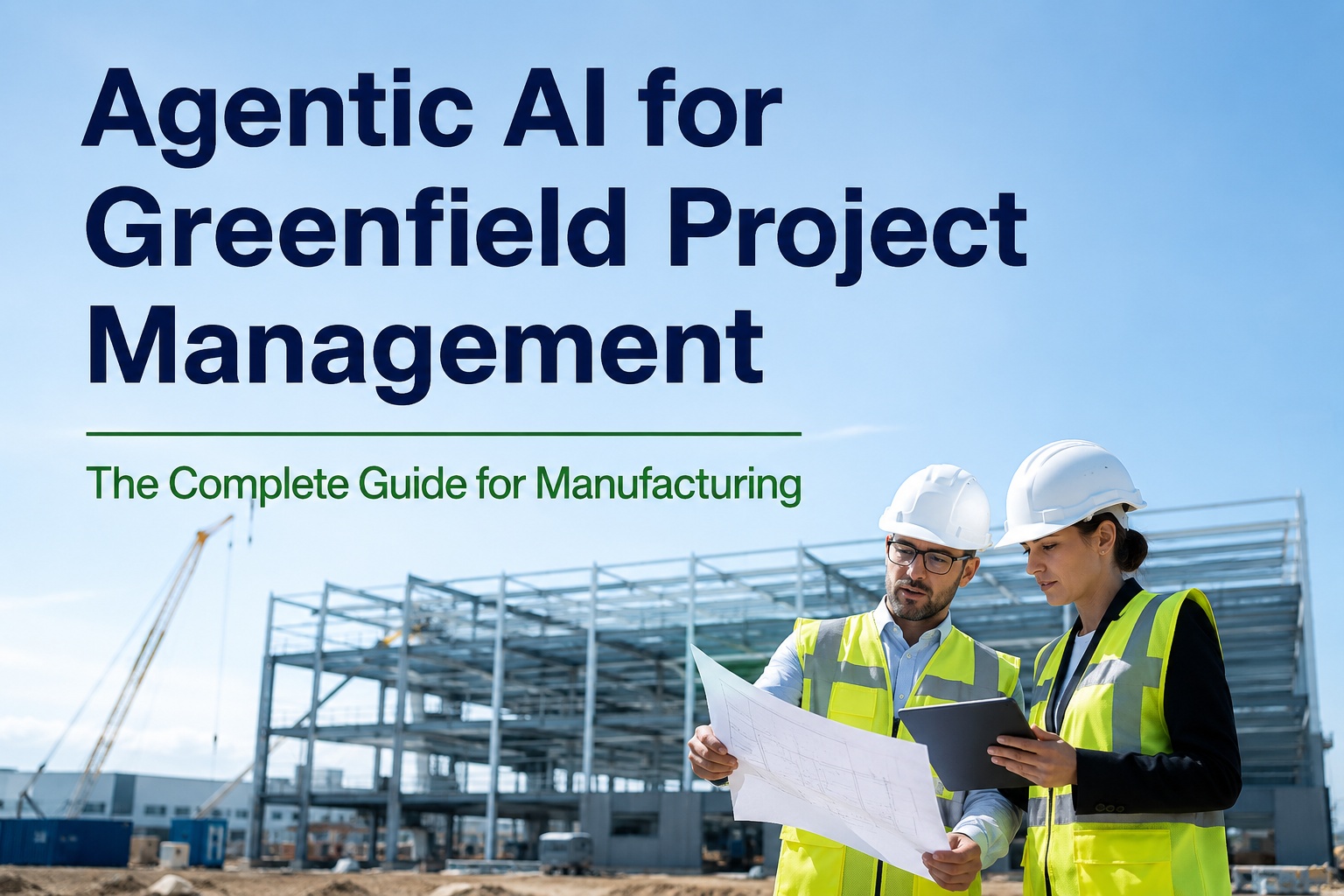
A greenfield build is thousands of interdependent decisions racing a clock — schedules to sequence, suppliers to chase, resources to balance, risks to head off. Traditional project tools surface that work on a dashboard and wait for a human to act, which is exactly where the days get lost. Agentic AI changes the model: instead of just flagging that a task is slipping, an AI agent re-sequences the schedule, issues the purchase order, and notifies the people affected — autonomously, within guardrails you set. This guide explains how agentic AI works, where it fits across a greenfield manufacturing project, and how to deploy it safely.
Planning a greenfield build? Book a 30-minute agentic AI consultation to map where autonomous agents can compress your project timeline.
The Agentic Loop: Perceive, Reason, Act, Learn
An agent senses the state of the project, reasons about what to do, takes the action through your tools, and learns from the result — then repeats. Every loop runs inside guardrails you set, with approval gates on high-stakes actions and a full audit trail of every decision.
What Makes AI "Agentic" — and Why It Matters for Capital Projects
The difference between a copilot and an agent is the difference between thinking and doing. A copilot waits for a prompt and helps you draft a status report or summarize a risk log. An agent is plugged into your tools and acts: it triggers workflows, reassigns tasks, and updates schedules within agreed rules, without a human clicking every button. For a greenfield project — a long chain of interdependent tasks that managers can usually only supervise reactively, after a delay has already landed — that shift is the whole point. The payoff is closing the gap between a problem appearing in the data and an action being taken, the place greenfield projects quietly lose weeks. If you want to see where that applies to your build, you can map it with a specialist.
People coordinate
Humans read dashboards and take every action themselves.
AI suggests
A copilot drafts and recommends; people still decide and do.
AI acts
The agent executes within guardrails; people set rules and oversee.
Where AI Agents Work Across a Greenfield Project
Agentic AI is not one tool but a team of specialized agents, each owning a slice of the project and coordinating with the others. Here is where they earn their keep on a greenfield build.
Scheduling Agent
Continuously checks the critical path, predicts bottlenecks weeks ahead, re-sequences tasks, and notifies the people affected.
Re-sequences a slipped task automaticallyResource Planning Agent
Matches people, equipment, and contractors to tasks and reallocates them in real time when priorities or availability shift.
Rebalances crews when a task movesProcurement Agent
Monitors suppliers, issues RFQs, evaluates bids, flags supplier risk, and executes purchase orders in the ERP within set rules.
Reorders a long-lead part before stockoutRisk Management Agent
Scans signals across the project, predicts delay and cost-overrun risks early, and triggers the right mitigation playbook.
Flags a weather-driven schedule riskExecution & Coordination Agent
Orchestrates the daily workflow across tools, assigns tasks, chases updates, and keeps the single plan current for everyone.
Closes the loop across siloed systemsCommissioning Agent
Tracks punch lists and acceptance gates, verifies closures, and drives the handover sequence from project to operations.
Advances a zone once defects clearCurious which agent would pay back first on your project? Book an agentic AI design workshop and we will map the highest-value workflow to start with.
Deploying Agentic AI Safely: Crawl, Walk, Run
Autonomy is a dial, not a switch. The teams that succeed turn it up gradually, earning trust at each level before granting the agent more authority.
Recommend
The agent analyzes and recommends; a human executes. You validate quality and build trust with zero risk.
Act with approval
The agent acts on low-risk, routine tasks on its own and routes anything high-stakes to a human for sign-off.
Autonomous in guardrails
The agent runs routine workflows end-to-end within set rules, escalating only the exceptions that need a person.
Whatever level you target, the same four moves keep deployment safe:
Ready to pilot one agent on your build? Book an implementation session and leave with a safe, phased rollout plan.
Put AI Agents to Work on Your Project
iFactory brings agentic AI to greenfield projects — autonomous scheduling, procurement, risk, and commissioning agents that act across your tools within the guardrails you set, closing the gap between a problem and the fix.
Expert Perspective
Projects do not slip because the data was missing. They slip because the time between a problem showing up in the data and someone acting on it is measured in days. A procurement exception flags, someone reads it, escalates it, schedules a call, finds an alternative, and updates the order — and a week is gone. The reason agentic AI matters on a greenfield build is that it collapses that gap to minutes, because the agent that spots the problem is the same one with the authority to fix it. The discipline is in the guardrails: give it a narrow job, a clear rulebook, and a human on the high-stakes calls.
— Project Intelligence Practice, iFactory Engineering Team
of manufacturing executives plan to invest in agentic AI this year
reduction in coordination overhead reported with agentic project management
collapsing the gap between a problem and the action that fixes it
The Bottom Line
Agentic AI is the shift from software that tells you what is wrong to software that does something about it. On a greenfield project, where weeks vanish in the lag between a flagged problem and a taken action, that is a direct lever on schedule and cost. Start narrow — one bounded workflow, real tool access, clear guardrails, a human on the high-stakes decisions — and turn up the autonomy as trust builds. Deployed this way, a team of specialized agents handling scheduling, procurement, risk, and commissioning lets your people stop chasing coordination and spend their judgment where it actually matters.
Build Your Project Around Agents, From Day One
From the first bounded pilot to a full team of project agents, iFactory helps greenfield teams deploy agentic AI safely — with the guardrails, audit trails, and tool integration that turn autonomy into delivered schedule.
Frequently Asked Questions
What is agentic AI, and how is it different from a copilot or chatbot?
A copilot is assistive and reactive — it waits for a prompt and helps you write, summarize, or analyze. Agentic AI is proactive and action-oriented: plugged into your tools, it can trigger workflows, reassign tasks, and update systems within agreed rules, without a human clicking every button. In short, a copilot helps you think and draft, while an agent helps you decide and do.
What can AI agents do in a manufacturing project?
Specialized agents can sequence and re-plan schedules, allocate people and equipment, run procurement from RFQ to purchase order, predict and mitigate risks, coordinate daily execution across tools, and drive commissioning handover. Crucially they do not just recommend these actions — within guardrails, they carry them out and update the systems of record, then coordinate with each other.
Is it safe to let AI agents act autonomously?
It is, when deployed with discipline. Keep humans in the loop on high-stakes actions through approval gates, define explicit guardrails for what each agent may do, and require a full audit trail of every decision. A sensible practice is to run a security review before granting any agent write permissions, and to expand autonomy gradually rather than all at once.
How should a greenfield project start with agentic AI?
Start with one bounded, high-value workflow rather than the whole project. Give the agent real read-and-write access to the tools it needs, set guardrails and approval gates, and measure the time it saves. Once that proves out, add agents one at a time — scheduling, procurement, risk, commissioning — turning up autonomy as trust builds.
How does iFactory support agentic AI for greenfield projects?
iFactory helps identify the highest-value workflows, integrate agents with your project and ERP tools, and set the guardrails and audit trails that make autonomous action safe, then expands coverage agent by agent. You can book an agentic AI consultation to plan a safe rollout for your build.