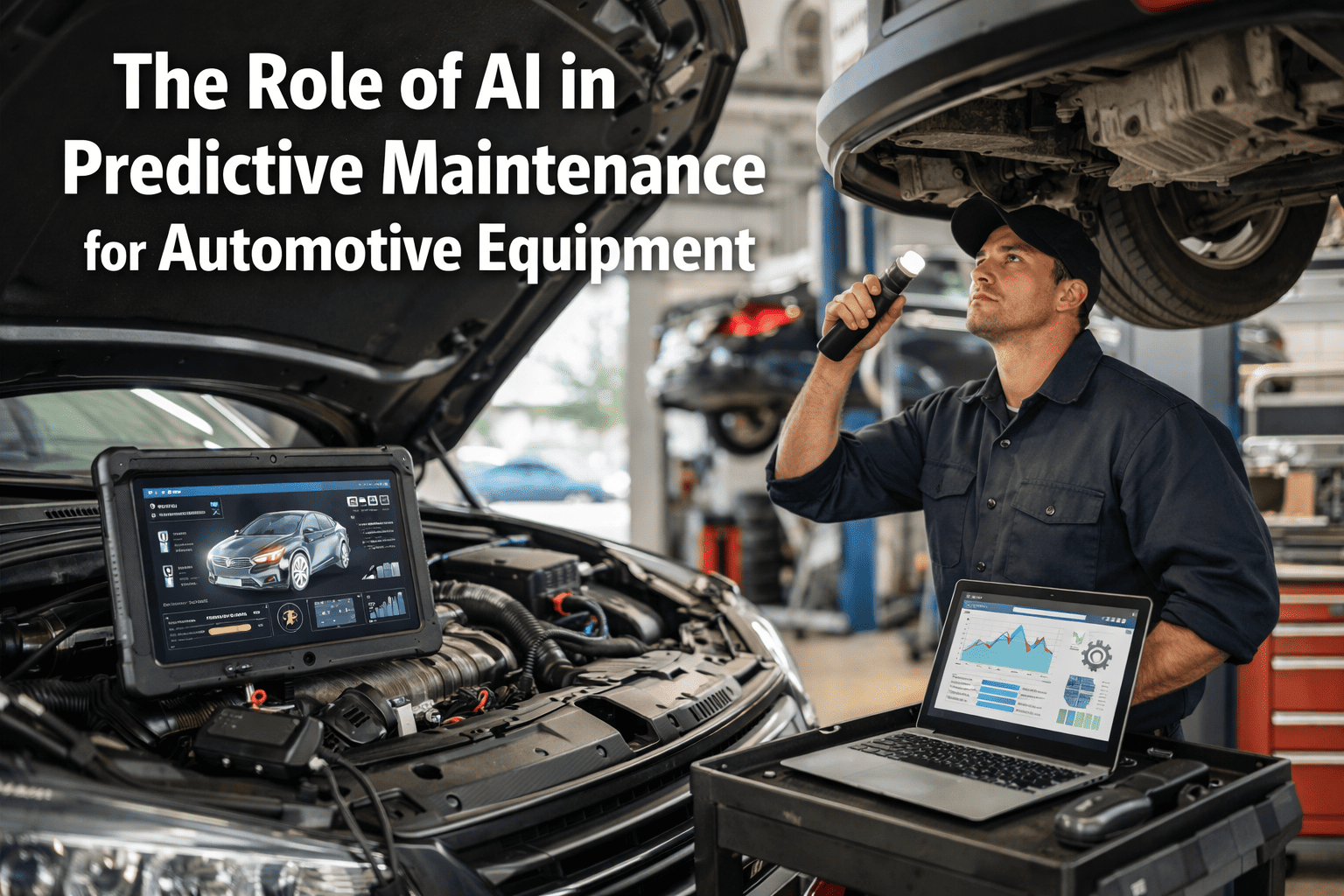
Unplanned equipment failures are the single most expensive problem in automotive manufacturing—costing plants an average of $250,000 per hour in lost production. AI-powered predictive maintenance is eliminating this risk by detecting equipment failures 2–6 weeks before they occur. Automotive plants deploying AI predictive maintenance report 50% reduction in unplanned downtime, 30% lower maintenance costs, and 25% longer equipment lifespan. This guide explains exactly how AI transforms maintenance from reactive firefighting into a precision science—and how leading manufacturers are implementing it today.
Why Traditional Maintenance Fails—And How AI Fixes It
Most automotive plants still operate on reactive or time-based maintenance schedules. Both approaches are costly. AI predictive maintenance is the only strategy that eliminates failure before it happens—based on actual equipment condition, not guesswork or calendars.
Reactive Maintenance
- Fix after failure Production stops unpredictably
- Emergency costs 3–5× higher repair bills
- No warning Full line shutdowns occur
- Secondary damage Cascading failures common
- Unknown risk No visibility into asset health
Time-Based PM
- Scheduled Replaces parts too early or too late
- Wasteful 30–40% of PM tasks are unnecessary
- Calendar-driven Ignores actual equipment condition
- Partial fix Doesn't prevent all failures
- Labor-heavy High technician hours per asset
AI Predictive Maintenance
- Condition-based Act only when data says so
- Planned windows Zero unplanned production stops
- 2–6 wk warning Prepare parts & technicians ahead
- Root cause AI Diagnose instantly, fix faster
- 50% less downtime Proven across automotive plants
Ready to move beyond reactive maintenance? Book a demo of iFactory's AI predictive maintenance platform.
How AI Predicts Equipment Failures: The Data Pipeline
AI predictive maintenance doesn't rely on intuition—it processes thousands of sensor signals continuously, identifies failure patterns invisible to human technicians, and generates precise maintenance recommendations weeks before breakdowns occur.
Continuous Sensor Data Collection
IoT sensors on every critical asset capture vibration, temperature, pressure, current draw, oil viscosity, and acoustic emissions at millisecond intervals—generating billions of data points per shift.
AI Pattern Recognition & Anomaly Detection
Machine learning models trained on equipment-specific failure histories identify micro-anomalies in the data stream. Patterns that precede failures—often subtle deviations invisible to any human inspector—are flagged immediately.
Failure Probability Scoring & Timeline
AI calculates the probability and estimated timeframe of each potential failure. Assets are risk-ranked in real-time, giving maintenance teams a prioritized action list—not just raw alerts—with 85–95% prediction accuracy.
Automated Work Order Generation
When AI confirms a maintenance need, it automatically creates a work order in the CMMS—pre-populated with the asset, recommended procedure, required parts, and optimal scheduling window to minimize production impact.
Want to see how AI diagnoses your specific equipment types? Talk to our predictive maintenance specialists for an asset-by-asset assessment.
UNIQUE SECTION: Equipment Types — replaces robot types gridAI Predictive Maintenance by Equipment Type
Different automotive equipment generates different failure signatures. AI models are trained specifically for each asset class, with tailored sensor sets and detection algorithms that maximize prediction accuracy.
Welding & Stamping Equipment
AI monitors electrode wear, contact resistance, weld current stability, and die condition. Detects degradation patterns that cause weld defects 3–4 weeks before quality failures appear.
CNC Machines & Spindles
Vibration signatures and cutting force data reveal tool wear, spindle bearing degradation, and geometric deviations before they produce scrap parts. AI extends tool life by 40% through optimized replacement timing.
Industrial Robots & Cobots
Joint torque signatures, servo motor current profiles, and repeatability metrics reveal gear wear, encoder drift, and bearing failures. AI schedules joint replacements during planned windows—never during production.
Conveyors & Transfer Systems
Belt tension, roller bearing vibration, and motor load profiles are monitored continuously. AI identifies wear patterns across hundreds of conveyor assets simultaneously—impossible for any manual inspection program.
Paint & Coating Systems
Pump pressure profiles, spray pattern consistency, and booth environmental conditions are tracked by AI to prevent coating defects, nozzle failures, and costly rework cycles that disrupt downstream assembly.
Power & Utility Infrastructure
Transformers, compressors, chillers, and hydraulic power units are monitored for electrical harmonics, oil quality degradation, and thermal drift—preventing utility failures that can shut down entire production facilities.
Start Predicting Failures Before They Happen
iFactory's AI predictive maintenance platform integrates with your existing sensors and CMMS to deliver failure predictions, automated work orders, and real-time asset health dashboards.
ROI Breakdown: The Business Case for AI Predictive Maintenance
Automotive plants running AI predictive maintenance consistently report measurable financial returns across multiple cost categories. Here's what the data shows from real implementations in 2026.
The most impactful ROI driver. At $250K/hour average downtime cost, eliminating even two unplanned stops per month delivers millions in annual savings.
Eliminating unnecessary scheduled PM tasks and emergency repair premiums reduces total maintenance spend significantly across the entire asset fleet.
Catching failures early prevents secondary damage that destroys equipment. Assets maintained predictively last 20–30% longer than those on reactive or fixed schedules.
AI-driven forecasting eliminates emergency part orders and overstocked safety stock. Parts arrive precisely when needed, freeing capital tied up in warehouse inventory.
Want to calculate the exact ROI for your plant's asset base? Get a custom predictive maintenance savings analysis from our team.
Implementation Roadmap: From Reactive to AI-Predictive
Transitioning to AI predictive maintenance doesn't require replacing your entire infrastructure. This roadmap builds on what you already have—adding intelligence layer by layer without disrupting ongoing operations.
Asset Criticality Assessment & Sensor Audit
- Rank all equipment by failure impact and downtime cost
- Identify existing sensor coverage and data gaps
- Define failure modes and target prediction horizons per asset
- Select AI platform and CMMS integration architecture
Sensor Deployment on Priority Assets
- Install IoT sensors on top 20% of assets by criticality
- Connect data streams to edge computing and AI platform
- Integrate with CMMS for automated work order generation
- Establish baseline health profiles for each asset
AI Model Training & Alert Validation
- Train ML models on equipment-specific historical failure data
- Validate prediction accuracy against known failure events
- Tune alert thresholds to minimize false positives
- Train maintenance technicians on AI-driven workflows
Full Fleet Coverage & Continuous Learning
- Expand AI monitoring to all plant assets and utility systems
- Activate autonomous maintenance scheduling optimization
- Feed outcomes back to AI for continuous model improvement
- Build plant-wide reliability KPI dashboards and reporting
Ready to start your predictive maintenance journey? Schedule a roadmap planning session with our implementation team.
Expert Perspective
"Automotive plants that have fully deployed AI predictive maintenance aren't just avoiding breakdowns—they're fundamentally changing the economics of their operations. The maintenance department has transformed from a cost center into a strategic function. When your AI tells you a robot joint will fail in 18 days with 92% confidence, you don't scramble—you schedule. That shift from chaos to control is what separates plants running at 92% OEE from those stuck at 74%."
Conclusion
AI predictive maintenance has moved from emerging technology to competitive necessity in automotive manufacturing. With 50% reduction in unplanned downtime, 30% lower maintenance costs, and 2–6 week advance failure warnings, the ROI is documented and the implementation path is proven. From welding equipment and CNC machines to industrial robots and paint systems, AI models trained on equipment-specific failure signatures deliver prediction accuracy levels that no manual inspection program can match. The shift from reactive and time-based maintenance to AI-driven predictive programs is no longer a future initiative for automotive plants—it's the foundation of operational excellence in 2026 and beyond.
Schedule your iFactory demo to see AI predictive maintenance in action, or connect with our specialists to discuss your equipment fleet.
Predict Failures Before They Happen
Join leading automotive manufacturers using iFactory to deploy AI predictive maintenance—with real-time asset health monitoring, automated work orders, and plant-wide reliability analytics.