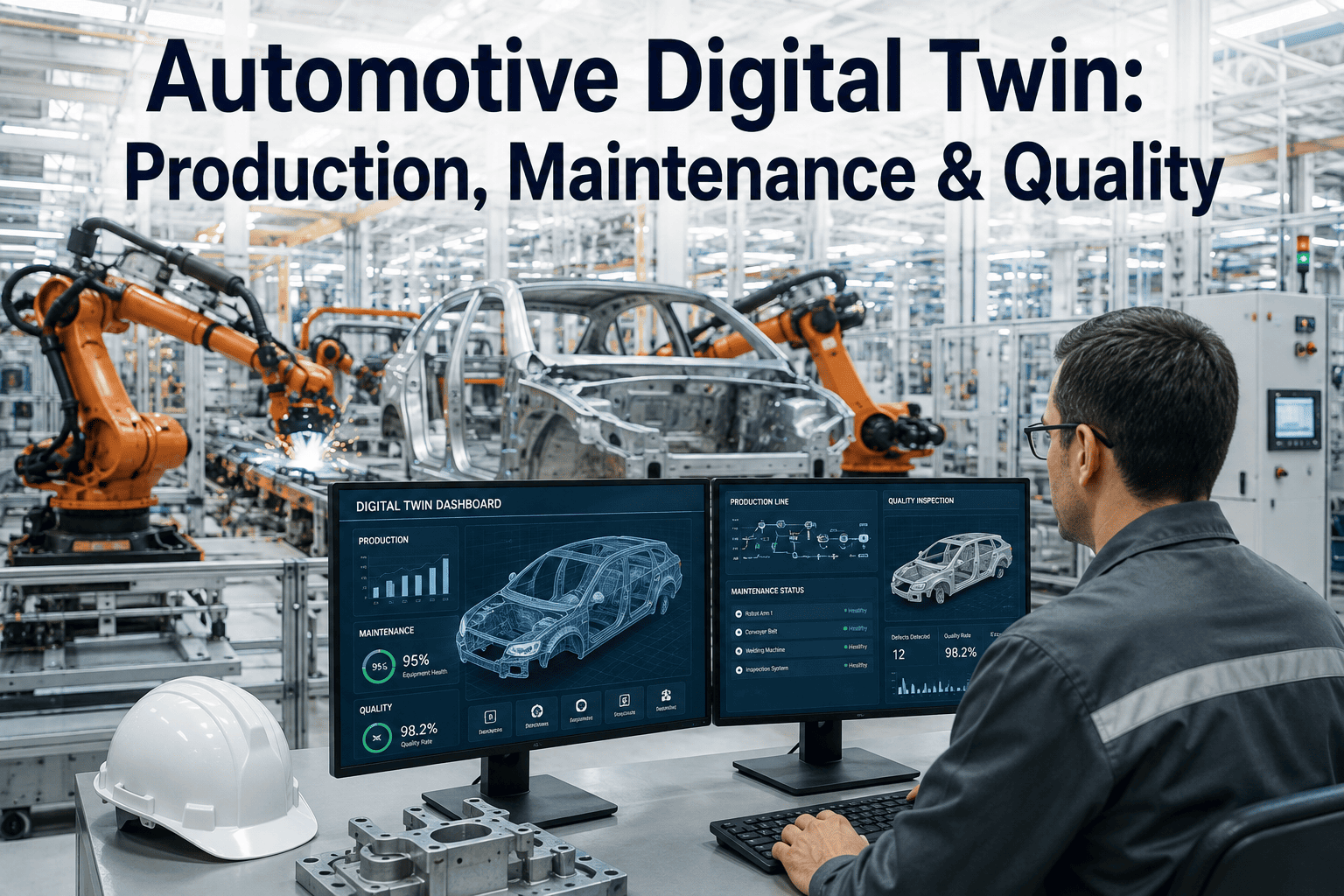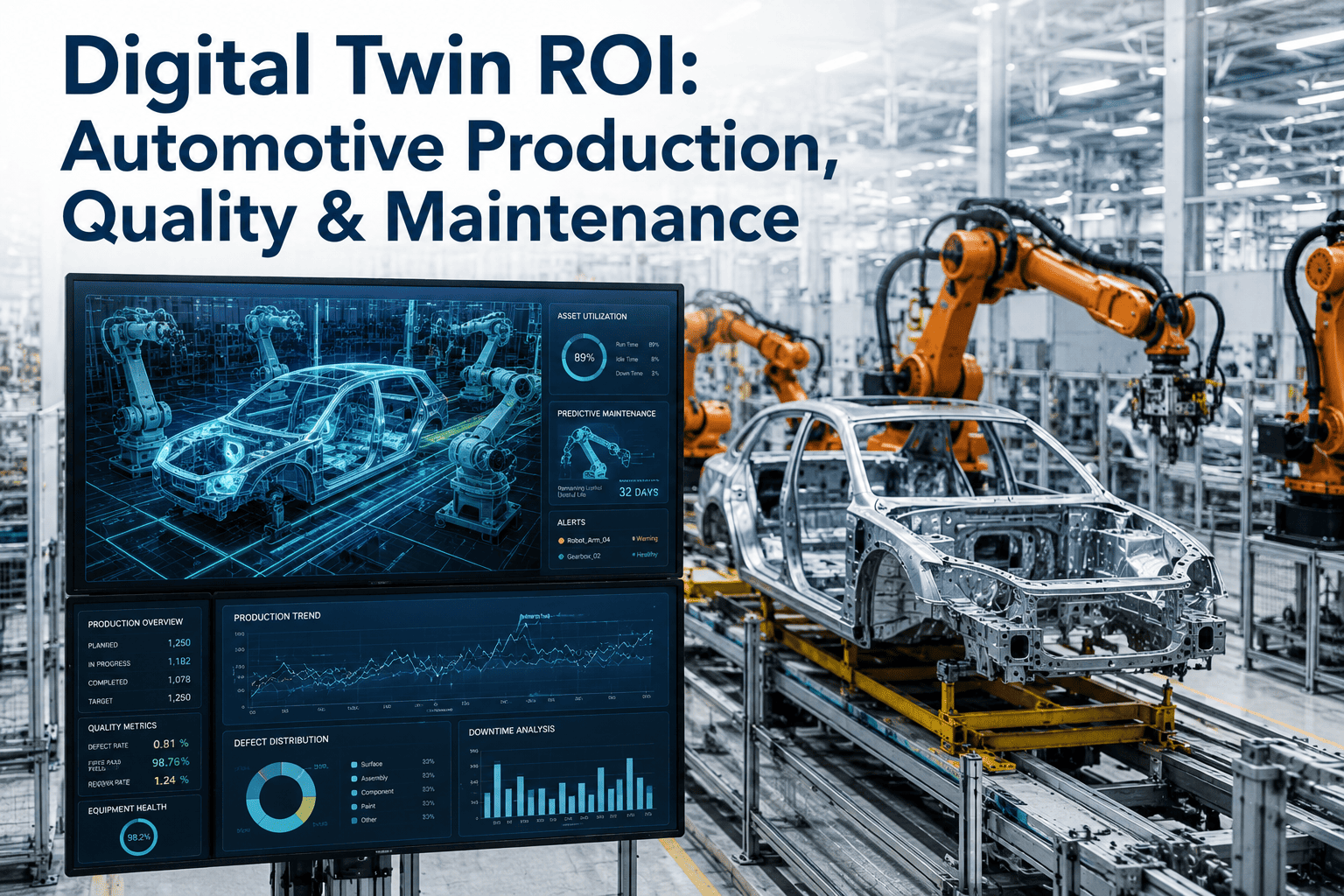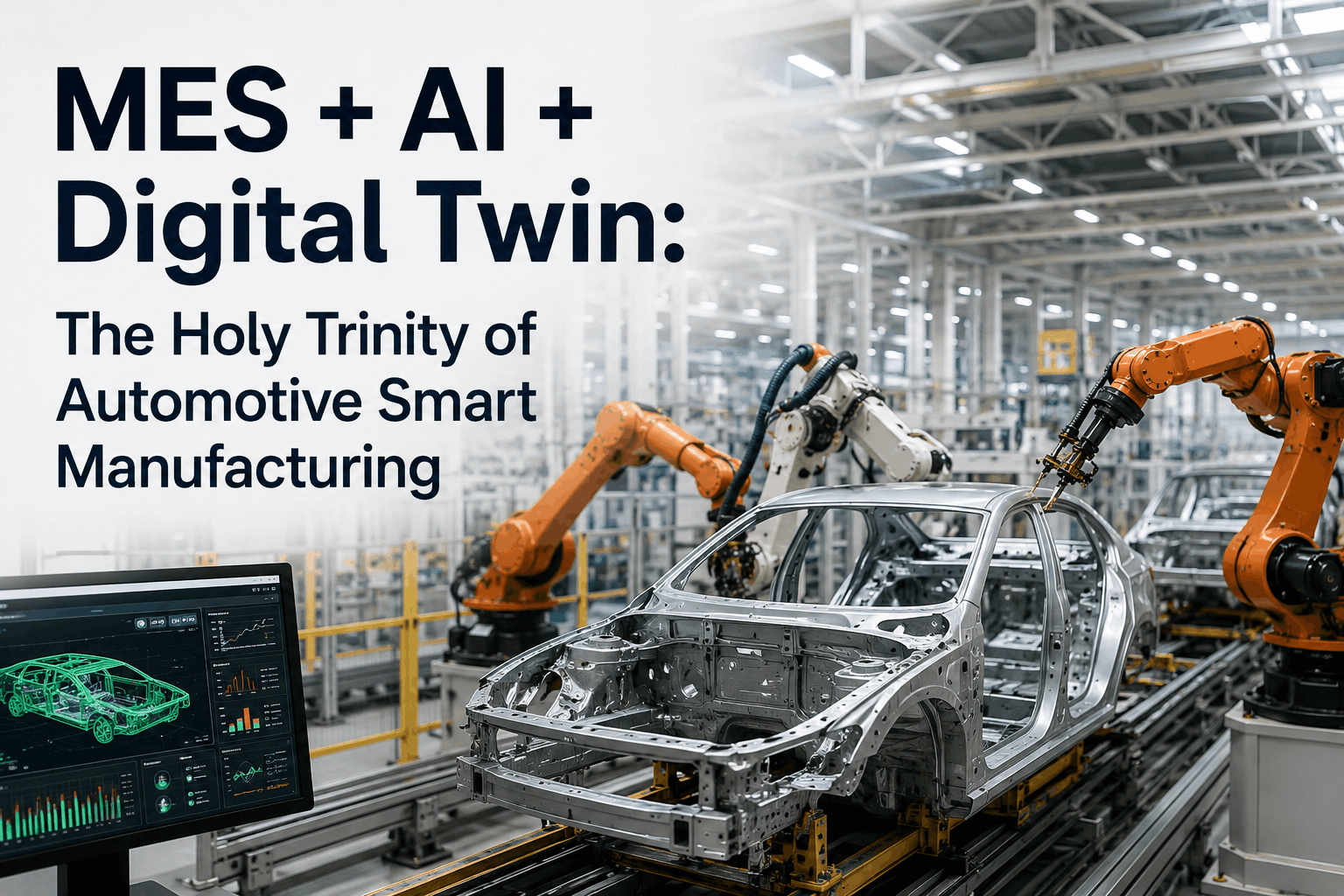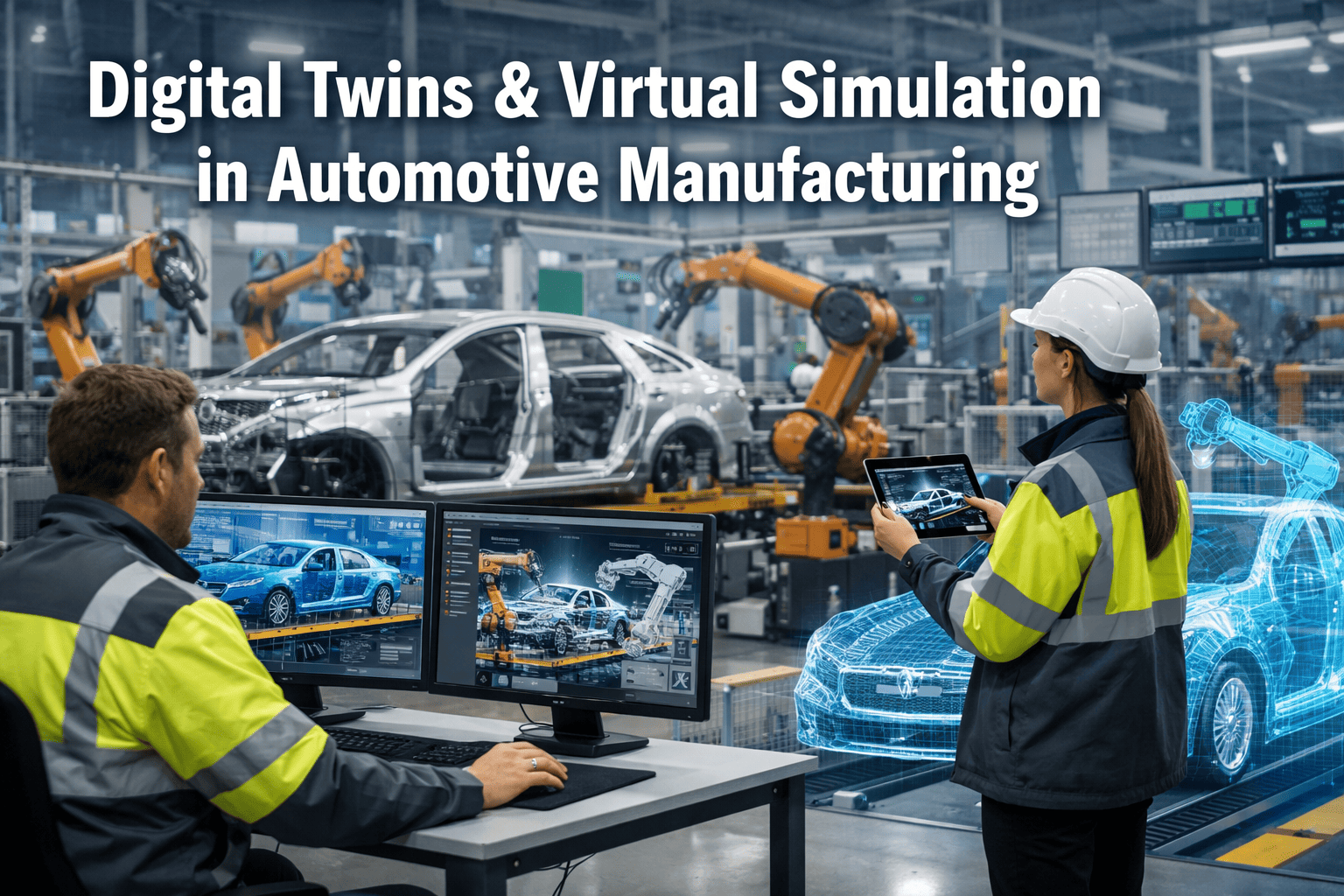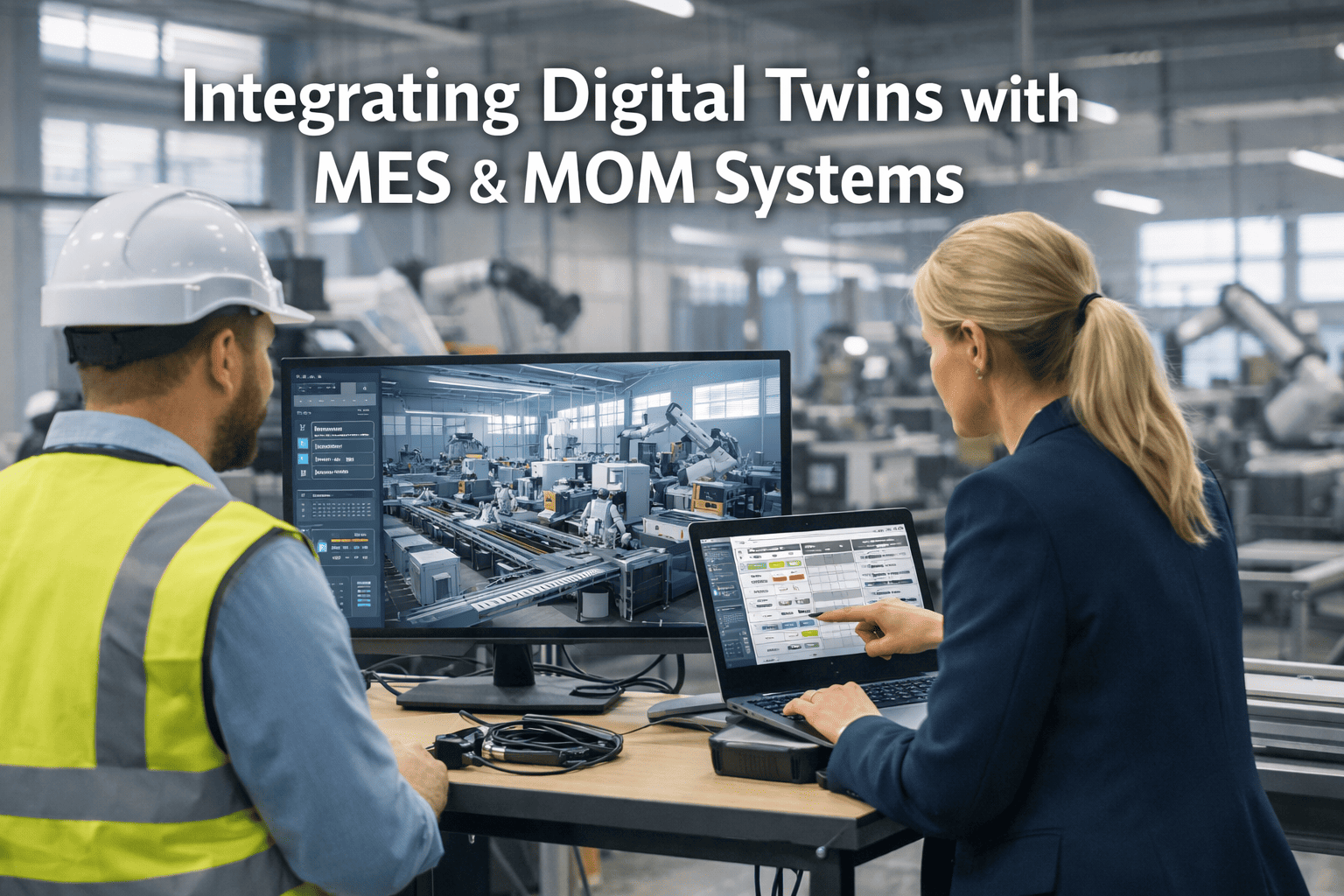
Digital twins are no longer confined to R&D labs and simulation environments—they're becoming the real-time decision layer inside manufacturing execution systems (MES) and manufacturing operations management (MOM) platforms. In 2026, automotive and industrial manufacturers integrating digital twins with their MES/MOM infrastructure report 35% faster root-cause analysis, 28% reduction in unplanned downtime, and 20% improvement in overall equipment effectiveness (OEE). This guide explores how the convergence of digital twins, MES, and MOM is creating a new operating model for intelligent, self-optimizing factories.
The Convergence Architecture: How Digital Twins Fit into MES & MOM
A digital twin without MES integration is a simulation. An MES without a digital twin is a transaction recorder. The real power emerges when the virtual model of your plant operates in closed-loop synchronization with your execution and operations management layers—creating a system that doesn't just record what happened but predicts what's about to happen and prescribes what to do about it.
Digital Twin Layer
- Real-time physics-based simulation
- Asset health & degradation modeling
- Process parameter optimization
- What-if scenario analysis
- Predictive quality inference
- Energy & throughput modeling
MES & MOM Outcomes
- Predictive production scheduling
- Autonomous quality gating
- Real-time process optimization
- Dynamic resource allocation
- Closed-loop corrective actions
- Continuous compliance assurance
Ready to explore digital twin integration? Book a demo of iFactory's digital twin and MES/MOM convergence platform.
5 Integration Strategies Driving the Digital Twin–MES/MOM Convergence
From real-time process mirroring to predictive scheduling, these five integration patterns deliver the deepest operational impact when digital twins are woven directly into your MES and MOM architecture.
Real-Time Process Twin Synchronization
Live sensor data from PLCs, SCADA systems, and IoT devices feeds directly into physics-based digital twins that mirror every production line in real-time. The MES consumes twin-generated insights—predicted deviations, optimal setpoints, and anomaly flags—to adjust work orders, routing, and machine parameters before defects materialize on the physical line.
Predictive Scheduling & Dynamic Dispatching
Digital twins simulate thousands of scheduling scenarios in seconds—accounting for machine health, material availability, energy costs, and workforce constraints—and feed the optimal production schedule directly into the MES dispatching engine. When conditions change mid-shift, the twin recalculates and the MES dynamically re-sequences without manual intervention.
Closed-Loop Quality Management
Digital twins predict quality outcomes based on upstream process parameters—temperature, pressure, cycle time, tool wear—and feed quality risk scores directly into MOM quality management modules. When the twin detects a quality drift trajectory, the MES automatically triggers hold orders, inspection gates, or parameter corrections before non-conforming product advances downstream.
Predictive Maintenance Integrated with Work Order Execution
Asset digital twins continuously model equipment degradation, vibration signatures, and thermal profiles to predict failures before they occur. These predictions flow directly into the MOM maintenance management module, auto-generating work orders with precise part requirements, estimated repair windows, and optimal scheduling that minimizes production impact—turning reactive firefighting into planned interventions.
Enterprise Performance & KPI Simulation
Plant-level digital twins aggregate line, cell, and asset models into a factory-wide simulation that connects directly to MOM performance management dashboards. Operations leaders can run what-if scenarios—new product introductions, shift pattern changes, capacity expansion—and see projected KPI impacts (OEE, TEEP, cost per unit) before committing resources, with results feeding directly into strategic planning systems.
Want to identify the highest-impact digital twin integration points in your MES/MOM stack? Talk to our integration specialists for a personalized convergence assessment.
Core Digital Twin Technologies for MES & MOM Integration
Different digital twin architectures serve different integration patterns. Selecting the right combination ensures seamless data flow, actionable insights, and closed-loop control across your entire manufacturing operations stack.
Physics-Based Process Twins
Most MatureFirst-principles simulation models that replicate thermodynamic, mechanical, and chemical behaviors of production processes—enabling real-time parameter optimization and predictive quality control through MES integration.
Data-Driven ML Twins
Fastest GrowingMachine learning models trained on historical production data that capture complex, non-linear relationships between process inputs and outputs—ideal for pattern detection and anomaly identification that feeds MOM quality and performance modules.
Hybrid Physics + ML Twins
High ImpactCombined architectures that use physics models as the structural backbone and ML layers to capture process drift and unmodeled dynamics—delivering the accuracy of simulation with the adaptability of data-driven approaches for MES closed-loop control.
Factory-Level Simulation Twins
StrategicDiscrete-event and agent-based models of entire production facilities that simulate material flow, bottleneck propagation, and resource contention—feeding MOM planning and scheduling modules with optimized capacity allocation and scenario analysis.
Unify Digital Twins with Your MES/MOM Stack
iFactory's convergence platform connects your digital twin models, MES execution layer, and MOM analytics into a single intelligent system—with real-time synchronization, closed-loop control, and predictive KPI dashboards.
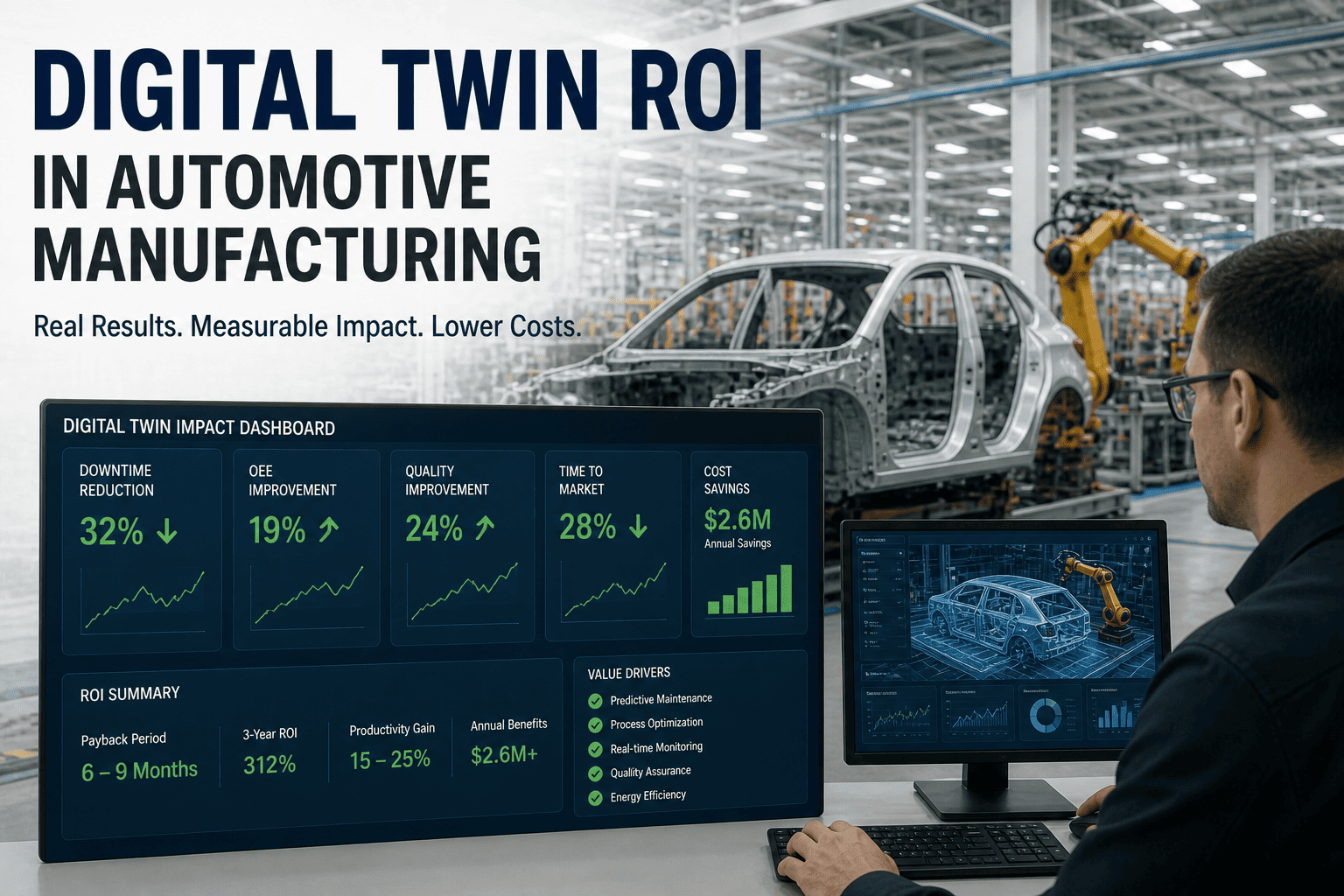
ROI Breakdown: The Numbers Behind Digital Twin–MES/MOM Integration
Integrating digital twins with MES and MOM platforms requires investment in data infrastructure, modeling capabilities, and system integration. Here's what the data shows about actual returns across manufacturing facilities that have deployed this convergence architecture in 2026.
Digital twins correlate process parameters, environmental conditions, and equipment state in real-time, enabling the MES to pinpoint failure origins in minutes instead of hours—eliminating the manual investigation that stalls production restarts.
Predictive asset twins detect degradation patterns weeks before failure, feeding auto-generated work orders into MOM maintenance modules with precise timing that prevents unscheduled production stops.
Closed-loop quality twins predict out-of-spec conditions before they produce defective parts, triggering MES-controlled parameter corrections or automatic hold orders that prevent non-conforming material from advancing downstream.
The combined effect of predictive scheduling, quality gating, and maintenance optimization drives availability, performance, and quality rates simultaneously—the three OEE pillars that compound into significant throughput and cost gains.
Want to calculate potential ROI for your digital twin integration project? Get a custom convergence analysis from our team.
Digital Twin–MES/MOM Integration Roadmap
Integrating digital twins with your MES and MOM infrastructure is a progressive journey. This proven roadmap delivers measurable production intelligence improvements at every phase while building toward full closed-loop autonomous operations.
Data Foundation & Architecture Design
- Audit existing MES/MOM data sources, PLC tags, and sensor coverage
- Define digital twin scope—asset-level, line-level, or plant-level
- Design integration architecture (ISA-95 layers, API topology, data pipelines)
- Establish unified data model and semantic layer for twin–MES interoperability
Pilot Twin Deployment & MES Connection
- Build and calibrate digital twins for one critical production line or asset class
- Establish real-time data feeds between shop floor, twin engine, and MES
- Deploy monitoring dashboards in iFactory platform with twin-generated KPIs
- Validate twin prediction accuracy against actual production outcomes
Closed-Loop Activation & MOM Integration
- Enable closed-loop control—twin insights auto-trigger MES actions
- Integrate predictive maintenance twins with MOM work order management
- Activate quality prediction models feeding MES inspection gating
- Connect scheduling twins with MES dispatching for dynamic optimization
Plant-Wide Scale & Autonomous Operations
- Expand digital twin coverage across all production lines and asset classes
- Deploy factory-level simulation twin for strategic capacity planning
- Enable cross-plant twin federation for multi-site optimization
- Activate autonomous decision loops with human-on-the-loop governance
Ready to start your digital twin integration journey? Schedule a roadmap planning session with our convergence architecture team.
Expert Perspective
"The manufacturers gaining the most from digital twin investments are those embedding them directly into their MES and MOM execution layers—not running them as standalone simulation projects. When a digital twin can predict a quality deviation and the MES automatically adjusts process parameters or reroutes production in real-time, you've moved from descriptive analytics to prescriptive manufacturing. By 2028, we expect 60% of Tier 1 automotive suppliers will require closed-loop digital twin integration as a condition of smart factory certification. The companies building this convergence architecture now will set the standard for operational excellence."
Conclusion
The integration of digital twins with MES and MOM platforms represents the most significant architectural shift in manufacturing operations since the introduction of MES itself. With 35% faster root-cause analysis, 28% reduction in unplanned downtime, 50% scrap reduction, and 20% OEE improvement, the operational and financial case is compelling and compounding as twin models grow more accurate with every production cycle. From real-time process synchronization and predictive scheduling to closed-loop quality management and autonomous maintenance orchestration, this convergence is creating factories that don't just execute—they anticipate, adapt, and optimize continuously. The technology stack is mature, the integration patterns are proven, and the competitive pressure is mounting as industry leaders establish new benchmarks for operational excellence. For manufacturing leaders, the question isn't whether digital twins belong in your MES/MOM architecture—it's how quickly you can build the convergence infrastructure that turns data into autonomous action.
Schedule your iFactory demo to see digital twin–MES/MOM integration in action, or connect with our convergence specialists to discuss your integration strategy.
Integrate Digital Twins with MES & MOM.
Join leading manufacturers using iFactory to synchronize digital twins with execution systems, enable closed-loop quality control, optimize scheduling, and achieve real-time production intelligence across every operation.