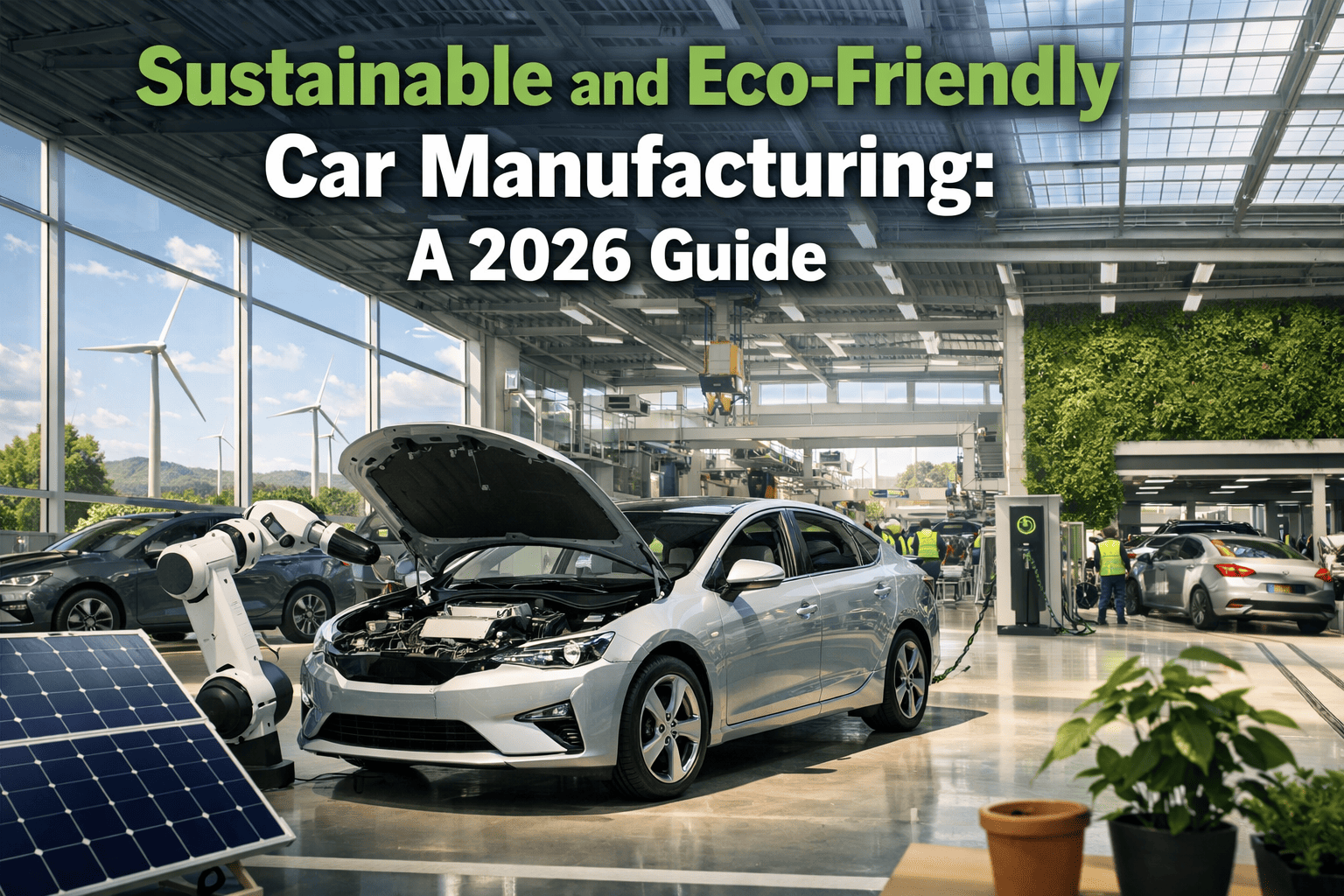
The automotive industry is undergoing its most radical green transformation in history. In 2026, sustainable and eco-friendly car manufacturing is no longer a marketing tagline—it's a survival strategy. From zero-emission paint shops and closed-loop water recycling to bio-based interior materials and solar-powered assembly lines, leading manufacturers are proving that environmental responsibility and operational excellence go hand in hand. Plants that have fully embraced eco-friendly manufacturing practices report 35% lower energy costs, 50% reduction in industrial waste, and measurable improvements in workforce retention and OEM contract wins. This guide explores how forward-thinking automotive manufacturers are building the sustainable factories that define competitiveness in 2026 and beyond.
The Sustainable Car Manufacturing Landscape in 2026
Eco-friendly car manufacturing has evolved from a niche differentiator to an industry-wide imperative. A convergence of tightening regulations, consumer demand for green vehicles, and investor pressure on ESG performance is forcing every automotive plant to rethink how cars are built from the ground up.
Emissions & Carbon Regulations
EU CSRD, EPA Greenhouse Gas Standards, CBAM, and national carbon pricing mechanisms are creating legally binding requirements for manufacturers to measure, report, and reduce Scope 1, 2, and 3 emissions across the entire vehicle production lifecycle.
Consumer & Market Demand
Over 70% of new car buyers in 2026 consider a manufacturer's environmental track record when making purchase decisions. OEMs are responding with "green factory" certifications and transparent lifecycle carbon labels on every vehicle produced.
Green Finance & Investor Pressure
Green bonds, sustainability-linked loans, and ESG fund mandates are channeling capital exclusively toward manufacturers that demonstrate verified emission reductions, circular material flows, and science-based targets aligned with 1.5°C pathways.
Need help navigating the 2026 green manufacturing landscape? Book a consultation with iFactory's sustainability specialists.
What Makes a Factory "Eco-Friendly" in 2026?
Eco-friendly car manufacturing in 2026 goes far beyond installing solar panels. It's a holistic, data-driven approach to eliminating waste, decarbonizing energy, closing material loops, and creating healthier work environments—all while maintaining production efficiency and quality.
Modern eco-friendly factories use real-time AI dashboards to continuously monitor energy consumption, water usage, waste generation, emissions, and VOC levels—flagging deviations and optimizing processes automatically.
The Green Factory Lifecycle: From Design to Decommission
Truly sustainable car manufacturing considers environmental impact at every stage—from how the factory itself is designed and built, through decades of production, to eventual facility decommissioning and site remediation.
Sustainable Factory Design
New plants designed with passive cooling, natural lighting, green roofs, on-site renewable energy generation, and building materials with low embodied carbon. Site selection prioritizes brownfield redevelopment over greenfield conversion.
Clean Energy & Electrification
Factory energy systems transitioned to 100% renewable electricity through on-site solar and wind, battery energy storage for peak shaving, and electrification of previously gas-powered processes like paint curing and heat treatment.
Low-Impact Production Processes
Waterborne paint systems, dry machining, minimum quantity lubrication, laser welding, and precision stamping that minimize chemical usage, water consumption, and energy waste per vehicle produced.
Circular Material Management
Closed-loop recycling of metal stampings, plastic runners, paint overspray, and solvent recovery systems. Production scrap is reprocessed on-site or returned to material suppliers as feedstock for new production cycles.
Workforce Health & Green Culture
Eco-friendly factories invest in improved air quality, reduced noise exposure, ergonomic workstations, and sustainability training programs that empower every team member to identify and eliminate waste in their processes.
Continuous Monitoring & Optimization
AI-driven energy management, real-time emissions tracking, predictive waste analytics, and automated sustainability reporting ensure continuous improvement. Digital twins model process changes before implementation to predict environmental impact.
Want to assess your factory's sustainability maturity? Talk to our green manufacturing specialists for a comprehensive eco-readiness assessment.
2026 Green Manufacturing Compliance Timeline
Environmental regulations targeting automotive manufacturers are accelerating rapidly. This timeline maps the critical green manufacturing milestones every plant leader and sustainability director must prepare for.
EU CSRD Sustainability Reporting (Wave 1)
Large automotive manufacturers must publish detailed sustainability reports covering energy consumption, emissions, waste, water, and workforce health under the European Sustainability Reporting Standards (ESRS).
CBAM Permanent Phase & EU ETS Tightening
Full Carbon Border Adjustment Mechanism charges begin on imported materials. EU Emissions Trading System free allowances further reduced, increasing carbon costs for energy-intensive manufacturing processes.
EPA Greenhouse Gas Standards (Phase 3)
Tightened manufacturing facility emission limits under EPA Clean Air Act rules. Automotive plants must demonstrate Best Available Control Technology (BACT) for VOCs, particulates, and greenhouse gases.
EU Zero-Pollution Action Plan Targets
Industrial water pollution and air quality targets take effect. Automotive paint shops and metal finishing operations face stricter discharge limits and mandatory advanced treatment requirements.
EU Fit for 55: 55% Emission Reduction Target
Manufacturing sector must demonstrate 55% greenhouse gas reduction vs. 1990 levels. Automotive plants that haven't transitioned to renewable energy and electrified processes face carbon penalties and market restrictions.
Stay ahead of every green manufacturing deadline. Book a regulatory readiness assessment with our sustainability compliance team.
5 Technologies Powering Eco-Friendly Car Factories
Achieving sustainable automotive manufacturing at scale requires a technology stack that integrates energy management, waste optimization, emissions monitoring, and sustainability reporting into a unified intelligent platform.
AI-Powered Energy Management Systems
Machine learning algorithms analyze real-time energy consumption across every production zone—body shop, paint shop, assembly, and logistics—and dynamically optimize HVAC, lighting, compressed air, and motor loads. AI identifies energy waste patterns invisible to human operators and automatically adjusts setpoints, schedules, and loads to minimize consumption without impacting production throughput.
Continuous Emissions Monitoring (CEMS)
IoT sensor networks continuously measure greenhouse gas emissions, VOCs, particulate matter, and air quality at every stack, vent, and process point. Data feeds directly into regulatory reporting systems and triggers automated alerts when emissions approach permit limits—enabling corrective action before violations occur.
Smart Water Recycling & Treatment
Advanced membrane filtration, reverse osmosis, and biological treatment systems reclaim and recycle up to 90% of process water in paint shops, cooling systems, and machining operations. AI-optimized treatment chemistry reduces chemical consumption while maintaining water quality specifications for reuse in production processes.
Digital Twin for Sustainability Simulation
Virtual replicas of entire production facilities simulate the environmental impact of process changes, layout modifications, and equipment upgrades before physical implementation. Digital twins model energy flows, waste streams, and emissions for every scenario—enabling plant leaders to optimize sustainability investments with data-driven confidence.
On-Site Battery Storage & Microgrids
Large-scale battery energy storage systems (BESS) paired with on-site renewable generation create factory microgrids that smooth renewable intermittency, shave peak demand charges, and provide grid-independent resilience. Second-life EV batteries from production rejects or warranty returns find productive use in stationary storage applications on the same factory site.
Automate Green Manufacturing Monitoring & Reporting
iFactory's sustainability module connects energy management, emissions monitoring, waste tracking, water stewardship, and ESG reporting into a unified platform—with real-time dashboards and automated regulatory compliance.
ROI Breakdown: The Business Case for Eco-Friendly Manufacturing
Green manufacturing investment delivers measurable financial returns—not just environmental improvements. Here's what the data shows across automotive plants with mature sustainability programs in 2026.
Renewable energy integration, AI-optimized consumption, and electrified processes replace volatile fossil fuel costs with predictable, declining renewable energy expenses—delivering compounding savings year over year.
Closed-loop material recovery, precision manufacturing techniques, and AI-driven waste analytics cut disposal costs in half while generating new revenue streams from high-value recycled material sales.
Advanced water recycling systems and optimized chemical management reduce freshwater purchase costs, wastewater treatment expenses, and chemical procurement budgets across paint, machining, and cleaning operations.
Cleaner air, lower noise, ergonomic improvements, and purpose-driven sustainability culture reduce turnover and absenteeism—cutting recruitment and training costs while improving productivity and quality output.
Want to model the ROI of green manufacturing investment for your plant? Get a custom sustainability savings analysis from our team.
Implementation Roadmap: Building Your Eco-Friendly Factory
Transforming a conventional automotive plant into an eco-friendly operation is a phased journey that builds capability and delivers measurable value at every stage. This roadmap aligns with 2026–2030 regulatory milestones.
Sustainability Baseline & Gap Assessment
- Conduct comprehensive energy, water, waste, and emissions audit across all production areas
- Benchmark current performance against industry standards and regulatory requirements
- Identify quick wins for immediate energy and waste reduction
- Define sustainability KPIs and set science-based reduction targets
Energy Transition & Process Optimization
- Deploy AI energy management across body shop, paint shop, and assembly
- Transition to renewable electricity via PPAs and on-site solar installation
- Implement waterborne paint conversion and VOC reduction systems
- Install IoT-based continuous emissions and water quality monitoring
Circular Systems & Advanced Sustainability
- Deploy closed-loop water recycling and chemical recovery systems
- Implement zero-waste-to-landfill material management programs
- Integrate sustainable materials (bio-based, recycled) into production BOM
- Activate automated ESG and regulatory reporting dashboards
Net Zero Operations & Continuous Improvement
- Achieve net-zero Scope 1 and 2 emissions through full electrification and renewables
- Deploy digital twins for ongoing process sustainability optimization
- Expand green logistics with electric fleet and rail-optimized distribution
- Pursue industry certifications: ISO 14001, ISO 50001, IATF green factory programs
Ready to start your green factory transformation? Schedule a roadmap planning session with our sustainability engineering team.
Expert Perspective
"The concept of the 'green factory' has matured from aspirational to operational in under five years. The manufacturers leading this transformation aren't treating sustainability as a cost center—they're treating it as a competitive weapon. Lower energy bills, reduced waste disposal costs, premium OEM contracts, preferential green financing, and dramatically better workforce retention all flow from the same investment in sustainable operations. The factories that will thrive in 2030 are the ones making these investments in 2026. Those that wait will find the cost of catching up far exceeds the cost of leading."
Conclusion
Sustainable and eco-friendly car manufacturing has moved from optional differentiator to operational necessity. With regulations like the EU CSRD, CBAM, and EPA Greenhouse Gas Standards tightening year over year, and with OEMs demanding verified environmental performance from every supplier tier, the business case for green manufacturing is overwhelming. Plants that have embraced AI-powered energy management, closed-loop water and material systems, continuous emissions monitoring, and circular economy practices are delivering 35% lower energy costs, 50% waste reduction, and measurable improvements in workforce retention and contract competitiveness. From sustainable factory design and clean energy transition to digital twin optimization and net-zero operations, the technology stack is mature and the implementation roadmap is proven. For plant leaders and sustainability executives, the question isn't whether eco-friendly manufacturing is worth the investment—it's whether your plant will lead the green transformation or be forced to catch up under mounting regulatory and market pressure.
Schedule your iFactory demo to see AI-powered sustainability monitoring in action, or connect with our green manufacturing specialists to discuss your eco-friendly factory strategy.
Reduce Emissions. Eliminate Waste. Lead the Industry.
Join leading automotive manufacturers using iFactory to automate energy optimization, emissions monitoring, waste reduction, and ESG reporting across every production zone and every regulation.