3D Printing and Additive Manufacturing for Airport Spare Parts Management
By Grace on May 31, 2026
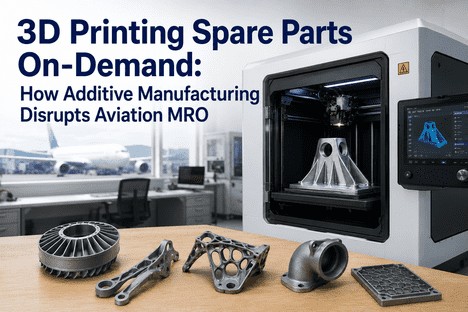
Aircraft ground, terminal systems, and airside equipment do not fail on a schedule. When a critical component breaks — a conveyor belt motor housing, a ground support equipment coupling, a passenger boarding bridge actuator bracket — the question is not whether you need the part. The question is how long your operation will be degraded while you wait for it. Traditional spare parts supply chains answer that question in weeks. 3D printing and additive manufacturing are beginning to answer it in hours. For airport maintenance and inventory teams, this is not a future technology story — it is a procurement strategy, an inventory optimisation tool, and an asset downtime reduction programme that is already operational at airports across the world.
3D Printing · Additive Manufacturing · Spare Parts · Inventory Management · Airport Operations
From Weeks on Order to Hours on Printer. iFactory Manages Every Part Your Airport Produces or Stocks.
AI-driven inventory management, digital parts library integration, on-demand production tracking, and full spare parts audit trails — built for airports moving from physical stockrooms to digital inventory.
Typical lead time for obsolete or low-volume spare parts through traditional OEM supply chains — during which the asset sits degraded or out of service
2–24 hrs
Production time for equivalent parts manufactured on-site or via local 3D printing service bureaus — turning a multi-week delay into same-day or next-day restoration
40–60%
Reduction in physical spare parts inventory holding costs achievable when slow-moving and obsolete parts are migrated to on-demand digital production models
Digital Twin
The asset-level digital file library that makes on-demand additive manufacturing repeatable, quality-controlled, and audit-traceable — replacing the physical shelf with a managed data repository
The Airport Spare Parts Problem That 3D Printing Actually Solves
Not all spare parts problems are the same. Understanding which category of spare parts challenge additive manufacturing addresses — and which it does not — is the starting point for building a programme that delivers real operational benefit rather than innovation theatre.
The Problem 3D Printing Solves
Obsolete and Discontinued Parts
Equipment 10–30 years old whose OEM no longer manufactures replacement parts — housings, brackets, guides, covers, bushings that must be reproduced from surviving samples or drawings.
Long Lead Time, Low Criticality Stock
Parts ordered infrequently, held in physical inventory at significant carrying cost, that could be produced on demand from a digital file with no storage overhead.
Custom Jigs, Tools and Fixtures
Maintenance aids, alignment fixtures, and temporary repair tooling that previously required specialist manufacture — now producible in-house in hours at a fraction of the cost.
Rapid Prototyping for Design Verification
Trial fitment of modified brackets, enclosures, and mounting hardware before committing to machined production — dramatically compressing the engineering change cycle.
Where Traditional Supply Chain Still Applies
Flight-Critical Structural Components
Aircraft airworthiness parts requiring certified manufacture under EASA Part 21 or FAA PMA — 3D printing is not yet a wholesale replacement for regulated aviation component production.
High-Wear, High-Load Mechanical Parts
Gears, bearings, drive shafts, and structural fasteners where material fatigue properties are tightly specified and polymer or standard metal powder printing does not meet performance.
High-Volume Commodity Parts
Standard fasteners, seals, and consumables available from global distributors in 24–48 hours at lower unit cost than additive production — no business case for on-demand manufacture.
Parts With Active OEM Support
Where a manufacturer provides parts with warranty, performance data, and liability coverage — the certified supply chain remains the appropriate procurement route.
Where Additive Manufacturing Creates Value Across the Airport Estate
The airport estate spans dozens of distinct asset categories — each with its own parts catalogue, failure profile, and supply chain relationship. Additive manufacturing's impact is not uniform across these categories, but the asset types where it delivers the most significant operational improvement are precisely the ones where traditional supply chains are most expensive and most unreliable.
BHS conveyor systems run continuously and generate wear on guides, deflectors, rollers, belt retainers, and sensor housings. Many BHS installations are 15–25 years old — original manufacturers may no longer supply parts, or lead times are measured in months. 3D-printed polymer replacements for non-load-bearing wear components can be produced and fitted within a maintenance window, eliminating the need to hold every variant in physical stock.
High AM Applicability
Passenger Boarding Bridges
PBB weather seals, cabin interior trim panels, handrail grip components, indicator light housings, and door mechanism brackets are all candidates for on-demand printing. PBB downtime directly affects turn-around — each minute of delay carries airline-related costs. Reducing parts wait time from weeks to hours has a directly quantifiable impact on airport operational performance and airline relationship management.
High AM Applicability
Ground Support Equipment
GSE fleets contain diverse, often aged equipment from multiple manufacturers — creating a long-tail parts problem where each unit may require unique components unavailable through standard channels. Cabin steps, GPU cable retainers, tug attachment brackets, and loading bridge adapters are all geometrically complex parts well-suited to additive production. GSE that would otherwise be AOG pending parts delivery can be returned to service within hours.
High AM Applicability
Building and Facility Systems
Terminal HVAC diffuser grilles, escalator balustrade trim, automatic door mechanism housings, signage mounting brackets, and building management sensor enclosures are all high-cost, slow-moving parts with no maintenance-critical urgency — but significant carrying cost in physical inventory. Migrating these to a digital file library with local printing capability eliminates warehouse space and purchase lead time simultaneously.
Moderate AM Applicability
Airfield Lighting and Visual Aids
Runway and taxiway light housing covers, PAPI unit secondary components, cable junction box lids, and sign frame mounting clips are all non-safety-critical secondary components that can be reproduced from print files and deployed as temporary replacements during the procurement cycle for OEM parts — maintaining lighting system serviceability without a compliance gap.
Temporary Replacement Use Case
Inventory Management · Digital Parts Library · On-Demand Production · Asset Downtime Reduction
The Part Is In the File. iFactory Manages the File, the Stock, and the Production Record.
Register your digital parts library alongside your physical inventory. Track every printed part against the asset it was fitted to. Generate the production and compliance records that quality audits require.
How iFactory Integrates Additive Manufacturing Into Airport Inventory Management
The operational value of 3D printing for airport spare parts is only realised when the production capability is connected to inventory management, asset maintenance records, and quality documentation systems. iFactory provides the platform layer that makes additive manufacturing a managed, auditable, and scalable programme rather than an ad hoc workshop activity.
Step 01
Digital Parts Library Registration
iFactory's inventory management module supports the registration of digital part files — STL, STEP, or OBJ format — as inventory items alongside physical stock. Each digital part record carries the part number, applicable asset types, approved print material specification, printer technology requirement (FDM, SLS, SLA, DMLS), quality acceptance criteria, and approved usage classification (permanent replacement, temporary repair, tooling only). When maintenance raises a work order for a part that is out of stock physically, the system checks for a digital equivalent and surfaces it as an on-demand production option — with the file, material spec, and acceptance criteria pre-populated.
Digital file linked to asset record
Material and process specification stored
Usage classification documented
Step 02
Demand Trigger and Production Order
When a maintenance work order is raised against an asset and requires a part registered as digital-only inventory, iFactory generates a production order — not a purchase order. The production order specifies the part file, material, quantity, priority, and target completion time derived from the maintenance work order's operational urgency classification. If the airport operates its own printer capability, the production order routes to the in-house facility. If production is outsourced to a service bureau, the order generates a procurement record with the file attachment and specification document for external fulfilment. Either way, the link from the maintenance demand to the production event to the fitted part is captured as a single traceable record.
Demand-to-production trace
In-house or bureau routing
Priority linked to work order urgency
Step 03
Quality Acceptance and Fitment Record
The produced part is received against the production order in iFactory with the quality acceptance check result — dimensional verification, visual inspection, material certification — recorded before the item is issued to the maintenance work order. The technician who fits the part records the installation against the asset record, including the part's production origin (file version, print date, material batch if applicable). This creates the same traceability chain that physically sourced spare parts carry — ensuring that the airport's asset maintenance records accurately reflect the provenance and specification of every component fitted, regardless of whether it was purchased or printed.
Quality acceptance records
File version and print date stored
Asset-level fitment audit trail
Step 04
Performance Tracking and Library Optimisation
iFactory's AI-driven inventory analysis tracks the service life of additively manufactured parts against OEM equivalents — identifying where printed parts are performing to specification and where material or design adjustments are needed. Parts that consistently underperform (higher failure rates, shorter service intervals) are flagged for review, and the digital library entry is updated with performance notes. Parts that perform as well as or better than OEM equivalents — at significantly lower cost and shorter lead time — are formally reclassified as preferred replacements, with the business case data captured in the inventory record. Over time, this builds an airport-specific knowledge base that continuously improves the additive manufacturing programme's scope and reliability.
Service life vs OEM benchmarking
AI-driven programme expansion flags
Cost and lead time savings tracked
The Business Case — What Additive Manufacturing Delivers When Properly Managed
Cost Impact
40–70%
Unit cost reduction for reproduced polymer parts versus OEM procurement, when total cost includes expediting fees, minimum order quantities, and carrying cost of physical stock that may never be used.
Downtime Impact
Days to Hours
Mean time to restore for assets with additive-eligible part failures — the most direct operational benefit, translating directly into reduced aircraft delays, improved gate availability, and lower airline penalty exposure.
Inventory Impact
30–50%
Reduction in physical parts inventory line items at airports that systematically migrate slow-moving and obsolete parts to digital-first procurement — freeing warehouse space and reducing write-off risk on obsolete stock.
"
We had a BHS deflector guide that had been discontinued by the manufacturer for eleven years. The only source was a specialist fabricator with a twelve-week lead time. We reverse-engineered the geometry from a worn sample, printed a replacement in glass-filled nylon in four hours, and had it fitted and running by the end of the shift. Six months later, that part is still in service. We have now digitised forty-three parts across our BHS and GSE fleet — and our average restoration time for those asset categories has dropped from nine days to under six hours.
— Head of Engineering and Maintenance, International Hub Airport — 20 Years Aviation Infrastructure
Frequently Asked Questions
Each digital part record in iFactory carries a usage classification field that specifies whether the part is approved for permanent installation, temporary repair pending OEM procurement, tooling and fixture use only, or prototype and verification only. This classification is set during the digital library registration process and cannot be overridden at the point of production order or fitment without a documented change authorisation. When a printed part is fitted under a temporary repair classification, the work order automatically generates a follow-up action to procure and install the permanent OEM replacement within the defined deferral window — ensuring that temporary additive repairs do not become permanent by default through workflow neglect. Book a Demo to see how usage classification is managed across the digital parts library.
iFactory's production order workflow supports both in-house and outsourced manufacturing routes. For externally sourced production, the production order functions as a procurement record — generating a request to the service bureau with the part file, material specification, quantity, and quality acceptance criteria attached. The bureau's delivery confirmation, quality certificate, and invoice are captured against the production order in iFactory, creating the same complete record as an in-house print job. The inventory module tracks the part from production order through goods receipt, quality acceptance, and fitment — with the service bureau identified as the production source in the asset-level maintenance record. Talk to an Expert to configure your production routing for in-house, outsourced, or hybrid models.
iFactory's AI-driven inventory analysis identifies digital migration candidates by analysing three factors across the existing parts catalogue: consumption frequency (parts consumed fewer than three times per year are candidates for on-demand production), lead time from the current supplier (parts with lead times exceeding four weeks are strong candidates for digital backup), and asset criticality versus part complexity (non-structural, non-safety-critical parts with geometrically reproducible forms are prioritised). The output is a ranked migration candidate list, sorted by potential downtime reduction and inventory cost saving — enabling the maintenance team to build their digital parts library systematically rather than opportunistically. Book a Demo to see the inventory analysis module in action against a sample parts catalogue.
For every additively manufactured part recorded in iFactory, the system generates and retains: the production order linked to the originating maintenance work order, the digital file version reference and approval history, the material specification and batch reference, the quality acceptance record with inspector identity and acceptance criteria, the fitment record identifying the specific asset, location, and fitting technician, and — where relevant — the deferral window and follow-up procurement action for temporary repairs. This documentation chain is exportable as a structured record for CAA audit, insurance inspection, or internal quality review. The record is identical in structure to that generated for physically procured parts — ensuring that the airport's asset maintenance documentation does not distinguish between sourcing methods in a way that creates compliance ambiguity. Talk to an Expert to begin building audit-ready records for your additive manufacturing programme from day one.
Conclusion
3D printing and additive manufacturing are not replacing the airport spare parts supply chain. They are filling the gaps in it — the obsolete parts without a supplier, the long-lead components that leave assets degraded for weeks, the low-volume items that cost more to stock than to print on demand. The airports that extract real operational value from additive manufacturing are not the ones that have bought a printer. They are the ones that have connected that printer to their inventory management system, built a governed digital parts library, and created the audit trail that makes every printed component as traceable and compliance-documented as every purchased one.
iFactory's inventory management platform gives you the infrastructure to run a 3D printing programme properly — digital parts library registration, AI-driven migration candidate identification, production order workflows for in-house and outsourced printing, quality acceptance records, and asset-level fitment documentation that satisfies every audit requirement. Book a Demo to see how iFactory connects your additive manufacturing capability to your inventory and maintenance systems, or Talk to an Expert to begin registering your digital parts library and identifying your first migration candidates today.
Your Obsolete Parts Are Not Missing. They Are Waiting to Be Printed. iFactory Manages the Entire Cycle.
Digital parts library, production order management, quality acceptance records, and asset-level fitment documentation — the inventory management platform that makes additive manufacturing a governed, auditable programme.