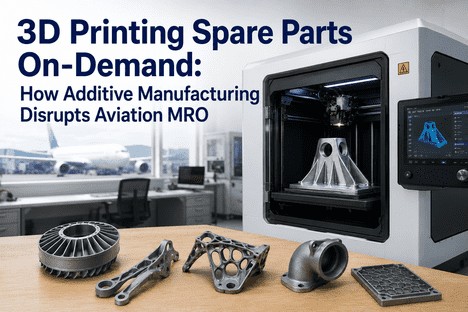
The aviation spare parts supply chain was built for a world where you had to predict every part that would break, stock it in warehouses on every continent, and pay 25-35% of the parts' value each year just to keep it there. That world is ending. Additive manufacturing replaces physical inventory with digital files. Instead of waiting 6 to 12 months for a forged or cast component, you print it on-site in 2 to 7 days. Instead of ordering minimum batch quantities of 50 or 100, you print exactly one. Instead of machining away 80-95% of a titanium block to make a bracket, you grow the bracket in near-net shape with 90% less waste. This is not theoretical. GE Aviation has 3D-printed over 100,000 fuel nozzle tips for the LEAP engine, consolidating 20 parts into one. Airbus produces 25,000 certified 3D-printed flight parts annually, with over 200,000 parts already in flight. Lufthansa Technik has developed, certified, and installed 2,200 additively manufactured aircraft parts. The FAA and EASA have established clear certification pathways for structural and flight-critical components. The technology is certified, scalable, and available today. The only question is whether your supply chain will adopt it before your competitors do.
DIGITAL INVENTORY. INSTALLED PARTS.
Move from Warehouse Shelves to Digital Files
iFactory's 3D Parts Inventory Module connects certified digital part files with on-demand print production, certification traceability, and CMMS integration — so you print what you need, where you need it, when you need it.
100K+3D-printed fuel nozzle tips produced by GE for the LEAP engine since 2015
25Kcertified flight parts printed annually by Airbus — 200,000+ already flying
2,200aircraft parts developed, certified and installed by Lufthansa Technik's AM center
90%reduction in raw material waste vs. traditional subtractive manufacturing
The Old Supply Chain vs. The Digital Warehouse
Two Models — One Costing Millions in Unnecessary Inventory, the Other Printing Parts On-Demand
The choice facing every airline and MRO today is not whether to adopt 3D printing. It is whether to continue paying for inventory that sits on shelves, parts that take a year to arrive, and waste that should never have been created in the first place. The comparison below shows why the math is already settled.
STOCK
Inventory Model
Physical parts stocked in warehouses across multiple regions. Inventory carrying costs of 25-35% of parts value annually. Obsolete parts written off when aircraft retire.
TIME
Lead Time
6 to 12 months for forged or cast components requiring specialized tooling. Emergency airfreight adds 300-500% to part cost for AOG situations.
BATCH
Minimum Orders
Manufacturers require minimum batch sizes of 20-100 units to amortize tooling setup costs. MROs stock 47 parts they do not need to get 3 they do.
WASTE
Material Utilization
Subtractive machining removes 80-95% of raw material. Buy-to-fly ratios of 10:1 or higher are common for complex titanium and nickel alloy components.
VS
DIGITAL
Inventory Model
Digital files stored in a certified parts library. Zero physical carrying cost. Print on demand — the part exists only when you need it. No obsolescence write-offs.
SPEED
Lead Time
2 to 7 days from digital file to certified part. Print at or near the point of maintenance. No tooling queues, no forging dies, no shipping delays.
ONE
Minimum Orders
Batch size of 1 at batch-of-100 economics. Zero setup cost per unique geometry. Print exactly the quantity needed — nothing more, nothing less.
GROW
Material Utilization
Near-net shape additive manufacturing uses 90%+ of raw material. Buy-to-fly ratios approach 1:1. Titanium waste dropped from 10 pounds to 1 pound per part.
What Parts Can Be 3D Printed Today
From Cabin Interiors to Critical Engine Components — The Catalog Is Expanding Rapidly
The range of certified 3D-printed aircraft parts has expanded far beyond prototyping. Today, production-grade metal and polymer parts fly on every major commercial aircraft type. Below are the categories where additive manufacturing has already replaced traditional supply chain routes.
Seat armrest covers, tray table latches, overhead bin components, lavatory fittings, galley inserts, window bezels, air vent grilles
Materials: ULTEM 9085, PA12, FR polycarbonate | Certification: OSD, EASA Part 21/G
Lufthansa Technik prints cabin interior parts on Stratasys Fortus systems — 2,200+ part numbers certified and flying
Environmental control system ducting, cable bracket assemblies, sensor mounts, clip brackets, conduit clamps, fairing supports
Materials: ULTEM 9085, AlSi10Mg, Ti-6Al-4V | Certification: FAA STC, EASA Form 1
Airbus consolidates 30 fuel system parts into one 3D-printed component, slashing weight by 75%
Fuel nozzle tips, combustor liners, turbine seal supports, bearing housings, compressor blade bleed valves, heat shield assemblies
Materials: Inconel 718, CoCr, Ti-6Al-4V, nickel superalloys | Certification: FAA Part 33, EASA CS-E
GE LEAP engine fuel nozzle: 20 parts consolidated into 1, 25% lighter, 5x more durable, 600 printed per week
Engine handling fixtures, inspection jigs, drill guides, seal installation tools, composite repair patches, temporary blanking plates
Materials: PA12 CF, ULTEM 1010, PEEK, AlSi10Mg | Certification: Internal tooling quality, non-flight-critical
Tooling printed on-site reduces lead times from 8 weeks to 48 hours for MRO fixture replacement
YOUR PART. YOUR FILE. YOUR SUPPLY CHAIN.
Start Building Your Digital Parts Library Today
iFactory's 3D Parts Inventory Module lets you upload, certify, and distribute digital part files to any qualified print shop — with full traceability, revision control, and CMMS integration built in.
The Digital Thread — From CAD File to Certified Part
How On-Demand 3D Printing Actually Works in Aviation Maintenance
The concept of "digital inventory" sounds abstract until you trace the path of a single part from digital file to installed component. Unlike traditional supply chains where a part passes through foundries, warehouses, and logistics networks, the digital thread for an additively manufactured part is direct and controlled at every step.
1
Digital Part File Creation
The 3D model is created or scanned from an existing part. Engineering validates the design for additive manufacturing — optimizing orientation, support structures, and lattice infill. The file includes all GD&T, material spec, and surface finish requirements.
2
Certification & Traceability Attachment
The digital file is bundled with its certification package: material certificate, process specification, quality inspection plan, and FAA/EASA approval documentation. iFactory's platform links every print job to its specific revision, creating an unbroken digital audit trail.
3
On-Demand Print Production
When a part is needed, the MRO or airline sends the file to a qualified print shop — in-house, local supplier, or network partner. The printer builds the part layer by layer under monitored conditions. Every process parameter is logged for quality assurance.
4
Post-Processing & CMMS Integration
The printed part undergoes post-processing — support removal, heat treatment, surface finishing, and dimensional inspection. With iFactory, the completed part is automatically matched to an open work order in your CMMS, with all inspection data and certifications attached.
Who Is Printing Certified Parts at Scale
Production Deployments Across the World's Largest Aerospace OEMs and MROs
GE Aerospace
LEAP Fuel Nozzle — The Most Produced AM Aviation Part in History
GE Aerospace passed 100,000 3D-printed LEAP fuel nozzle tips in 2021 and now prints 600 per week at its Auburn, Alabama facility. Each nozzle consolidates 20 traditionally brazed and welded parts into a single component, is 25% lighter, and 5x more durable. The LEAP engine with these nozzles powers the Airbus A320neo, Boeing 737 MAX, and Comac C919. GE has invested over $50 million in the Auburn AM facility and expanded to print GEnx brackets and Catalyst turboprop engine components using the same additive manufacturing infrastructure.
Airbus
25,000+ Parts per Year — Over 200,000 3D-Printed Parts In Flight
Airbus produces more than 25,000 certified 3D-printed flight parts annually in partnership with Stratasys, with over 200,000 additive parts already flying on commercial aircraft. On the A350 XWB, 3D-printed parts reduced component weight by 43% and cut lead times by 85%. Airbus has integrated w-DED (wire-directed energy deposition) titanium parts into A350 cargo door surrounds, consolidating multiple forged components into single printed structures. The company is actively expanding AM into wing and landing gear applications for next-generation aircraft programs.
Lufthansa Technik
2,200 Certified Parts — First Load-Bearing Metal AM Spare Part Approved by EASA
Lufthansa Technik's ADDITIVE Manufacturing Center has developed, certified, and installed 2,200 aircraft part numbers produced through additive manufacturing. In 2022, the company achieved a world first: EASA certification of a load-bearing metal 3D-printed spare part — the A-Link for the IAE-V2500 engine's anti-icing system. The titanium component, produced via LPBF on EOS and AMCM systems, exceeds the tensile strength of the original forged part. Lufthansa Technik also prints cabin interior parts on Stratasys Fortus systems and operates an EASA Part 21/J design organization for AM.
Boeing & Norsk Titanium
FAA-Approved Structural Titanium Parts on the 787 Dreamliner
Boeing was the first to fly FAA-approved 3D-printed structural titanium components on the 787 Dreamliner, produced using Norsk Titanium's Rapid Plasma Deposition technology. The parts reduce production costs by an estimated $2-3 million per aircraft. Boeing has expanded additive manufacturing across the 777X program with additional Norsk-supplied titanium structural parts and has incorporated thousands of 3D-printed polymer and metal parts across its commercial and defense platforms, with dedicated AM production cells in its supply chain.
What On-Demand 3D Printing Saves
Per-Part and Annual Cost Comparison for a Typical 50-Engine Fleet
Digital inventory replaces physical stock — zero warehousing, insurance, or obsolescence costs for 3D-printable parts
No tooling queues, no forging die production, no minimum batch wait. Upload file, print, inspect, install.
Near-net shape additive manufacturing grows the part in its final form instead of machining it from a solid block
Print at point of maintenance — no airfreight, no customs clearance, no last-minute logistics costs
For a 50-engine fleet transitioning 30% of its spare parts to on-demand additive manufacturing, the combined savings in inventory carrying costs, expedited shipping, material waste, and reduced teardowns typically reaches $5 million to $12 million annually. Against iFactory's 3D Parts Inventory Module — including digital file management, certification tracking, and CMMS integration — documented payback periods range from 4 to 10 months, with fleets holding higher volumes of low-turnover parts seeing the fastest returns.
CALCULATE YOUR FLEET SAVINGS
Run Your Parts Data Through iFactory's AM Model
Share your top 50 slow-moving part numbers by annual spend. We will project exactly how many can transition to on-demand 3D printing — and what that saves in inventory, logistics, and lead time costs.
How iFactory's 3D Parts Inventory Module Works
From Digital Spec to Installed Part — One Integrated Platform
01
Build Your Digital Parts Library
Upload existing part designs or collaborate with OEMs to obtain certified digital files. iFactory's platform organizes parts by aircraft type, ATA chapter, material specification, and certification status. Each file carries its complete digital thread — design revision, material cert, process spec, and approval documentation.
02
Qualify & Connect Print Partners
iFactory maintains a qualified network of EASA Part 21/G and FAA-approved print shops. You can also connect your own in-house additive manufacturing capability. The platform routes each print job to the appropriate partner based on material requirements, certification needs, and geographic proximity.
03
Trigger On-Demand Print Production
When a CMMS work order requires a 3D-printable part, iFactory automatically sends the digital file to the designated print partner with all process parameters, inspection criteria, and delivery instructions. No manual file transfer, no email chains, no version confusion.
04
Track & Close the Digital Loop
The print partner uploads completion data — print log, inspection report, material cert, and images — back into iFactory. The platform links each installed part to its specific print job, creating a complete digital lifecycle record from file creation through installation and future inspection cycles.
Frequently Asked Questions
Are 3D-printed aircraft parts certified by aviation authorities?
Yes. The FAA and EASA have established clear certification pathways for additively manufactured aircraft parts. GE Aerospace's 3D-printed LEAP fuel nozzle was certified under standard FAA Part 33 engine certification. Honeywell received FAA certification for the first 3D-printed flight-critical engine part — the #4/5 bearing housing — in 2020. Lufthansa Technik and Premium AEROTEC received EASA certification for the first load-bearing metal AM spare part in 2022. EASA's Certification Memorandum CM-S-008 Issue 04 provides comprehensive guidance for AM part certification across all criticality classes. iFactory's platform documents every print job with the full audit trail that regulators require.
What materials are approved for 3D-printed aircraft parts?
Approved materials include titanium alloys (Ti-6Al-4V), aluminum alloys (AlSi10Mg, AlSi7Mg0.6), nickel superalloys (Inconel 625, Inconel 718), cobalt-chrome alloys, stainless steel (17-4PH, 316L), ULTEM 9085 and 1010, PEEK, PA12 carbon-fiber reinforced, and PEKK. Each material requires process-specific qualification, but the major aerospace OEMs and material suppliers have already completed this qualification for the most commonly used alloys and polymers. iFactory's platform stores material specifications and only routes print jobs to partners with the corresponding process qualification.
How do 3D-printed part costs compare to traditionally manufactured parts?
The per-unit cost of a 3D-printed part is typically 20-40% higher than a mass-produced forged or cast part at high volumes. However, the total cost of ownership tells a different story. When you factor in eliminated minimum order quantities, zero inventory carrying costs, no tooling amortization, reduced shipping, and zero obsolescence risk, on-demand 3D printing is 30-60% cheaper per installed part for low-volume, complex-geometry components. For high-volume simple parts, traditional manufacturing remains more cost-effective — which is exactly why iFactory's platform helps you choose which parts to transition and which to keep in bulk production.
Which aircraft types are compatible with 3D-printed spare parts?
3D-printed parts are certified and flying on the Airbus A320 family, A330, A350 XWB, A380, Boeing 737 NG and MAX, 747-8, 777 and 777X, 787 Dreamliner, Embraer E-Jets, Bombardier CRJ series, and multiple business aviation and defense platforms. Engine-specific parts are certified for CFM LEAP and CFM56, GE GEnx and GE90, Pratt & Whitney PW1000G, IAE V2500, and Rolls-Royce Trent family engines. iFactory's platform includes pre-configured part categories for 60+ aircraft and engine types, with the ability to add custom parts as your digital library grows.
What is the typical payback period for implementing on-demand 3D printing?
Against iFactory's complete 3D Parts Inventory Module deployment — including digital library setup, print partner qualification, and CMMS integration — fleet operators report payback within 4 to 10 months. The primary savings driver is inventory carrying cost elimination for low-turnover parts. A typical 50-engine fleet carrying $15 million in slow-moving spares can eliminate $3.5-5 million in annual carrying costs by transitioning just 30% of those parts to on-demand production. Additional savings from reduced expedited shipping and lower material waste typically accelerate payback in the first quarter of operation.
Can 3D-printed parts be tracked in existing maintenance systems?
Yes — and this is one of iFactory's core capabilities. Every 3D-printed part produced through iFactory's platform carries a unique digital identifier linked to its specific print job, material lot, certification documents, and inspection results. When the part is installed, iFactory automatically creates the corresponding CMMS record in your existing system — AMOS, TRAX, SAP PM, or any OData-compatible platform. The part's entire lifecycle — from its first digital file creation through every subsequent inspection cycle — remains traceable within your maintenance ecosystem with no manual data entry required.
FROM DIGITAL FILE TO INSTALLED PART IN DAYS, NOT MONTHS
See iFactory's 3D Parts Inventory Module Live
Our team will walk you through a complete on-demand print workflow — from digital file upload through print partner routing to CMMS work order closure — using your actual part numbers and fleet profile. No generic demo, no commitment.