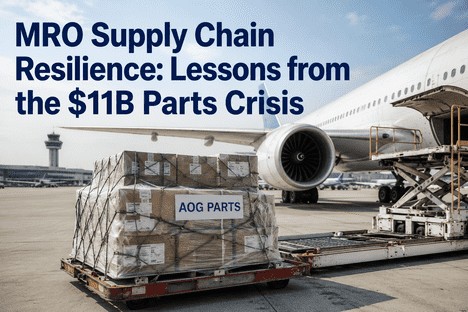
Supply chain disruptions in commercial aviation have reached a threshold where the cost is no longer measured in delayed deliveries alone. A joint study by IATA and Oliver Wyman estimates that supply chain challenges will cost the airline industry more than $11 billion in 2025. The breakdown is sobering: $4.2 billion in lost fuel efficiency from operating older aircraft, $3.1 billion in inflated maintenance costs for aging fleets, $2.6 billion in excess engine leasing driven by extended turnaround times, and $1.4 billion in emergency parts stockpiling. Behind these numbers lies a structural reality that every MRO organization now faces. The supply chain that the industry relied on for decades is not coming back. Building resilience is no longer a procurement initiative. It is an operational survival strategy.
IATA / OLIVER WYMAN 2025 STUDY
The $11B Parts Crisis
Lessons for Building MRO Supply Chain Resilience
With a record 17,000-aircraft backlog, parts lead times stretching 20-40 weeks, and engine durability issues grounding hundreds of aircraft, the aviation supply chain has reached a structural breaking point. Here is what caused it, what it costs, and how MRO organizations can build genuine resilience.
THE $11B BREAKDOWN
Where the Money Goes: Four Cost Drivers of the Supply Chain Crisis
The $11 billion figure is not a single line item. It is the combined effect of four distinct cost pressures, each driven by the same root cause: an aviation supply chain that cannot keep pace with demand. Understanding the breakdown is the first step toward building targeted resilience strategies.
$4.2B
38%
Delayed Fuel Savings
Airlines are operating older, less fuel-efficient aircraft because new deliveries are delayed 18-24 months behind schedule. Each additional year of operating a legacy fleet adds measurable fuel burn that compounds across every flight hour.
$3.1B
28%
Higher Maintenance Costs
Aging fleets require more frequent heavy checks, non-routine repairs, and component overhauls. Extended service life pushes airframes past original design limits, increasing both scheduled and unscheduled maintenance events.
$2.6B
24%
Excess Engine Leasing
Engine shop visit turnaround times have grown 35-150% depending on platform. Airlines must lease spare engines to cover the gap, driving up lease rates 20-30% above 2019 levels and creating a cascading cost across the fleet.
$1.4B
10%
Extra Spares Inventory
Unpredictable supply has forced operators to stockpile parts beyond normal planning levels. Emergency AOG parts exchanges, technical robberies between aircraft, and premium freight for expedited orders have become routine operational costs.
THE DOMINO EFFECT
How One Supply Chain Break Creates a Cascade
The MRO supply chain crisis did not happen all at once. It unfolded as a chain reaction where each broken link amplified the next. Understanding this cascade is essential for identifying where intervention can break the cycle.
1
Production Slowdown
Aircraft deliveries fall 30% below pre-COVID targets. Backlog swells to 17,000+ units.
2
Fleet Age Increases
Airlines keep older aircraft in service 3-5 years longer than planned. Retirement rates drop.
3
Maintenance Demand Surges
Older fleets require more frequent heavy checks and unscheduled repairs. MRO slots fill up.
4
Parts Supply Tightens
High demand meets constrained production. Lead times stretch from weeks to months. Costs rise at every link.
ROOT CAUSES
Five Structural Weaknesses That Created the Crisis
The $11B price tag is a symptom, not the disease. These five structural weaknesses in the aviation supply chain are the root causes that MRO resilience strategies must address directly.
01
OEM Dependence
Concentration Risk in Single-Source Supply
The aerospace supply chain is deeply tiered and heavily concentrated. When a single tier-3 supplier for coated components or flight deck windows falters, the entire production line slows. OEMs control design data, parts distribution, and repair certification, leaving MROs with limited alternatives when OEM lead times extend beyond 40 weeks.
02
Data Fragmentation
Limited Visibility Across the Supply Chain
Most MROs operate on disconnected systems for procurement, inventory, maintenance planning, and vendor management. Without a unified data layer, they cannot see parts availability across sites, forecast demand against scheduled checks, or identify alternative sourcing options before a stockout becomes an AOG event.
03
Workforce Gap
Skilled Labor Deficit Across the Ecosystem
Parts availability is only half the problem. The MRO sector faces a projected shortfall of 22,000+ technicians by end of 2026. Simultaneously, manufacturing and supplier workforces are aging out. Labor constraints at every tier of the supply chain compound parts delays and extend turnaround times.
04
Demand Volatility
Unpredictable Maintenance Demand Patterns
New-generation engine durability issues have added hundreds of unscheduled shop visits that were not factored into capacity or parts planning. GTF powder metal contamination and LEAP component issues created sudden demand spikes that the supply chain was structurally unable to absorb.
05
Regulatory Lag
Slow Certification of Alternative Sources
Qualifying new parts suppliers or repair sources requires regulatory approval that can take 12-18 months. When primary sources fail, the industry lacks the agility to quickly stand up alternatives. PMA and USM adoption is growing but remains constrained by certification timelines and operator risk tolerance.
IFACTORY SUPPLY CHAIN MODULE
Turn Supply Chain Fragility Into Forecastable Resilience
iFactory's Supply Chain Module connects parts demand forecasting, vendor performance tracking, multi-site inventory visibility, and automated procurement workflows in one platform. Stop reacting to shortages. Start predicting them.
THE RESILIENCE FRAMEWORK
Four Pillars of a Resilient MRO Supply Chain
Resilience is not about holding more inventory. It is about having the data, relationships, and workflows to respond faster when supply breaks. These four pillars form the foundation of a supply chain that can absorb disruption without grounding aircraft.
Demand Visibility and Forecasting
The ability to predict parts demand 60-90 days in advance based on scheduled maintenance, historical usage patterns, and fleet composition. AI-driven forecasting aligns procurement with actual need, not reactive stockouts.
Multi-Source and Alternative Supply
A diversified sourcing strategy that balances OEM, PMA, and USM channels. Vendor scorecards track lead time reliability, pricing trends, and certification status so buyers can switch sources before a shortage becomes critical.
Real-Time Inventory Intelligence
Unified visibility across all stocked locations with automated reorder points, cross-site transfer logic, and shelf-life monitoring. Eliminates the paradox of excess inventory in one location and stockouts in another.
Collaborative Vendor Ecosystem
Live performance data shared across procurement, maintenance, and finance teams. Automated alerts for vendor lead time changes, quality issues, and pricing shifts enable proactive sourcing decisions before problems escalate.
KEY LESSONS
What the $11B Crisis Teaches Us About Supply Chain Strategy
The IATA and Oliver Wyman study offers more than a cost estimate. It reveals patterns that every MRO supply chain leader should integrate into their resilience planning. These four lessons emerge directly from the data.
01
Visibility Is Not Optional
The single biggest predictor of supply chain disruption is the time lag between when a problem occurs and when it is visible to decision-makers. MROs with real-time dashboards connecting procurement, inventory, and maintenance planning identified shortages 3-5 weeks earlier than those relying on periodic reports.
02
Forecasting Beats Stockpiling
Airlines that invested in predictive demand forecasting reduced emergency procurement by 40% compared to operators that simply increased buffer stock. Forecasting addresses the root cause of shortages while stockpiling merely masks it and ties up capital.
03
Supplier Diversity Reduces Risk
MROs that maintained active relationships with at least three sourcing channels per high-criticality part category experienced 60% fewer AOG events during supply chain disruptions compared to single-source dependent organizations.
04
Data Integration Accelerates Recovery
Organizations with integrated maintenance and supply chain systems recovered from parts shortages 2.5 times faster than those with disconnected platforms, because automated cross-referencing identified substitute parts and alternative sources in minutes instead of days.
IFACTORY SUPPLY CHAIN MODULE
Move from Reactive Procurement to Predictive Supply Chain Management
iFactory's Supply Chain Module gives MRO teams the demand forecasting, vendor intelligence, and multi-site inventory visibility needed to build genuine supply chain resilience. Deploy a pilot in weeks, not months.
FAQ
Common Questions About MRO Supply Chain Resilience
How does the $11 billion cost break down across airline operations?
The IATA and Oliver Wyman study identifies four primary cost drivers. Delayed fuel savings account for $4.2 billion as airlines operate older, less efficient aircraft while waiting for new deliveries that are 18-24 months behind schedule. Higher maintenance costs add $3.1 billion because aging fleets require more frequent heavy checks and non-routine repairs. Excess engine leasing contributes $2.6 billion as extended shop visit turnaround times force airlines to lease spare engines at rates 20-30% above 2019 levels. Extra spares inventory stockpiling accounts for $1.4 billion as operators buy ahead to hedge against unpredictable supply. These are direct costs only; the study notes additional indirect impacts from delayed route expansion, higher lease rates, and operational disruptions.
What specific supply chain capabilities should MROs prioritize to build resilience?
Based on the IATA report and operational data from MROs that successfully navigated the 2024-2025 disruption period, the highest-impact capabilities are demand forecasting integrated with maintenance scheduling, multi-source vendor management with live performance scorecards, real-time multi-site inventory visibility with automated cross-site transfers, and procurement workflows that automatically flag lead time changes and suggest alternative sourcing options. Organizations that deployed these four capabilities in an integrated platform reported 40% fewer emergency procurements and 60% fewer AOG events compared to those using disconnected systems.
Can digital supply chain tools integrate with existing ERP and maintenance systems?
Yes. Modern supply chain platforms like iFactory's Supply Chain Module are designed as an overlay layer that connects to existing ERP, CMMS, and procurement systems without requiring replacement of core infrastructure. The platform pulls data from work order systems, inventory databases, and vendor records to create a unified operational view. API-based bi-directional integration means existing systems continue functioning normally while the platform adds the demand forecasting, vendor intelligence, and cross-site visibility that disconnected systems cannot provide. Deployment timelines typically range from 2-6 weeks depending on the number of data sources and sites.
What measurable ROI have MRO organizations achieved after implementing supply chain digitalization?
MRO facilities using integrated supply chain management platforms report measurable improvements within the first quarter of deployment. Typical outcomes include a 40-50% reduction in AOG parts escalation events, 18-25% reduction in procurement costs through optimized sourcing and reduced premium freight, 30-40% improvement in inventory turnover as cross-site visibility eliminates duplicate stockpiling, and a 60-80% reduction in time spent on manual procurement coordination and vendor follow-up. For a mid-size MRO with 50-80 aircraft in annual heavy checks, these improvements typically generate positive ROI within 60-90 days of platform deployment.
BUILD SUPPLY CHAIN RESILIENCE
The $11B Crisis Is Not Over. But Your Response Can Be Different.
Supply chain disruptions will continue through 2027 and beyond, according to industry forecasts. The MROs that emerge stronger will be those that replace reactive procurement with predictive intelligence. iFactory's Supply Chain Module gives you the forecasting, visibility, and vendor management tools to turn supply chain fragility into operational resilience. Deploy your first pilot in weeks.