Aviation maintenance consumes 15 to 20 percent of every airline's operating budget — and the majority of that spend is not fixed. It is preventable. Airlines, MRO operators, and ground service teams deploying AI-driven analytics in 2026 are documenting 20 to 35 percent reductions in unscheduled maintenance costs, 60 to 68 percent fewer unscheduled component removals, and AOG cost avoidance exceeding $4 million per year for a 40-aircraft operator. This guide breaks down the real benchmarks, the technology behind them, and a framework you can use to calculate exactly what AI analytics would save your operation.
What "Unscheduled Maintenance" Actually Costs Aviation
The Three Cost Layers Most Budgets Miss
When an engine component fails between scheduled checks, the bill is never just the part. Three distinct cost layers activate simultaneously, and most accounting systems only capture the first one.
A McKinsey study found that AI-driven predictive maintenance cuts unscheduled downtime by 30 to 50 percent while reducing overall maintenance costs by 18 to 25 percent. Deloitte research validates a 15 percent reduction in aircraft downtime and a 20 percent improvement in labor productivity across MRO organizations using AI analytics. These are not vendor projections — they are published benchmarks from two of the most respected research organizations in industrial operations.
Aviation Analytics Cost Benchmarks — 2026 Reference Table
Fixed-Schedule vs. AI-Driven Maintenance: Measured Across 7 Categories
| Cost Category | Without AI Analytics | With AI Analytics | Improvement |
|---|---|---|---|
| Unscheduled maintenance spend | Full reactive burden | Reduced 20-35% | -20-35% |
| AOG events per 40-aircraft fleet | 12-18 per year | 4-7 per year | -60-68% |
| Unplanned downtime hours | Baseline (reactive) | Reduced 30-50% | -30-50% |
| Maintenance labor productivity | Baseline efficiency | Improved 20% | +20% |
| Component removal rate | Unscheduled removals | Condition-based removal | -60-68% |
| Parts inventory carrying cost | Safety stock buffers | Optimized 15-20% | -15-20% |
| Annual maintenance cost per aircraft | Full burden | Reduced 18-25% | -18-25% |
Sources: McKinsey & Company (2024), Deloitte (2023), Oliver Wyman Global Fleet & MRO Forecast 2026-2036. Benchmarks represent documented ranges across commercial airline, MRO, and regional operator deployments.
ROI Calculator: What AI Aviation Analytics Delivers
Annual Savings Breakdown for a Mid-Size Fleet Operator
For a 40-aircraft operator, combined annual savings from avoided AOG events, reduced unscheduled maintenance, optimized parts inventory, and labor efficiencies consistently fall between $2 million and $6 million. Against a typical AI analytics platform investment, documented payback periods range from 6 to 14 months, with 95 percent of implementers reporting positive ROI and 27 percent achieving full payback within the first year.
How AI Analytics Cuts Aviation Costs — The Technology Behind the Benchmarks
From Sensor Data to Scheduled Intervention in Under 60 Seconds
The benchmarks above are not achieved through a single algorithm or dashboard. They come from an integrated stack of data ingestion, machine learning models, and automated work order generation that operates continuously across every aircraft in the fleet.
Industry-Leading Results — Real Deployments, Real Numbers
What Leading Operators Are Achieving with AI Analytics Today
How iFactory Delivers Aviation Analytics ROI
From Data Connection to Cost Reduction in 60 Days
Frequently Asked Questions
How quickly does AI aviation analytics start producing cost savings?
Most operators see measurable reductions in unscheduled maintenance events within 30 to 60 days of deployment. The first month is baseline learning — AI models analyze historical failure data and build predictive profiles. By day 30 to 45, anomaly detection alerts begin flagging components before failure. Documented ROI through avoided AOG events and reduced unscheduled repairs is typically confirmed within 90 days. Full payback on platform investment is commonly achieved within 6 to 14 months, with 27 percent of operators reaching payback within the first 12 months.
What data sources does iFactory need to start generating predictions?
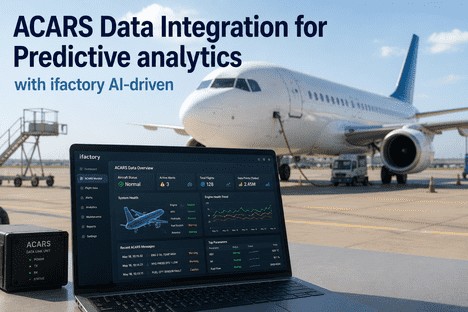
iFactory ingests data from ACARS streams, onboard engine sensors, maintenance log systems (AMOS, TRAX, SAP PM, Maximo), parts inventory databases, and flight operations records. The more historical data available, the faster the AI models reach reliable accuracy — but the platform begins generating value with as little as 12 months of maintenance records and live sensor feeds. All integrations are read-only and do not write to your control systems.
Can AI aviation analytics work with our existing MRO software?
Yes. iFactory is built to integrate with existing maintenance management systems rather than replace them. Standard connectors exist for AMOS, TRAX, SAP PM, IBM Maximo, and most major CMMS platforms. Integration happens via standard APIs or OPC-UA — the AI layer consumes your existing data and pushes predictive work orders back into your current workflow. No infrastructure replacement, no dual-system overhead, no IT transformation required. Typical integrations go live within 60 days.
Is AI-driven maintenance analytics only viable for large airlines?
No. Cloud-based AI platforms scale efficiently down to operators with as few as 5 to 10 aircraft. The economic logic — fewer unscheduled removals, fewer AOG events, optimized parts inventory — applies at any scale. Regional operators and business aviation fleets often see faster percentage-based savings because their existing unscheduled maintenance ratio tends to be proportionally higher without dedicated analytics teams. Per-aircraft platform costs decrease with fleet size, but the ROI equation remains positive across all operator categories.
How does AI analytics for aviation maintenance differ from traditional engine health monitoring?
Traditional engine health monitoring (EHM) systems provide real-time parameter dashboards and threshold-based alerts — they tell you when a reading exceeds a preset limit. AI analytics goes several steps further: it learns normal operating patterns for each individual engine, detects subtle deviations that precede failure by weeks, correlates data across multiple systems (engine, hydraulics, avionics) to identify root causes, and automatically generates work orders with parts and labor estimates. EHM answers "what is happening now." AI analytics answers "what will fail, when, and what to do about it."
What is the typical payback period for iFactory's aviation analytics platform?
For a 40-aircraft operator, the combined annual savings from AOG avoidance, unscheduled maintenance reduction, parts optimization, and labor efficiency typically ranges from $2 million to $6 million. Against iFactory's platform investment, this produces documented payback within 6 to 14 months. Operators targeting their highest-cost asset categories — engines, landing gear, avionics — often see single-event avoidance that covers the full platform investment within the first quarter. Industry-wide, 95 percent of AI predictive maintenance adopters report positive returns, with an average ROI of 10:1 to 30:1 within 12 to 18 months.