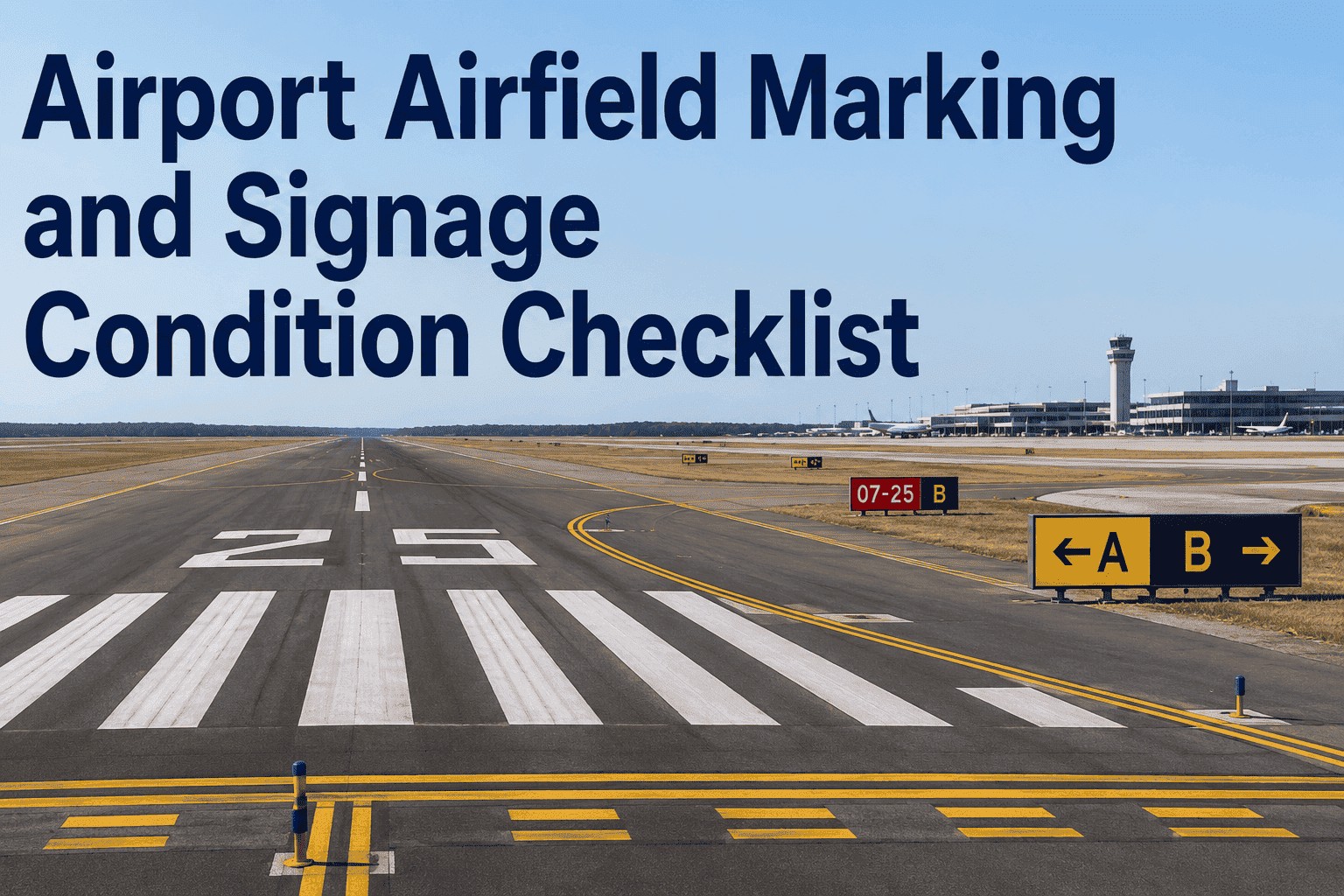
A runway centerline marking that has faded below 100 mcd/m2/lx does not fail all at once. It becomes a little harder to see each night until, during a low-visibility departure in heavy rain, a pilot cannot confirm the centerline at 50 knots. Taxiway direction signs lose retroreflectivity gradually over three to five years of UV exposure, until a ground vehicle operator misses a turn at a complex intersection. Holding position markings that have worn below specification are invisible to a landing aircraft's enhanced vision system — and that is when incursions happen. The FAA mandates that certificated airports maintain marking retroreflectivity and sign legibility under 14 CFR Part 139, and ICAO Annex 14 sets global standards for visual aids. This checklist gives airfield operations, maintenance, and compliance teams a structured, measurement-based framework to assess every marking and sign on the airfield — before a faded marking becomes a safety investigation.
3-5 yrs
typical airfield marking service life before retroreflectivity degrades below minimum
100 mcd
minimum retroreflectivity threshold for white runway markings per FAA standards
50%
of airfield marking visibility loss happens in the final year before replacement is due
Daily
inspection requirement for movement area markings under 14 CFR Part 139
Airfield Visual Aids Classification
Five categories of markings and signs. Each has its own degradation curve, inspection method, and compliance threshold.
CAT 01
Runway
Threshold & Centerline
CAT 02
Taxiway
Centerline & Edge
CAT 03
Hold
Position Markings
CAT 04
Signage
Mandatory & Direction
CAT 05
Surface
Painted Signs
What Happens When You Skip a Zone
Every unchecked item on this checklist represents a measurable safety risk and a potential compliance finding. This is what the data reveals about deferred marking and sign maintenance.
Runway Zone
Low-Visibility Confusion
Skip retroreflectivity trending -> threshold marking fades below 100 mcd -> pilot cannot confirm position at night -> runway excursion or wrong-surface landing risk elevated
Taxiway Zone
Navigation Ambiguity
Skip enhanced centerline checks -> worn markings at runway approach -> pilot misses turn at speed -> runway incursion with arriving aircraft
Hold Zone
Incursion Risk
Skip holding position inspection -> marking obscured by rubber -> pilot holds beyond limit -> ATC detects incursion -> operational disruption and mandatory reporting
Signage Zone
Position Error
Skip sign retroreflectivity measurement -> faded sign illegible at night -> pilot misses taxiway turn -> wrong taxi route delays departing aircraft
Retroreflectivity Zone
Unseen Degradation
Skip mobile retroreflectometer surveys -> degradation unmeasured -> 70% of marking life lost without documentation -> safety case cannot be defended during audit
Compliance Zone
Regulatory Finding
Skip inspection documentation -> FAA or CAA inspector finds no records -> Part 139 non-compliance finding -> mandatory re-inspection and potential operations restriction
Frequently Asked Questions
Regulatory guidance varies by jurisdiction, but the FAA-recommended best practice is mobile retroreflectometer surveys conducted annually for certificated airports, with handheld verification measurements quarterly on critical markings including runway holding positions and threshold markings. White runway markings should maintain a minimum RL of 100 mcd/m2/lx, yellow markings a minimum of 50 mcd/m2/lx. The key to effective condition-based management is trending. A marking measuring 180 mcd in year one that has dropped to 110 mcd by year two is on track to fall below minimum before the next annual survey. iFactory's compliance tracking module logs every retroreflectivity reading, plots degradation curves per marking zone, and generates re-marking recommendations based on projected service life rather than fixed calendar intervals.
The leading cause of marking performance failure is glass bead loss from the paint or thermoplastic surface due to traffic abrasion, rubber deposit coverage, and UV degradation of the binder. Bead loss directly reduces retroreflectivity and is difficult to assess visually during daytime inspections. The second most common cause is rubber deposit accumulation in touchdown zone markings, which can reduce RL by 60-80% within 12 months at high-traffic runways. Regular rubber removal using high-pressure water or chemical methods restores retroreflectivity significantly. For signs, UV degradation of the reflective sheeting is the primary failure mode, typically becoming noticeable after 3-5 years of exposure in high-sunlight environments. iFactory's platform tracks bead retention, rubber accumulation cycles, and sign sheeting age to predict when each marking or sign element will require maintenance.
iFactory's compliance tracking module is purpose-built for airfield visual aids management. Every inspection item on this checklist maps directly to a digital inspection template within the platform. Inspectors record marking conditions via mobile device with photo attachments, GPS location tagging, and quantitative retroreflectivity measurements. The platform generates degradation trend charts per marking zone, tracks corrective actions from detection to closure, and maintains a timestamped audit trail that satisfies FAA Part 139 and ICAO Annex 14 documentation requirements. When a marking is re-marked or a sign replaced, the asset record is updated with material type, installation date, contractor details, and warranty period. The platform also integrates with mobile retroreflectometers to import measurement data directly, eliminating manual transcription errors. Compliance dashboards show real-time status across all zones with automatic alerts when any marking approaches minimum thresholds.
The primary regulatory framework for US airports is 14 CFR Part 139.311, which requires certificate holders to maintain marking and sign systems authorised by the Administrator. The FAA implements this through Advisory Circular AC 150/5340-1 (Standards for Airport Markings) and AC 150/5340-18 (Standards for Airport Sign Systems). Internationally, ICAO Annex 14 Volume I Aerodromes establishes standards and recommended practices for visual aids. The Manual of Aerodrome Standards provides national implementation guidance in many countries. For retroreflectivity specifically, ASTM E1710 and E2832 define measurement standards. Airport certification manuals must document the marking and signage inventory, inspection frequency, and corrective action procedures. Maintaining alignment between the physical airfield and the documented layout is a recurring compliance challenge that iFactory addresses through digital asset tracking and automated change notifications.
Yes. iFactory supports data import from handheld retroreflectometers (such as those meeting ASTM E1710 standard) and mobile retroreflectometer survey vehicles that capture RL measurements at traffic speed across a wide field of assessment. Measurement data with GPS coordinates can be ingested via API or CSV upload, mapped to the corresponding marking asset in the platform, and automatically plotted on degradation trend charts. This eliminates manual data entry and ensures that every retroreflectivity reading is linked to a specific date, location, and inspection event. The platform also tracks instrument calibration certificates and alerts the team when a retroreflectometer is due for recalibration. For airports managing large airfields with multiple runways and complex taxiway networks, this integration transforms survey data from a static report into a live, actionable condition management system.
iFactory Compliance Tracking Platform
Stop Chasing Faded Markings. Build an Audit-Ready Visual Aids Programme.
iFactory connects to your retroreflectometer surveys, daily inspection workflows, and corrective action tracking to create a single, compliance-ready system for every marking and sign on your airfield. Trusted by infrastructure operators across the UK, EU, Middle East, and Asia-Pacific.
Pilot in 30 days. Full integration in one quarter.