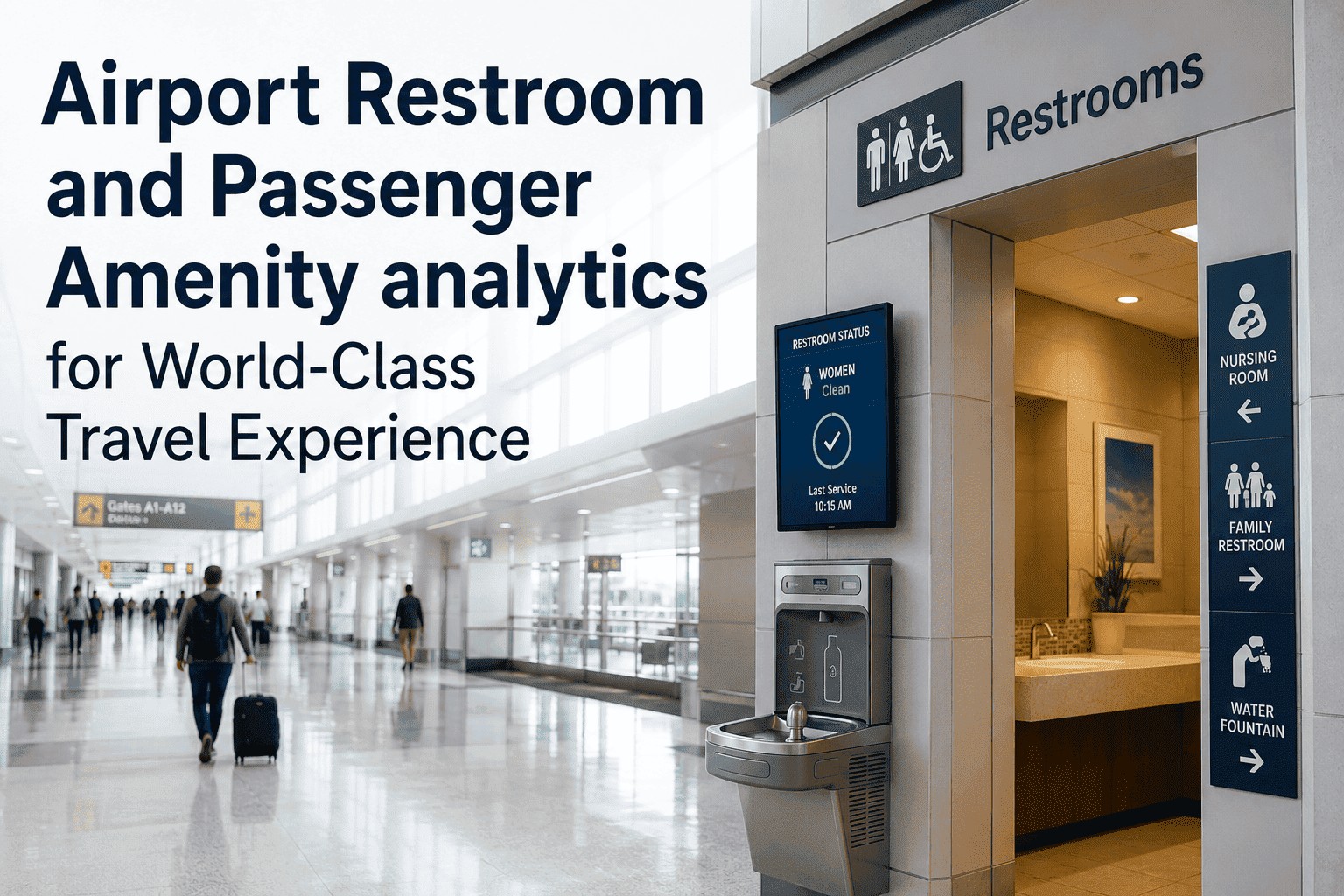
Every passenger who walks through your terminal uses at least one restroom. Most use two or three. And every time they encounter a soap dispenser running on empty, a nursing room door that won't lock, or a water fountain out of service, they make a quiet judgment about your airport — one that shows up weeks later in your ASQ scores and your retail revenue. Airport Council International data shows restroom cleanliness alone accounts for over 50% of total terminal cleanliness scores, and cleanliness is the single largest weighted driver of passenger satisfaction globally. Yet most airports still manage these amenities on fixed schedules, not real demand. That gap is where iFactory's work order analytics closes the loop.
Restrooms · Nursing Rooms · Water Stations · Family Amenities · Hygiene Compliance
Your Passengers Judge Your Airport in the Restroom. Make Sure It Passes.
iFactory's work order management platform brings demand-based scheduling, real-time fault tracking, and compliance documentation to every passenger amenity in your terminal — so every touchpoint reflects the standard your passengers expect.
50%+
Of terminal cleanliness score driven by restroom condition alone
14.5%
Satisfaction score increase at ATL after demand-based restroom management
+8%
F&B revenue lift per 10% increase in passenger dwell time
5.3%
Global air travel demand growth in 2025 — more passengers, higher amenity pressure
Why Amenity Failures Are Revenue Events, Not Just Complaints
A dirty restroom does not just upset a passenger — it shortens their dwell time. A passenger who encounters a poor restroom experience moves toward the gate earlier, bypassing retail and food and beverage stops they would have made in a comfortable terminal. Research across 89 US airports confirms this directly: a 10% increase in dwell time corresponds to an 8% lift in food and beverage revenue and a 6% lift in retail revenue. The inverse is equally true. Every amenity failure that pushes a passenger to leave the concourse early is a non-aeronautical revenue event — silent, cumulative, and almost never attributed correctly in operations reviews.
How Amenity Failures Flow Through to Non-Aeronautical Revenue
1
Amenity fails — restroom dirty, dispenser empty, nursing room unavailable
Passenger has a negative touchpoint. The experience is immediate and visible.
2
Passenger comfort drops — stress level rises, dwell intent collapses
Instead of browsing, the passenger heads to the gate. The concourse window closes early.
3
F&B and retail revenue misses — units unsold, tables half-full
The revenue loss is real but never connected back to the amenity failure on that morning.
4
ASQ scores fall — airline partners notice — concession renegotiations follow
The long-term cost of repeated amenity failures surfaces in the next contract cycle.
Four Amenity Systems. One Analytics Platform. Complete Passenger Experience Visibility.
iFactory's work order management platform treats every passenger-facing amenity as a trackable, schedulable, compliance-documented asset — with work orders triggered by real demand signals, not calendar dates.
Amenity System 01
Terminal Restrooms — Demand-Based Scheduling and Supply Tracking
Highest Passenger Touchpoint Frequency
Restrooms are the one amenity virtually every passenger uses — often multiple times per visit. A fixed 90-minute cleaning cycle that made sense for an average Thursday becomes completely inadequate during a 400-person international arrival bank. iFactory tracks occupancy signals and departure wave schedules to trigger cleaning work orders before congestion builds, not after the first complaint registers. Supply levels — soap, paper towels, toilet tissue — are monitored against consumption rates, and replenishment orders are generated automatically when thresholds are approached. No more empty dispensers discovered during manual rounds an hour too late.
Demand-triggered cleaning orders
Supply threshold monitoring
Inspection log with timestamped records
Amenity System 02
Nursing Rooms and Family Amenities — Upkeep and Compliance Tracking
Federal Compliance + Experience Risk
The Friendly Airports for Mothers (FAM) Act mandates a clean, private lactation space in every terminal of every commercial airport in the US. But compliance is not a checkbox — it is a condition maintained in real time, every operating hour. A nursing room with a broken lock, an out-of-service outlet, a soiled surface, or an empty supply bin represents both a regulatory exposure and a moment of distress for a passenger who has no alternative. iFactory schedules condition checks, tracks maintenance faults, and ensures that supply inventories are logged against usage — creating the documented compliance trail that protects operators and, more importantly, ensures the room is actually usable when a passenger needs it.
FAM Act compliance documentation
Fault and lock mechanism tracking
Supply and fixture condition log
Amenity System 03
Water Fountains and Hydration Stations — Uptime and Sanitation Tracking
Silent Satisfaction Drain
A water fountain or bottle-filling station out of service is invisible on most maintenance dashboards — but highly visible to the passenger standing in front of it with an empty bottle before a long-haul flight. These stations carry a hygiene inspection requirement that, when undocumented, creates regulatory exposure under EPA Safe Drinking Water Act standards for public facilities. iFactory tracks each unit's operational status, schedules sanitation checks at the required frequency, and generates immediate work orders when a fault is detected or a filter replacement threshold is reached. Uptime data is logged per unit, per terminal, giving operations teams a clear record of service quality over time.
Operational uptime per unit
Filter change and sanitation scheduling
EPA-aligned hygiene documentation
Amenity System 04
Terminal Common Area Hygiene — Surface, Seating, and High-Touch Zone Analytics
ASQ Score Multiplier
Gate seating areas, check-in hall surfaces, stairwell handrails, elevator buttons, and concourse floor zones are all high-touch, high-visibility surfaces that passengers use to form their overall impression of terminal quality. A single departure wave can leave seating areas in near-unusable condition for the next arrival bank if cleaning schedules are not responsive to actual traffic. iFactory maps these zones to departure and arrival schedule data, triggering work orders between peak windows and tracking cleaning confirmation by zone and shift. Every completed task is logged with the time, team member, and area — creating the continuous inspection record that backs up ASQ responses with operational evidence.
Zone-based cleaning triggers
Shift completion verification
ASQ-aligned documentation trail
Fixed Schedule vs Demand-Based: What the Difference Looks Like in Practice
400-passenger international arrival at 6 AM
Cleaning crew scheduled at 8 AM per calendar — restrooms already degraded before they arrive
Work order triggered at 5:45 AM against flight schedule — crew on site before passengers arrive
Soap dispenser at 15% fill level, Terminal B
Discovered empty during next manual round — passenger complaint already logged
Threshold alert at 20% — replenishment work order dispatched before depletion
Nursing room outlet fault reported
Enters general maintenance queue — resolved in 2–3 days depending on load
Flagged as high-priority compliance fault — escalation triggered within the hour
Water fountain filter due for replacement
Tracked manually by facilities team — often runs overdue until the next audit
Automatic work order at threshold — documented against EPA sanitation schedule
ASQ inspection preparation
Manual records assembled before each survey period — gaps are common
Continuous documentation per amenity, per zone — audit-ready at all times
Work Order Management · Demand-Based Scheduling · Compliance Documentation
Stop Managing Amenities on a Calendar. Start Managing Them on Demand.
iFactory connects your passenger amenity assets to real demand signals — dispatching work orders when conditions require it, not when the schedule says so. Every task is logged, every threshold is tracked, every compliance requirement is documented continuously.
Compliance Is Not Annual — It Is Every Operating Hour
Airport amenities operate under a layered compliance environment that most facilities teams manage reactively — assembling documentation before inspections rather than maintaining it continuously. iFactory changes that structure entirely, turning compliance from a periodic effort into an operational output that happens automatically as work orders are completed.
Federal Legislation
Friendly Airports for Mothers Act
Every commercial airport terminal is required to provide a clean, private lactation space. iFactory documents condition checks, fault resolution, and supply availability for each nursing room — creating a timestamped compliance record that demonstrates continuous standard, not just the state of the room at the last audit date.
Life Safety
OSHA 1910.22 Sanitation Standards
OSHA requires that sanitary facilities in occupied workplaces — including public-use terminals — are maintained in a clean and sanitary condition at all times. iFactory's work order logs provide the documented chain of custody that demonstrates ongoing compliance and protects the operator in the event of a health complaint or OSHA review.
Water Quality
EPA Safe Drinking Water Act — Public Facility Standards
Water fountain and hydration station sanitation and filter replacement schedules must meet EPA public facility requirements. iFactory tracks each unit's filter change history, sanitation log, and fault record — so the documentation exists per unit, per terminal, ready for review without manual reconstruction.
Passenger Experience Standard
ACI ASQ Cleanliness and Amenity Benchmarks
ACI's Airport Service Quality program benchmarks restroom and amenity cleanliness against global standards. Airports that invest in continuous documentation and demand-based maintenance consistently achieve higher ASQ scores — which in turn support airline partner retention, concession contract performance, and overall terminal positioning.
"
The first time we ran our amenity completion data against our ASQ scores quarter-over-quarter, the correlation was unmistakable. The quarters where our restroom cleaning completion rate dropped below 94% — usually around the summer bank holiday peaks — were exactly the quarters where our cleanliness scores took a hit. It was not a mystery anymore. It was a management problem with a data solution. Once we could see which terminals were falling behind and when, we could actually fix it before passengers noticed.
— Terminal Operations Manager, Major European Hub Airport — 11 Years Airport Facilities Management
Frequently Asked Questions
Conclusion
Passenger amenity quality is not a soft metric. It is the physical infrastructure through which every non-aeronautical revenue opportunity flows. A passenger who encounters clean, well-stocked, fully operational amenities stays longer, spends more, rates the airport higher, and is more likely to return. A passenger who encounters the opposite leaves the concourse early and takes their retail spend with them. The difference between these two outcomes is not the size of the facilities budget — it is whether amenity operations are managed on a fixed schedule or on real demand.
iFactory's work order management platform brings demand-based scheduling, automated threshold alerts, and continuous compliance documentation to every passenger amenity in your terminal — turning a reactive cleaning schedule into a proactive, data-backed passenger experience operation. Book a Demo to see how the platform maps to your terminal asset structure, or Get In Touch to begin your amenity asset registry and generate your first demand-based work order queue.
Your passengers are rating your terminal right now. The question is whether your amenity operations are keeping pace with the demand they are walking through the door with.
iFactory tracks every passenger amenity asset, triggers work orders on demand, and delivers the compliance documentation your ASQ scores and regulatory obligations require — all in one platform.