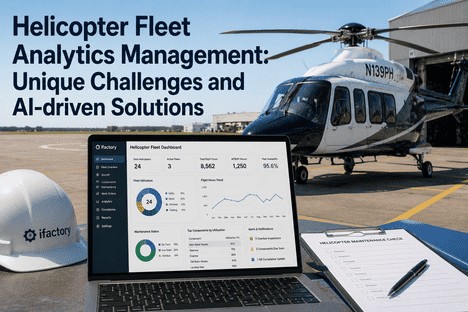
Helicopter fleet analytics management presents fundamentally different challenges than fixed-wing MRO. Rotary-wing aircraft face higher vibration loads, shorter component life limits, diverse operational environments from offshore to HEMS, and unique data streams from HUMS that require specialized analytics. The global helicopter MRO market reached $9.45 billion in 2025 and is projected to grow to $15.04 billion by 2035 as fleets age and safety regulations tighten. ifactory Rotary-Wing Module delivers AI-driven predictive maintenance, component life tracking, and fleet-wide analytics built specifically for the operating dynamics of helicopter fleets.
Operating a helicopter fleet is not a variation of fixed-wing MRO. It is a fundamentally different operational discipline — one where rotor blades accumulate fatigue cycles on every flight, where a single gearbox chip detection event can ground an entire aircraft type across the fleet until the root cause is determined, and where maintenance planning must account for mission profiles that range from offshore platform crew transfers in corrosive salt spray to mountain HEMS landings at high density altitude. The data streams that matter in a helicopter fleet — HUMS vibration spectra, rotor track and balance measurements, chip detector trends, and component life burn-down rates — have no direct equivalent in fixed-wing operations, and they demand analytics infrastructure built specifically for the rotary-wing environment. Most helicopter operators are still managing these critical data streams through a combination of OEM software, spreadsheet tracking, and manual logbook review — a patchwork that leaves significant efficiency gains unrealised and exposes operators to compliance risk that a unified analytics platform would eliminate.
Why Helicopter Analytics Is a Different Problem Than Fixed-Wing MRO
The aviation analytics industry has made enormous progress in fixed-wing MRO data management. But helicopters are not small fixed-wing aircraft. They are mechanically more complex, operate in fundamentally different stress regimes, and produce maintenance data that requires domain-specific interpretation. Applying fixed-wing analytics logic to a rotary-wing fleet produces misleading benchmarks, missed failure precursors, and inefficient maintenance planning.
The Five High-Impact Systems That Define Helicopter Analytics
Helicopter maintenance analytics must address five critical systems that have no direct equivalent in fixed-wing operations. Each generates distinct data types, faces different failure modes, and requires specialised tracking logic in a rotary-wing analytics platform.
How AI Transforms Rotary-Wing Analytics: Four Capabilities That Change Helicopter Maintenance
The difference between a helicopter fleet managed with basic maintenance tracking and one managed with AI-driven analytics is not incremental. It is the difference between reacting to failures and predicting them before they occur. ifactory Rotary-Wing Module applies machine learning to four specific areas where helicopter maintenance data has traditionally been underutilised.
IFactory ingests HUMS vibration data from main rotor, tail rotor, gearbox, and engine sensors, then applies machine learning models trained on thousands of helicopter operating hours to identify vibration pattern shifts that precede component failure. The system distinguishes between normal wear trend progression and anomalous vibration signatures that require immediate inspection — reducing false alarms by correlating vibration data with maintenance history, current operating conditions, and fleet-wide trend baselines. Engineers receive a ranked list of components requiring attention, prioritised by failure probability and operational criticality, rather than reviewing raw vibration spectra manually.
Helicopter fleets carry dozens of life-limited components per aircraft — main rotor blades, gearboxes, driveshafts, tail rotor hubs, and engine modules — each with hard life limits measured in flight hours, cycles, or landings, whichever comes first. ifactory automates the tracking of every life-limited component across the entire fleet, calculating remaining life based on actual usage data from flight logs and HUMS. When a component approaches its life limit, the system generates a replacement alert with lead-time visibility, cross-fleet stock check, and scheduled maintenance window optimisation — eliminating the manual spreadsheet tracking that still governs component life management at most helicopter operators.
A helicopter operating offshore in a coastal environment experiences different wear patterns than the same type flying HEMS missions in mountainous terrain. ifactory Rotary-Wing Module factors operating environment into its maintenance prediction models by tagging each flight segment with environmental context — altitude, temperature, humidity, salinity exposure, landing surface type, and mission duration. The predictive engine adjusts maintenance interval recommendations based on actual operating conditions rather than manufacturer baseline schedules, enabling operators to extend intervals where the operating environment is benign and tighten them where stress factors accelerate wear. This environment-aware approach delivers maintenance savings of 8-14% per aircraft annually compared to fixed-interval programmes.
When a fleet includes multiple helicopter types operating across different bases and mission profiles, identifying which maintenance trends are normal and which signal a developing problem requires fleet-wide comparative analytics. ifactory aggregates health data from every aircraft in the fleet and generates comparative trend visualisations — gearbox vibration trends by serial number, engine EGT margin distribution across the fleet, blade life burn-down rates by operating base, and component removal cause code frequency by helicopter type. The fleet health dashboard gives maintenance directors the cross-fleet comparative view that reveals which aircraft are operating outside normal parameters, which bases are experiencing higher component removal rates, and which maintenance interventions are delivering the best return in extended component life.
Before ifactory, our engineering team was manually tracking over 400 life-limited components across our H135 and H145 fleet using five different spreadsheets. The reconciliation process took two days every week and we still had a component retirement that we missed — resulting in an AOG at an offshore base 200 kilometres from the nearest replacement part. The automated life tracking in Rotary-Wing Module paid for itself in that single incident, and the fleet health dashboard has fundamentally changed how we plan our maintenance forward load.
— Chief Engineer, European Helicopter Emergency Services Operator — 22 Aircraft, 6 BasesSupported Helicopter Platforms
ifactory Rotary-Wing Module supports the full range of commercial helicopter platforms across all major OEMs, with type-specific maintenance logic and HUMS integration profiles configured per platform.
Frequently Asked Questions
Conclusion
Helicopter fleet analytics is not a subcategory of fixed-wing MRO software. It is a distinct discipline with its own data sources, failure modes, analytics methodologies, and operational requirements. The helicopter MRO market is growing at 4.75% annually, with an aging global fleet, expanding mission profiles across offshore, emergency, and utility operations, and increasing regulatory pressure to adopt data-driven maintenance practices. Operators who continue managing their rotary-wing fleets with fixed-wing analytics tools — or worse, with spreadsheets and disconnected base-level systems — will find themselves at an increasing efficiency disadvantage as fleet complexity grows.
ifactory Rotary-Wing Module is the analytics platform built specifically for the operating reality of helicopter fleets — HUMS integration, automated life limit tracking, mission-specific maintenance prediction, and fleet-wide health benchmarking in a single unified platform. Book a Demo to see how the platform maps to your helicopter types and operational profile, or Get In Touch to configure your fleet and begin receiving automated life tracking and health analytics within your first month.