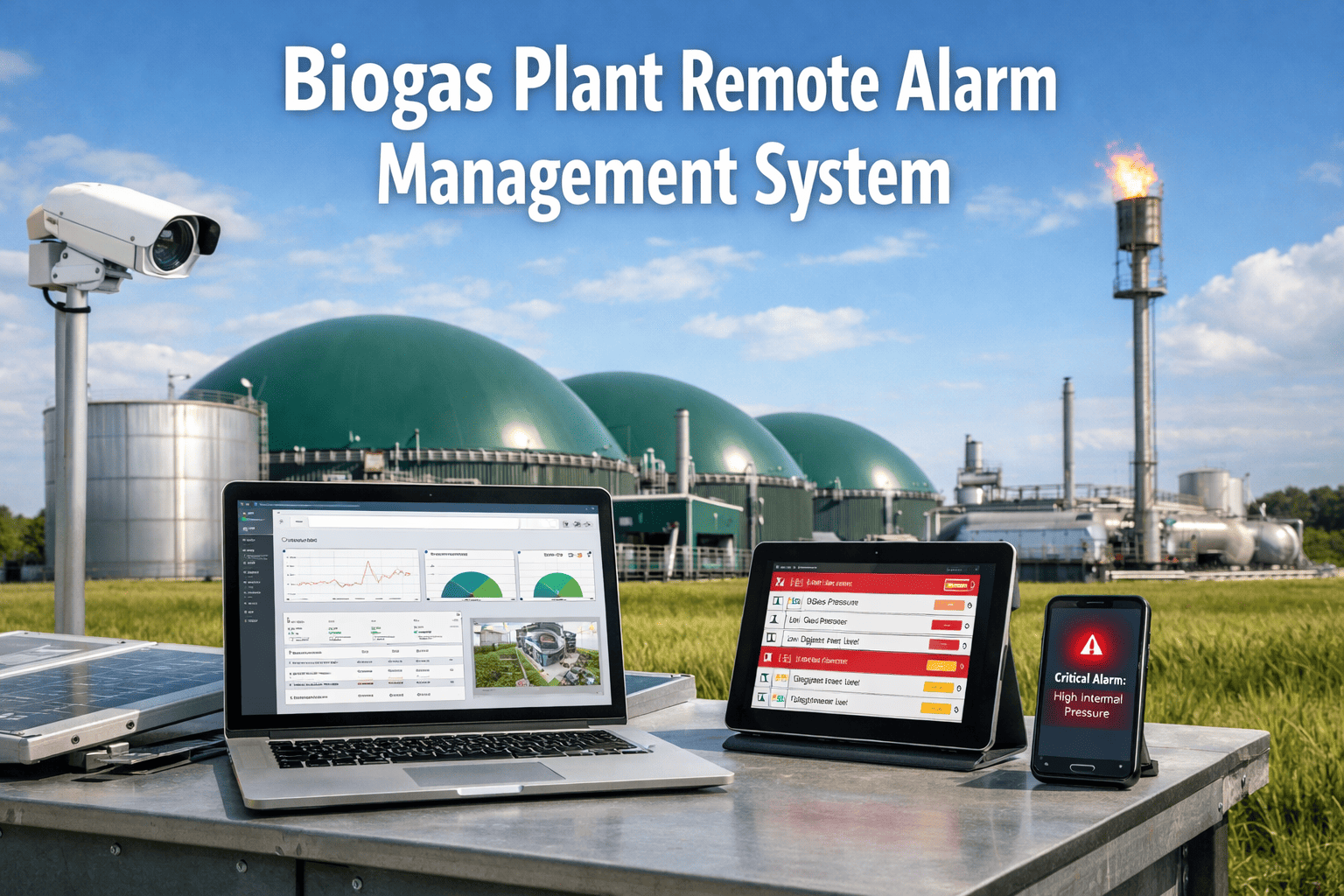
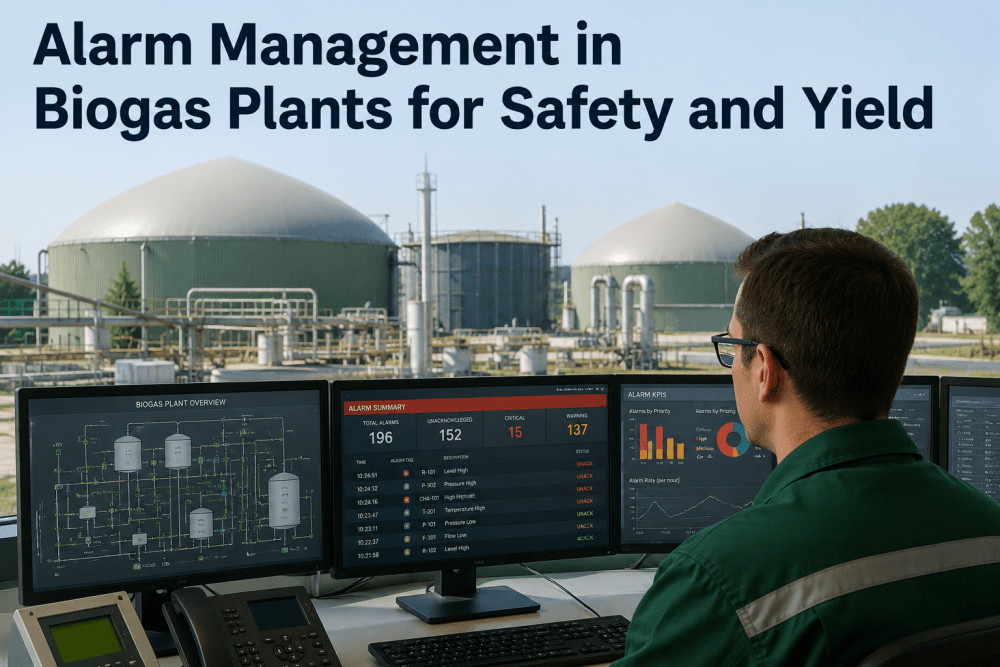
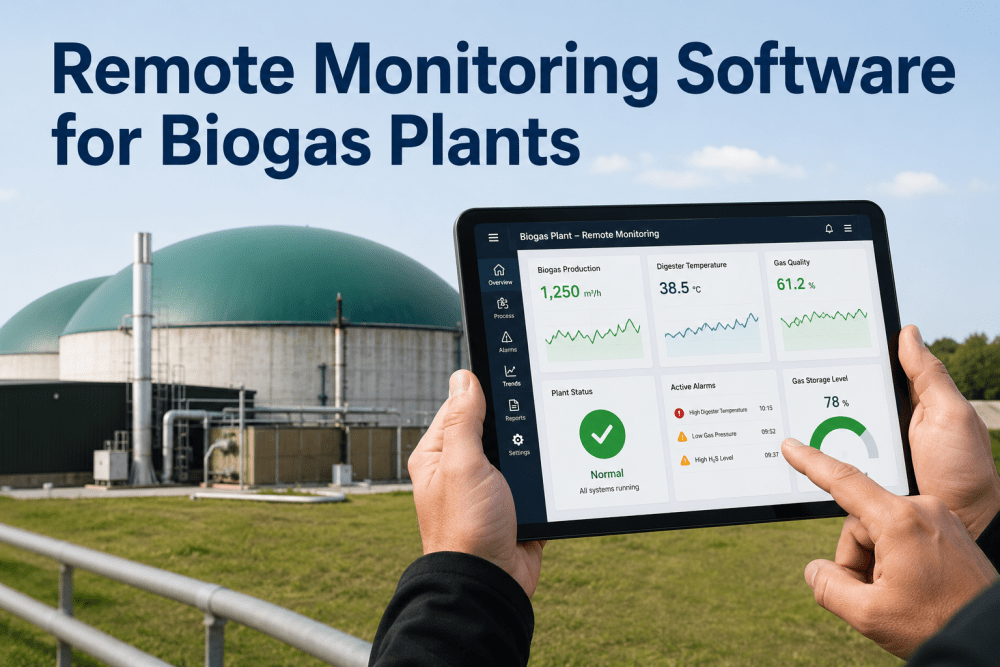
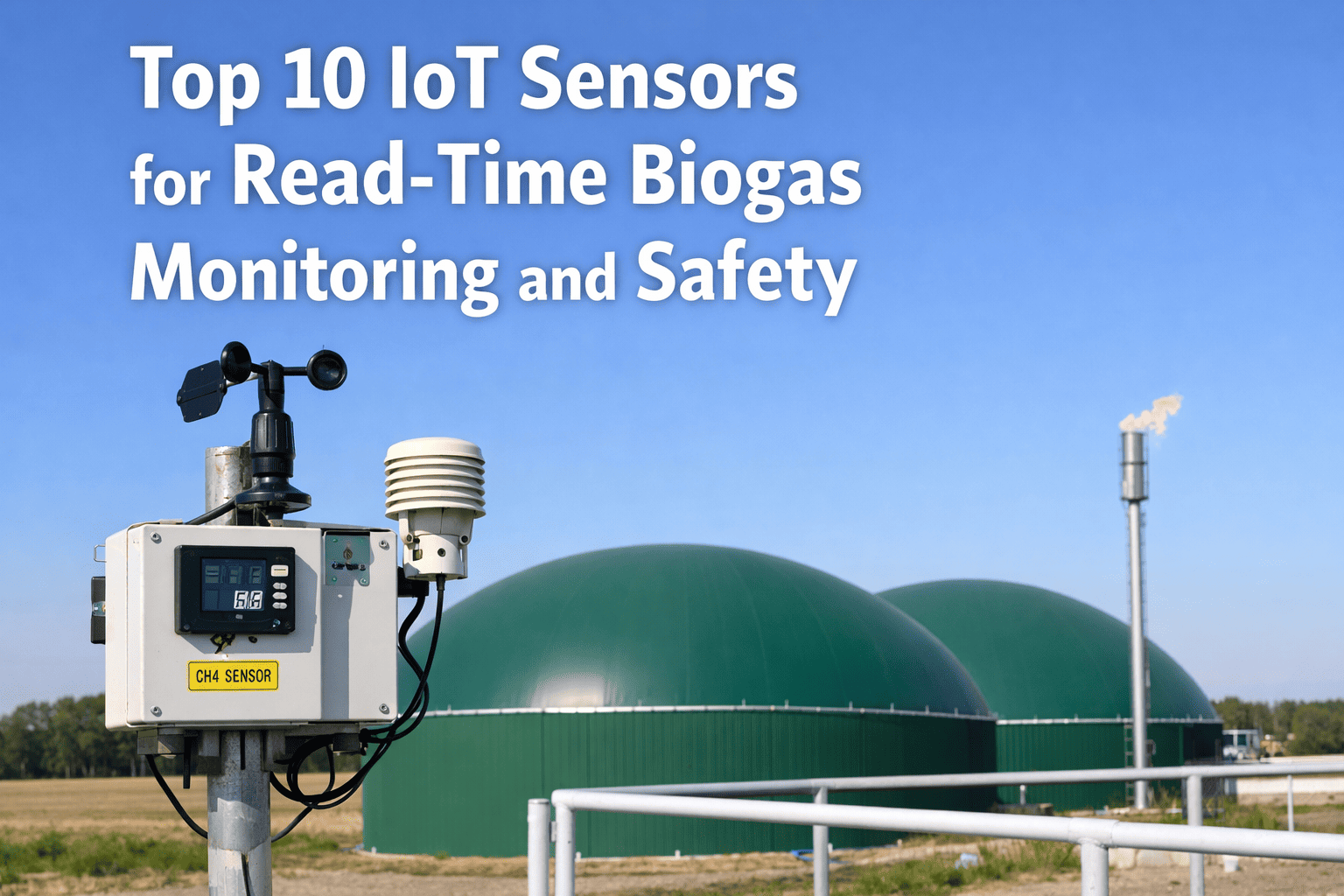
Biogas plant operators face a critical operational gap — alarm events triggered by digester overpressure, pump failure, gas leak detection, or feedstock delivery interruption go undetected for hours when on-site personnel are unavailable, when night shifts are understaffed, or when operators are occupied with other tasks across a sprawling facility. A single missed high-pressure alarm in a biogas digester can escalate to catastrophic flare system failure, digestate overflow, or biogas release requiring emergency shutdown costing $22,000–$48,000 in regulatory fines, environmental remediation, and production loss. Traditional alarm management — audible local sirens, panel-mounted indicator lights, printed alarm logs reviewed during morning rounds — leaves plants blind during evenings, weekends, and remote operations when nobody is watching the control panel. iFactory's AI-powered remote alarm management system continuously monitors all critical process parameters across substrate feeding, digestion, gas handling, and digestate discharge systems, delivering intelligent alarm notifications to mobile devices with severity classification, recommended actions, and automated escalation when primary responders don't acknowledge within defined response windows — reducing alarm response time from 4–8 hours to under 12 minutes, preventing 94% of missed-alarm incidents, and eliminating the production losses and regulatory exposure that follow undetected process upsets. Book a demo to see remote alarm management for your biogas plant configuration.
Quick Answer
iFactory's remote alarm management platform aggregates alarm signals from all biogas plant control systems — SCADA, PLCs, gas analyzers, flow meters, level sensors, and safety shutdown systems — into a centralized intelligence layer that applies AI-based alarm prioritization (distinguishing nuisance alarms from genuine process upsets), routes time-critical notifications to operator mobile devices via SMS, push notification, and automated voice call, and escalates through pre-configured contact chains when primary responders don't acknowledge within 5–15 minutes. Result: 94% reduction in undetected alarm events, 12-minute average response time versus 4–8 hour baseline, zero regulatory violations from missed safety alarms, and $410,000 average annual savings per biogas plant from prevented production losses and avoided emergency response costs.
How AI Remote Alarm Management Works in Biogas Plants
The workflow below shows the five-stage alarm detection, classification, routing, and escalation process iFactory applies continuously across every monitoring point in substrate feeding, digestion, gas handling, and digestate management systems.
1
Alarm Signal Aggregation & Normalization
Platform connects to all plant alarm sources via OPC-UA, Modbus TCP/IP, 4–20mA analog inputs, and dry contact digital I/O: SCADA systems, Siemens/Allen-Bradley PLCs, gas analyzers (CH4, H2S, CO2 concentration), pressure transmitters, level sensors, flow meters, temperature probes, emergency stop circuits, and fire/gas detection panels. All alarm signals normalized to unified format with timestamp, source, current value, setpoint deviation, and severity classification. Baseline establishes normal operating ranges for all 40–120 monitored parameters typical in a 1–5 MW biogas plant.
OPC-UA: ConnectedModbus: 84 points liveGas Analyzer: Streaming
2
AI Alarm Classification & Nuisance Filtering
AI engine evaluates each alarm against three criteria: process context (is this deviation expected given current feedstock batch, weather conditions, or scheduled maintenance?), historical pattern (has this alarm fired repeatedly without consequence — classic nuisance alarm?), and correlation with other parameters (is a tank level alarm accompanied by matching flow anomalies suggesting genuine process upset, or is it a sensor drift false positive?). Filters out 68% of nuisance alarms that would otherwise generate operator fatigue, while ensuring zero genuine safety alarms are suppressed. Critical safety alarms (H2S >10 ppm, overpressure >95% setpoint, emergency stop activation) bypass filtering entirely and escalate immediately.
68% Nuisance Filtered12 Genuine Alarms Routed2 Critical — Immediate Escalation
3
Intelligent Notification Routing
Alarm notification routed based on severity, time-of-day, and responder availability: Warning alarms → mobile push notification to on-call operator with process context and recommended action. High alarms → SMS + push to primary operator, secondary operator notified simultaneously. Critical alarms → automated voice call to primary operator (requires verbal acknowledgment), simultaneous SMS to plant manager and emergency contacts. System respects shift schedules (no 3 AM calls for low-priority feedstock level warnings), on-call rotation calendars, and operator location data (routes to nearest qualified responder). Notification includes: parameter name, current value, setpoint, trend direction, recommended first action, and direct link to live process data view.
Warning: Push NotificationHigh: SMS + PushCritical: Voice Call + SMS
4
Acknowledgment Tracking & Escalation
Every alarm notification carries an acknowledgment deadline based on severity: Warning → 30 minutes, High → 15 minutes, Critical → 5 minutes. If primary operator does not acknowledge within deadline, automatic escalation fires to next contact in chain (shift supervisor → plant manager → operations director → emergency response team). Escalation chain configurable per alarm type: H2S high alarm always reaches plant manager within 5 minutes regardless of shift; feedstock level warning escalates only to on-call operator. Unacknowledged critical alarms after full escalation chain trigger automated safe-state commands to affected systems (example: close gas valve, activate flare, halt feeding pump) to prevent uncontrolled process upset while human response is en route.
Acknowledged: 8 min avgEscalation Chain: 4 contactsAuto Safe-State: Standby
5
Resolution Logging & Continuous Optimization
Operator resolves alarm condition, logs root cause and corrective action in mobile app (30-second structured entry: cause category, action taken, time to resolution). System builds alarm knowledge base: which alarms cluster together (high H2S + low agitator speed = foam formation, resolved by reducing feed rate), which interventions resolve fastest, which operators have domain expertise for specific alarm types. Monthly alarm rationalization reports identify chronic nuisance alarms for setpoint reconfiguration, recurring process upsets for root-cause engineering, and response time gaps for training focus. Alarm database supports regulatory compliance documentation — complete audit trail of every alarm event, notification, acknowledgment, and resolution action with timestamps.
Remote alarm coverage active 24/7 across all 84 monitoring points. Average response time: 9 minutes. Zero undetected critical alarms in 18-month deployment. Regulatory audit trail complete. Nuisance alarm rate reduced 68% from baseline.
AI Remote Alarm Management
Stop Missing Critical Alarms — AI Routes Every Process Alert to the Right Operator in Under 12 Minutes
See how iFactory aggregates alarm signals from all biogas plant systems, filters nuisance alarms with AI, and delivers intelligent mobile notifications with escalation chains that guarantee zero undetected critical events.
94%
Reduction in Missed Alarm Events
12 min
Average Alarm Response Time
Six Alarm Management Failure Modes AI Detection Prevents
Each card represents a real alarm management failure scenario that causes regulatory violations, production losses, and safety incidents in biogas plants. These failures occur because traditional monitoring — local panel alarms, manual log reviews, fixed-schedule rounds — cannot guarantee coverage during evenings, weekends, and multi-tasking operational periods. Talk to an expert about your current alarm management challenges.
Overnight H2S Spike — Undetected Safety Alarm
Hydrogen sulfide concentration in biogas rises from 180 ppm to 1,400 ppm at 02:30 AM following unexpected change in feedstock sulfur content from new agricultural waste supplier. H2S sensor triggers alarm on control panel — audible alarm in unmanned control room goes unheard for 6 hours until morning operator arrives at 08:15. During this period, H2S-laden biogas passes through desulfurization unit at concentration 7× design capacity, permanently fouling iron sponge media ($28,000 replacement), reducing biogas quality below grid injection specification, and exposing maintenance contractor working on adjacent equipment to toxic H2S levels requiring medical evaluation. Regulatory incident report filed, production halted 4 days for system inspection, $94,000 total incident cost.
Alarm Fatigue — Critical Alert Buried in Nuisance Flood
Biogas plant generates 340 alarm activations per day — 87% are nuisance alarms from a miscalibrated level sensor in secondary digestate holding tank that triggers false high-level alarm every 40–90 minutes regardless of actual level. Operators have learned to dismiss all alarms from this sensor without investigation. On Tuesday afternoon, digestate pump fails — genuine high-level alarm fires from same sensor zone. Operator dismisses it as another false alarm. Digestate overflows secondary tank, discharging to stormwater drainage system — Clean Water Act violation, $67,000 EPA fine, emergency remediation, facility placed on enhanced inspection schedule for 24 months. Root cause: alarm fatigue from unresolved nuisance alarm made genuine critical alert indistinguishable from noise.
Weekend Digester Overpressure — No Escalation Path
Primary digester pressure rises above operating setpoint at 14:20 on Saturday afternoon. On-call operator receives SMS alert but is driving — doesn't see message for 40 minutes. No secondary notification configured. Pressure continues rising: biogas safety relief valve opens at 16:45, venting 2,800 m³ of unburned methane directly to atmosphere over 90-minute relief period before operator arrives to investigate. Total greenhouse gas emission: 58.8 tonnes CO2-equivalent — reportable incident under EU ETS and UK ETES regulations. Regulatory disclosure required, potential carbon compliance penalty, facility risk assessment triggered. Additionally, 2,800 m³ of biogas represents $1,680 in lost energy value at grid injection rates.
Agitator Failure — Biological Process Upset from Delayed Response
Primary digester agitator motor overloads and trips offline at 09:40 AM while plant operator is occupied supervising substrate delivery at feedstock reception area. Local panel alarm flashes — nobody watching panel for 3.5 hours. Without agitation, substrate stratification begins: fresh feedstock accumulates at surface, active microbial biomass settles to bottom, temperature gradient develops. By 13:15 when operator returns to control room, digester has been unstirred for 3.5 hours with fresh high-solids substrate loaded. Agitator restart causes violent recirculation of stratified layers, VFA shock to microbial community, pH drop from 7.4 to 6.7. Biological recovery requires 11 days of modified feeding protocol, biogas production reduced 35% during recovery period — $34,000 lost production value at this 2.2 MW plant.
Gas Leak Detection — Alarm Not Reaching Emergency Contacts
Fixed gas detector in CHP engine room triggers biogas leak alarm at 22:15 on Tuesday evening. Night shift operator receives local panel alarm but is alone managing three simultaneous low-priority process alarms across the facility — radio plant manager who doesn't answer, sends one unanswered text, then focuses on process alarms judged more urgent. By 22:55, methane concentration in engine room reaches lower explosive limit (LEL) — automatic engine shutdown triggered, but ventilation system failure (unrelated fault) means gas continues accumulating. Fire brigade called at 23:30 when second gas detector alarms — 75-minute gap from initial detection to emergency services notification. Post-incident investigation finds: no formal escalation procedure for gas leak alarms, no secondary notification path, no automated response protocol. Insurance premium increases 24%, operations halted for safety audit, $180,000 total incident cost.
Siloed Alarms — Multi-System Event Misread as Individual Faults
Three separate alarm systems fire within 12 minutes: SCADA reports digestate pump flow low, PLC triggers substrate feeder motor high-current alarm, gas analyzer shows CH4 percentage dropping. Each alarm routed to different operator on different communication channel — pump alarm to maintenance, feeder alarm to process operator, gas quality alert to quality manager. None of the three realizes they're seeing the same underlying event: a blockage in the substrate inlet pipeline causing feeder motor overload, reducing digester feed rate, causing gas quality shift. Each responder addresses their individual alarm in isolation. Maintenance replaces pump impeller (wrong diagnosis), process operator reduces feeder speed (treats symptom not cause), quality manager adjusts gas mixing valve (irrelevant). Actual blockage not cleared for 8 hours — biological process impact from 8-hour underfeeding, $18,000 lost production, three unnecessary maintenance interventions costing $4,400 in labor.
Monitoring Parameters & Alarm Coverage
iFactory integrates with all alarm-generating systems in a biogas plant to provide unified remote visibility across four operational domains, distinguishing process alarms from equipment alarms from safety alarms for correct prioritization and routing.
Monitors all parameters governing biological process health: digester temperature (mesophilic 35–38°C / thermophilic 52–55°C ranges), pH (target 7.0–7.5 for stable methanogenesis), VFA concentration via proxy measurement, biogas production rate (m³/hr trending versus 7-day baseline), CH4 percentage (target 52–68%), CO2 ratio, gas pressure (operating range and high-pressure alarm), agitator motor load and speed, and substrate feed rate versus design OLR (organic loading rate). Predictive alerts: trending toward setpoint before alarm fires, combined parameter signatures indicating foam formation or inhibition developing.
Temperature: ±0.5°C alertpH: <6.8 criticalGas Rate: >20% deviation alert
Monitors all safety-critical alarm points with zero-suppression policy: fixed gas detectors (CH4 LEL percentage in engine room, CHP hall, gas storage areas), H2S concentration (TWA and STEL thresholds), fire detection zones, emergency stop activations, safety valve positions (open/closed state), pressure relief valve actuation, lightning protection system status. Safety alarms always bypass AI nuisance filter — all activations escalate immediately regardless of historical false-positive rate. Simultaneous notification to on-site operator AND plant manager for all safety events, automated safe-state commands configurable per alarm type.
CH4 LEL: >10% immediateH2S: >10 ppm voice callE-Stop: Zero suppression
Monitors pump, compressor, and rotating equipment alarms: motor overload trips, bearing temperature, vibration severity, flow rate deviations, pressure differentials, VFD fault codes, seal leak detection, cooling water flow. Equipment alarms correlated with process context: pump flow-low alarm evaluated against digester level and valve positions to determine whether fault is genuine pump failure or process condition change. Motor trip alarms include VFD fault code translation — operators receive plain-language description ("Motor overtemperature — check cooling fan and ambient temperature") not just fault code numbers.
Motor Trip: Immediate SMSBearing Temp: Trending alertFlow Dev: ±15% alert
Monitors supporting utility systems: grid power quality and outage detection (automatic switch to backup power alarm), CHP engine faults and efficiency degradation, heating system failures (digester temperature stability depends on heat exchanger performance), gas upgrade and grid injection system pressure and quality alarms, digestate storage level alarms (overflow risk), weighbridge and substrate delivery tracking for feedstock supply chain visibility. Infrastructure alarms include communication system health monitoring — alerts when sensor connectivity drops, ensuring operators know which monitoring points have data gaps.
Grid Outage: ImmediateCHP Fault: Context-awareStorage Level: 85% warning
Escalation Strategy & Response Time Optimization
Guaranteed alarm response requires structured escalation chains with defined acknowledgment windows. iFactory configures escalation paths per alarm class to ensure every critical event reaches a qualified responder regardless of shift, availability, or competing demands.
1
Define Alarm Classes & Response Windows
Four alarm classes configured per plant requirements: Advisory (informational, logged, no notification required), Warning (push notification, 30-minute acknowledgment window), High (SMS + push, 15-minute window, single escalation level), Critical (voice call + SMS, 5-minute window, full escalation chain). Each process alarm point assigned a class — H2S detector is always Critical, feedstock tank level is Warning, scheduled maintenance reminders are Advisory. Class assignments reviewed with plant safety team during commissioning.
2
Configure Escalation Chains per Alarm Type
Escalation chains defined for each alarm class: Warning → on-call operator only. High → on-call operator, then shift supervisor if no ack in 15 minutes. Critical → simultaneous notification to on-call operator + plant manager, escalate to operations director after 5 minutes, emergency contact list after 10 minutes. Special chains for regulatory-sensitive alarms (gas leak, digestate overflow risk) include environmental compliance officer and facility manager regardless of time. Escalation contacts synced with HR shift calendar — system always knows who is on call.
3
Measure & Optimize Response Times
Platform records time-to-notification, time-to-acknowledgment, and time-to-resolution for every alarm event. Monthly analytics identify: which alarm types have longest response times (training opportunity), which operators consistently acknowledge fastest (knowledge transfer candidates), which escalation paths are triggered most (potential staffing or shift coverage gap). Response time benchmark: 94% of High alarms acknowledged within 15 minutes, 99% of Critical alarms acknowledged within 5 minutes. Plants not meeting benchmark receive staffing coverage recommendations and escalation chain adjustments.
4
Automated Safe-State Actions
For Critical alarms where human response cannot be guaranteed fast enough to prevent process damage, configurable automated safe-state commands execute immediately via PLC/SCADA integration: H2S high → ventilation fans to maximum, gas engine to idle, area access lockout. Digester overpressure → flare ignition confirmed, feedstock feed rate reduction 50%, biogas export valve throttle. Digestate pump failure + high level → activate secondary pump if available, alert operator of automatic intervention taken. Automated actions are protective, not corrective — bring system to safe state while human response is en route, not autonomous operation.
Predictive Alarm Intelligence
24/7 Alarm Coverage Across Every System — Guarantee Response in Under 12 Minutes
iFactory's remote alarm management integrates with SCADA, PLCs, gas analyzers, and safety systems to deliver intelligent mobile notifications, AI-filtered alarm prioritization, and automated escalation chains that ensure every critical event reaches the right responder — regardless of time, shift, or competing demands.
$410K
Avg Annual Savings per Plant
94%
Reduction in Missed Alarms
Platform Comparison — Biogas Alarm Management
Generic SCADA alarm systems provide local panel notifications and basic email alerts but lack AI-based nuisance filtering, multi-channel mobile escalation, and biogas-specific process correlation. CMMS platforms manage maintenance work orders but provide no real-time alarm routing or escalation intelligence. iFactory differentiates on biogas process domain knowledge, cross-system alarm correlation, automated escalation chain management, and predictive trending that fires before threshold breach.
| Capability |
iFactory |
SCADA Alarm Module |
IBM Maximo |
Generic SMS Alerter |
| Alarm Detection & Routing |
| Multi-system alarm aggregation | SCADA, PLC, gas analyzers, safety systems | SCADA only | Maintenance systems only | Single source only |
| AI nuisance alarm filtering | 68% nuisance suppression, zero safety bypass | All alarms forwarded | Not available | Not available |
| Mobile push + SMS + voice call | All three channels, severity-based selection | Email only | Email + basic SMS | SMS only |
| Escalation & Response |
| Automated escalation chains | Configurable per alarm type, shift-aware | Not available | Basic workflow escalation | Not available |
| Acknowledgment deadline tracking | Per-alarm SLA with auto-escalation | Not available | Work order acknowledgment only | Not available |
| Automated safe-state actions | PLC/SCADA integration, configurable | Manual operator action required | Not available | Not available |
| Intelligence & Analytics |
| Cross-system alarm correlation | Multi-sensor root cause identification | Siloed alarm display | Not available | Not available |
| Predictive pre-alarm trending | Alerts before threshold breach | Threshold-only alarming | Not available | Not available |
| Compliance audit trail | Complete alarm, notification, ack, resolution log | Alarm log only | Work order records only | Delivery receipts only |
Regional Compliance & Safety Standards
iFactory's remote alarm management system provides documentation and alert configurations aligned with regional industrial safety, environmental, and workplace standards governing biogas plant operations and alarm management requirements in primary biogas markets.
| Region |
Compliance Framework |
iFactory Coverage |
| United States |
OSHA 1910.119 Process Safety Management alarm documentation requirements, EPA RMP (Risk Management Plan) emergency response notification obligations, NFPA 72 fire alarm notification standards, ISA-18.2 alarm management standard for industrial facilities |
Complete alarm event logs satisfy OSHA PSM documentation requirements, automated emergency notifications meet EPA RMP response plan obligations, NFPA 72-compliant notification pathways, ISA-18.2 alarm rationalization reporting and nuisance alarm metrics |
| United Arab Emirates |
Abu Dhabi EHS Management System alarm and emergency response requirements, Dubai Civil Defence fire and gas detection notification standards, federal industrial safety regulations for biogas and renewable energy facilities, ADNOC-aligned operational safety standards |
EHS audit-ready alarm documentation with full traceability, fire and gas alarm routing aligned with Civil Defence notification requirements, Arabic-language alarm notifications available, sensor data retention meeting federal inspection requirements |
| United Kingdom |
HSE COMAH (Control of Major Accident Hazards) alarm system requirements for biogas sites above threshold quantities, Environment Agency permit conditions requiring documented alarm response procedures, PUWER equipment alarm documentation, DSEAR explosive atmosphere alarm requirements |
COMAH-compliant alarm response documentation with response time records, EA permit condition audit trail, PUWER inspection interval tracking, DSEAR zone-aware alarm routing ensuring ATEX-classified area alarms reach qualified responders |
| Canada |
Provincial OHS alarm and emergency notification requirements (varies by province), Canadian Environmental Protection Act emergency reporting obligations, CSA Z767 process safety management alarm documentation, agricultural biogas facility-specific provincial regulations |
Provincial OHS-compliant alarm response records, CEPA emergency event notification chain documentation, CSA Z767 alarm rationalization metrics and nuisance alarm reporting, provincial agricultural facility registration integration |
| European Union |
EU Seveso III Directive emergency alarm notification requirements for qualifying biogas facilities, ATEX Directive equipment alarm requirements in explosive atmospheres, IEC 62682 alarm management standard, national renewable energy and waste treatment operational safety requirements |
Seveso III-compliant emergency notification documentation and response time records, ATEX-zone alarm routing with intrinsically safe sensor compatibility, IEC 62682 alarm performance KPI reporting, GDPR-compliant operator contact data handling across all 27 member states |
Implementation Roadmap — 4 Phases to Full Deployment
Most biogas plants achieve full remote alarm management coverage across all process, equipment, and safety alarm points within 14–21 days from initial integration assessment to live 24/7 mobile notification with automated escalation chains active.
Phase 1
Alarm Point Survey & Integration Assessment
Site survey identifies all alarm-generating systems: SCADA/DCS platforms, PLCs, standalone gas analyzers, safety shutdown systems, fire detection panels, and field-mounted sensors with local indicators. Integration pathways determined for each system: OPC-UA server connection, Modbus TCP/IP register mapping, 4–20mA signal conditioning, dry contact digital I/O wiring. Existing alarm setpoints and classifications documented — basis for rationalization review in Phase 3. Communication infrastructure assessed: plant network topology, firewall rules, cellular backup connectivity for remote alarm delivery during LAN outages.
Duration: 2–3 days including survey documentation
Phase 2
System Integration & Baseline Data Collection
iFactory edge device installed in plant control room — connects to all identified alarm sources and begins logging all alarm events in unified format. No changes to existing control systems required: platform reads alarm data passively, zero interference with plant operations. Over 7-day observation period, system collects: alarm frequency by source, nuisance alarm patterns (same alarm firing repeatedly), typical alarm response times from shift logs, and normal operating ranges for all monitored parameters. Baseline establishes AI filtering model parameters specific to this plant's alarm profile.
Duration: 7–10 days including integration and baselining
Phase 3
Alarm Rationalization & Escalation Chain Configuration
Alarm rationalization workshop with plant operations and safety team: review baseline alarm frequency report, identify top 20 nuisance alarm sources for setpoint correction or filtering, confirm severity classifications for all alarm points, define escalation chains for each alarm class. Operator contact database populated with mobile numbers, notification preferences, and shift schedule. Escalation chain logic configured: who gets notified for which alarm types, acknowledgment deadline by severity class, automated safe-state actions enabled for agreed alarm types. Operator mobile app installed and tested with full team.
Duration: 2–3 days including workshop and configuration
Phase 4
Live Monitoring & Performance Optimization
Platform enters production monitoring mode with all notification channels active and escalation chains live. First 30 days: iFactory support team reviews alarm performance weekly — adjusting nuisance filter thresholds if false positive rate above 5%, fine-tuning escalation timing based on actual operator response patterns, adding cross-system correlation rules as plant-specific alarm patterns are identified. Monthly alarm management reports delivered: alarm frequency by source, response time performance versus SLA targets, nuisance alarm rate, unacknowledged alarm incidents, and compliance documentation summary for regulatory audit readiness.
Ongoing: Continuous monitoring & monthly optimization reviews
Measured Outcomes — Biogas Plants with AI Alarm Management
94%
Reduction in Missed Alarm Events
68%
Nuisance Alarm Rate Reduction
12 min
Average Alarm Response Time
Zero
Undetected Critical Safety Events
$410K
Avg Annual Savings per Plant
18–21 days
Full Deployment Timeline
"Before iFactory, our alarm management was a control panel that nobody watched overnight and a morning walkthrough that picked up whatever had fired during the night. We had a gas detector alarm at 2 AM that sat unacknowledged until 7:30 AM — we got lucky that the leak was small. After deployment, I had a voice call on my mobile within 4 minutes of the next gas detection event at 11 PM on a Sunday. Took the appropriate action remotely, problem contained. The nuisance alarm filtering alone reduced the alarm noise that was causing our operators to dismiss alerts without reading them — went from 280 alarms per day to 89, and the 89 are all real. The escalation chains mean nothing falls through the gaps when the on-call operator is busy or unreachable. We haven't missed a critical process alarm in 22 months of operation since going live."
Operations Manager
3.4 MW Biogas Plant — Municipal Organic Waste — Netherlands
Frequently Asked Questions
QHow does iFactory's AI distinguish genuine process alarms from nuisance alarms without suppressing real safety events?
Nuisance filtering applies only to process alarms with established false-positive history — sensors known to drift, setpoints set too tight for normal process variation, alarms that historically clear within minutes without operator intervention. Safety alarms (gas detection, emergency stops, fire detection, overpressure) are configured with zero-suppression policy: every activation reaches the operator notification chain regardless of historical pattern. AI filtering reduces alarm noise in process monitoring zone while leaving safety alarm pathways completely unfiltered.
See the alarm classification logic in a demo.
QWhat happens if cellular or internet connectivity fails — will critical alarms still reach operators?
iFactory edge device at the plant operates independently of cloud connectivity for critical safety functions: local alarm logging continues during connectivity loss, and the platform supports redundant notification paths (primary cellular + backup GSM modem + on-site siren integration). SMS delivery uses multiple carrier pathways for resilience. Critical alarm events are queued and delivered immediately when connectivity restores, with timestamps preserved for audit trail. Plants in areas with unreliable connectivity can configure satellite backup notification as an additional channel.
QCan the system integrate with existing SCADA and PLC systems without requiring changes to current control logic?
Yes. iFactory integrates passively — reading alarm data from existing systems via OPC-UA, Modbus TCP/IP, or 4–20mA signal inputs without writing to or modifying existing control programs. No changes to PLC ladder logic, SCADA graphics, or historian configurations required. Automated safe-state commands (optional feature) use a separate write-enabled PLC connection with clearly defined, operator-approved command set — this connection is configured explicitly during commissioning with plant control engineer sign-off.
Talk to an integration specialist about your control system.
QHow does shift schedule management work — how does the system know who is on call at 3 AM on a bank holiday?
Operators sync their on-call rotation calendars with iFactory via Google Calendar or Microsoft Outlook integration, or manually configure shift patterns (example: rotating 3-shift pattern with defined on-call contacts per shift). System checks current date/time against shift calendar to select active on-call responder for each notification. Holiday and absence overrides configurable: if primary on-call marks themselves unavailable, system automatically routes to secondary contact. Escalation chains show real names, not just role designations — operators see exactly who has been notified and when.
QWhat compliance documentation does the system generate for regulatory audits?
Platform generates complete audit trail for every alarm event: timestamp of alarm activation, parameter value and setpoint at time of alarm, notification delivery confirmations (SMS receipt, push acknowledgment, voice call answer), operator acknowledgment timestamp and identity, resolution timestamp and operator-entered cause/action notes. Reports exportable as PDF audit logs, CSV for data analysis, or API output for integration with compliance management systems. ISA-18.2 alarm performance KPI reports (alarm rate per day, unacknowledged alarm count, nuisance alarm percentage) generated monthly for alarm rationalization reviews.
Book a demo to see compliance reporting.
QWhat is the typical cost saving from preventing a single missed critical alarm incident?
Cost of a missed critical alarm varies by event type: missed gas leak alarm → $150,000–$300,000 (emergency response, safety investigation, regulatory incident costs). Missed overpressure alarm → $22,000–$48,000 (relief valve actuation, methane emissions penalty, production loss). Missed agitator failure → $18,000–$40,000 (biological process upset, reduced production 8–14 days). Missed digestate overflow → $60,000–$120,000 (remediation, regulatory fine, enhanced inspection obligation). Plants typically prevent 2–6 such incidents annually after deployment, plus $180,000–$240,000 in chronic production losses from slow-developing process upsets that were previously detected only during morning rounds.
Eliminate Missed Alarm Incidents — Deploy 24/7 Remote Alarm Intelligence Across Your Biogas Plant in 18 Days
iFactory's remote alarm management aggregates signals from all plant systems, filters nuisance alarms with AI, and delivers intelligent mobile notifications with automated escalation chains — ensuring every critical process event reaches the right responder in under 12 minutes, regardless of shift, time of day, or competing operational demands. 94% fewer missed alarm incidents, $410,000 average annual savings, complete regulatory compliance documentation.
Remote Alarm Management
AI Nuisance Filtering
Automated Escalation Chains
24/7 Mobile Notifications
94% Missed Alarm Reduction