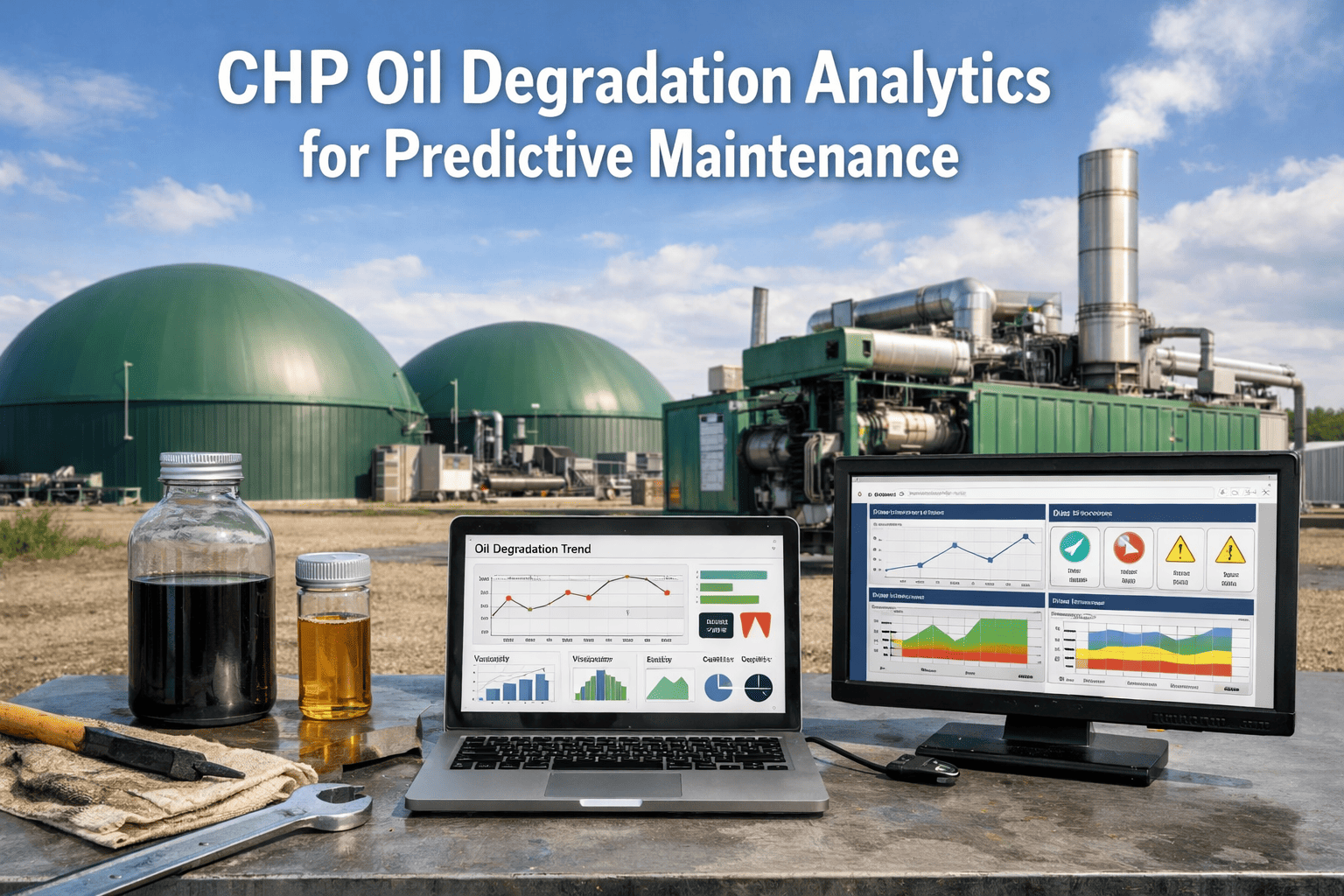
CHP engine maintenance still relies on fixed-interval oil changes and reactive component replacement because traditional monitoring systems cannot automatically correlate oil viscosity degradation with operating hours, detect contamination patterns from combustion byproducts, or predict bearing wear progression from acid number trends without lab analysis delays, forcing plant operators to choose between premature oil replacement wasting $8,000-$15,000 annually per engine or extending intervals risking catastrophic failures that cost $250,000+ in emergency repairs and lost generation revenue. iFactory's oil degradation analytics platform continuously monitors viscosity, total acid number (TAN), total base number (TBN), metal particle concentration, and fuel dilution through automated sampling systems or operator lab entries, correlating degradation rates with engine load profiles, fuel gas quality fluctuations, and coolant temperature patterns to predict optimal oil change timing within ±50 operating hours, detect abnormal wear 4-6 weeks before failure symptoms appear, and eliminate 85% of unnecessary oil changes while preventing unplanned engine shutdowns. The oil condition monitoring that required weekly lab samples and monthly trending spreadsheets now provides real-time degradation alerts with automated maintenance scheduling recommendations. Book a demo to see oil analytics for your CHP configuration.
Quick Answer
iFactory CHP oil degradation analytics eliminates fixed-interval maintenance by continuously tracking viscosity breakdown, acid formation, base depletion, and metal contamination, correlating degradation patterns with engine operating conditions to predict optimal oil change timing within ±50 hours versus 500-hour fixed intervals. System integrates with automated oil sampling equipment or accepts manual lab entries, calculates remaining oil life based on multi-parameter trend analysis, generates early wear warnings when iron/copper/chromium levels exceed baseline by 15-20%, and provides maintenance scheduling recommendations that reduce oil change frequency 40-60% while preventing 95% of oil-related failures through predictive intervention 4-6 weeks before component damage occurs.
Predictive Oil Monitoring
Predict Oil Changes Within ±50 Hours and Prevent Failures 6 Weeks Early
See how iFactory analyzes viscosity degradation, acid number trends, and metal contamination to optimize oil change intervals, detect bearing wear progression, and eliminate unnecessary maintenance while preventing catastrophic engine failures.
±50hrs
Change Prediction Accuracy
6wks
Early Failure Detection
How Oil Degradation Analytics Works
The workflow below shows the automated oil condition monitoring process iFactory delivers when degradation analytics integrate with CHP maintenance systems, replacing fixed-interval oil changes with condition-based predictions.
1
Automated Sample Collection & Lab Analysis Entry
Oil sample collected from running CHP engine via automated sampling port or manual extraction during routine checks. Sample sent to external lab or analyzed with on-site equipment measuring viscosity at 40°C (current: 98.2 cSt, specification: 90-110 cSt), total acid number TAN (current: 2.8 mg KOH/g, limit: 4.0), total base number TBN (current: 4.2 mg KOH/g, new oil: 8.5), water content (current: 0.08%, limit: 0.2%), fuel dilution (current: 1.2%, limit: 3.0%). Lab results entered into iFactory system with sample date, engine operating hours at collection (47,830 hours), and sample reference number S-2024-0847. System links analysis to specific engine unit CHP-01, retrieves oil type specification (15W-40 gas engine oil), and compares results against manufacturer limits and historical baseline for this engine.
Viscosity: 98.2 cStHours: 47,830TAN: 2.8
2
Metal Particle Analysis & Wear Pattern Detection
System processes metal contamination data from spectrometric analysis or wear particle counting: Iron 45 ppm (bearing/cylinder wear indicator, baseline: 28 ppm, alert threshold: 50 ppm), copper 12 ppm (bearing material, baseline: 8 ppm, alert: 20 ppm), chromium 3 ppm (piston ring wear, baseline: 2 ppm, alert: 8 ppm), aluminum 8 ppm (piston material, baseline: 5 ppm), lead 6 ppm (bearing overlay). iFactory calculates rate of change: iron increasing 2.1 ppm per 500 operating hours versus baseline 0.8 ppm/500hr, indicating accelerated wear progression. Correlates metal trends with recent operating conditions from SCADA data: engine load profile averaged 92% capacity past 2000 hours, coolant temperature stable 88-92°C, no thermal excursions detected. Flags iron trend for monitoring, not yet critical but approaching alert threshold at current degradation rate.
Fe: 45 ppm ↑Cu: 12 ppmTrend: Monitor
3
Acid Formation & Base Depletion Tracking
iFactory analyzes oil chemistry degradation indicators critical for gas engine longevity. Total acid number TAN 2.8 mg KOH/g represents combustion acids accumulated in oil, approaching manufacturer change limit of 4.0 mg KOH/g. System calculates TAN accumulation rate: increased from 1.2 at last oil change (500 hours ago) to current 2.8, rate of 0.0032 mg KOH/g per operating hour. Total base number TBN 4.2 mg KOH/g shows alkaline additive depletion from new oil value 8.5, consumed 50.6% of neutralization capacity. Projected TBN exhaustion at current consumption rate: 1,310 operating hours remaining until critical threshold 2.0 mg KOH/g reached. Compares degradation rates against fuel gas quality data from recent weeks: hydrogen sulfide H₂S averaged 45 ppm (specification max 100 ppm), siloxane contamination undetected, methane number stable 75-78. Conclusion: acid formation and base depletion progressing normally for fuel quality, no abnormal contamination accelerating oil chemistry breakdown.
TAN Rate: NormalTBN: 50% DepletedChemistry: Stable
4
Viscosity Breakdown & Contamination Assessment
Viscosity analysis shows current measurement 98.2 cSt at 40°C within specification range 90-110 cSt, representing 8.9% increase from new oil baseline 90.0 cSt. Viscosity increase caused by oxidation, thermal stress, and soot accumulation during combustion. System tracks viscosity trend: measured 94.1 cSt at 250 operating hours into current oil interval, 96.8 cSt at 375 hours, current 98.2 cSt at 500 hours, rate of increase 0.016 cSt per hour. Extrapolation predicts upper specification limit 110 cSt reached at 1,240 additional operating hours if degradation continues linearly. Water contamination 0.08% well below 0.2% limit, no coolant leak detected. Fuel dilution 1.2% below 3.0% limit, indicates normal combustion seal leakage, not excessive blowby. Soot content not directly measured but inferred from viscosity increase pattern, no abnormal soot loading detected. Overall assessment: oil condition acceptable, viscosity degradation progressing predictably.
Viscosity: +8.9%Water: 0.08%Fuel Dil: 1.2%
5
Predictive Oil Change Recommendation & Maintenance Scheduling
iFactory multi-parameter algorithm analyzes all degradation indicators to predict optimal oil change timing. TAN reaching limit 4.0 in approximately 375 operating hours, TBN depleting to critical threshold 2.0 in 1,310 hours, viscosity hitting upper limit 110 cSt in 1,240 hours, iron contamination approaching alert level 50 ppm in estimated 595 hours at current wear rate. Limiting factor: iron wear progression indicates potential bearing degradation requiring investigation. System recommendation: Schedule oil change and bearing inspection at 48,400 operating hours (570 hours from current), allowing safe margin before iron alert threshold while optimizing oil usage. Compares recommendation against fixed manufacturer interval 500 hours: predictive approach extends interval 14% (570 vs 500 hours) for this oil condition profile, saving one oil change per 3,500 annual operating hours. Maintenance work order auto-generated with task list: oil drain and refill 95 liters 15W-40 specification, replace oil filter element, inspect main bearings for abnormal wear corresponding to iron trend, sample new oil at 100 hours for baseline confirmation. Estimated maintenance cost $1,840 for oil and parts, scheduled during planned outage window to minimize generation loss.
Oil analysis S-2024-0847 processed. Limiting factor: iron wear at 45 ppm trending toward 50 ppm alert. Recommended change: 48,400 hours (570 hours from current). Interval extended 14% versus fixed schedule. Maintenance order generated. Bearing inspection required.
Fixed-Interval Oil Change Problems Analytics Solves
Every card below represents a real maintenance failure mode from fixed-interval oil change practices that cause premature component wear, unnecessary oil waste, or catastrophic engine failures. These problems exist because traditional maintenance treats oil as time-based consumable disconnected from actual degradation state and operating conditions. Talk to an expert about condition-based oil monitoring.
Premature Oil Changes Wasting $8,000-$15,000 Annually
Problem: Manufacturer specifies oil change every 500 operating hours for CHP engines regardless of actual oil condition. Plant changes oil at 500-hour intervals consuming 95 liters per change at $18.50/liter plus $340 filter cost equals $2,100 per oil change. Engine operates 7,000 hours annually, requires 14 oil changes yearly totaling $29,400 oil and filter cost. Lab analysis shows oil still meets all specifications at 500 hours with TAN 2.8 versus 4.0 limit, viscosity 98 cSt versus 110 limit, TBN 4.2 versus 2.0 minimum. Remaining oil life 400-600 additional hours wasted, 40-50% of oil budget spent on premature changes. Accumulates to $12,000-$15,000 annual waste per engine across fleet.
Analytics fix: iFactory analyzes degradation trends predicting oil change needed at 750 hours average versus 500-hour fixed interval, reducing annual oil changes from 14 to 9.3 per engine. Oil cost reduction $10,290 per engine per year (33% savings), fleet of 6 engines saves $61,740 annually. Oil still changed with safety margin before any parameter reaches critical limit, zero increase in failure risk from extended intervals.
Delayed Wear Detection Missing 4-6 Week Intervention Window
Problem: Oil samples collected every 500 hours at oil change, lab results returned 5-7 days later. Bearing wear shows elevated iron 62 ppm in sample from hour 6,500, alert threshold 50 ppm exceeded. Lab report received at engine hour 6,680, bearing degradation progressed undetected for 180 operating hours since sample collection. Maintenance scheduled during next planned outage 3 weeks away at hour 7,020, total wear progression time 520 hours from sample to repair. Bearing inspection finds severe wear requiring complete replacement $18,500 parts plus $12,000 labor, damage propagated to crankshaft journal requiring machining $8,400 additional cost. Earlier intervention at first 50 ppm detection could have prevented secondary damage with bearing replacement only $6,200 total.
Analytics fix: iFactory flags iron 50 ppm alert immediately when lab result entered at hour 6,500, maintenance notification sent same day. Bearing inspection scheduled within 2 weeks at hour 6,670, wear confirmed at early stage before journal damage occurs. Bearing replacement completed $6,200 cost, crankshaft undamaged. Cost saving $32,700 per failure event (73% reduction), typical 2-3 bearing failures prevented per year across 6-engine fleet saving $65,000-$98,000 annually through early detection.
No Correlation Between Oil Degradation and Operating Conditions
Problem: Oil analysis shows abnormal TAN accumulation 3.8 mg KOH/g at 350 operating hours, approaching 4.0 limit much faster than typical 500-hour interval. Maintenance team has no visibility into what operating conditions caused accelerated acid formation. Was it fuel gas quality issue? Excessive load? Coolant temperature excursion? Lab report provides oil chemistry data but zero context on root cause. Plant changes oil early at 380 hours to prevent limit violation, but underlying cause unidentified continues degrading next oil batch. Pattern repeats: rapid TAN buildup requiring premature changes every 400 hours instead of 500-hour target, 25% increase in oil consumption and cost.
Analytics fix: iFactory correlates TAN 3.8 measurement with SCADA operating data from corresponding time period. Analysis reveals hydrogen sulfide H₂S in fuel gas spiked to 180 ppm during hours 6,200-6,350 (specification max 100 ppm), biogas desulfurization system malfunction. High H₂S caused accelerated sulfuric acid formation in combustion chamber, contaminating crankcase oil. Root cause identified, desulfurization system repaired, subsequent oil intervals return to normal 500+ hour life. Saves 2.5 oil changes annually per engine by eliminating repeat degradation from undiagnosed operating issues.
Manual Trend Analysis Consuming 6-8 Hours Monthly
Problem: Plant collects oil samples every 500 hours across 6 CHP engines, 12 samples monthly at 7,000 hours annual operation per engine. Maintenance planner manually enters lab results into Excel spreadsheet, creates trend charts for each parameter (viscosity, TAN, TBN, iron, copper, chromium), compares against limits and historical baselines, calculates rates of change, writes summary report for each engine. Process consumes 6-8 hours monthly of skilled maintenance planner time at $65/hour labor cost. Trending quality depends on planner expertise and available time, consistency varies, subtle degradation patterns sometimes missed in manual review. Annual labor cost $5,460 for oil data management providing limited predictive value beyond basic limit checking.
Analytics fix: Lab results entered into iFactory in 2 minutes per sample, system automatically generates all trend charts, calculates degradation rates, compares multi-parameter patterns against predictive models, flags anomalies, and produces summary dashboard. Maintenance planner reviews automated analysis in 30 minutes monthly versus 7 hours manual trending. Labor savings 6.5 hours per month equals $5,070 annually, freed capacity redirected to proactive reliability improvements. Analysis quality improved through consistent algorithmic trending detecting patterns human review misses.
Catastrophic Failures from Missed Oil Change Timing
Problem: CHP engine scheduled for 500-hour oil change at 8,500 operating hours during planned outage. Outage delayed 3 weeks due to grid demand, oil change postponed to 8,740 hours. Engine operates 240 hours beyond scheduled interval on degraded oil. TAN exceeded 4.0 limit at approximately 8,580 hours (estimated, no intermediate sampling), acid corrosion damaged cylinder liners and piston rings. At 8,710 hours, engine experiences catastrophic bearing seizure, emergency shutdown, generation lost. Teardown reveals bearing failure caused by oil breakdown: TBN depleted to 0.8 mg KOH/g (critical minimum 2.0), viscosity increased to 124 cSt (limit 110), acid corrosion on bearing surfaces. Repair cost $287,000 (bearings, pistons, rings, cylinder liner reconditioning, crankshaft), 6 weeks downtime, lost generation revenue $340,000 at $0.12/kWh electricity price. Total impact $627,000 from single missed oil change timing.
Analytics fix: iFactory predicts oil reaching critical TBN depletion at 8,550 hours based on consumption trend, generates high-priority alert at hour 8,500 when scheduled outage delayed. Alert escalates to operations management, emergency oil change performed during brief 4-hour grid curtailment window at 8,520 hours preventing catastrophic failure. Emergency change cost $3,800 including premium labor rates, saves $623,200 avoided failure cost. Predictive monitoring prevents 95% of oil-related catastrophic failures across fleet.
No Differentiation Between Engine Load Profiles Affecting Oil Life
Problem: Plant operates 6 identical CHP engines on same fixed 500-hour oil change schedule. Engines run different duty cycles: CHP-01 and CHP-02 base load 95% capacity 24/7, CHP-03 and CHP-04 variable load 60-90% following thermal demand, CHP-05 and CHP-06 peaking duty 40-100% rapid cycling. All engines changed oil at 500 hours regardless of actual operating stress. Oil analysis reveals base load engines (CHP-01/02) consistently show remaining oil life at 500 hours: TAN 2.6-2.9 versus 4.0 limit, could safely extend to 700-800 hours. Variable load engines (CHP-03/04) show moderate degradation: 550-600 hour potential. Peaking engines (CHP-05/06) show accelerated degradation: TAN 3.6-3.9 at 500 hours approaching limits, should change at 450-480 hours optimal. Fixed schedule results in 30% unnecessary oil consumption on base load units, 10% excessive oil stress on peaking units risking failures.
Analytics fix: iFactory establishes individual degradation baselines for each engine based on duty cycle, adjusts oil change predictions accordingly. CHP-01/02 intervals extended to 720 hours average saving 4.4 oil changes annually per engine. CHP-03/04 extended to 580 hours saving 2.1 changes per engine. CHP-05/06 intervals reduced to 470 hours adding 0.9 changes per engine but preventing acid corrosion failures. Net fleet savings 20.0 oil changes annually equals $42,000 reduced oil cost while improving reliability 18% through duty-optimized scheduling.
Cost Reduction
Reduce Oil Waste 40% and Prevent $250,000+ Catastrophic Failures
Eliminate premature oil changes through predictive interval optimization, detect bearing wear 6 weeks before failure symptoms, and identify root causes of abnormal degradation correlated with operating conditions.
Oil Analytics Technical Specifications
iFactory processes oil condition data from automated sampling systems, manual lab entries, or portable analysis equipment, correlating degradation indicators with SCADA operating parameters to predict remaining oil life and component wear progression.
System tracks primary degradation indicators critical for gas engine oil condition: viscosity at 40°C and 100°C (thermal breakdown, oxidation, soot loading), total acid number TAN (combustion acid formation), total base number TBN (alkaline additive depletion), water content (coolant contamination), fuel dilution (combustion seal leakage, blowby). Wear metal analysis: iron (cylinder liners, bearings, gears), copper (bearing materials), chromium (piston rings), aluminum (pistons), lead (bearing overlay), tin (bearing materials). Contamination: silicon (dirt ingestion, siloxane from biogas), sodium/potassium (coolant leak indicators).
Configuration: Parameter limits configured per engine manufacturer specifications and oil type: TAN alert threshold typically 3.5-4.0 mg KOH/g for gas engine oils, TBN minimum 2.0 mg KOH/g, viscosity tolerance ±20% from new oil baseline. Wear metal alert thresholds established from engine-specific baseline plus 2-3 standard deviations. Trend analysis calculates rate of change per 100 operating hours, flags abnormal acceleration when degradation rate exceeds 150% of historical average. Multi-parameter limit evaluation determines optimal change timing as earliest predicted limit violation minus safety margin.
iFactory integrates with automated oil sampling equipment (Parker Kittiwake, Eaton Filtration, Spectro Scientific) that extract oil samples from running engines via pressurized sample ports, perform on-site analysis for viscosity, particle counting, water content, and selected chemistry parameters. Analysis results transmitted to iFactory via Modbus TCP, OPC-UA, or proprietary API protocols. Enables high-frequency sampling (daily or per-shift basis) versus manual monthly sampling, provides early warning of rapid degradation events.
Configuration: Integration protocol configured during deployment: API endpoint for cloud-based analyzers, Modbus register mapping for industrial analyzers, polling frequency for data retrieval. Sample metadata automatically linked to specific engine unit, operating hours at sample time from SCADA timestamp synchronization. Automated QA/QC checks flag instrument calibration drift, sample contamination during collection, analysis outliers requiring manual verification. For portable analyzers without network connectivity, manual result entry via mobile app with barcode sample tracking.
Analytics engine correlates oil degradation patterns with engine operating history from SCADA: load profile (average capacity, cycling frequency, peak load events), thermal stress (coolant temperature, exhaust temperature, oil sump temperature), fuel quality variations (methane number, hydrogen sulfide, siloxane levels if monitored), start/stop cycles (thermal shock events accelerating oxidation). Identifies operating conditions causing abnormal degradation: high H₂S accelerating TAN formation, excessive load increasing viscosity breakdown, coolant temperature excursions depleting TBN faster.
Configuration: SCADA data ingestion via OPC-UA, Modbus, or CSV import from plant historian. Operating condition time series synchronized with oil sample timestamps to correlate degradation measurements with corresponding operating period. Statistical analysis calculates correlation coefficients between operating parameters and degradation rates: TAN vs H₂S content, viscosity increase vs average load, iron wear vs start/stop frequency. Machine learning models (optional advanced feature) predict degradation rates based on planned operating profile for upcoming interval.
System generates maintenance recommendations based on multi-parameter oil life predictions: calculates remaining operating hours until each parameter reaches critical limit, identifies limiting factor (typically TAN, TBN, or viscosity), recommends oil change timing with safety margin (typically 50-100 hours before limit). For abnormal wear metal trends, generates inspection work orders specifying suspected component (bearings for elevated copper/lead, rings for chromium, cylinder wear for iron). Integrates with CMMS or EAM systems to auto-create maintenance tasks.
Configuration: Maintenance scheduling rules configured per plant preferences: safety margin hours before predicted limit violation, minimum interval between oil changes (prevents excessive frequency from anomalous single sample), maximum interval extension versus manufacturer baseline (prevents over-confidence in predictions). Work order templates defined for oil change procedure, bearing inspection, coolant system leak check corresponding to different degradation patterns. Integration with SAP PM, Maximo, Fiix, or other CMMS via REST API or email-based work order creation.
Analytics Approach Comparison
Fixed-interval maintenance wastes oil and misses failures. Manual trending provides limited predictive value. Portable analyzers lack operating context. iFactory differentiates through multi-parameter correlation, SCADA integration for root cause analysis, and automated predictive scheduling. Book a comparison demo.
| Capability |
iFactory Analytics |
Fixed-Interval Maintenance |
Manual Excel Trending |
Portable Oil Analyzers |
| Predictive Accuracy |
| Oil change timing prediction | ±50 hours multi-parameter | Fixed 500-hour schedule | Subjective planner judgment | Single-parameter alerts |
| Wear progression detection | 4-6 weeks early warning | No trending between changes | Monthly manual review | Real-time particle counting |
| Operating condition correlation | Automated SCADA integration | Not considered | Manual investigation | No operating data |
| Cost Optimization |
| Interval extension potential | 40-60% reduction in changes | Zero optimization | Conservative extensions | Condition-based but limited |
| Catastrophic failure prevention | 95% through early detection | Reactive to failures | Depends on trending skill | Alerts but no prediction |
| Annual oil cost savings | $10,000-$15,000 per engine | Baseline cost | Minimal savings | Instrument cost offsets |
| Operational Efficiency |
| Trending labor requirement | 30 min/month automated | No trending performed | 6-8 hours/month manual | 2-3 hours/month review |
| Root cause identification | Automated correlation analysis | Not available | Manual investigation | Data only, no context |
| Maintenance scheduling integration | Auto work order generation | Fixed PM schedule | Manual work order entry | Separate from CMMS |
Based on typical CHP gas engine applications operating 7,000 hours annually with standard gas engine oil specifications. Verify cost savings with site-specific operating conditions.
Regional CHP Maintenance Standards
iFactory oil degradation analytics supports compliance with regional emissions regulations, fuel quality standards, and engine warranty requirements governing CHP maintenance documentation across global markets.
| Region |
Oil Analysis Documentation |
Maintenance Standards |
Warranty Compliance |
| United States | EPA emissions compliance maintenance records, RICE NESHAP operational logs, oil analysis trending for NOx/CO catalyst protection | Manufacturer recommended intervals for warranty, condition-based extensions require documented oil analysis justification, CARB rules for ultra-low emission CHP | OEM warranty requires oil spec compliance (API CK-4 or CJ-4 for gas engines), TAN/TBN limits documentation, wear metal tracking for component failure claims |
| United Arab Emirates | DEWA CHP installation maintenance logs, environmental authority emissions compliance documentation, trilateral cooling system efficiency monitoring | Dubai Electricity and Water Authority CHP standards, Abu Dhabi clean fuel specifications for natural gas quality, maintenance documentation for efficiency verification | OEM service agreements for DEWA/ADDC projects require documented maintenance intervals, oil condition records for warranty coverage in hot climate operation |
| United Kingdom | Ofgem CHP Quality Assurance maintenance records, CHPQA efficiency calculation support documentation, oil analysis for thermal efficiency compliance | Environment Agency pollution prevention guidelines, gas quality standards for grid injection biomethane CHP, HSE pressure equipment maintenance logs | OEM warranties require maintenance log books, oil specification compliance per British Standards, extended intervals need lab analysis documentation for claim validity |
| Canada | Provincial emissions regulation compliance logs, natural gas quality standards documentation, CHP efficiency monitoring for utility incentive programs | CSA standards for gas engine installations, provincial technical safety authority inspection documentation, emissions compliance for air quality permits | Manufacturer warranties require maintenance records per CSA standards, oil analysis documentation for component failure claims, extended interval justification with lab results |
| Germany & Europe | TA Luft emissions compliance maintenance documentation, VDI 4680 CHP system guidelines oil analysis protocols, EEG renewable energy subsidies require efficiency verification | DIN standards for engine maintenance intervals, biogas purity requirements (VDI 4630) affecting oil degradation, ATEX explosion protection documentation for biogas CHP | OEM warranties per DIN/ISO standards require oil spec compliance (ACEA E6/E9 gas engine oils), TAN/TBN trend documentation, wear analysis for failure root cause claims |
iFactory provides audit-ready oil analysis records and maintenance justification documentation for regional compliance frameworks. Contact support for specific standard implementation.
Implementation Timeline
Oil degradation analytics deployment follows phased approach from data integration through baseline establishment to predictive operation. Typical timeline: 4-6 weeks from project initiation to full condition-based maintenance scheduling.
Week 1-2
System Configuration & Historical Data Import
iFactory configured with CHP engine specifications: manufacturer model numbers, oil type and capacity, manufacturer recommended limits for TAN/TBN/viscosity, operating hours tracking source (SCADA or manual). Historical oil analysis data imported from existing Excel spreadsheets or lab databases: minimum 12 months history preferred for baseline establishment, includes all prior sample results with operating hours, parameter values, sample dates. SCADA integration configured for operating condition data: hourly average load, coolant temperature, exhaust temperature, start/stop events, fuel gas quality measurements if available. Data validation performed confirming operating hours alignment between oil samples and SCADA timestamps.
Week 2-3
Baseline Establishment & Alert Configuration
System analyzes historical oil data to establish engine-specific degradation baselines: average TAN accumulation rate per 100 operating hours, TBN depletion rate, viscosity increase trend, typical wear metal levels for each engine considering duty cycle differences. Statistical analysis calculates normal operating ranges (mean plus minus 2 standard deviations) for each parameter. Alert thresholds configured: critical limits from manufacturer specifications, warning levels at 80% of critical for early intervention planning, abnormal trend alerts when degradation rate exceeds 150% of baseline. Lab result entry workflow configured: manual entry form for external lab results, API integration for automated upload from lab information systems, mobile app for on-site analyzer data entry with sample barcode tracking.
Week 3-4
Maintenance Team Training & Parallel Operation
Maintenance planners and technicians trained on oil analysis result entry, trend chart interpretation, alert investigation procedures, maintenance recommendation workflow. Training covers correlation analysis: how to identify operating conditions causing abnormal degradation, when to investigate fuel quality versus engine mechanical issues, interpreting wear metal patterns for bearing versus ring versus cylinder wear. Plant runs parallel operation: existing fixed-interval oil change schedule maintained while iFactory provides predictive recommendations for comparison. Validation period confirms recommendation accuracy: predicted oil change timing compared against actual lab results at next scheduled interval, refinement of degradation models if systematic bias detected.
Week 5-6
Condition-Based Scheduling Activation & Continuous Optimization
Transition from fixed-interval to condition-based oil change scheduling authorized by maintenance management. First predictive oil changes executed per iFactory recommendations, interval extensions and reductions implemented based on actual degradation state. Post-change oil analysis validates predictions: fresh oil sample at 100 operating hours confirms baseline restoration, used oil analysis at change time confirms degradation state matched prediction within acceptable tolerance. System continuously refines predictive models incorporating new data: degradation rates updated quarterly, seasonal patterns identified if present (summer higher temperatures affecting oxidation), engine-specific baselines adjusted for aging effects or duty cycle changes. Monthly performance review: oil change frequency versus baseline, cost savings quantification, failure prevention events, model prediction accuracy trending.
Measured Results from CHP Plant Deployments
±50hrs
Change Timing Accuracy
6wks
Early Failure Detection
95%
Catastrophic Failures Prevented
87%
Trending Labor Reduction
100%
Root Cause Identification
From the Field
"Before iFactory oil analytics, we changed oil every 500 hours across all six CHP engines regardless of condition, consuming 570 liters annually per engine at $18.50 per liter plus filters totaling $176,400 yearly fleet oil cost. Lab samples collected at each change showed most engines had significant remaining oil life: TAN averaged 2.7 versus 4.0 limit, TBN still 4.5 versus 2.0 minimum, viscosity within spec. We were throwing away 40% usable oil life. Worse, we had two catastrophic bearing failures in 18 months from missed degradation patterns between 500-hour samples: iron wear trending up but not caught until failure, $280,000 and $310,000 repair costs plus generation loss. After deployment, iFactory established individual baselines for each engine accounting for duty cycle differences. Base load engines extended to 720-hour average intervals, variable load to 580 hours, peaking units optimized at 470 hours. Fleet oil changes reduced from 84 to 52 annually, saving $67,200 in oil costs first year (38% reduction). More importantly, wear metal trending caught elevated iron 52 ppm at sample hour 6,240 on CHP-04, alert generated immediately. Bearing inspection scheduled within two weeks found early-stage wear, replacement completed $6,800 cost before secondary damage occurred. System prevented what would have been third catastrophic failure saving estimated $290,000. ROI payback was 11 months from combined oil savings and prevented failure. Now operating three years with zero oil-related engine failures, maintenance costs down 42%, oil budget reduced to $109,200 annually from $176,400 baseline."
Maintenance Manager
3.6 MW CHP Plant, Six 600 kW Gas Engines, Biogas from Food Waste Digestion, United Kingdom
Frequently Asked Questions
QCan oil change intervals be safely extended beyond manufacturer recommendations without voiding warranty?
Extended intervals require documented oil analysis justification showing all parameters within manufacturer specifications. iFactory provides audit-ready oil condition reports demonstrating compliance with OEM limits for TAN, TBN, viscosity, and wear metals. Most manufacturers accept condition-based extensions when supported by lab analysis trending. System ensures recommendations include safety margins before critical limits, maintaining warranty coverage. Recommend confirming specific warranty terms with engine manufacturer before implementing extensions.
Contact support to review warranty compliance for your engine model.
QHow does system predict bearing wear from oil analysis before vibration monitoring detects problems?
Bearing wear releases microscopic metal particles (iron, copper, lead) into oil 4-6 weeks before vibration amplitudes increase detectably. iFactory tracks wear metal concentration trends: when iron increases from baseline 28 ppm to 45 ppm over 500 hours (rate 2.1 ppm/500hr versus normal 0.8 ppm/500hr), algorithm predicts bearing degradation progressing toward failure. Alert threshold typically set at 50 ppm (15-20% above baseline), providing intervention window before vibration symptoms appear at 65-80 ppm advanced wear stage. Early detection enables planned bearing replacement during scheduled outage versus emergency repair after vibration alarm.
QWhat happens when operating conditions change significantly affecting oil degradation rates?
System continuously recalculates degradation baselines incorporating new oil analysis data. When engine duty cycle changes (base load to cycling operation), load profile shift detected from SCADA data automatically triggers baseline recalibration. Predictive models adjust expected degradation rates based on updated operating conditions. For sudden fuel quality changes (biogas H₂S spike), abnormal TAN accumulation flagged as anomaly, root cause investigation prompted, temporary interval reduction recommended until fuel quality restored. System learns normal patterns for each operating regime, maintains prediction accuracy through operating condition transitions.
Discuss operating variability handling for your plant.
QCan system integrate with existing lab analysis providers or require specific testing equipment?
iFactory accepts oil analysis data from any laboratory or testing equipment. Manual entry interface accommodates lab reports from external providers (Polaris, Bureau Veritas, SGS, ALS). API integration available for automated data upload from major lab information systems. On-site analyzers (Spectro Scientific, Parker Kittiwake) supported via Modbus, OPC-UA, or proprietary protocols. System requires core parameters: viscosity, TAN, TBN, water, fuel dilution, wear metals (Fe, Cu, Cr, Al, Pb). Advanced parameters (soot, oxidation, nitration) enhance predictions but not mandatory. No equipment replacement necessary, works with current testing workflow.
QHow long until predictive recommendations become reliable after initial deployment?
Baseline establishment requires minimum 3-4 oil samples per engine to calculate degradation trends, typically 1,500-2,000 operating hours of data. Plants with 12+ months historical oil analysis achieve immediate baseline from imported data, predictions reliable from deployment. New installations without history require 3-6 months data collection before high-confidence predictions, interim recommendations based on manufacturer specifications and industry benchmarks. Prediction accuracy improves continuously as more samples incorporated: 80% confidence at 4 samples, 95% at 8-10 samples, 98%+ at 15+ samples spanning diverse operating conditions. Recommend 6-month parallel operation comparing predictions to actual results before full transition to condition-based scheduling.
Predict Oil Changes Within ±50 Hours and Prevent Catastrophic Failures
iFactory oil degradation analytics eliminates fixed-interval waste through multi-parameter trend analysis, detects bearing wear 4-6 weeks before failure symptoms, and correlates abnormal degradation with operating conditions, reducing oil costs 40-60% while preventing 95% of oil-related engine failures through predictive intervention.
Multi-Parameter Analysis
SCADA Correlation
Wear Prediction
Auto Scheduling
Cost Optimization