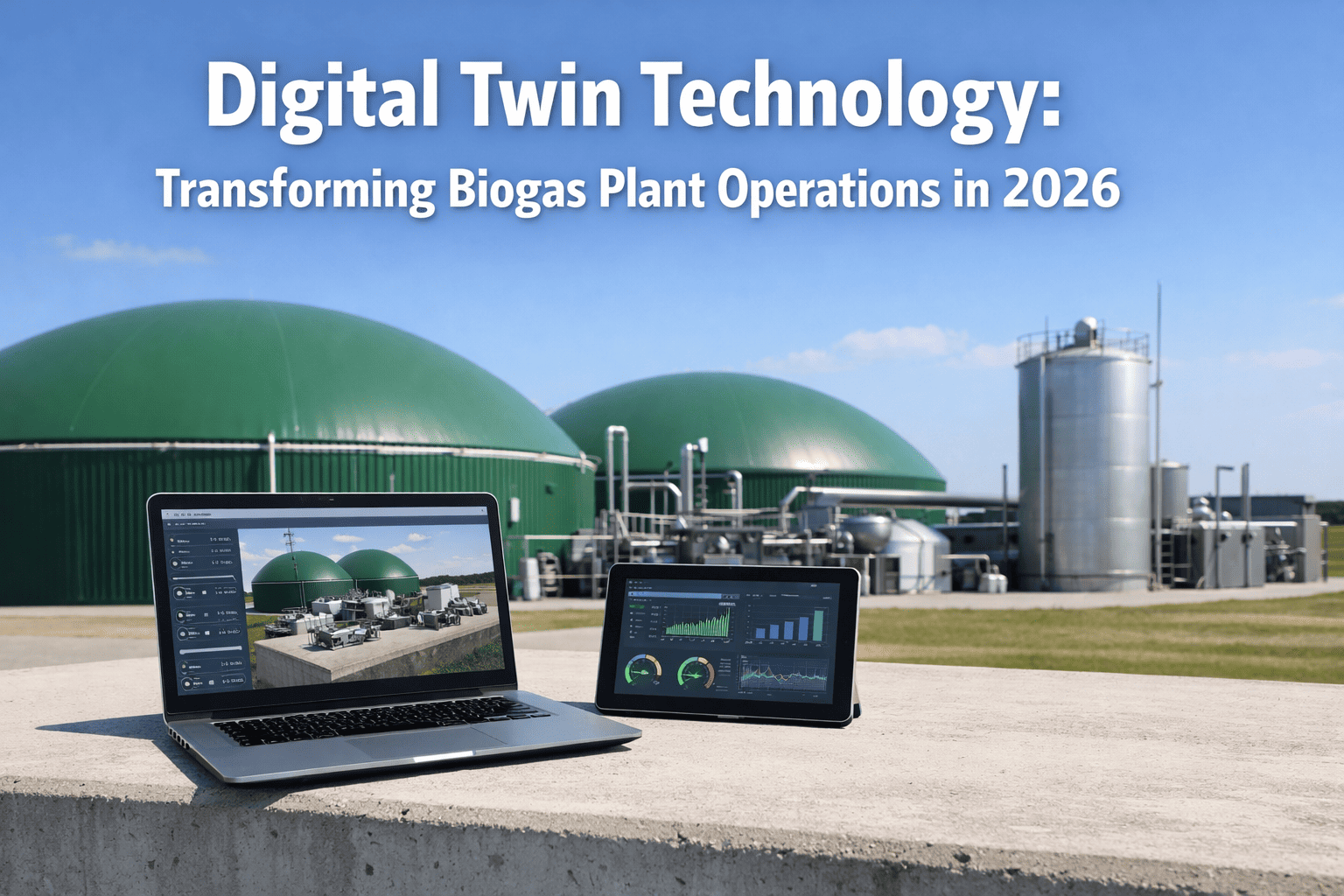
Biogas plants run on biology—and biology is unpredictable. Feedstock quality shifts with every delivery, microbial populations react to temperature swings overnight, and a single VFA spike can crash methane production for weeks. Digital twin technology eliminates this guesswork by building a continuously learning virtual replica of your entire facility—digesters, gas collection, CHP engines, heat recovery—that predicts process behavior before it happens. As the global biogas market accelerates toward $87.8 billion by 2034 and more than 19,000 plants operate across Europe alone, facilities that deploy AI-driven simulation are pulling ahead of those still relying on weekly lab samples and operator intuition. Schedule a consultation to explore how digital twin deployment can transform operations at your biogas facility.
The $87.8 Billion Biogas Industry Has a Visibility Problem
The biogas sector is booming—driven by energy security concerns, emissions regulations, and circular economy incentives. Yet most plants still operate with a fundamental blind spot: they cannot see inside the digester in real time. Operators make critical decisions about feeding rates, temperature adjustments, and maintenance scheduling based on data that is hours or days old. Digital twins close this gap by creating a living mathematical model that mirrors every biochemical and mechanical process as it happens.
$428B
Global digital twin market by 2034
41.4%
Annual market growth rate (CAGR)
30%
Energy efficiency gain from twin-optimized bioenergy systems
80.5%
Methane yield in digital twin-equipped bioreactors
The twin does not simply display sensor readings on a screen. It runs AI models that simulate the complex biochemistry of acidogenesis, acetogenesis, and methanogenesis—predicting how your digester will behave minutes, hours, and days into the future based on current conditions, incoming feedstock quality, and weather forecasts. Research published in 2025 confirmed that digital twin-equipped bioreactors achieved methane yields of 80.5% while enabling real-time corrective actions that manual monitoring structurally cannot deliver. Get Support for iFactory to see how predictive biogas intelligence works in practice.
Digester Upsets Cost Thousands—AI Catches Them 48 Hours Early
A single digester upset—caused by VFA accumulation, ammonia inhibition, or sudden pH drops—can halt methane production for weeks and cost tens of thousands in lost output and corrective treatment. The root cause is almost always the same: operators did not see the problem developing until it was already too late. Digital twin simulation changes this dynamic entirely by detecting the biochemical precursors of instability long before they become visible to manual testing.
VFA/Alkalinity Trajectory Modeling
AI continuously projects the FOS/TAC ratio trajectory—not where it is, but where it is heading. When the ratio starts trending above 0.4, alerts fire 24-48 hours before visible instability, giving operators time to reduce organic loading or add buffering agents before methane production is affected.
Microbial Ecosystem Stress Detection
Using ADM1-enhanced machine learning, the twin simulates methanogen and acidogen population dynamics. It detects stress from ammonia toxicity (above 3,000 mg/L), sulfide inhibition, or thermal shock—conditions that standard pH and temperature sensors cannot identify until damage is already underway.
Automated Corrective Response
Through SCADA integration, the twin does not just alert—it acts. When developing instability is detected, it can automatically adjust mixing intensity, reduce feed pump rates, modify recirculation flow, or trigger heat loop adjustments to stabilize the digester before human intervention is needed.
Stop losing methane production to preventable failures. See how AI simulation catches process instability days before it impacts your gas output and revenue.
Book a Demo
Simulate Before You Feed: Virtual Testing for Feedstock Changes
Every biogas operator knows the risk of introducing a new feedstock or changing blend ratios—will the digester handle it, or will it destabilize? Traditionally, the only way to answer this question was to try it and hope for the best. Digital twins eliminate this gamble by letting you run the experiment virtually before a single kilogram enters the digester.
01
Dynamic Co-Digestion Optimization
AI calculates ideal feedstock mixtures by analyzing volatile solids, C:N ratios, and biochemical methane potential (BMP) for every incoming substrate. The twin recommends blends that adapt to daily quality variations—research shows co-digestion optimization can boost biogas yield by up to 400% compared to single-substrate digestion.
02
Organic Loading Rate Precision
Overloading crashes the digester; underloading wastes capacity. The twin calculates the maximum safe OLR based on current microbial health, buffering capacity, and VFA levels—pushing operation to the productive edge without crossing into instability territory.
03
Retention Time Calibration
HRT directly controls how completely organic matter converts to biogas. The twin models substrate degradation kinetics for each feedstock combination, finding the retention sweet spot—typically 20-40 days for agricultural plants—that maximizes gas yield without unnecessarily tying up digester volume.
04
Gas Quality Tuning
Beyond volume, the twin optimizes gas composition—maximizing CH4 and minimizing H2S and CO2. For biomethane upgrading plants, this reduces scrubbing costs and methane slip. Published research shows digital twin-guided oxygen adjustments alone increase methane content by 4% volume.
From Weekly Lab Reports to Minute-by-Minute Process Intelligence
The gap between manual sampling and digital twin monitoring is not just about speed—it is about capturing an entirely different depth of operational intelligence. Weekly lab analysis reveals what happened days ago. A digital twin reveals what is happening now, why it is happening, and what will happen next.
Manual Sampling Reality
Lab results arrive 2-5 days after sampling
1-2 samples per week miss rapid VFA events
No real-time feedstock-to-gas correlation
Equipment issues found after failure
Compliance reports compiled manually
10-20%methane yield typically lost
Digital Twin Intelligence
Sub-minute sensor data feeds AI models live
Anomaly detection within 15 minutes of onset
AI correlates feedstock, weather, retention time
Vibration trending predicts failures weeks out
Audit-ready reports generated automatically
5%+ morefull-capacity hours per year
See the difference real-time intelligence makes. Walk through a live digital twin dashboard and discover what your current monitoring is missing.
Get Support
Connecting the Twin to Your SCADA, CMMS, and Compliance Stack
A digital twin that does not connect to your operational systems is just an expensive dashboard. The transformative value comes when AI insights flow directly into the tools your operators and maintenance teams already use—automating responses, generating work orders, and producing compliance documentation without manual effort.
SCADA / DCS
Real-time bidirectional
Reads process variables and writes back optimized setpoints. When AI identifies that mixing speed needs adjustment to prevent stratification, the command reaches the PLC without operator intervention.
CMMS / EAM
Event-triggered automation
Predictive maintenance alerts generate prioritized work orders automatically. When CHP engine vibration exceeds trending thresholds, a maintenance task appears in the queue before any performance degradation occurs.
Feedstock Tracking
Batch-level correlation
Every delivery is linked to digester performance, building an automated knowledge base of which suppliers, substrates, and seasonal conditions produce the best methane yields over time.
Environmental
Continuous data feed
Real-time methane slip, CO2, and H2S tracking flows into compliance platforms. Audit-ready reports generate automatically, and the system alerts before permit thresholds are approached.
Agricultural, Municipal, Industrial: Tailoring the Twin to Your Facility
Digital twins are not one-size-fits-all. The AI models, monitoring priorities, and optimization strategies differ significantly depending on your plant type, feedstock variability, and output objectives.
Agricultural AD Plants
Manure, crop residues, silage, energy crops
Greatest value from co-digestion blend optimization and seasonal feedstock planning. Substrate quality varies dramatically with weather and harvest cycles—AI models adapt blend recommendations weekly to maintain peak output through every season.
Municipal Wastewater Digesters
Sewage sludge, FOG, co-digested food waste
Digital twins help municipal facilities safely increase co-digestion acceptance rates without risking process upsets. Sludge thickening optimization and real-time stability monitoring protect digester health during variable organic loading periods.
Industrial Waste-to-Energy
Food processing waste, brewery effluent, dairy waste
High-rate systems (UASB, membrane reactors) are highly sensitive to load variations. Real-time process modeling prevents the upsets that high-strength industrial substrates frequently cause, while maximizing energy recovery efficiency.
Biomethane Upgrading Facilities
Raw biogas for grid injection or vehicle fuel
Twins optimize upstream digestion to produce consistent raw gas quality, stabilizing CH4/CO2 ratios before upgrading. This reduces scrubbing energy costs and methane slip—the two largest expenses in biomethane production economics.
Measured Results: Production Gains, Cost Savings, and Efficiency Metrics
The business case for digital twins in biogas is built on documented, measurable improvements across multiple operational dimensions—not theoretical projections. Published research and industrial deployment data confirm consistent returns across facility types.
Energy Efficiency Improvement
Integrated digital twin optimization in bioenergy systems
30%
Maintenance Efficiency Gain
Predictive scheduling replacing reactive repair cycles
35%
Operational Cost Reduction
AI-driven treatment and process optimization
17%
Additional Full-Capacity Hours
Reduced unplanned downtime through predictive controls
5%
Compliance Reporting Time
Automated documentation and audit-ready generation
55%
Calculate your facility's digital twin potential. Connect with our team and we will model the specific production gains and cost savings for your operation.
Book a Demo
Deployment Roadmap: First Insights Within 30 Days
Digital twin implementation does not require years of infrastructure overhaul. A phased deployment delivers early optimization wins while building toward comprehensive facility-wide intelligence. Most plants identify their first actionable insights within the first month of sensor activation.
Week 1-3
Facility Audit & Architecture Design
Complete plant sensor inventory and gap analysisHistorical data collection for AI model baselineIntegration architecture with existing SCADA/PLC
Week 4-6
Sensor Deployment & Data Pipeline
IoT sensor installation and calibrationEdge computing and connectivity setupReal-time data validation against baselines
Week 7-9
AI Model Training & Calibration
Digital twin model trained on plant-specific dataAnomaly detection thresholds tuned to your operationsPredictive algorithms validated against known events
Week 10+
Live Optimization & Continuous Learning
Real-time monitoring and predictive alerting go liveFeedstock optimization and maintenance prediction activeAI models continuously improve with operational data
Digital twins do not just track what is happening inside the digester—they model why it is happening and forecast what comes next. That predictive layer transforms biogas management from reactive troubleshooting into continuous intelligent optimization.
— Biogas Process Engineering Director
Build a Smarter, More Profitable Biogas Facility
Your weekly lab samples cannot detect a digester trending toward upset 48 hours in advance, or predict whether next week's feedstock delivery will disrupt microbial equilibrium. iFactory helps you deploy digital twin technology that monitors every critical parameter, simulates process outcomes with AI precision, and optimizes methane yield automatically—turning biogas operations from periodic sampling into continuous intelligent control.
Frequently Asked Questions
When do most plants start seeing measurable production improvements?
First optimization opportunities typically surface within 30 days—usually through anomaly detection revealing invisible inefficiencies. Measurable methane yield improvements appear within 2-3 months as AI models learn your plant's patterns. Full ROI including maintenance savings and compliance automation usually arrives within 6-12 months.
Book a demo to discuss projected timelines for your facility.
Do we need to replace all our existing sensors and SCADA equipment?
No. Digital twin platforms integrate with existing infrastructure through standard protocols (Modbus, OPC-UA, HART). The platform delivers value with your current instrumentation, and a phased sensor upgrade strategy—prioritized by optimization impact—is recommended. Many plants see significant gains by adding just 5-10 targeted sensors to their existing setup.
Our feedstock quality changes constantly—can the AI keep up?
This is exactly the scenario where digital twins deliver the most value. AI models continuously correlate feedstock characteristics—volatile solids, C:N ratio, BMP values, moisture—with digester performance and gas output. The system adapts predictions as quality shifts and simulates new substrates before they enter the digester.
Get Support to see feedstock optimization in action.
Will this help with environmental permits and emissions reporting?
Automated compliance is one of the highest-value applications. The platform continuously calculates methane slip, CO2, and H2S levels, generating audit-ready documentation in real time. Facilities report up to 55% reduction in compliance reporting effort after deployment, and the system alerts before any permit threshold is approached.
Our operators are not data scientists—can they actually use this?
Modern platforms translate complex AI analysis into clear, actionable recommendations—not raw statistics. Operators receive specific guidance such as "reduce feed rate 8% for next 6 hours" or "schedule mixer bearing inspection within 2 weeks." Most plant teams reach full proficiency within 2-3 weeks.
Schedule a demo to see the operator interface firsthand.