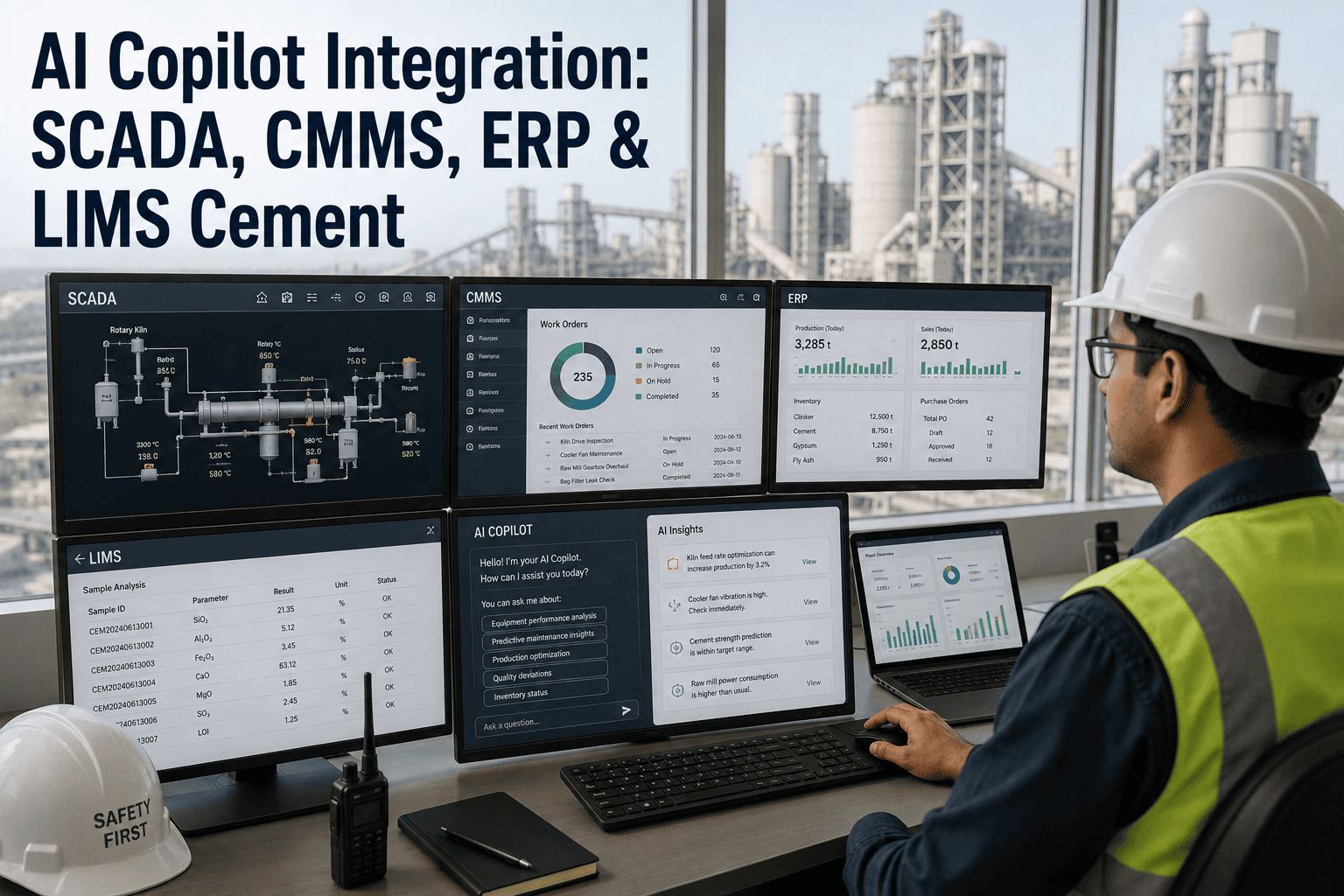
Cement manufacturing intelligence has undergone a fundamental transformation. What was once treated as a back-office reporting function — isolated SCADA dashboards and periodic manual log entries reviewed days after a kiln trip — is now redefining how enterprise cement producers manage uptime maintenance agility, and capital investment in real time. In 2026, leading producers are no longer asking whether to connect their process control to their maintenance suite; they are asking how quickly they can consolidate fragmented OT data into a unified Integration Control Tower that triggers actions across their entire facility network. If your SCADA and AI-driven systems still live in departmental silos, Book a Demo to see how iFactory's manufacturing intelligence software converts raw process alarms into enterprise-grade decision support.
Turn Your Process Data Into an Automated Action Tower
iFactory's integration platform unifies SCADA/DCS alarms, asset health, and maintenance workflows into a single operational intelligence layer — purpose-built for cement plant enterprises.
Why Cement SCADA-AI-driven Silos Have Outgrown the Cost Center Model
For decades, the air-gap between process control and maintenance in cement plants was defined by what it could not do. Isolated SCADA screens that showed a motor overload but couldn't check if a spare part was in stock; historians that logged kiln shell hot-spots but didn't notify the maintenance lead; and AI-driven systems that scheduled work based on the calendar rather than real-time vibration alerts — these were the building blocks of the cost center model.
That model is being replaced at pace. The catalysts are structural: labor cost inflation has eliminated the buffer of manual oversight; input volatility has compressed the margin for equipment failure to near zero; and the complexity of modern mills has made reactive maintenance economically untenable. Manufacturers with a single structural advantage — an integrated industrial analytics platform — have repositioned their SCADA data from a viewing tool to a strategic control tower that triggers maintenance interventions in the moment they are needed.
— Operations Director, APAC Cement Group
What an Action-Linked Control Tower Means for Cement Plant Operations
The control tower concept describes a centralized intelligence layer that provides real-time visibility, automated triggers, and decision support across the full operational network. For a cement plant, a true control tower software architecture means that a kiln shell hot-spot in facility one, a VRM torque spike in facility two, and a baghouse pressure drop in facility three are all visible — and actionable — simultaneously.
This is categorically different from process historians that simply aggregate data. An integrated manufacturing intelligence software control tower is action-linked. When a fan motor in the cooler shows a vibration pattern consistent with bearing fatigue, the system doesn't just log the alarm — it cross-references the asset health score, checks the parts inventory, generates a prescriptive work order, and updates the production schedule to account for a 2-hour planned intervention. To see how this architecture operates across a real multi-site cement network, Book a Demo and walk through a live integration audit.
The Five Pillars of a SCADA-to-AI-driven Integration Control Tower
Bi-Directional OT-IT Connectivity
A control tower requires a single data layer that ingests from SCADA/DCS (via OPC-UA or MQTT) while simultaneously syncing back maintenance status to the operator. This ensures the control room knows exactly when an asset is under repair or being bypassed.
Intelligent Alarm Governance
Prevent 'alarm fatigue' by applying AI logic to SCADA triggers. The system correlates process alarms with asset health scores to distinguish between operational 'noise' and true maintenance requirements, ensuring only high-priority issues trigger work orders.
Automated Work Order Triggers
SCADA-driven maintenance transforms the platform into an intervention engine. Temperature exceedances or motor torque spikes automatically generate work orders, pre-populated with SOPs and historical repair data, shifting maintenance from reactive to prescriptive.
Spare Parts & Inventory Sync
The control tower integrates the process alarm with the warehouse ledger. When a critical asset flags a failure, the system instantly identifies the required spare parts, their current aisle location, and lead times for replacements, eliminating search time.
Enterprise Decision Support
When the executive team shares the same real-time view of 'Alarm-to-Action' performance across every facility, capital allocation for automation upgrades or system integration is informed by operational intelligence rather than lagged financial reports.
Production Performance Analytics: Where Integration Generates Immediate ROI
Real-Time Process Alarm Root Cause Attribution
Control tower analytics correlate SCADA alarms with specific equipment health states. By identifying whether a kiln trip was a process error or a mechanical failure within seconds, the system directs the right team to the site instantly.
Enterprise OEE Monitoring Linked to Asset Health
Enterprise-wide OEE monitoring through an integrated platform reveals how process set-points in one facility are impacting asset longevity in another. High-throughput targets are balanced against 'equipment stress' scores in real time.
Automated Alerts for Process Exceedances
Stop managing by exception. The control tower identifies when a cooler fan's vibration or a mill's thermal signature drifts outside the 'Golden Batch' parameters, alerting operators and maintenance before a hard trip occurs.
Reduction in Nuisance Alarms & Manual Reporting
Integrated OT-IT architecture eliminates the need for manual 'Alarm Logs' and redundant data entry. Technicians receive actionable triggers, while management receives automated performance reports on total plant reliability.
AI-Driven Visibility vs. Traditional Business Intelligence: A Direct Comparison
| Capability Dimension | Traditional SCADA / Silos | Integrated AI Control Tower | Strategic Impact |
|---|---|---|---|
| Data Integration | Manual export to Excel | Automated OT-IT Data Ingestion | Eliminate data silos & human entry error |
| Work Order Generation | Manual (Phone/Radio) | Automated Alarm-Based Triggers | Mean Time to Action (MTTA) reduced by 70% |
| Alarm Governance | Alarm fatigue (Thousands/Day) | AI-Correlated Actionable Alerts | Maintenance focuses on high-ROI interventions |
| Executive Visibility | Weekly manual PDF reports | Real-time Integrated Dashboard | Capital decisions informed by live process data |
| Inventory Lifecycle | Manual check on failure | Automated Part-to-Alarm Sync | Zero downtime from 'Part Not In Stock' events |
Ready to Close the OT-IT Gap with Real-Time Integration?
See how iFactory's integration platform gives cement manufacturers the process visibility, automated triggers, and maintenance intelligence to operate faster than the competition.
Frequently Asked Questions: Cement Plant SCADA-to-AI-driven Integration
How does an integrated control tower differ from our existing SCADA or PI system?
Your SCADA and PI systems are great at *recording* data. A control tower is designed for *acting* on data. It connects those process records to your maintenance workflow—automatically generating work orders, checking spare parts, and updating asset health scores when a process exceedance occurs.
Does the integration require replacing our existing DCS or plant historians?
No. iFactory acts as an intelligent 'overlay.' We integrate with existing DCS (Honeywell, ABB, Siemens) and historians (OSIsoft PI, Aveva) using standard industrial protocols like OPC-UA, MQTT, and API-based ingestion to add an action layer on top of your current tech stack.
How do you prevent 'Alarm Fatigue' from flooding our maintenance team with work orders?
This is where the AI logic is critical. We don't trigger a work order for every alarm. The system applies correlation rules—checking if an alarm is a repeat event, if it correlates with a drop in asset health, or if it has been flagged as a 'nuisance' by operators—ensuring only actionable maintenance tasks are generated.
Can we trigger work orders based on kiln shell scanner temperatures?
Yes. By integrating shell scanner data, the platform can monitor for 'hot-spots' or 'cold-spots' and automatically trigger a masonry inspection or air-fan adjustment work order the moment a predefined threshold is exceeded.
How does the platform handle the security risks of bridging OT and IT networks?
iFactory uses industry-standard DMZ architectures and unidirectional data diodes where required. We prioritize read-only access for process data and use encrypted tunnels to ensure that your plant's control layer remains isolated from the external internet while still delivering data to the AI-driven.
How long does it take to set up a bi-directional sync between SCADA and maintenance?
Initial data ingestion for priority assets (like kilns and mills) typically goes live within 4 weeks. Full bi-directional sync and automated work order calibration are usually completed within 2–3 months as the system learns your specific plant's alarm profile.
What is MTTA and why is it a better metric than total downtime?
Mean Time to Action (MTTA) measures how long it takes from the moment an alarm occurs to the moment a maintenance technician is assigned or the issue is identified. Reducing MTTA is the fastest way to lower total downtime, as it eliminates the 'hidden' hours wasted on manual reporting and diagnosis.
Build the Integration Control Tower Your Enterprise Strategy Requires
iFactory's industrial analytics platform transforms process alarms, asset health, and maintenance workflows into a unified strategic control tower — giving cement plant executives the real-time visibility to lead operations with precision rather than react to them with urgency.