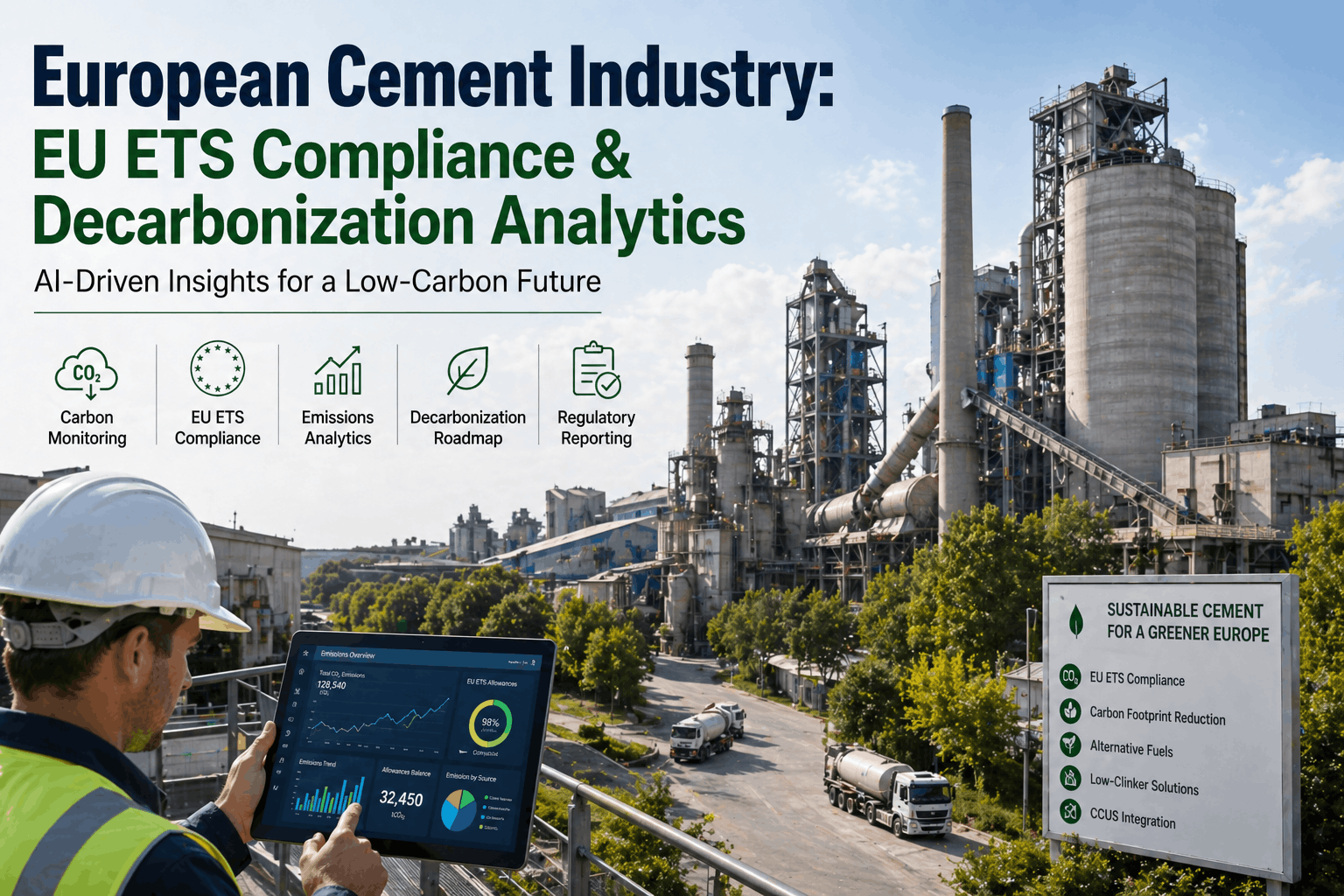
European cement manufacturing has transitioned from a heavy-industry sector to a carbon-tech frontier. Driven by EU ETS Phase 4 regulations and the looming implementation of CBAM (Carbon Border Adjustment Mechanism), the region's 180+ MTPA capacity is facing a historical mandate: decarbonize or face economic obsolescence. Carbon prices fluctuating between €80 and €100 per ton have transformed emissions from an environmental metric into the primary driver of plant profitability. iFactory's European Decarbonization Module addresses this paradox—the requirement for rapid clinker reduction and alternative fuel scaling—using real-time ETS tracking, TSR (Thermal Substitution Rate) optimization, and CCUS performance monitoring to systematically reduce carbon intensity while securing market access in a Net-Zero economy. Book a Decarbonization Audit to see how our platform handles your ETS liability.
European Cement: EU ETS Compliance, TSR Optimization & Decarbonization Analytics
Automated carbon tracking, alternative fuel scaling, and low-clinker blending — mitigating ETS liability while driving toward 2050 Net-Zero targets.
The European Carbon Paradox: Rising Prices vs. Technical Complexity
In the European Union, cement producers are trapped in a regulatory squeeze: free carbon allocations are phasing out exactly as the cost of decarbonization technology (CCUS, calcined clays) is peaking. This creates a financial paradox: plants must invest in Net-Zero infrastructure while their operating margins are being consumed by €90/ton carbon permits. Schedule a carbon strategy session to optimize your ETS exposure.
The cost per ton of CO2 that makes traditional coal-fired production economically unviable in the EU.
The projected profit loss for plants that fail to reach >75% TSR and clinker factors below 0.65.
Achieved through AI-driven LC3 and calcined clay blending optimization in Tier-1 EU plants.
The goal of integrated carbon tracking: automated, real-time documentation for EU auditors.
The European Compliance Matrix — Prioritizing Net-Zero Interventions
iFactory classifies decarbonization levers using a combined Financial Impact (ETS savings) and Technical Complexity matrix—automating the operational shifts that drive the lowest "Carbon per Euro" of investment.
| Carbon Intensity kg CO2 / ton clinker |
Fuel Substitution TSR % (AFR Usage) |
Regulatory Risk ETS/CBAM Compliance |
|
|---|---|---|---|
| High Impact (Kiln, TSR, LC3) |
Clinker Factor
LC3 & calcined clay blending. AI-driven quality prediction to push low-clinker limits.
|
TSR Max
SRF/RDF chlorine bypass optimization. 90%+ TSR targets with kiln stability guardrails.
|
ETS Live
Real-time kg CO2/shift tracking. Automated liability forecasting for the CFO.
|
| Strategic (CCUS, Green Energy) |
Capture ROI
CCUS energy penalty monitoring. Amine scrubbing efficiency vs. carbon price delta.
|
AFR Quality
SRF moisture & PVC content correlation with preheater combustion stability.
|
CBAM Passport
Automated SEE (Simple Embedded Emissions) data for export documentation.
|
What iFactory European Module Does — Five Core Capabilities
iFactory connects emission telemetry to kiln process control and financial ETS ledgers—automating the decarbonization decisions that manual reporting misses. Schedule a decarbonization module demo configured for EU ETS Phase 4.
Real-Time EU ETS Carbon Tracker
iFactory converts CEMS (Continuous Emissions Monitoring) data into real-time financial liability. It tracks kg CO2 per ton of cement across every shift, providing a live 'Carbon P&L' for the plant manager and CFO.
TSR (Alternative Fuel) Optimizer
Scale alternative fuel usage without kiln trips. iFactory correlates SRF/RDF feed rates with preheater oxygen and chlorine levels, automatically prescribing the optimal TSR for maximum coal substitution.
Low-Clinker Factor Intelligence
Optimize the production of LC3 and other low-carbon cements. The platform monitors mill throughput and 28-day strength predictions in real-time, allowing you to push the clinker factor down while maintaining EN standards.
CCUS Performance & Energy Monitor
Analyze the 'Carbon Captured per kWh' for your CCUS pilot. iFactory monitors the amine regeneration energy and compression power, ensuring your capture unit operates at the lowest possible energy penalty.
Before vs. After — 3 MTPA Integrated Plant in Central Europe
Results verified by plant sustainability and finance leadership after 12 months on iFactory European Decarbonization Module. Carbon price average: €90/ton.
What a Group Sustainability Director Said
In the European market, carbon isn't just a compliance report anymore; it's our biggest variable cost. We were operating our kilns with zero real-time visibility into our ETS position. iFactory changed that—providing our burner teams with a live 'Carbon Intensity' dial. By correlating TSR and clinker factor with our EN-197 strength tests, we've reduced our group carbon footprint by 22% in 12 months, saving €14 million in ETS permit costs.
Frequently Asked Questions
How does iFactory track EU ETS liability in real time?
We integrate directly with your CEMS (Continuous Emissions Monitoring System) and fuel weighing systems. By applying the EU ETS Phase 4 calculation methodology, we provide a live kg CO2 per ton of cement metric, updated every 15 minutes, allowing you to manage your carbon position like a utility cost.
Can iFactory help increase our TSR (Thermal Substitution Rate) safely?
Yes. Alternative fuels like SRF and RDF introduce chlorine and sulfur variability that can cause kiln rings and bypass blockages. iFactory's AI monitors these process signatures, automatically prescribing the optimal TSR that maximizes carbon savings while keeping the kiln within stable operating limits.
Does the platform support LC3 and low-clinker blended cement production?
Absolutely. Lowering the clinker factor is the fastest lever for decarbonization. iFactory monitors the chemical and physical properties of blended cements (like LC3), using machine learning to predict 2-day and 28-day strengths, which allows you to minimize clinker usage while ensuring EN-197-1 compliance.
How does the platform handle CBAM (Carbon Border Adjustment Mechanism) reporting?
For European producers with export markets, iFactory automates the collection of 'Embedded Emissions' data required for CBAM documentation. This ensures your products have a verifiable 'Carbon Passport' for global trade.
Is the platform compatible with CCUS (Carbon Capture) pilot projects?
Yes. We track the 'Energy Penalty' of CCUS units. By monitoring amine regeneration energy and CO2 compression power against the amount of carbon captured, we help engineers optimize the ROI of their Net-Zero infrastructure.
How long does it take to deploy the Decarbonization Module?
Standard ETS tracking and TSR optimization go live within 6–8 weeks. Advanced low-clinker strength prediction and CCUS performance monitoring typically complete by Week 12, following historical data ingestion.
Does the platform integrate with our existing Carbon Trading platforms?
Yes. iFactory can export real-time emission forecasts to your carbon trading or ERP systems (like SAP Sustainability Control Tower), allowing your finance team to make informed 'Buy vs. Mitigate' decisions on ETS permits.
Build Your Net-Zero Control Tower Today
Demo configured around your EU ETS liability, TSR goals, and low-clinker standards.