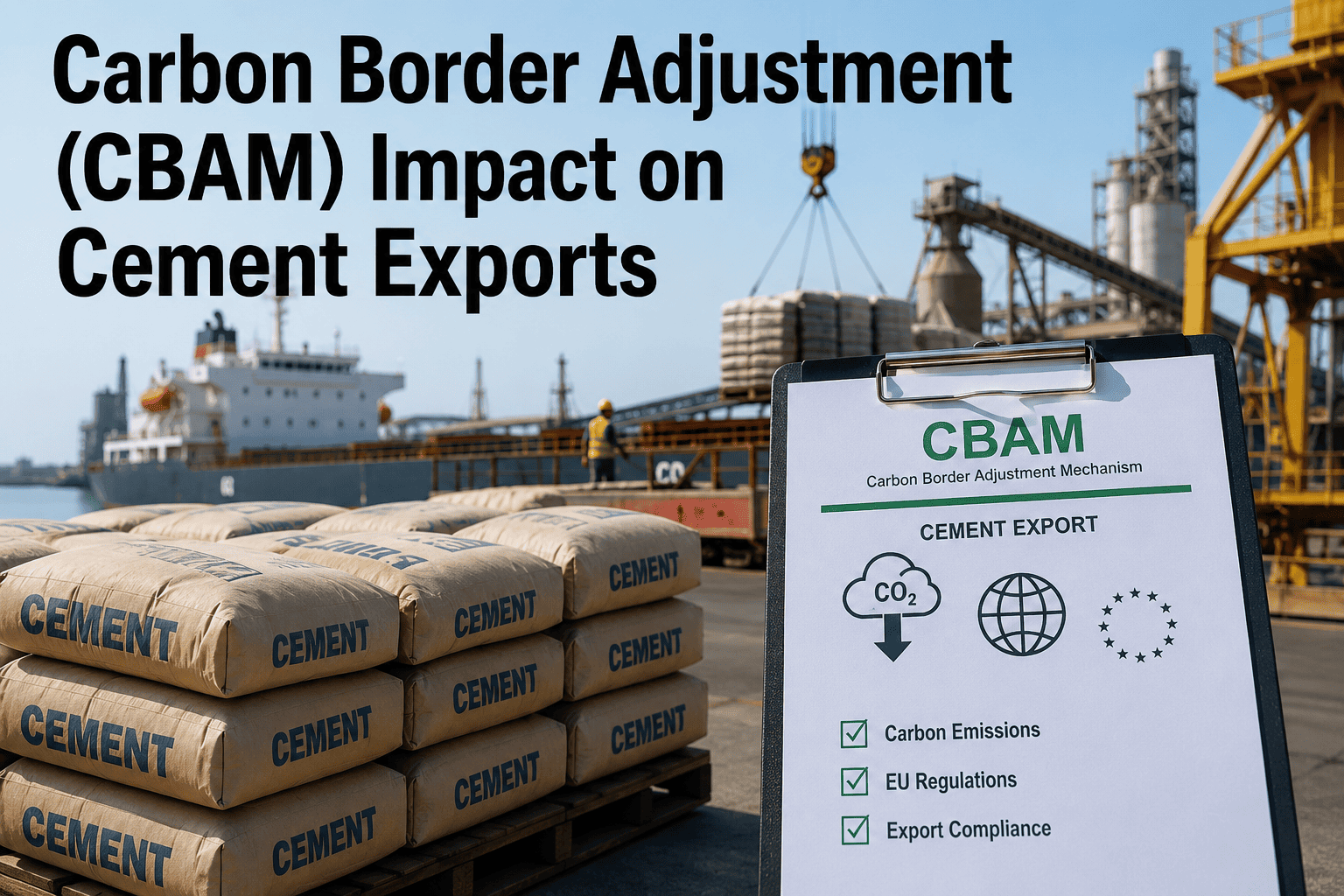
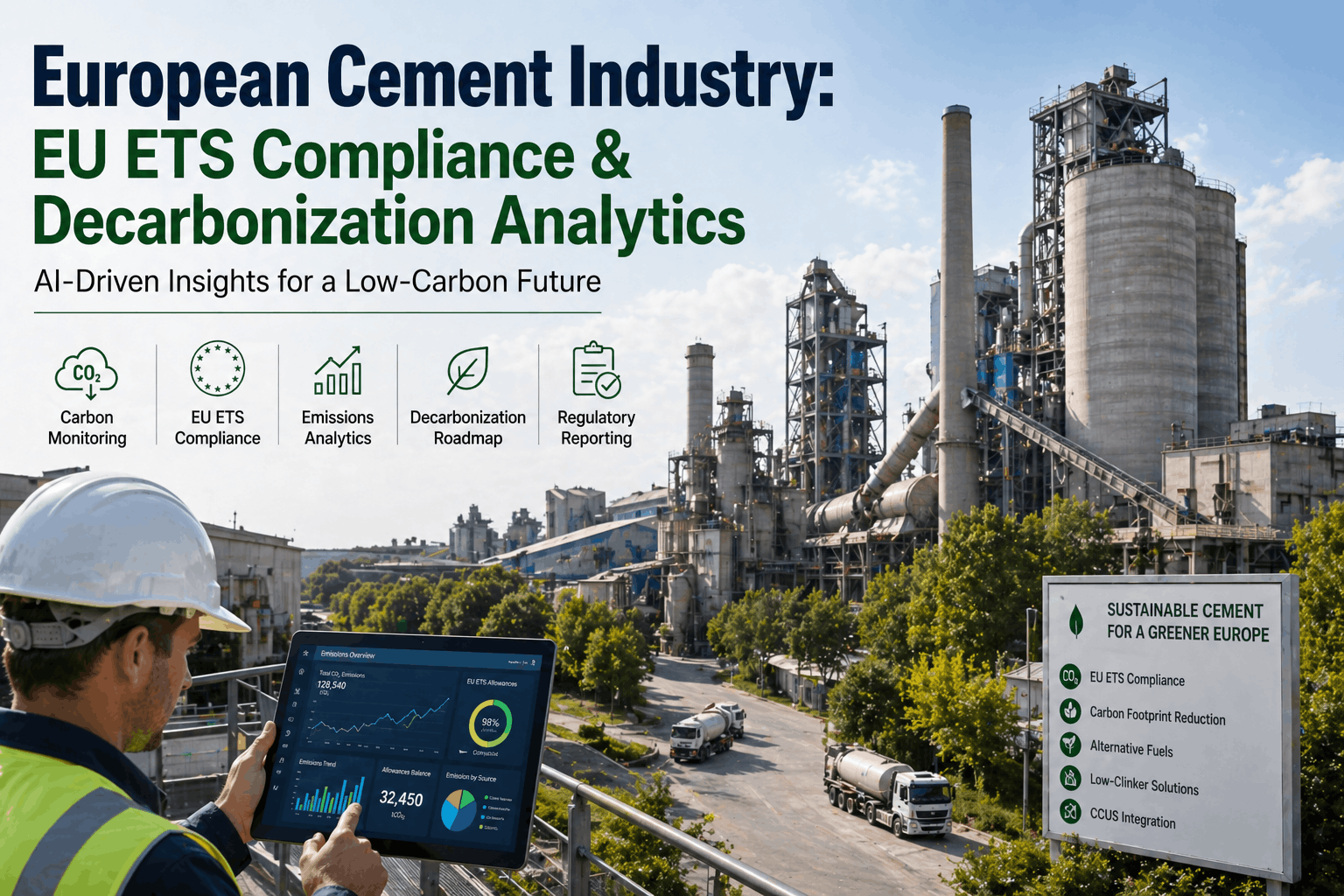
The EU Carbon Border Adjustment Mechanism (CBAM) enters its definitive phase on January 1, 2026 — ending the transitional reporting period and imposing real financial obligations on every tonne of cement imported into the European Union. Cement is one of the six sectors hit hardest by CBAM, facing carbon intensity scrutiny that exposes exporters to costs of €70–100+ per tonne of embedded CO₂. Yet most cement producers still calculate emissions using annual spreadsheets, quarterly lab samples, and retrospective energy audits — methods that cannot produce the granular, verifiable, real-time data that CBAM demands. This is where AI-powered emissions monitoring transforms compliance from a bureaucratic burden into a competitive advantage. iFactory AI gives cement plants continuous carbon intensity tracking, automated CBAM documentation, and AI-driven process optimization that reduces both emissions and costs simultaneously. Book a free consultation and discover how AI keeps your plant compliant — and competitive — under CBAM 2026.
€70-100+
CBAM Carbon Cost per Tonne of CO₂ Embedded in Cement
Jan 2026
CBAM Definitive Phase — Full Financial Obligations Begin
8%
Of Global CO₂ Emissions Come From Cement Production
24/7
Continuous AI Tracking Required for Verifiable CBAM Data
What Is CBAM — and Why Does It Change Everything for Cement?
The Carbon Border Adjustment Mechanism is the EU's landmark regulation designed to prevent "carbon leakage" — where manufacturers relocate production to countries with weaker emissions standards and then export carbon-intensive goods back into Europe. Under CBAM, importers must purchase certificates corresponding to the carbon price that would have been paid if the goods were produced under the EU Emissions Trading System (EU ETS). For cement, this means every tonne of clinker and finished cement crossing an EU border now carries a verifiable carbon cost.
The transition from reporting-only (2023–2025) to full financial obligations (January 2026) is a seismic shift. Plants that cannot produce accurate, auditable embedded emissions data face rejection at EU borders, financial penalties, and loss of market access to the world's largest economic bloc. AI-powered monitoring isn't optional anymore — it's the infrastructure that determines whether your cement reaches European customers or sits at the dock.
Anatomy of CBAM Compliance: 5 Critical Workstreams
01
Carbon Intensity Measurement
Continuous monitoring of direct emissions (Scope 1) from kiln combustion, calcination, and fuel use — measured per tonne of clinker and cement product, not per facility aggregate.
02
Indirect Emissions Tracking
Scope 2 emissions from electricity consumption must be attributed to production. Grid emission factors, on-site generation, and renewable sourcing all require documented verification.
03
Data Verification & Audit Trail
Every emissions data point must be traceable, timestamped, and verifiable by accredited third-party auditors. Manual spreadsheets fail this standard — automated sensor-to-report pipelines are required.
04
CBAM Certificate Procurement
EU importers must purchase CBAM certificates at the current EU ETS carbon price. Accurate embedded emissions data directly determines how many certificates — and how much money — each shipment requires.
05
Process Optimization for Cost Reduction
Lower embedded emissions = fewer CBAM certificates = lower cost per tonne exported. AI-driven kiln and mill optimization directly reduces the carbon cost burden on every EU-bound shipment.
CBAM Implementation Timeline — From Reporting to Full Obligations
Transitional PhaseOct 2023 – Dec 2025
Full ObligationsJan 2026
Certificate Purchase2026 – 2034
Free Allowance Phase-Out2026 – 2034
Full Carbon Cost2034+
Free EU ETS allowances for domestic producers phase down annually from 2026 to zero by 2034 — CBAM costs escalate in parallel.
The 7 Compliance Risks That Threaten Cement Exporters Under CBAM
CBAM introduces financial and market-access risks that most cement producers have never faced. Plants relying on manual emissions tracking are exposed to every one of these failure modes. Understanding — and mitigating — each risk with AI-powered monitoring is the foundation of competitive CBAM compliance.
Inaccurate Embedded Emissions Data
EU importers overpay for CBAM certificates or face penalties for underreporting — both destroy your competitiveness
Deploy continuous AI emissions monitoring with sensor-verified data at every process stage
Critical
Missing Audit Trail
Non-verifiable data triggers default EU values — often 50–80% higher than actual emissions — inflating certificate costs
Automated sensor-to-report pipeline with immutable timestamps and third-party audit readiness
Critical
Kiln Thermal Inefficiency
Every 1% excess thermal energy = higher CO₂ per tonne of clinker = more CBAM certificates per shipment
AI kiln optimization reduces thermal energy 3–8% per tonne — directly cutting embedded emissions
Critical
Scope 2 Attribution Gaps
Inability to prove renewable electricity sourcing means grid-average emission factors are applied — penalizing clean plants
AI tracks electricity source mix in real time, documenting renewable vs. grid consumption per production batch
High
Alternative Fuel Documentation Failure
Biomass and waste fuel carbon offsets require precise calorific value and biogenic fraction tracking per batch
Continuous fuel composition analysis via AI sensor fusion — every batch documented automatically
High
EU Importer Relationship Loss
Importers choose suppliers with lowest verified carbon intensity — manual reporters lose market share to AI-monitored competitors
Provide importers with real-time carbon intensity certificates per shipment — a competitive differentiator
High
Carbon Price Volatility Exposure
EU ETS prices fluctuate €60–120+ — plants that cannot forecast their certificate costs face margin uncertainty
AI models forecast carbon cost exposure based on production plans and ETS price scenarios
Moderate
AI Technology Stack: Building CBAM-Ready Infrastructure
CBAM compliance requires a technology infrastructure that most cement plants don't have today. The gap between "annual emissions estimate" and "continuous verified carbon intensity per tonne" is a technology gap that only AI-powered monitoring can bridge.
Deploy continuous emission monitoring systems (CEMS) on kiln stacks
Install fuel flow meters with calorific value analyzers on all fuel feeds
Implement raw material composition analyzers (XRF) for calcination tracking
Connect electricity sub-meters per production zone for Scope 2 attribution
Impact: Creates the sensor foundation for auditable, per-tonne carbon data.
Build a digital twin that models mass and energy balance across the entire process
Train ML models to correlate process parameters with emissions in real time
Implement AI kiln optimization that minimizes thermal energy per tonne of clinker
Deploy predictive carbon intensity scoring per production batch and product type
Impact: Transforms raw sensor data into verified, optimized carbon metrics.
Auto-generate CBAM-compliant embedded emissions reports per shipment
Provide EU importers with real-time carbon intensity certificates via secure API
Integrate with EU CBAM registry for direct certificate calculation support
Maintain immutable audit trail accessible to accredited third-party verifiers
Impact: Eliminates manual documentation and ensures audit-ready compliance.
Deployment Roadmap: From Legacy Monitoring to CBAM-Ready AI
Achieving CBAM compliance before January 2026 requires a structured deployment that delivers quick wins immediately while building toward full autonomous emissions management.
Phase 1
Emissions Baseline & Gap Analysis (Weeks 1–4)
Audit existing CEMS, fuel metering, and electricity monitoring
Map sensor gaps against CBAM data requirements
Collect 12-month historical energy and production data
Calculate current carbon intensity baseline per product
Identify highest-impact optimization opportunities
Phase 2
Sensor Deployment & Digital Twin Build (Weeks 4–10)
Install missing CEMS, fuel analyzers, and electricity sub-meters
Build digital twin with mass-energy balance model
Connect all data streams to iFactory AI platform
Calibrate AI models against verified historical data
Configure automated CBAM report templates
Phase 3
AI Optimization & Compliance Activation (Weeks 10–16)
Activate AI kiln and mill optimization for emissions reduction
Enable real-time carbon intensity scoring per batch
Launch automated CBAM documentation per shipment
Validate audit trail with third-party verifier
Train operations and compliance teams on platform
AI-Powered Optimization: Reducing Your CBAM Cost Burden
Compliance is table stakes. The real competitive advantage is reducing the carbon intensity that determines your CBAM cost. Every percentage point of embedded CO₂ reduced per tonne translates directly to fewer certificates purchased, lower costs for your EU importers, and stronger market positioning against competitors still running unoptimized kilns.
Kiln Thermal Optimization
AI simultaneously optimizes 200+ kiln parameters for minimum fuel per tonne
Flame temperature, secondary air, feed rate, and rotation speed auto-tuned
Reduces thermal energy consumption by 3–8% per tonne of clinker
Directly lowers Scope 1 emissions — the largest CBAM cost component
Alternative Fuel Maximization
AI optimizes co-processing of biomass, waste tires, and RDF
Tracks biogenic carbon fraction per fuel batch automatically
Maximizes fossil fuel substitution while maintaining clinker quality
Documents biogenic offsets for CBAM certificate reduction
Clinker-to-Cement Ratio Reduction
AI optimizes supplementary cementitious material (SCM) blending
Maximizes fly ash, slag, and limestone filler without strength loss
Reduces clinker factor — the primary driver of cement carbon intensity
Each 1% clinker reduction = ~0.8% lower embedded CO₂ per tonne
Every Tonne of CO₂ You Don't Emit Is a CBAM Certificate You Don't Pay For
iFactory AI gives cement plants the real-time emissions intelligence to minimize carbon intensity, automate CBAM documentation, and turn environmental compliance into a cost advantage. See it in action.
Stakeholder Alignment: Who Owns CBAM Compliance?
CBAM compliance isn't a single department's responsibility — it spans production, maintenance, quality, commercial, and executive teams. Misalignment between these stakeholders is the #1 reason plants miss compliance deadlines.
Plant Director / CEO
Total CBAM cost exposure, competitive positioning vs. other exporters, capital planning
Executive AI dashboard: total carbon cost per tonne, EU market risk scoring, ROI on optimization
Environmental / ESG Manager
Verified Scope 1 & 2 data, CBAM report generation, third-party audit coordination
Automated CBAM reports, immutable audit trail, accreditation-ready documentation
Production Manager
Real-time carbon intensity per batch, kiln optimization guidance, quality vs. emissions trade-offs
Live digital twin, AI process recommendations, per-batch carbon scoring
Commercial / Export Team
Per-shipment carbon intensity certificates for EU importers, competitive pricing intelligence
Automated carbon certificates per shipment, importer portal with verified data
Maintenance Engineering
Equipment efficiency data, predictive maintenance to prevent emissions-increasing degradation
CMMS integration, AI-predicted equipment failures that increase carbon intensity
EU Importers / Buyers
Verified embedded emissions data per product, certificate cost predictability
Secure API access to real-time verified carbon intensity data per order
Manual Reporting vs. AI-Powered CBAM Compliance
Manual / Spreadsheet Approach
Emissions calculated from annual fuel purchase invoices — not actual combustion
Clinker-to-cement ratios estimated quarterly, not tracked per batch
No real-time visibility into which process changes affect carbon intensity
CBAM reports assembled manually over weeks — error-prone and unauditable
Default EU values applied when data gaps exist — inflating certificate costs 50–80%
EU importers prefer competitors who provide verified, real-time data
iFactory AI-Powered Approach
Continuous CEMS + fuel analyzer data feeding AI carbon models in real time
Per-batch carbon intensity scoring with product-level granularity
Digital twin shows exactly how every parameter change affects emissions
CBAM reports auto-generated per shipment — audit-ready in seconds
Actual verified data always used — never penalized by default values
EU importers get instant carbon certificates — you become the preferred supplier
€3-8M
Annual CBAM cost savings from AI-driven carbon intensity reduction per plant
5-15%
Reduction in embedded CO₂ per tonne via AI kiln + fuel + clinker optimization
100%
Automated CBAM documentation accuracy — no default value penalties
CBAM Is Not a Future Risk — It's a January 2026 Reality
iFactory AI gives your plant the real-time emissions intelligence, automated compliance documentation, and process optimization needed to turn CBAM from a cost burden into a competitive differentiator. Talk to our cement decarbonization specialists today.
Frequently Asked Questions