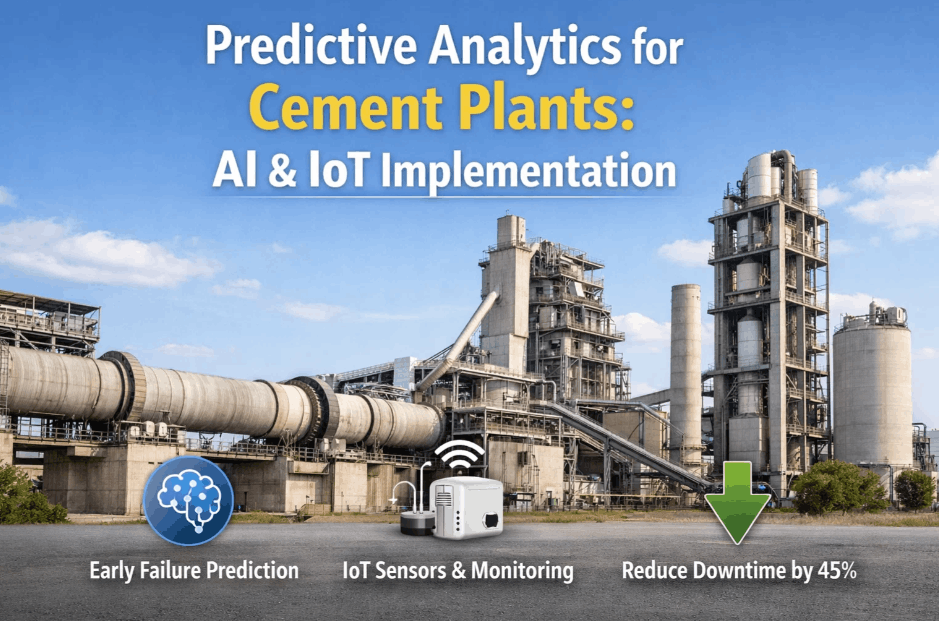
When one of India's top-10 cement producers began evaluating its unplanned downtime profile across three integrated plants in Rajasthan and Gujarat, the numbers were stark: ₹14 crore lost annually to equipment failures that post-incident analysis consistently showed were predictable. Kiln shell hot spots, raw mill bearing failures, and coal mill fire events each had detectable precursor signatures in sensor data — but no platform was correlating that data into actionable alerts. In 2023, the group deployed iFactory's IoT sensor network and predictive analytics platform across its flagship 4.2 MTPA facility. In the first 12 months, the plant saved ₹8 crore in avoided downtime and maintenance costs — with a payback period of under 8 months on the full platform investment. This case study details how. Book a Demo to see how iFactory delivers the same results for your cement operation.
The Challenge: Reactive Maintenance Costing ₹14 Crore Per Year
High-Value Equipment Failing Without Warning
The plant's 6-stage preheater kiln, 3 raw mills, and 2 coal mills were monitored by a legacy SCADA system with fixed-threshold alarms — alarms that triggered only when equipment had already entered a failure state. Bearing temperature alarms sounded with 2–4 hours of lead time, insufficient for planned intervention. Kiln shell scanning data existed but was reviewed manually on a weekly basis, allowing hot spots to develop between reviews. The result: 11 significant unplanned stoppages in 2022 costing an average of ₹1.27 crore per event in lost production, emergency parts procurement, and expedited maintenance labour.
No Cross-Sensor Intelligence — Data Existed, Insight Did Not
The plant had 340+ existing sensors generating data into the DCS. The problem was not sensor coverage — it was correlation. A coal mill inlet bearing whose temperature was rising 0.3°C per day while vibration amplitude at 1× running speed was simultaneously increasing 0.8 mm/s per week was not detectable from either sensor independently. Both trends together formed an unmistakable bearing race defect signature — but no platform was joining those signals. iFactory's multi-sensor fusion AI layer operates on exactly this principle: finding the cross-sensor patterns that predict failures weeks before any single parameter crosses a threshold. Schedule a demo to see a live example of multi-sensor predictive alerting on cement mill equipment.
The Solution: iFactory IoT Sensor Deployment & Predictive Analytics
Phase 1: IoT Sensor Network Installation (Weeks 1–6)
iFactory's implementation team deployed 180 additional IoT sensors across 42 critical assets — wireless vibration sensors on all raw mill and cement mill main bearings and pinion drives, kiln shell thermal sensors integrated with the existing scanning system, coal mill differential pressure and inlet/outlet temperature sensors, and preheater cyclone differential pressure sensors across all 6 stages. All sensor data was routed through iFactory edge gateways installed at each mill area — providing 1-second data resolution on vibration and 15-second resolution on temperature and process parameters, with local buffering to ensure no data loss during network interruptions.
Phase 2: AI Model Commissioning & Baseline Learning (Weeks 6–14)
iFactory's predictive analytics models were commissioned using 18 months of historical DCS data imported from the plant historian, combined with live sensor data from the new IoT network. The AI engine established individual healthy-state baselines for each monitored asset — accounting for load-dependent vibration signatures, seasonal ambient temperature effects on bearing temperatures, and process-variable correlations unique to this plant's raw material mix and pyroprocessing conditions. By week 14, all models were validated against 3 historical failure events in the imported data — each event was retrospectively detected by the model 12–19 days before the recorded failure date, confirming model sensitivity and specificity before go-live. Book a Demo to see how iFactory's model commissioning works for cement plant assets.
Year 1 Results: Event-by-Event Breakdown
| Event | Equipment | Alert Lead Time | Action Taken | Saving (₹) |
|---|---|---|---|---|
| Raw Mill #2 main bearing race defect | Roller mill main bearing | 19 days | Planned replacement during scheduled weekend stop | ₹1.4 Cr |
| Kiln shell hot spot — Zone 4 | Rotary kiln shell | 11 days | Speed reduction + refractory patch; kiln maintained in service | ₹90 L |
| Coal Mill #1 separator bearing failure | Dynamic separator bearing | 21 days | Bearing replaced; zero unplanned downtime | ₹65 L |
| Preheater cyclone blockage (Stage 3) | Cyclone Stage 3 | 8 days | Planned cleaning; prevented fire event | ₹1.1 Cr |
| Cement Mill #1 pinion gear wear | Ball mill pinion drive | 14 days | Planned change; prevented catastrophic ring gear damage | ₹2.2 Cr |
| Kiln thrust roller overheating | Kiln riding ring / thrust | 9 days | Lubrication correction + tyre profiling; kiln remained in service | ₹55 L |
| Raw Mill #3 gearbox oil contamination | Bevel-helical gearbox | 17 days | Oil change + filter replacement; prevented gear tooth failure | ₹80 L |
| Residual downtime & labour savings | Multiple assets | — | Reduced emergency call-out, parts premium, and overtime labour | ₹60 L |
| Total Year 1 Savings | ₹8.0 Cr | |||
"The cement mill pinion alert was the event that made the entire investment unquestionable for our board. iFactory flagged an abnormal vibration signature at 2× meshing frequency 14 days before we would have seen any temperature rise. We had seen that mill pinion failure mode before — in 2019, we lost the ring gear too, and that repair cost us ₹3.1 crore and 18 days of downtime. This time, we replaced the pinion in a planned 22-hour window over a long weekend. The ring gear was inspected, found to be within tolerance, and remained in service. The saving on that single event was over ₹2 crore. iFactory paid for itself three times over on that one alert alone. Everything else in the year was a bonus."
What the Plant Gained Beyond ₹8 Crore in Year 1
OEE Improvement from 78% to 86%
Reducing unplanned stoppage events by 67% translated directly into a measurable OEE improvement from the pre-deployment 12-month baseline. The 8 percentage point OEE gain at 4.2 MTPA represents approximately 336,000 additional tonnes of production capacity recovered — without any capital investment in new equipment.
Maintenance Labour Optimised — 22% Cost Reduction
Shifting from reactive to planned maintenance reduced emergency overtime, weekend call-outs, and multi-trade simultaneous emergency mobilisations. Planned repairs require fewer trade hours than emergency equivalent events — allowing the plant to execute the same maintenance scope with a leaner permanent workforce and significantly reduced contract labour expenditure.
Spare Parts Inventory Rationalised
With 14+ days of early warning on bearing and gear failures, the plant eliminated the need to hold expedited-procurement spare parts inventory for high-value items. Strategic spare parts holdings were rationalised based on actual failure rate data from the iFactory platform — releasing ₹1.2 crore of working capital from the spare parts store in Year 1.
Energy Efficiency Improved — 3.2 kWh/tonne Reduction
iFactory's process analytics layer identified 4 operating windows where raw mill and cement mill specific power consumption was 8–12% above the peer benchmark due to process parameter deviations — high circulating load, suboptimal separator speed, and air balance issues. Corrective actions implemented during planned stops reduced average specific power by 3.2 kWh/tonne — saving an additional ₹95 lakhs annually at the plant's grid tariff rate.
Bureau of Energy Efficiency (BEE) PAT Compliance Strengthened
iFactory's energy monitoring layer provided the plant with real-time SEC (specific energy consumption) tracking across all sections — kiln, raw mill, cement mill, and utilities — in the format required for BEE Perform Achieve and Trade (PAT) Cycle reporting. The plant achieved its PAT Cycle target with documented evidence from the iFactory platform, avoiding the PAT non-compliance penalty of ₹15 lakhs per non-achieved unit.
Scalability: Group Rollout to 2 Additional Plants in Year 2
Based on Year 1 results, the group's corporate engineering team approved iFactory deployment to their second and third integrated plants in Gujarat — with a group-level maintenance intelligence dashboard that enables the corporate maintenance director to compare equipment health KPIs, deficiency rates, and PM compliance across all three facilities from a single interface.